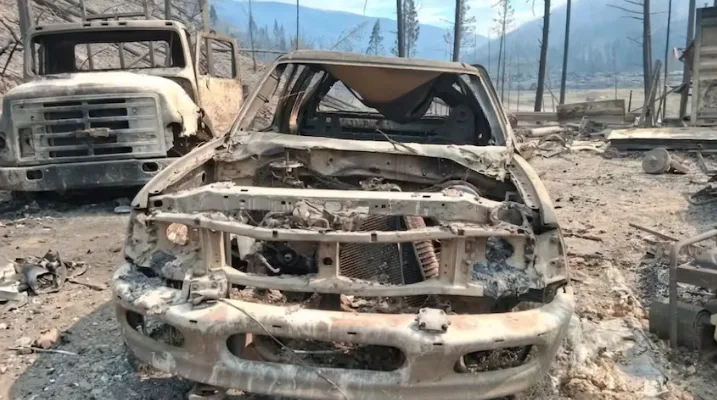
Clinton, B.C., to assess damage after 'apocalyptic' wildfire forces evacuations

"Apocalyptic" is how Dustin Bentall describes the wildfire that swept through Clinton, B.C., and the surrounding communities over the weekend.
“It came through with like a 200-foot wall of fire," the musician and son of roots rocker Barney Bentall told CBC News.
“All the firefighters and people working on it, they just said they’d never seen anything like it.”
Keep up with the latest wildfire information at The Weather Network's wildfire hub.
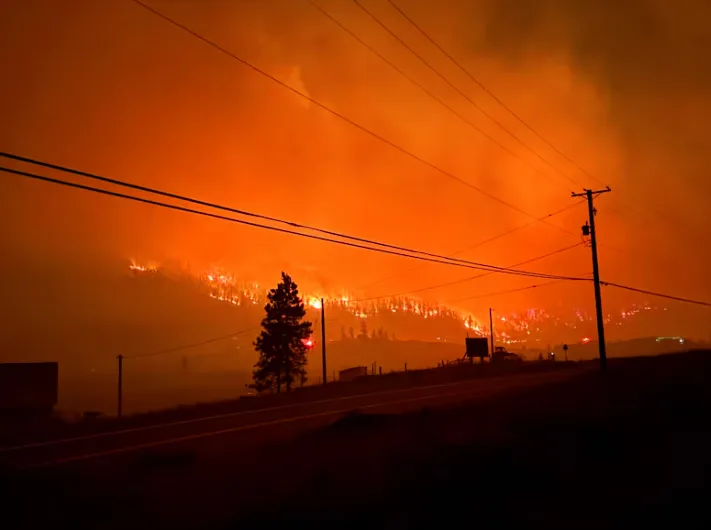
The Pear Lake and Fiftynine Creek fire merged to form the larger combined Pear Lake fire over the weekend. (Jen Monsos)
Bentall has a home in the village itself, while his family operates a farm not far out of town.
They're among the hundreds who have been evacuated from the area, where the Pear Lake and Fiftynine Creek fires have merged into a 668-square-kilometre (66,871.2-hectare) behemoth that's destroyed a number of structures and continues to burn out of control.
On Monday, the Thompson-Nicola Regional District added 70 Mile House to evacuation orders that now cover about 650 properties on both sides of Highway 97.
That's in addition to the entirety of the Village of Clinton, where officials issued an evacuation order Friday as the fires rapidly converged on the valley.
Both fires were sparked by lightning on July 17 and grew rapidly. Wildfire officials say they expect "extreme fire behaviour" to continue this week as hot and dry conditions persist, with winds gusting up to 50 kilometres per hour.
'Not the way to go about it'
Officials in Clinton have previously said that while the village was "preserved from major loss," some structures had been lost in the south side of town.
In a Monday update on social media, the Village of Clinton said staff hoped to begin assessing damage "within the next day or two."
It added that more than 15 members of its fire department remained to protect the townsite as the fire roared down the valley around it.
Crews have divided the village into quadrants where they are patrolling to extinguish spot fires, it said, while B.C. Wildfire Service structure protection teams have deployed hoses and equipment to safeguard homes and critical infrastructure.
"Their dedication, courage, and commitment during this challenging time have been truly extraordinary," the village wrote.
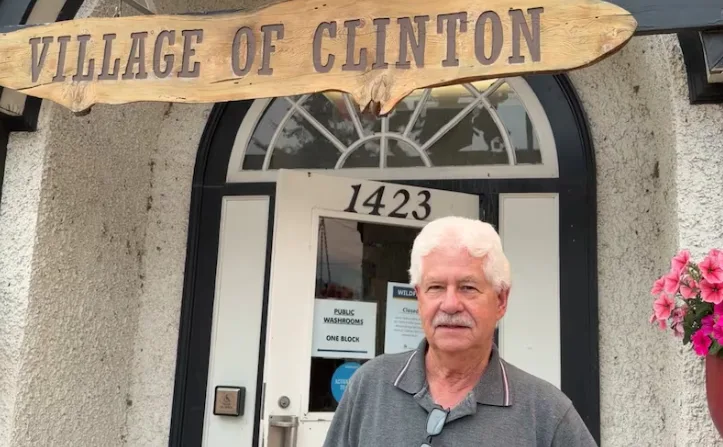
Clinton Mayor Roland Stanke is pictured. The village is urging people not to share pictures and videos of the fire's aftermath online. (Shelley Joyce/CBC)
Clinton Mayor Roland Stanke said some people stayed behind, despite the evacuation order, and have since been posting video of the aftermath to social media.
"That is the kind of thing we are trying to squash because people want to find out directly, they don't want to see it on social media that their house is damaged or their house is burned," he told CBC News.
"That's not the way to go about it, it just creates more uncertainty and more angst."
'No trees were spared'
Bentall said he's been told his own house and most of the buildings on the farm survived, with the exception of a hay shed, thanks to the "phenomenal" work of structure protection crews.
But he's bracing for the bleak scene that will greet his family when they return.
"No trees were spared, it’s going to be very barren all the way to the top of the Marble Mountains," he said.
“The only saving grace is that we don't have to worry about a wildfire coming through now.”

Dustin Bentall opens Fire Aid at Edmonton's Commonwealth Stadium in June 2016. (Terry Reith/CBC)
Bentall and his family are now sheltering in Armstrong, where they've joined up with the Caravan Farm Theatre — and have been sharing their evacuation story as a part of the group's production.
“The whole theme of this play is this valley through the Shuswap and Armstrong and the connection of nature and people and natural disaster and climate change,” he said.
“It’s been quite incredible and powerful.”
As of Monday night there were 136 active wildfires across B.C., almost 40 per cent of them classified as out of control.
Experts say that while fire is a natural part of Canada's forests, human-caused climate change has led to more extreme and more frequent natural disasters, including wildfires.
This article, written by Simon Little, was originally written by published for CBC News. With files from Marcella Bernardo