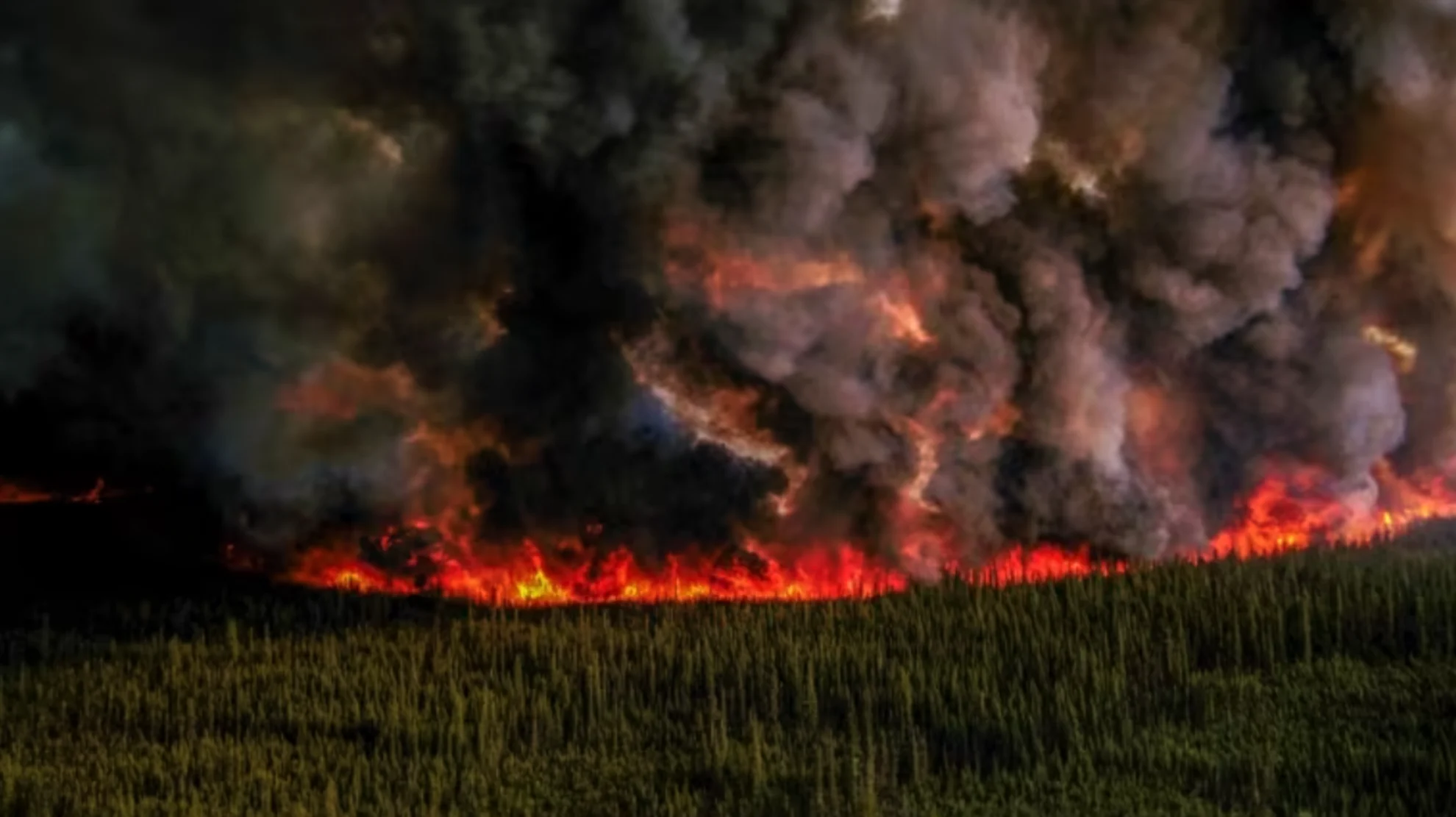
Donnie Creek fire compared to other historic blazes, major North American cities

Visit The Weather Network's wildfire hub to keep up with the latest on the active start to wildfire season across Canada.
Hot weather will continue to challenge firefighters in B.C. this week, as statistics released Monday confirmed that the 2023 wildfire season has already broken some records.
Much of the area burned so far has come about as a result of the Donnie Creek blaze, 158 kilometres north of Fort St. John in northeastern B.C.
The fire is burning over an area of 2,404.8 square kilometres as of 8 p.m. Monday, making it the second largest fire on record in the province — although not as large as the 2017 Plateau Fire near Williams Lake, an amalgamation of several smaller fires that burned a total of 5,210 square kilometres.
It's also not as large as the 2018 Tweedsmuir complex of fires, nor the 2017 Hanceville Riske Creek complex, which burned 3,015 and 2,412 square kilometres, respectively. However, wildfire officials say because those complexes consisted of multiple fires burning in separate but nearby areas, they are not considered a single blaze.

The Donnie Creek wildfire is now the second largest recorded in B.C. history. (CBC News)
The size of the Donnie Creek fire is comparable to the Capital Regional District, which covers much of the southern tip of Vancouver Island and is also close to the size of Metro Vancouver.
While the fire is not burning near major population centres, it has resulted in evacuation orders for a sparsely populated region primarily used by the forestry and oil and gas industry.
According to fire information officer Julia Caranci, the fire grew significantly due to two planned ignitions last week that burned a 55-kilometre portion along its southern flank in an effort to control it and create "confinement lines."
"When a fire is burning at the intensity that this fire has been burning at a particular time, it's too dangerous to put firefighters into a position where they are directly attacking it," she said. "So, that is the time, with larger fires, when we use fire to fight fire."
Much of B.C.'s most concerning fire activity so far this year has been concentrated in the province's northeast, but hot and dry conditions forecast for the province have led to concerns heading into summer.

A firefighter uses a hand tool to create a fire boundary near the Donnie Creek fire. (B.C. Wildfire Service)
The 2023 wildfire season has already seen more land burned than in 2022. The wildfire service says it's not unusual for boreal forests — like those in northeastern B.C. — to have fires this size during the spring, especially given previous drought conditions.
Wildfire service advises caution in backcountry
Numerous visible fires were ignited over the weekend, including on Vancouver Island and in the Okanagan.
The new fires have prompted concerns that this year could be particularly bad, particularly as June is also forecast to continue to be hot and dry following an unseasonably warm May.
According to the CBC News climate dashboard, which compares Environment Canada forecasts against seasonal averages, the coming week will be particularly warm. In Fort St. John, for example, a temperature of 30 C forecast for Friday would set a daily temperature record and is 11 C above average for the season.
In Kelowna, the maximum temperature forecast is 35 C, 12 C above seasonal, while Vancouver and Victoria are forecast to hit 25 C, which is 6 C above seasonal.
Elsewhere in Canada: Poor air quality from wildfire smoke pushes east:
Warmer weather, combined with low precipitation, make it more likely fires can start and spread, officials warn.
Statistics from the fire service show that, so far, most fires in the province are suspected to have been caused by humans. Historically, most fires during wildfire season are caused by lightning.
"Human-caused fires draw resources away from fires that aren't preventable, like the lightning-caused fires," said fire information officer Jean Strong on Sunday.
Strong says that it's important for people to follow their local fire prohibitions and practise fire safety while camping in the backcountry.
"There is a category two and three open burning prohibition provincewide at the moment," she said. "I would urge people to ensure that before they are lighting a campfire, that they're in an area that allows it."
Strong also says that it isn't just discarded cigarette butts that can cause fires but also chainsaws, campfires, and gas-fired vehicles like quad bikes or dirt bikes.
Thumbnail courtesy of BC Wildfire Service.
This article was published for the CBC by Akshay Kulkarni. It contains files from The Canadian Press.