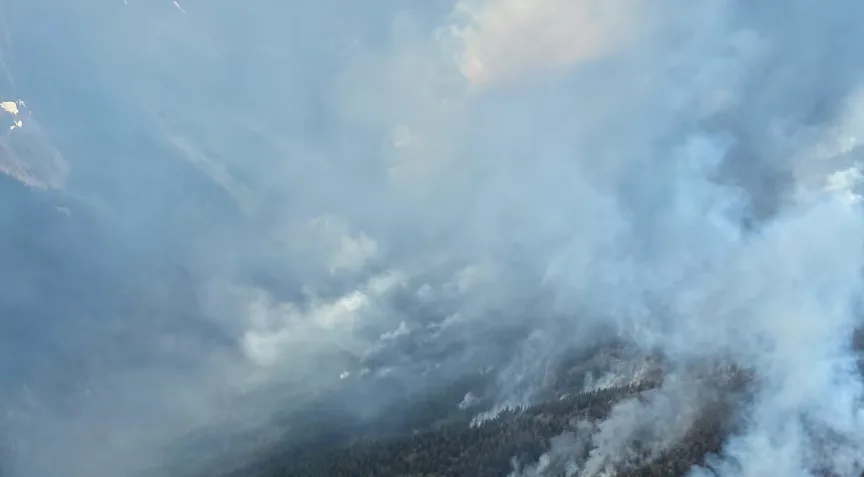
After 34K lightning strikes, almost 100 wildfires burning across B.C.

Recent days have seen B.C.’s wilderness struck by lightning almost 34,000 times, fire crews report, and the hot, dry conditions are expected to linger.
The B.C. Wildfire Service notes almost 100 fires burning, as of Monday afternoon.
At the same time, several parts of the province are under a heat warning until Thursday: the Okanagan Valley, the Fraser Canyon, South Thompson, Shuswap, West Kootenay, Kitimat Terrace and the Sunshine Coast.
FORECAST: Wildfire smoke threatens air quality across B.C.'s South Coast
An air quality alert due to wildfire smoke is also in effect for the Northeast, Fraser Canyon, and East and West Kootenay.
Sunday saw people living in the East Kootenay city of Kimberley placed under an evacuation alert and the situation remains uncertain in eastern British Columbia.
About 9,000 people live in the community, which is threatened by the out-of-control Matthew Creek and Tower Creek 2 wildfires.
Mayor Don McCormick told the Canadian Press that steep and inaccessible terrain is challenging crews but for now the wind "seems to be blowing in a great direction," and the air in the town is "pretty clear."
RELATED: Number of wildfires more than doubles after lightning strikes across B.C.
McCormick said he's most concerned about the wind.
"As long as the wind stays down, things are good. The wind comes back up again. It could get a little bit unpredictable."
The Matthew Creek wildfire was discovered on Saturday and is suspected to have been caused by lightning.
Ranch's guests, cattle forced to flee
In the Thompson Nicola Regional District, the Fiftynine Creek and French Bar Creek fires are over 130 and 100 square kilometres in size, respectively, according to the wildfire service. The fires, burning northwest of Kamloops, sparked evacuation alerts and orders over the weekend.
People from about 240 properties are under evacuation orders and over 60 are under alerts, meaning they must be ready to leave at a moment’s notice, according to the Thompson Nicola Regional District.
As of Monday afternoon, the Downing Provincial Park day use area and campground are under evacuation order due to the nearby Pear Lake Fire, as are 11 properties south of the park.
"It's hot and dry in the forecast… And it's been dry for quite some time," said district spokesperson Colton Davies.
"Obviously when we're dealing with some significant wildfires already, it's not the forecast you want, but we're taking it day by day."
At the Meadow Lake Guest Ranch, near Clinton, staff and guests were forced to flee due to the Fiftynine Creek fire.
Manager Daphne Jefferson described getting about 20 guests to safety, as well as some of the ranch's cattle herd.
"There's still going to be 23 cattle on our land and we're monitoring what we're going to do with with those cattle," Jefferson told Daybreak Kamloops. "But right now things are looking pretty positive for us."
Other fires of note
Along with the fires near Kimberley, the wildfire service's other "wildfires of note” include the Brunswick Creek and Ainslie Creek fires near Boston Bar, which it defines as an incident that is creating "an increased level of interest."
Brunswick Creek and Ainslie Creek — together referred to as the Brunswick Complex — have combined to cover about 200 square kilometres of rugged Fraser Valley hinterland that has made things “challenging” for crews.
“[Monday], winds have shifted to northerlies as a result of outflow conditions, bringing warmer and drier air,” an online update from the wildfire service reads. “While strong winds are not expected, hotter and drier conditions mean less wind is needed to increase fire activity.”
Over 250 firefighters are working to contain it, along the 23 helicopters and heavy equipment, the update reads.
Prof. Lori Daniels, Koerner Chair in Wildfire Coexistence at the University of British Columbia, noted Canada’s 2026 fire season is within the 30-year average but there are still two months to go.
The number of fires is down, she added, but their intensity is not.
“Because they're developing under hot, dry conditions … those lightning strikes in remote areas often become very large, intense fires that are very difficult and virtually impossible to put out,” she said.
“Those are the hallmarks … kind of the signals, of climate change.”
Daniels adds forestry practices over the last 50 to 70 years, including the type of trees chosen for post-logging tree planting operations and a focus on suppression in forest fire fighting, have made wildfires more likely as well.
WATCH: Top 5 ways humans cause forest fires in Canada
The story was originally published for CBC News. With files from the Canadian Press, Daybreak Kamloops and On The Island