700+ mm of rain in 72 hours: how does it compare to Canada?

Louisiana’s downpours this week produced more rain than some Canadian cities pick up during an entire year
Flash flood emergencies blared across the northern Gulf Coast this week as Tropical Storm Arthur brought torrential rainfall to the region.
Some parts of Louisiana saw estimated totals of 700+ mm of rain in just 72 hours, giving these hard-hit communities more rainfall than many Canadian cities receive in an entire year.
DON’T MISS: What’s the wettest month in your corner of Canada?
Louisiana and Canada are tied together by history. Thousands of Acadians forced out of Eastern Canada in the mid-1700s eventually settled in Louisiana, giving rise to the Cajun culture and language that remains influential today.
The regions’ climates couldn’t be more different, with this week’s Tropical Storm Arthur highlighting some of the dramatic contrasts.
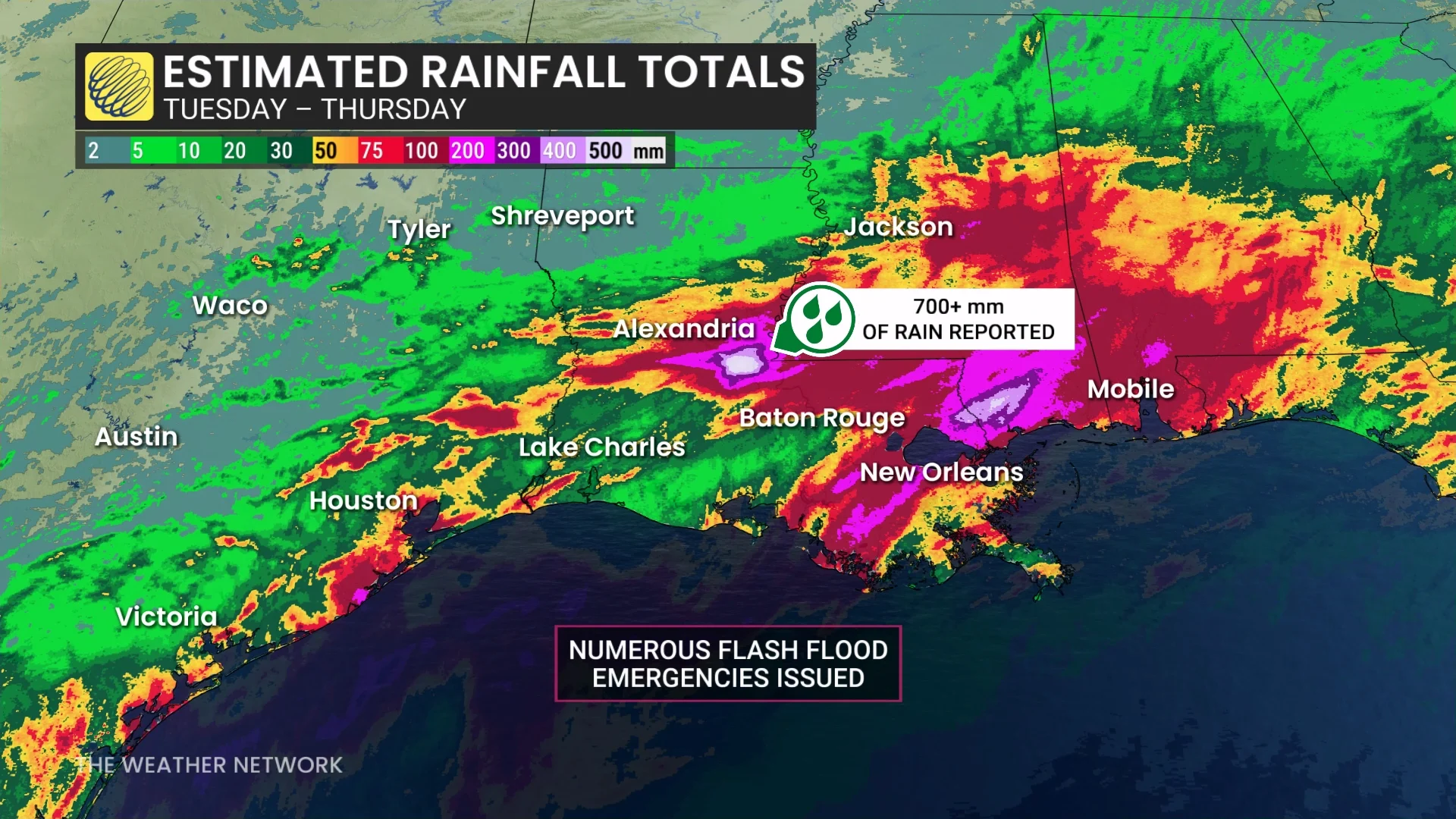
A vast reserve of atmospheric moisture streaming over the northern Gulf Coast provided a rich environment for repeated rounds of torrential downpours.
Forecasters with the U.S. National Weather Service issued numerous flash flood emergencies across the region. This enhanced wording is similar to tornado emergencies, reserved for life-threatening and catastrophic flooding.
Radar estimates show that Avoyelles Parish, about halfway between the cities of Baton Rouge and Alexandria, picked up between 700 and 800 mm of rain between Tuesday afternoon and Thursday afternoon.
A widespread region of 500+ mm of rain fell across southeastern Louisiana and southern Mississippi.
RELATED: What is a flash flood? A civil engineer explains
As much as 800 mm of rain in 72 hours is a whopper of a storm even for this region of the world. That’s more than a year’s worth of precipitation for many Canadian cities.
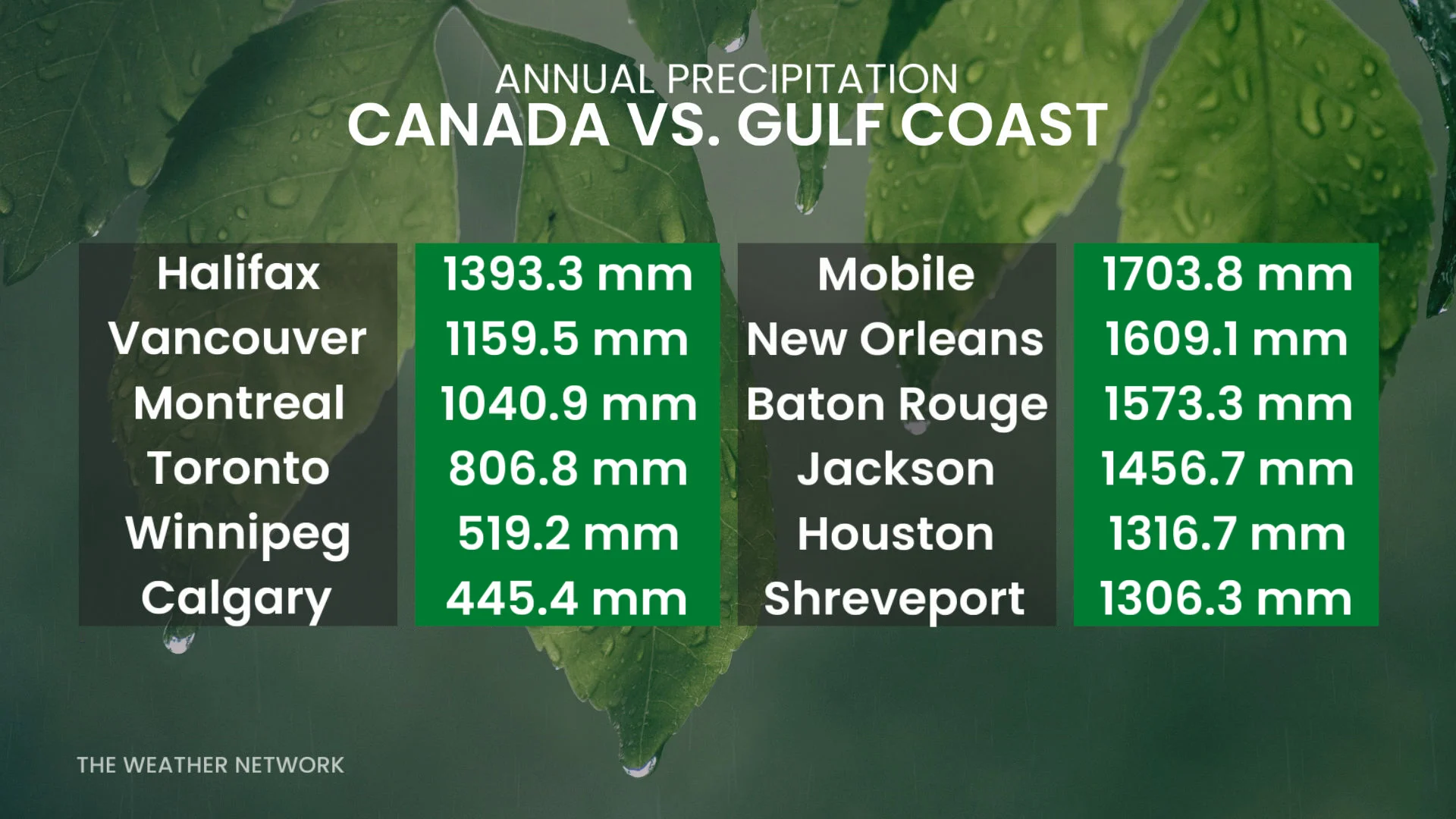
Toronto averages just over 800 mm of precipitation during a typical year. The total that fell in Louisiana eclipsed the annual precipitation measured in both Calgary and Winnipeg.
A similar total in Halifax would represent more than half of the city’s average annual precipitation.
By comparison, most of the northern Gulf Coast averages between 1,500 and 1,700 mm of rain in an average year. The region is one of the wettest on the continent.