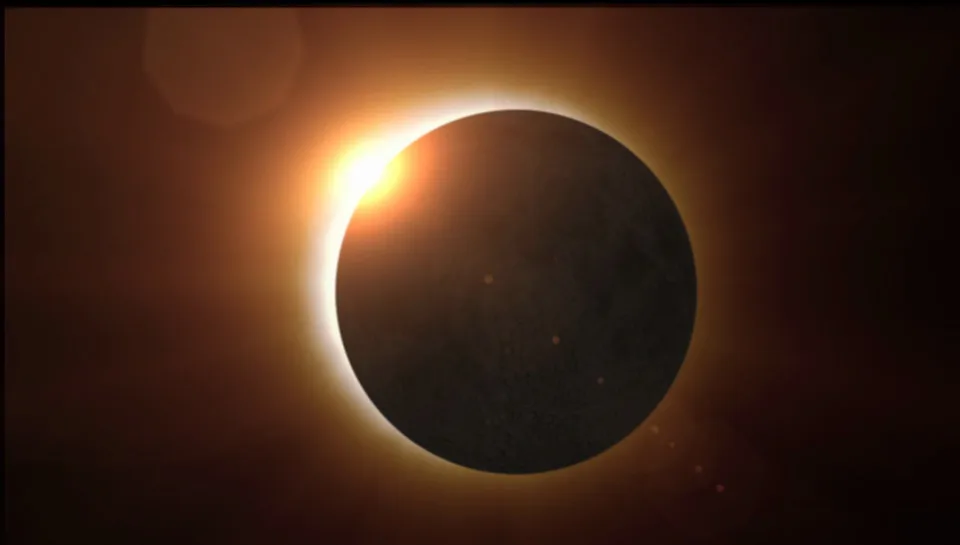
How to watch today's Total Solar Eclipse over South America from anywhere

While not visible from Canada, there's a solar eclipse happening on Monday, and we should be able to watch it from anywhere in the world.
On Monday, for the second time in less than three years, the shadow of the Moon swept across southern Chile and Argentina. Even here in Canada, there were ways to watch this amazing celestial phenomenon.
Starting at 8:33 a.m. EST on Monday, December 14, the New Moon began passing directly between Earth and the Sun, producing a total solar eclipse. Over the course of about five and a half hours, the shadow of the Moon made a slow crawl across Earth's surface. Tracing a line across the south Pacific Ocean, the shadow passed over southern Chile and Argentina, and then crossed the south Atlantic Ocean before slipping off the 'edge' of the planet at 1:53 p.m. EST.
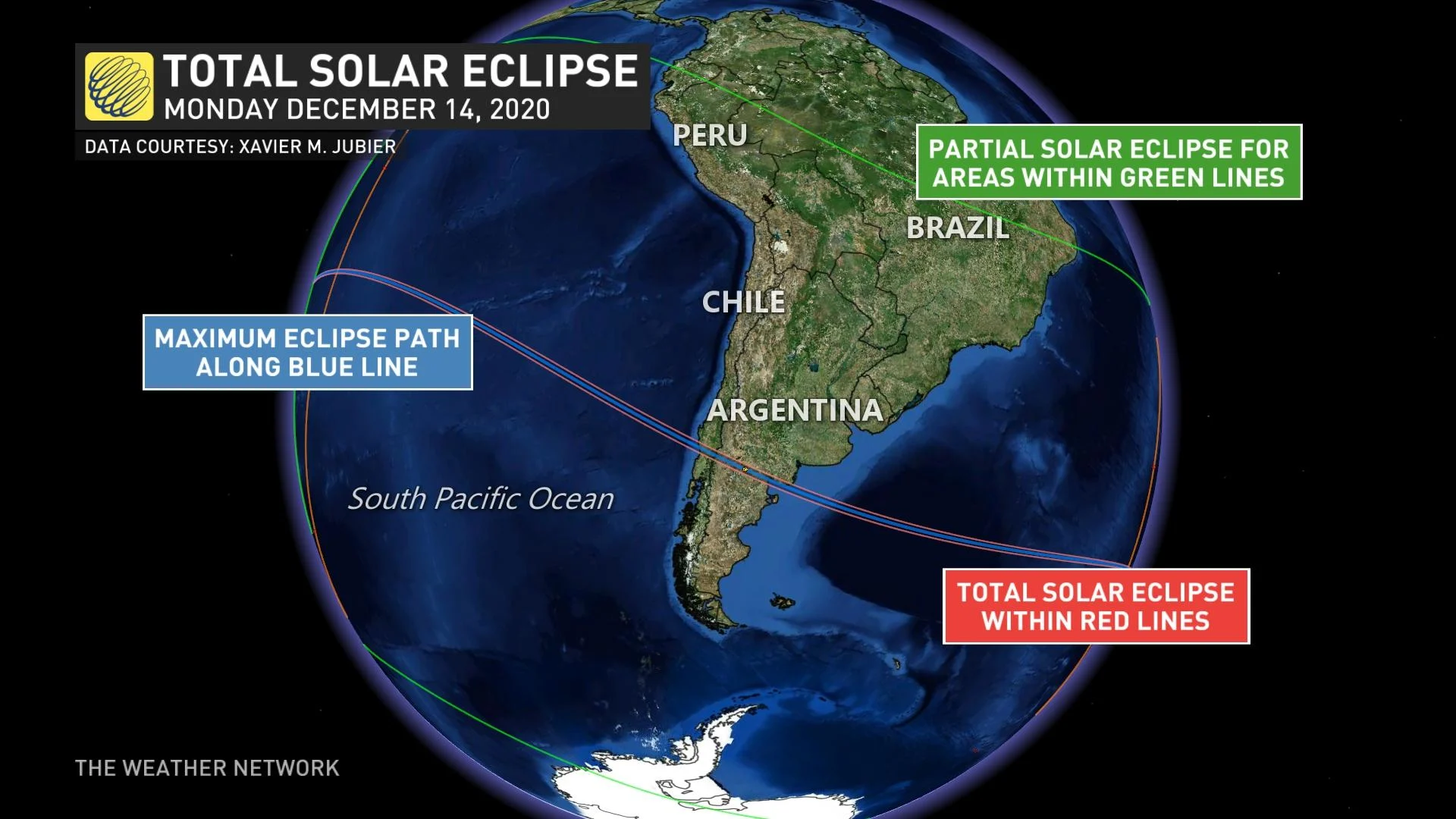
WATCH FROM ANYWHERE
As happened during the July 2019 solar eclipse, this event was not directly visible from Canada or anywhere else in the northern hemisphere. Still, there were ways to watch the event without having to travel long distances. In fact, we didn't even have to leave our homes.
Astronomers with the Slooh Observatory presented views of the eclipse live from Volcán Villarrica, one of the most active volcanoes in Chile. That location just happens to be within the path of totality. Thus, the views they shared were some of the best of the day!
Livestreams were also be available through TimeandDate.com and NASA.
NASA TV hosted a special Spanish-language livestream of the event starting at 10:30 a.m. EST, with NASA scientists Yari Collado-Vega and Bea Gallardo-Lacourt providing commentary during the stream. NASA said that the total eclipse was visible during the show at 11:02 a.m. EST.
NOAA's GOES 16 weather satellite picked up the eclipse from space!
Back during the July 2019 eclipse, the Moon's shadow swept over roughly this same region of the world, at the very end stretch of the eclipse's path of totality. During this December 14 eclipse, however, it actually reach its maximum, at around 11:13 a.m. EST, almost directly over the small town of Sierra Colorada, Argentina. So, that meant that the view of this eclipse were even better than last year!
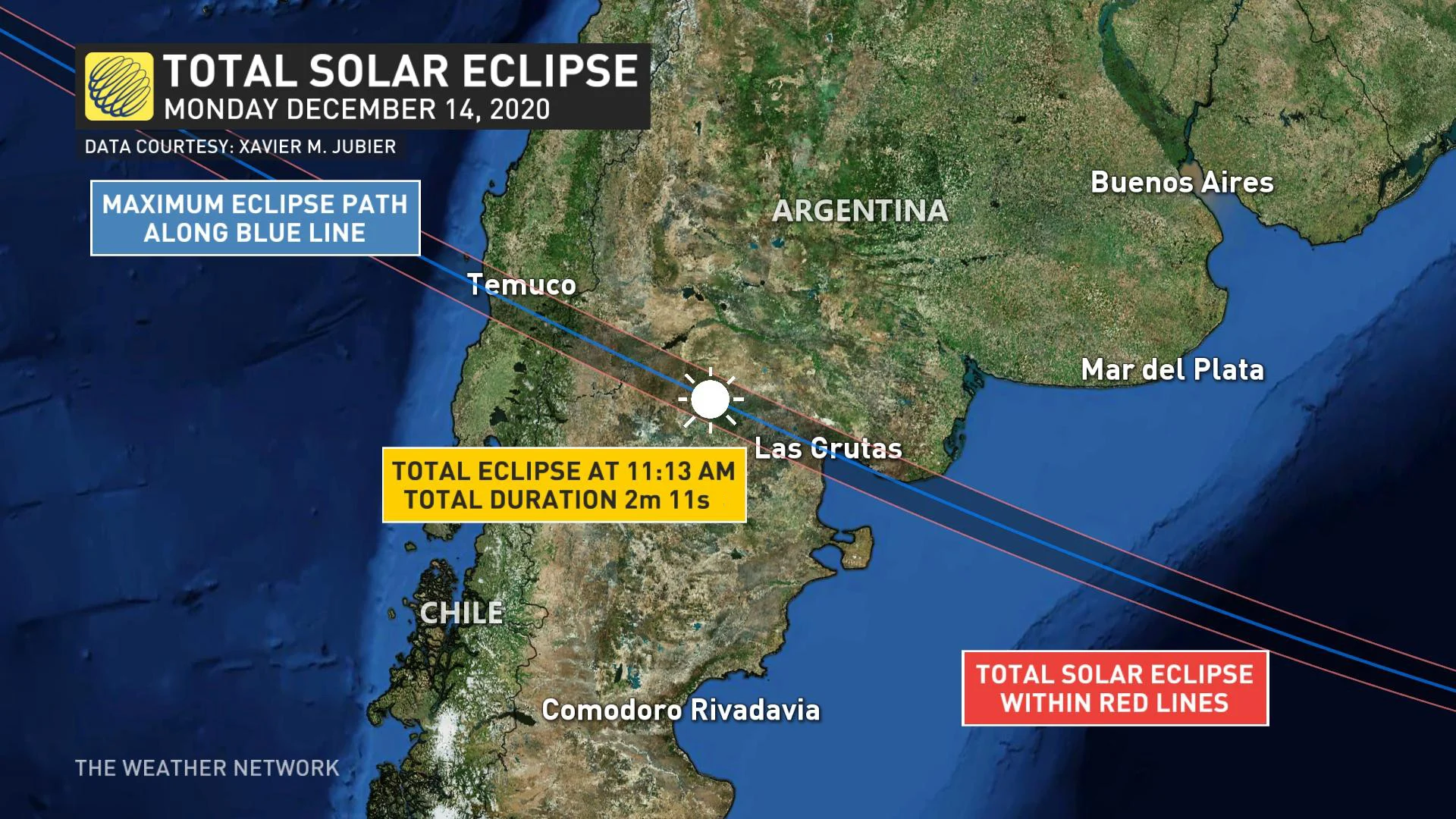
No special protections were necessary when watching an eclipse through your computer, of course. Any cameras recording the event had the proper filters in place to protect the equipment (and our eyes).
If you missed it Monday morning, definitely catch the replays of this celestial show!