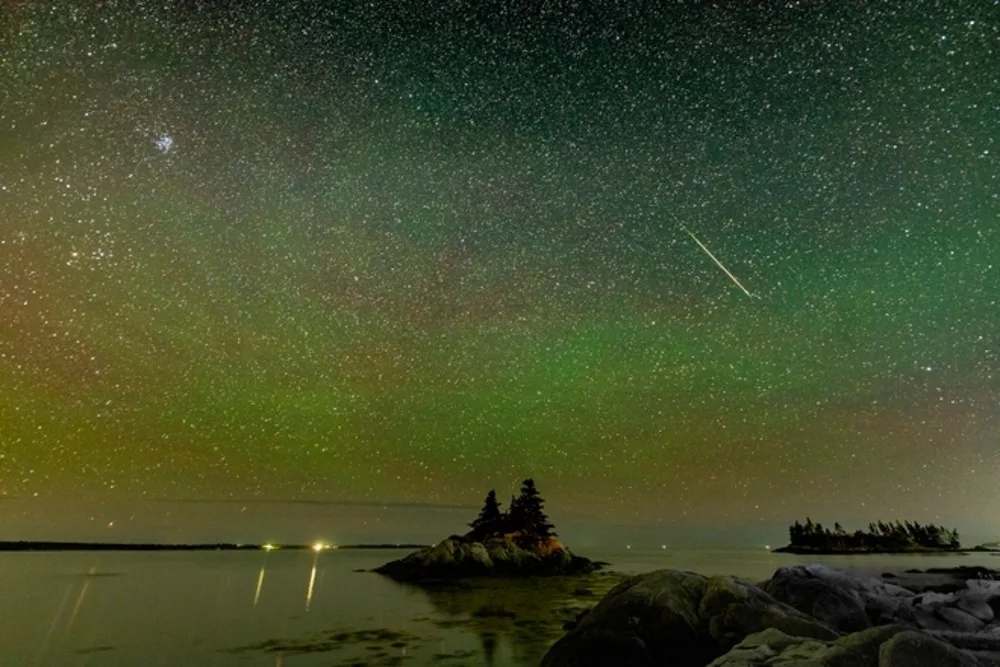
Look up this weekend to see the Geminids 'rock comet' meteor shower

With the New Moon approaching, the Geminids have the best viewing conditions of any meteor shower for 2020.
On the night of Sunday, December 13-14, stargazers are in for a treat.
The annual Geminid Meteor Shower reaches its peak this weekend, as Earth passes through a stream of dust and gravel in space left behind by the famous 'rock comet' 3200 Phaethon.
What's a rock comet? Most meteor showers originate from icy comets, which are giant 'dirty snowballs' left over from the solar system's formation. They tend to follow elliptical orbits as they travel around the Sun, becoming active — spewing out gas and dust — when they're close to the Sun, and go 'inactive' when they are farther away.
3200 Phaethon is an asteroid, discovered in 1983, that was found to behave like a comet, as it follows the same kind of elliptical orbit. On every close pass around the Sun, its surface suffers intense heating, which fractures the rocks and causes dust and gravel to be ejected into space along its path. With the same orbit and characteristic debris trail as a comet, but the rocky form of an asteroid, scientists nicknamed it a rock comet.
Earth passes through the stream of debris left behind by 3200 Phaethon each December, sweeping up a multitude of the tiny meteoroids. As the dust and gravel plunge into Earth's atmosphere, they produce streaks of light that appear to originate from the constellation Gemini. This gives the meteor shower its name.
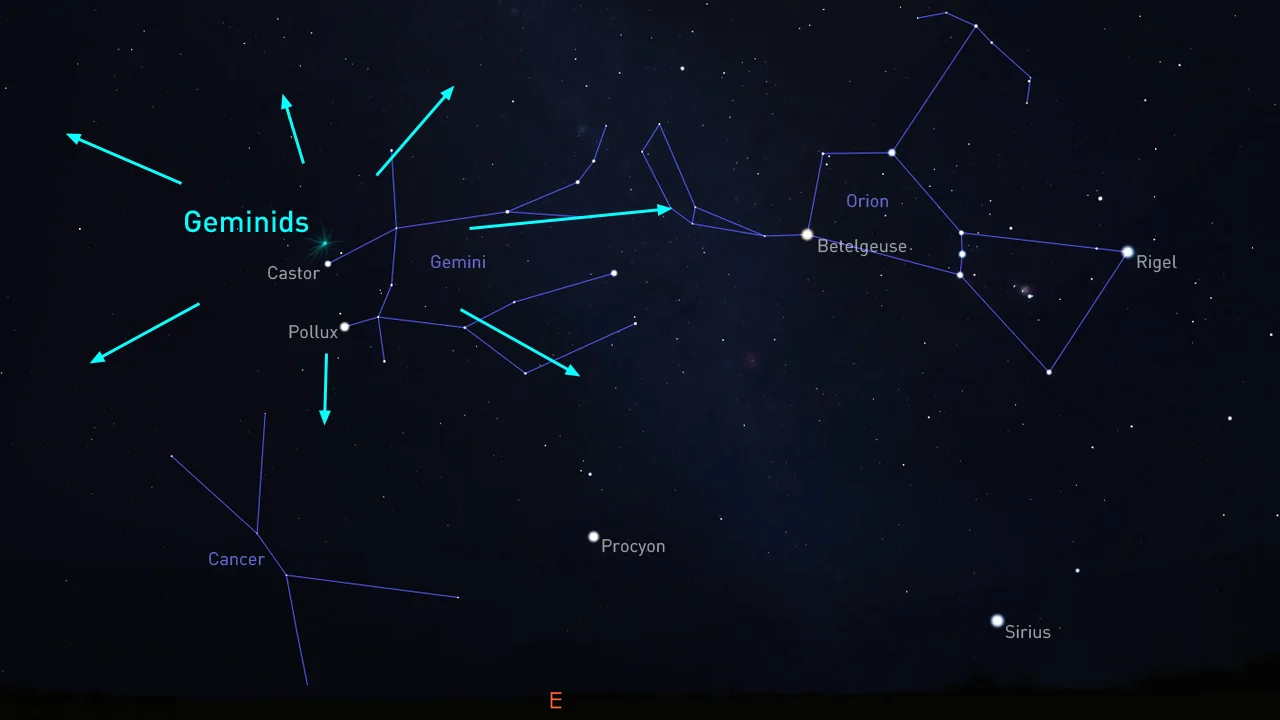
The radiant of the Geminid meteor shower, on the night of December 13-14. Credit: Stellarium/Scott Sutherland
Although the radiant of the meteor shower - the point in the sky where the meteors appear to originate from - will be up from dusk until dawn, there are optimal times to watch.
In his guide to watching the Geminids, Robert Lunsford, of the American Meteor Society wrote: "The prime hours to watch Geminid activity are between 11 p.m. and 4 a.m. local standard time. During these hours the radiant of the Geminid meteors will lie highest above the horizon. The radiant lies in the constellation of Gemini near the bright star known as Castor (alpha Geminorum)."
WILL WE SEE IT?
Clear skies will be crucial for watching this meteor shower. Here is the current forecast cloud map across Canada for Friday night.
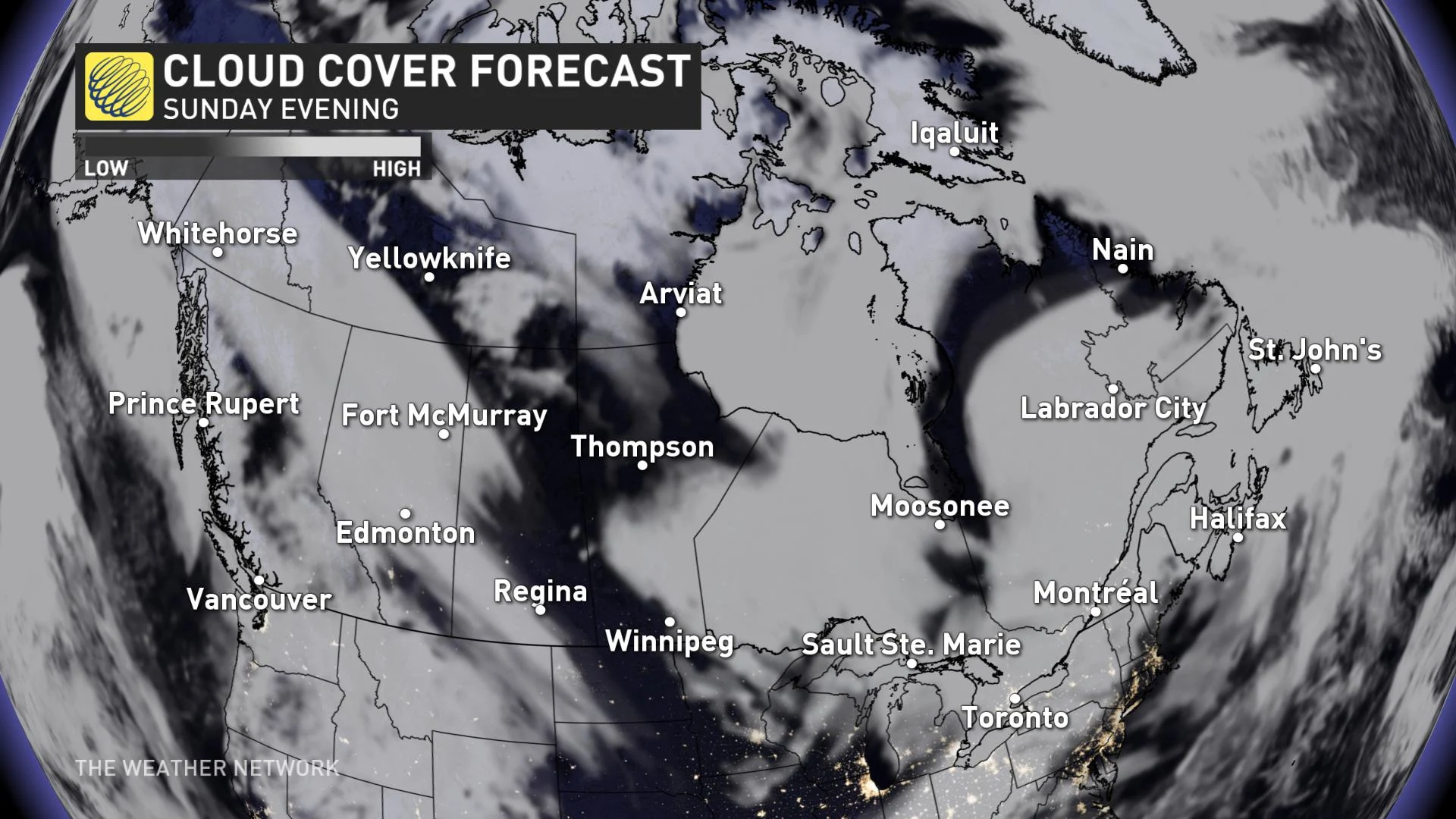
Based on the above map, viewing conditions are not ideal for Sunday night, except for parts of Saskatchewan and southern Manitoba. However, things may change between now and then, so keep an eye on your local forecast!
According to the AMS, though: "If your weather appears to be overcast on the peak night, the two nights prior and the one night after the peak will also produce impressive activity."
So, catching the meteor shower at any time this weekend, or even on Monday night, is expected to give good results. Just make sure you have reasonably clear skies!
WATCH FROM ANYWHERE
For those of us who are stuck under cloudy skies that night, there are still ways to watch.
The Virtual Telescope Project will be hosting a Livestream on their website starting at 5 p.m. EST, Sunday night.
We can even 'watch' the Geminids via meteor radar, as shown below.
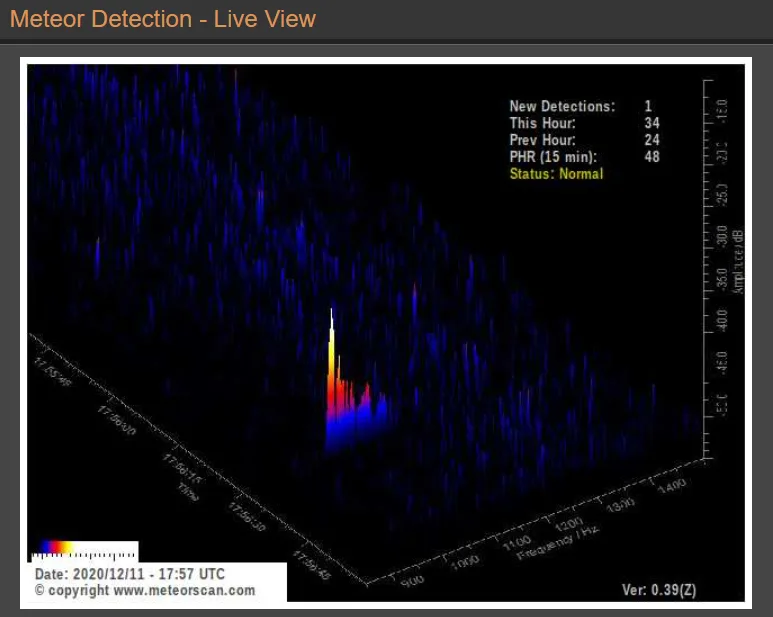
This image screencapped from MeteorScan.com shows a meteor detection at 12:57 p.m. EST (17:57 UTC) on December 11, 2020. Credit: MeteorScan
Plus, we can 'listen' to the meteor shower via the Meteor Echoes live stream, which presents the impact of meteoroids on the top of the atmosphere as high pitched audio chirps.
BEST METEOR SHOWER OF THE YEAR
The Geminids tend to put on the best meteor shower display of the year for four main reasons.
First, this shower produces the most meteors of any other shower of the year during its peak, and those numbers appear to be climbing, year by year. In 2020, the International Meteor Organization (IMO) predicts that it could produce up to 150 meteors per hour.
One caveat, though: The above rate is what astronomers call the 'zenith hourly rate', which includes all meteors of all levels of brightness, specifically at the time when the radiant is directly overhead, and when the viewer has absolutely optimal sky conditions. The average viewer will likely spot about half that 'ZHR' number while watching. So, that's around 75 meteors per hour or an average of more than one every minute!
Second, the size and relatively slow speed of the meteoroids means that we tend to see plenty of slow-moving fireballs from the Geminids.
Third, the grit and gravel from 3200 Phaethon produce multicoloured meteors when they hit the atmosphere! Most meteors show up as white as they flash overhead. Due to minerals and metals in the rocks and dust shed by this asteroid, Geminid meteors have been known to appear yellow, blue, and/or green.
Fourth, with the longer nights at this time of year, and the radiant up from dusk until dawn, there is more time to see this meteor shower in action.
TIPS FOR METEOR WATCHING
First, some honest truth: Many people who want to watch a meteor shower end up missing out on the experience, because they are not informed of the best way to prepare. Follow the guidelines below to get the most out of these events.
Here are the three 'best practices' for watching meteor showers:
Check the weather,
Get away from light pollution, and
Be patient.
Clear skies are very important for meteor-spotting. Even a few hours of cloudy skies can ruin an attempt to see a meteor shower. So, be sure to check The Weather Network on TV, on our website, or from our app, and look for my articles on our Space News page, just to be sure that you have the most up-to-date sky forecast.
Next, you need to get away from city light pollution. If you look up into the sky, are the only bright lights you see street lights or signs, the Moon, maybe a planet or two, and passing airliners? If so, your sky is just not dark enough for you to see any meteors. You might catch a bright fireball, but there's no guarantee, and those are typically few and far between. So, get out of the city, and the farther away you can get, the better!
Watch: What light pollution is doing to city views of the Milky Way
For most regions of Canada, getting out from under light pollution is simply a matter of driving outside of your city, town or village until a multitude of stars is visible above your head. In some areas, especially southwestern and central Ontario and along the St. Lawrence River, the concentration of light pollution is too high. Getting far enough outside of one city to escape its light pollution tends to put you under the light pollution dome of the next city over.
In these areas of concentrated light pollution, there are dark sky preserves. However, a skywatcher's best bet for dark skies is usually to drive north and seek out the various Ontario provincial parks or Quebec provincial parks. Even if you're confined to the parking lot after hours, these are usually excellent locations from which to watch (and you don't run the risk of trespassing on someone's property).
Sometimes, based on the timing, the Moon is also a source of light pollution, and it can wash out all but the brightest meteors. We can't get away from the Moon, so we can just make do as best we can in these situations.
Once you've verified you have clear skies and you've gotten away from light pollution, this is where having patience comes in.
For best viewing, you must give your eyes time to adapt to the dark. Give yourself at least 20 minutes, but the longer, the better. Warning: if you skip this step — even if you follow the rest of this guide — you will miss out on a lot of the action.
During this adjustment time, avoid all bright light sources - overhead lights, car headlights and interior lights, and cellphone and tablet screens. Any exposure to bright light during this period will cancel out some or all the progress you've made, forcing you to start over. Shield your eyes from light sources. If you need to use your cellphone during this time, set the display to reduce the amount of blue light it gives off, and reduce the screen's brightness as much as possible. It may also be worth finding an app that puts your phone into 'night mode' to shift the screen colours into the red end of the light spectrum, which has less of an impact on your night vision.
You can certainly look up into the starry sky while you are letting your eyes adjust. You may even see a few brighter meteors as your eyes become accustomed to the dark. If the Moon is shining brightly, turn so that it is out of your personal field of view.
Once you're all set, just look straight up!