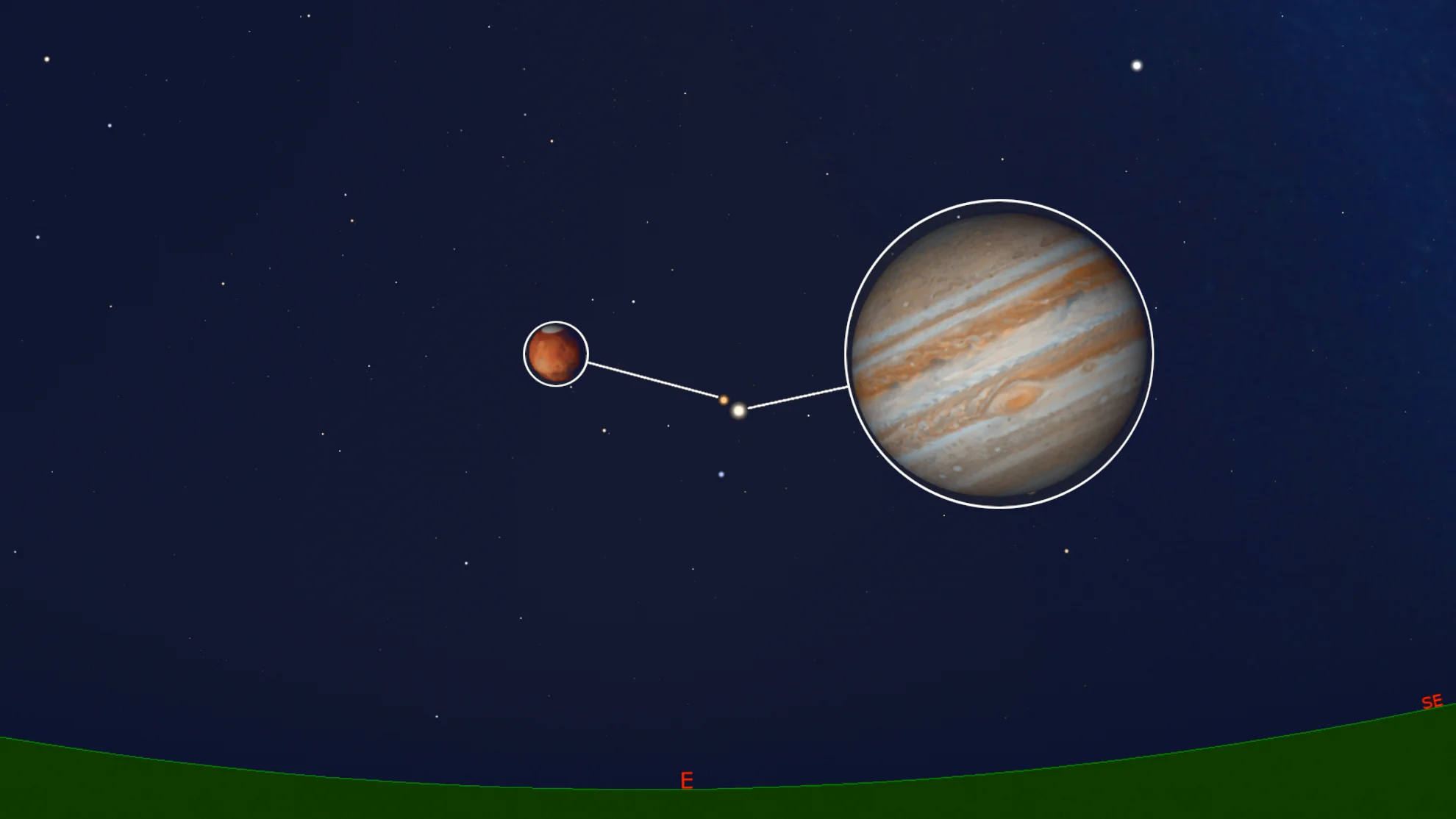
Look up Saturday night to see Mars and Jupiter at their closest in our night sky

If you have clear skies this weekend, look to the east around midnight to see two bright planets very close together in the sky.
The planets in our solar system are millions to billions of kilometres away from each other at all times. However, when they appear as tiny, steady points of light in our night skies, we can see them much closer together, sometimes drawing close enough that they appear to touch.
Astronomers call these events conjunctions.
Over the past few months, a slow progression has been taking place in our predawn skies. The planet Mars has been rising, fairly consistently, just after midnight. Then, Jupiter has followed along afterward — closer to dawn way back in August, but earlier and earlier each night, as it seemed to be racing to catch up with Mars.
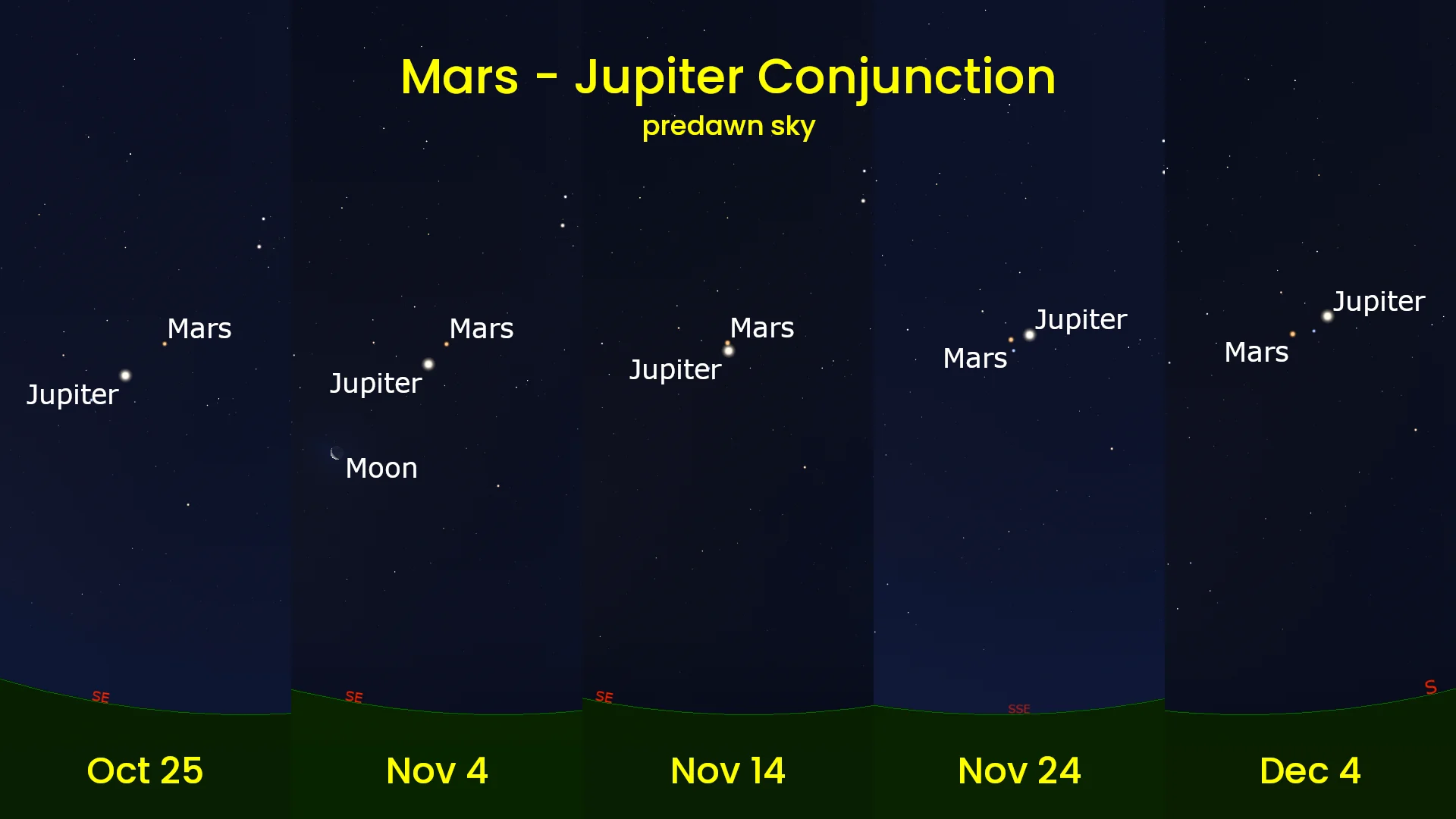
Mars and Jupiter come together and then split apart again with their close conjunction on the night of November 14, 2026. (Stellarium/Scott Sutherland)
READ MORE: Look up! Meteor shower season has begun for Fall 2026!
As of mid-November, these two planets are now rising almost on top of one another, and on the night of November 14-15, they will reach their closest approach in the sky.
This is the 2026 Mars-Jupiter Conjunction.
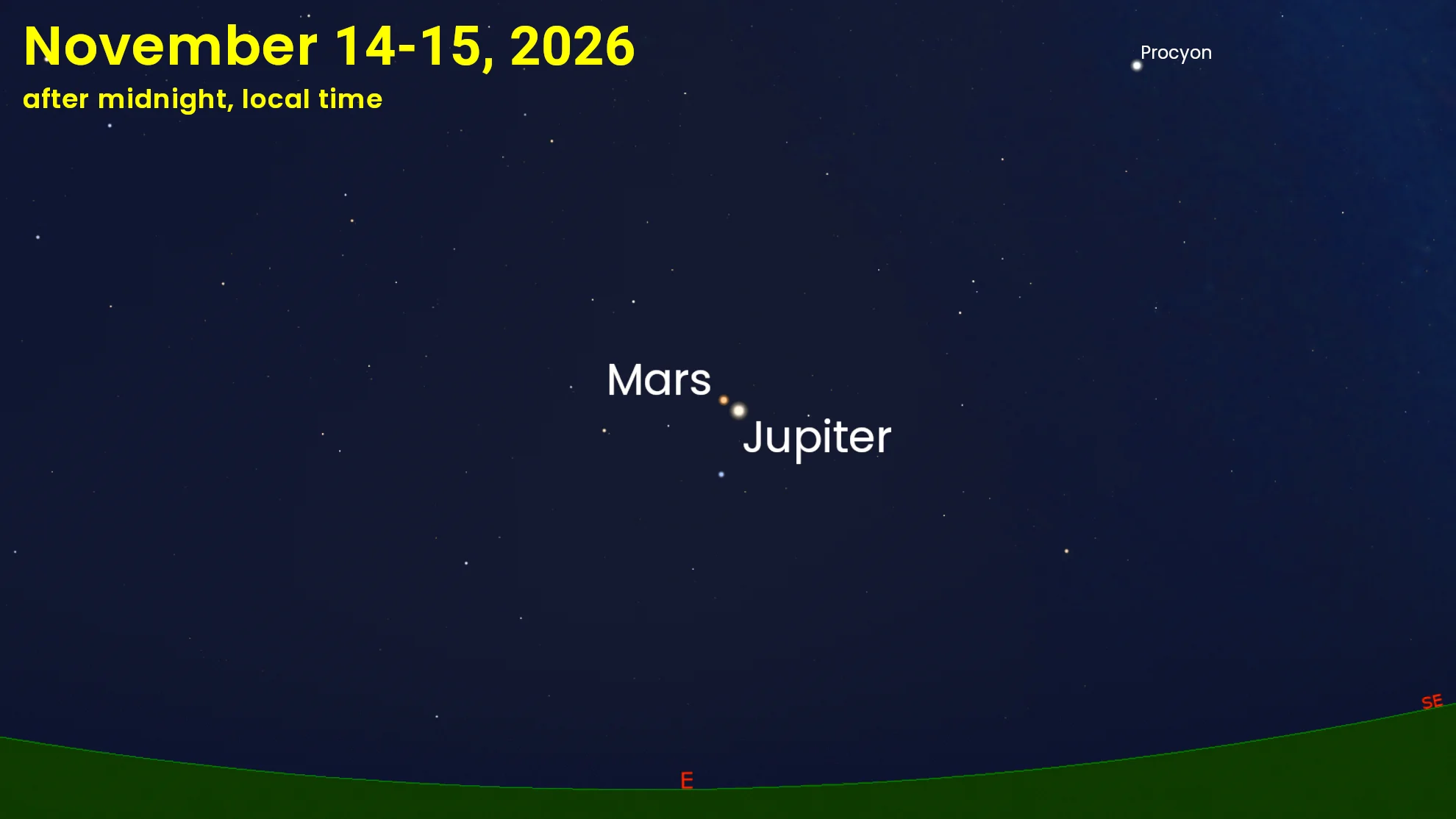
The Mars-Jupiter Conjunction on the night of November 14, 2026. (Stellarium/Scott Sutherland)
The pair will become visible along the eastern horizon between 11 p.m. on Saturday and 12:45 a.m. Sunday, local time, depending on the observer's location and time zone. In general, the farther west the observer is within a particular time zone, the later they will appear.
Local obstacles, such as trees and buildings, that block direct view of the horizon, will delay their appearance for a short time. In regions of British Columbia, the mountains to the east can delay their rise by up to 45 minutes.
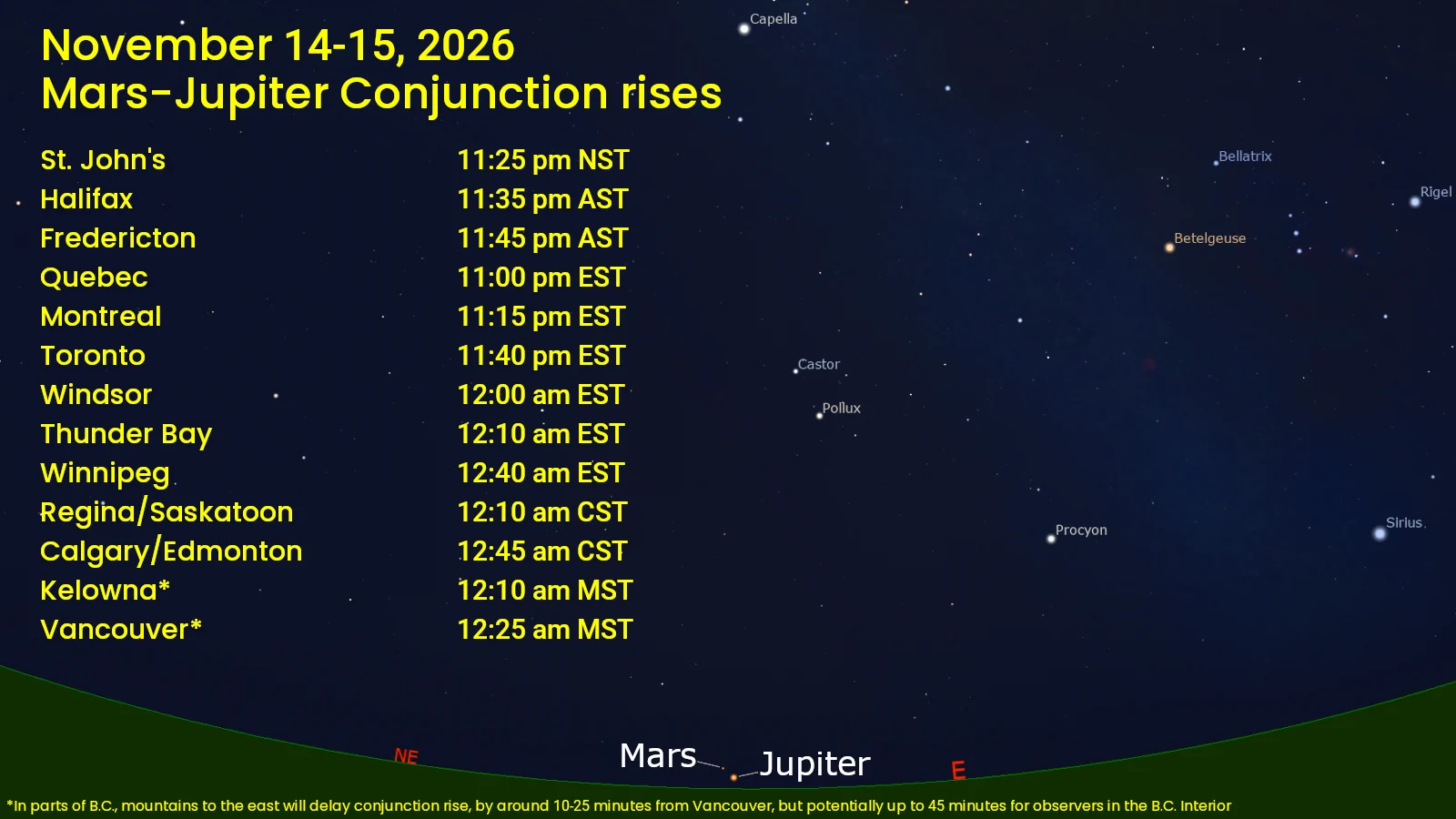
The timing of when the Mars-Jupiter Conjunction rises in the east depends on the observer's exact location. (Stellarium/Scott Sutherland)
DON'T MISS: NASA is looking for a way to rescue Hubble from a fiery fate
Throughout the night on Saturday to Sunday, as Mars and Jupiter cross the sky, the distance between the two planets will be just over 1 degree. That's the equivalent of the width of a pinky finger, held out at arm's length.
Although Mars has led the way as the two have been crossing our skies so far, after this conjunction, they will switch positions.
Each night going forward, the pair will rise a little earlier, with Jupiter cresting the horizon first and Mars following along shortly after. By the end of November, they will already be visible roughly a half-hour earlier than during the conjunction, and as of mid-December, that timing will shift back by an additional 30 minutes or so.
By year's end, they will be plainly visible by mid-evening, weather permitting, making them easier to find for those who cannot stay up all night stargazing.
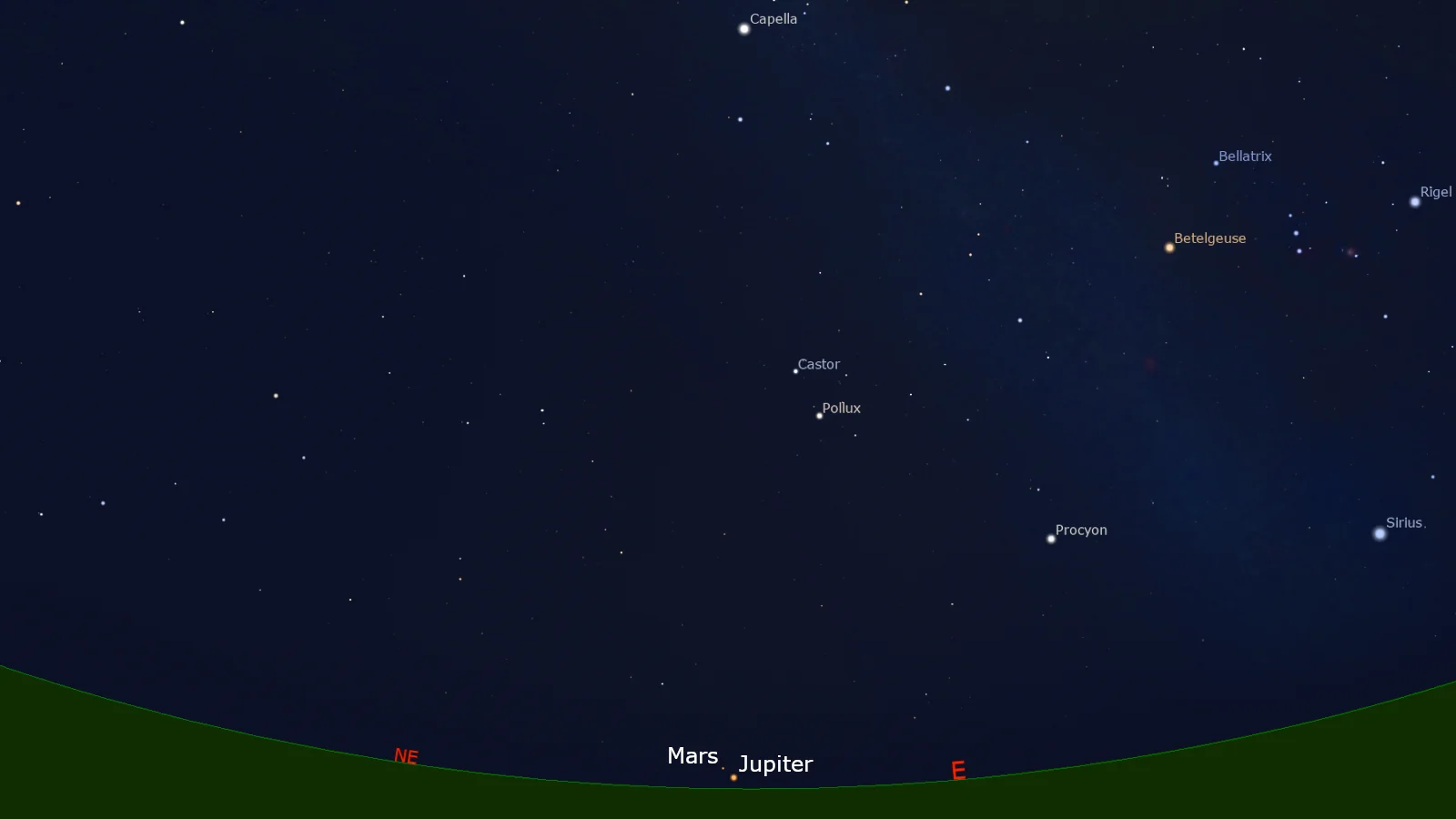
The bright stars that will precede Mars and Jupiter in the night sky are labelled here. ((Stellarium/Scott Sutherland)
MORE FROM SPACE: Mars Perseverance rover sets new record for farthest off-world driving distance
For a guidepost to finding these planets, use the constellations Orion and Gemini, or perhaps the 'Winter Triangle' asterism, which is made up of the bright stars Betelgeuse (from Orion), along with Sirius and Procyon.
Wait until these constellations and asterism are already in the southeastern or southern sky, then turn your gaze to the east to find Mars and Jupiter.