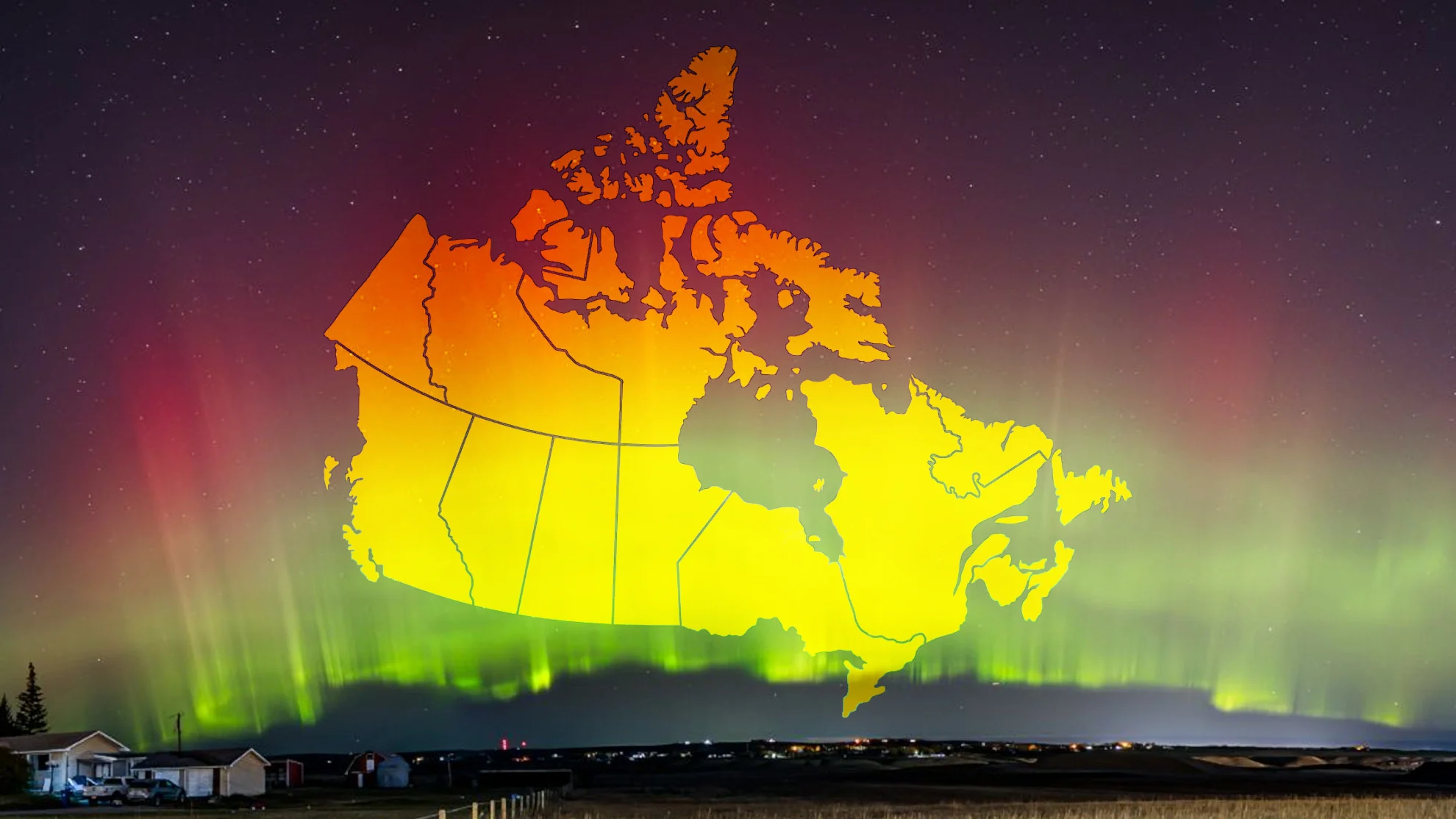
The Northern Lights may shine alongside a lunar eclipse Thursday night

Even as the Full Moon darkens Thursday night, due to passing through Earth's shadow, skies across parts of Canada could burst with colour as a geomagnetic storm sparks displays of the Aurora Borealis.
We already have a nearly-total lunar eclipse happening across Canada Thursday night, and now there's a chance that a display of the Northern Lights could join this astronomical event in the sky.
Tuesday morning, a magnetic 'tangle' on the surface of the Sun, known as sunspot 4513, blasted out a moderate-strength M7-class solar flare. Accompanying this explosion was the eruption of a massive coronal mass ejection, or solar storm.
Based on modelling of this solar storm by both NASA and NOAA, both agencies expect it to arrive on the night of August 27-28, when it will score a glancing blow on Earth's geomagnetic field.
The timing of this not only coincides with the anticipated partial lunar eclipse that occurs that very same night, but is also happening at the same time that a blustery stream of the solar wind will be sweeping past our planet.
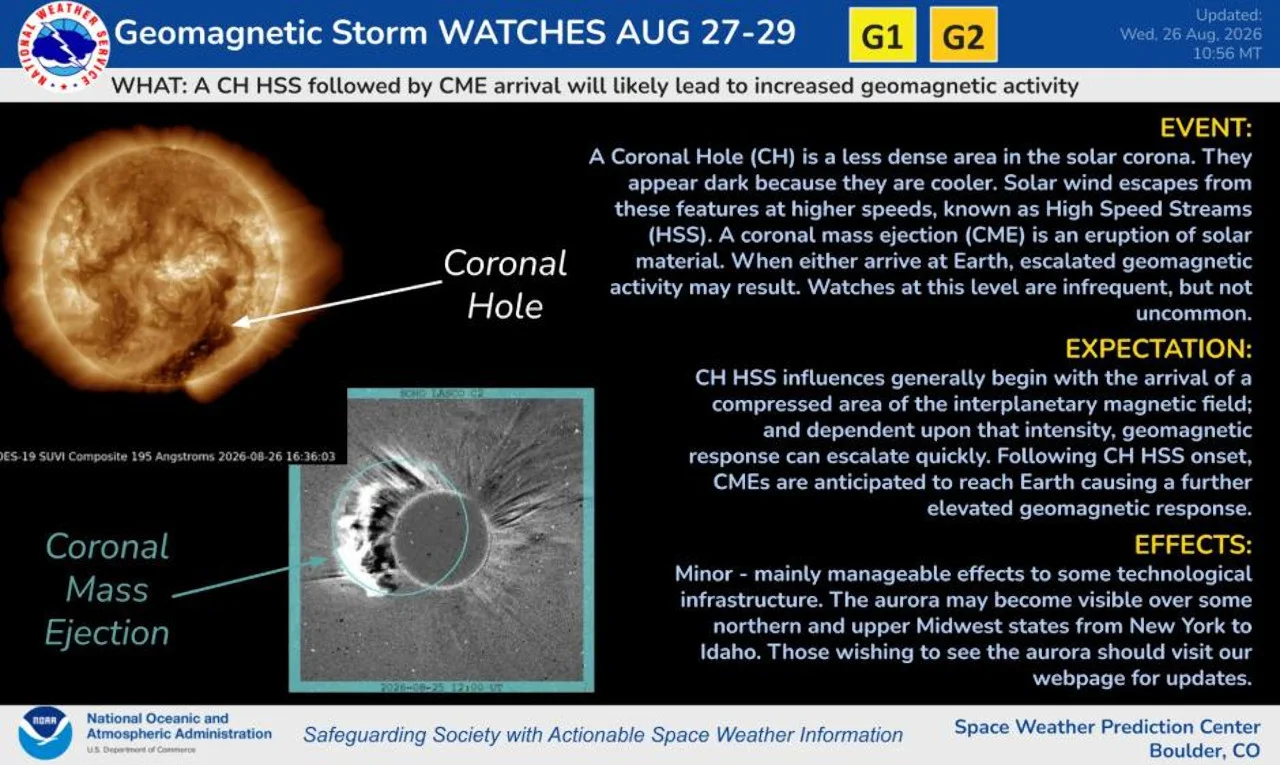
A geomagnetic storm watch from NOAA includes images of the coronal hole where the fast stream of the solar wind is originating (top left), and the coronal mass ejection that erupted on August 25 (bottom centre). (NOAA SWPC)
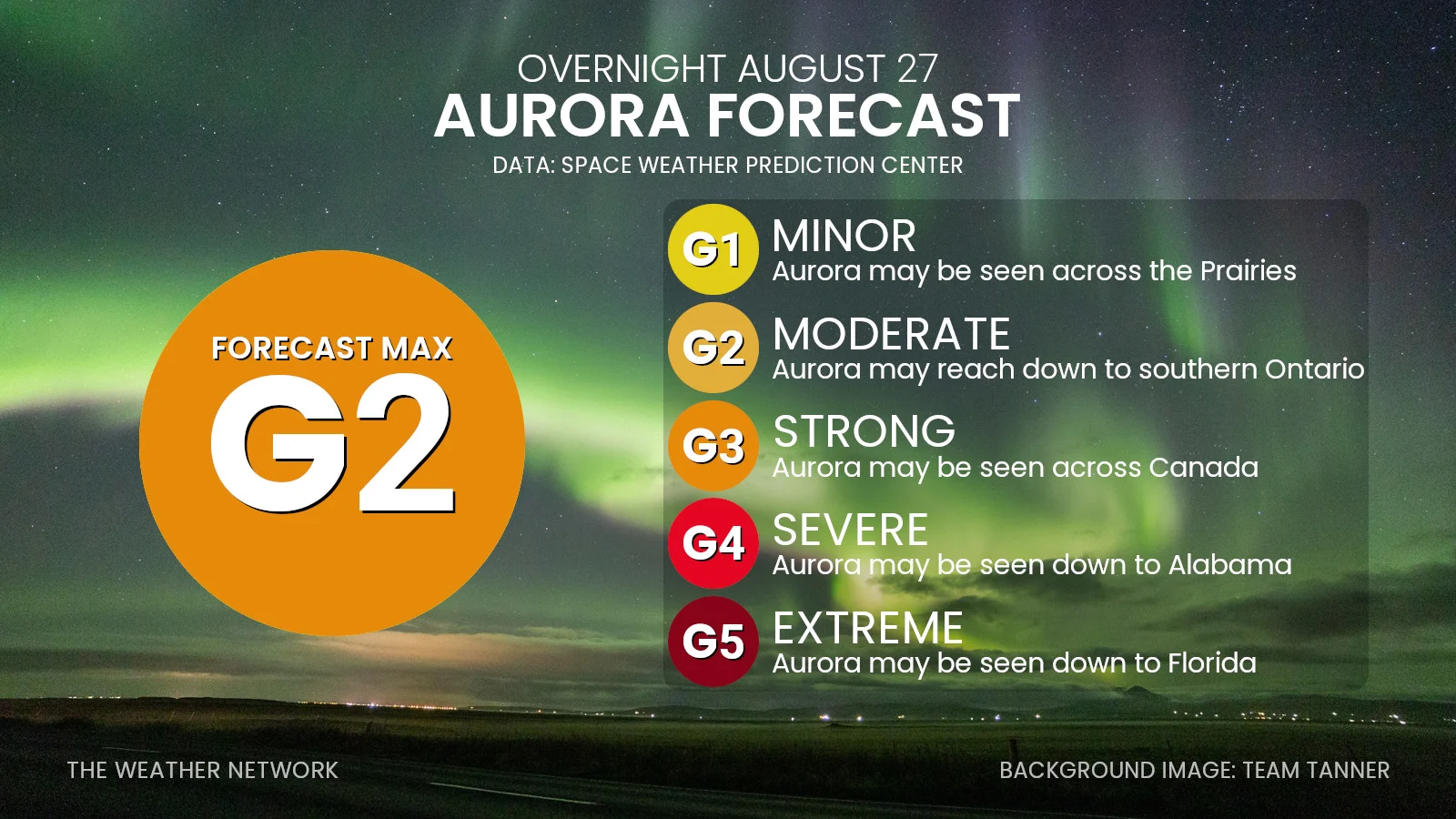
Either a fast solar wind stream or a glancing blow from a CME brings the possibility of some geomagnetic activity. In all likelihood, this would be just a G1 (minor) storm.
However, due to the combination of both the CME and the fast solar wind affecting us simultaneously, NOAA has issued a G2 geomagnetic storm watch for Thursday night.
DON'T MISS: This week's Full Moon will produce a 'nearly-total' lunar eclipse in the sky
Normally, auroras showing up on the night of a Full Moon would be rather bad timing on the universe's part. This is because the brightness of a Full Moon can spoil our ability to see the auroral lights overhead.
In this case, though, they seem perfectly timed! With the Moon passing through Earth's shadow, its light will dim significantly, giving us a much better opportunity to spot the Northern Lights.
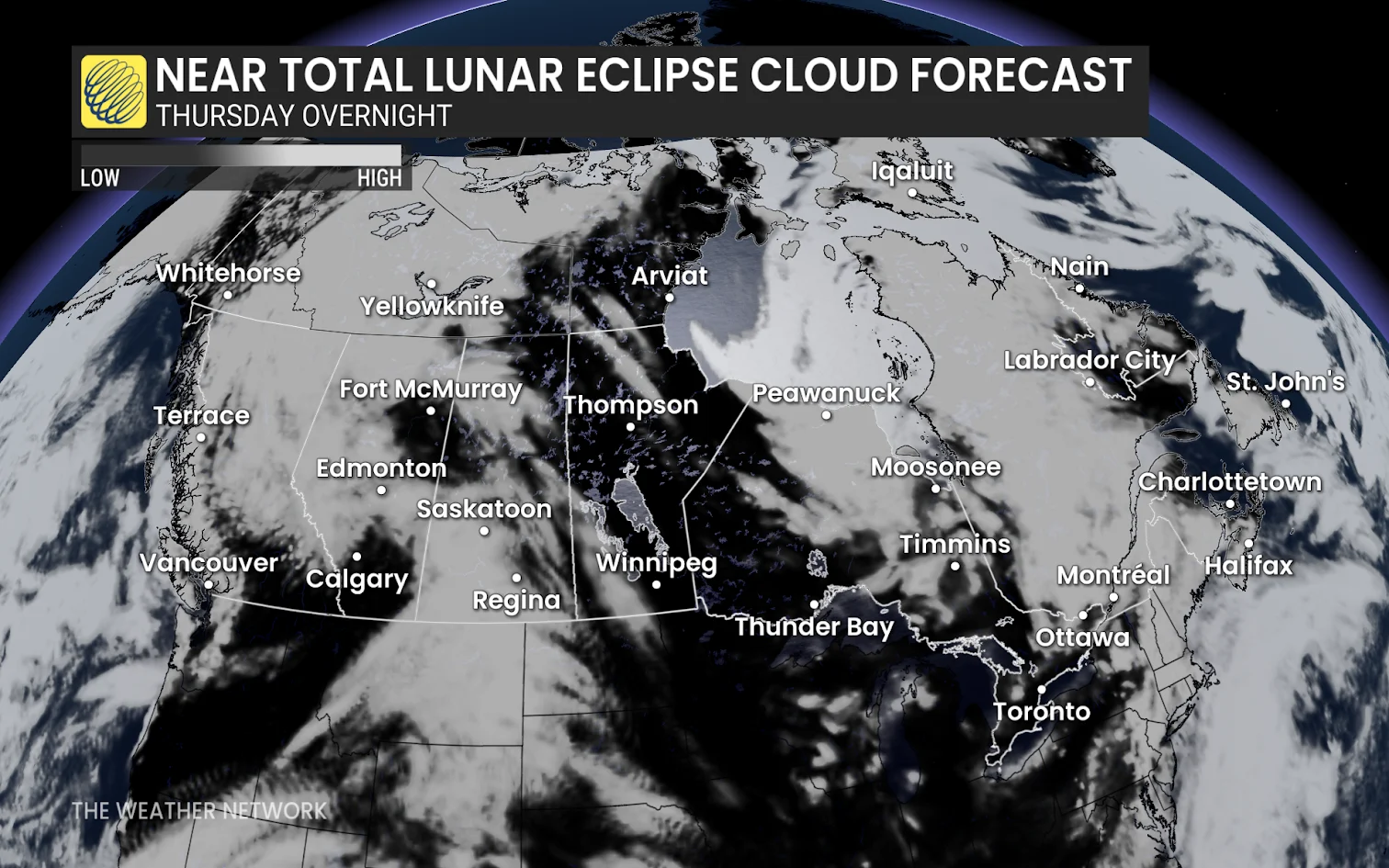
With this anticipated as a G2 geomagnetic storm, the aurora 'oval' will likely appear over northern regions of Atlantic Canada, Quebec, and Ontario, as well as through the central Prairies.
However, 'substorm' activity — brief bursts of brighter, more dynamic auroras — could push displays farther south at times throughout the night.
Video at the top: Meteorologist Aman Purewal breaks down the forecast for a celestial double feature: a near-total lunar eclipse and a moderate (G2) aurora borealis. Discover the best viewing locations across North America based on cloud cover and timing.