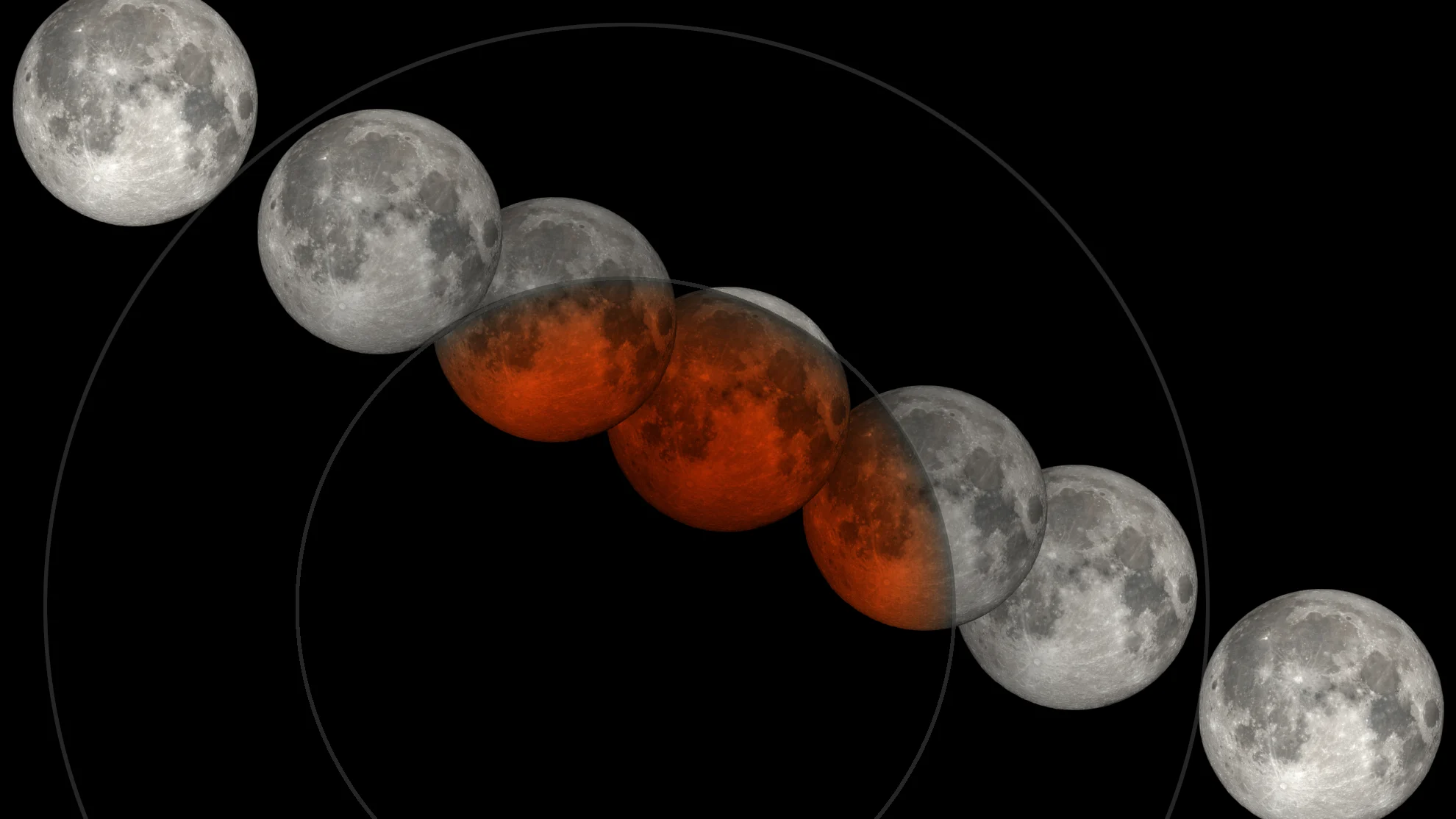
Tonight's Full Moon will produce a 'nearly-total' lunar eclipse in the sky

Don't miss this lunar eclipse! We won't see a better one until the end of 2028 or the middle of 2029!
Check your weather forecast for clear skies tonight, so you don't miss out on the 'nearly-total' lunar eclipse.
This evening, the Full Moon will rise. However, depending on where you are at the time, it may or may not immediately light up your sky.
This is because the Sun, Earth, and Moon will be lined up nearly perfectly, causing the Full Moon to pass straight through Earth's shadow.
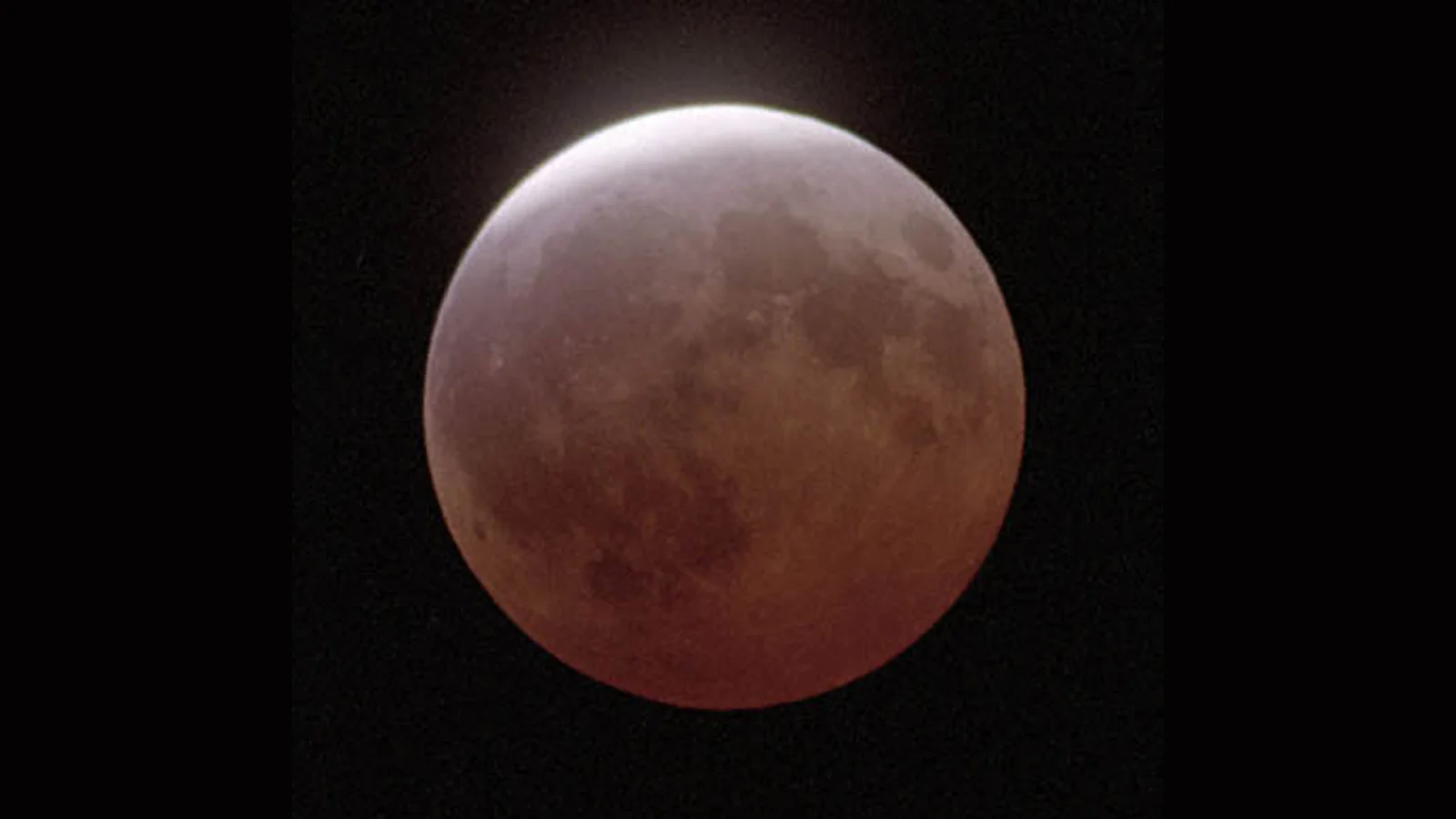
The March 24, 1997 partial lunar eclipse, pictured here, is a reasonably close match with what the August 27-28 lunar eclipse will look like at maximum. (Dale Ireland/Wikimedia Commons (CC BY-SA 3.0))
DON'T MISS: What is a lunar eclipse, and why don't we see one every month?
What will happen?
Over the course of about five and a half hours, the Moon will first enter the diffuse outer portion of our planet's shadow, then spend about three hours and twenty minutes crossing the darker, red-tinged umbra, until it passes out into the other side of the penumbra, growing brighter until it exits the shadow altogether.
For roughly an hour at the start, the Moon will darken, almost imperceptively. This darkening will become more obvious between 60-90 minutes after the start, as the Moon closes in on the edge of the umbra. Then, it will increase dramatically as the eastern limb of the Moon (the left side) slips into the umbra.
From there, once the Moon starts its journey across the umbra, it will take about one hour and 45 minutes for the eclipse to reach its maximum.
Since the alignment of the Sun, Earth, and Moon aren't perfect this time around, the Moon will be roughly 93 per cent immersed in the umbra at maximum, making this a partial lunar eclipse.
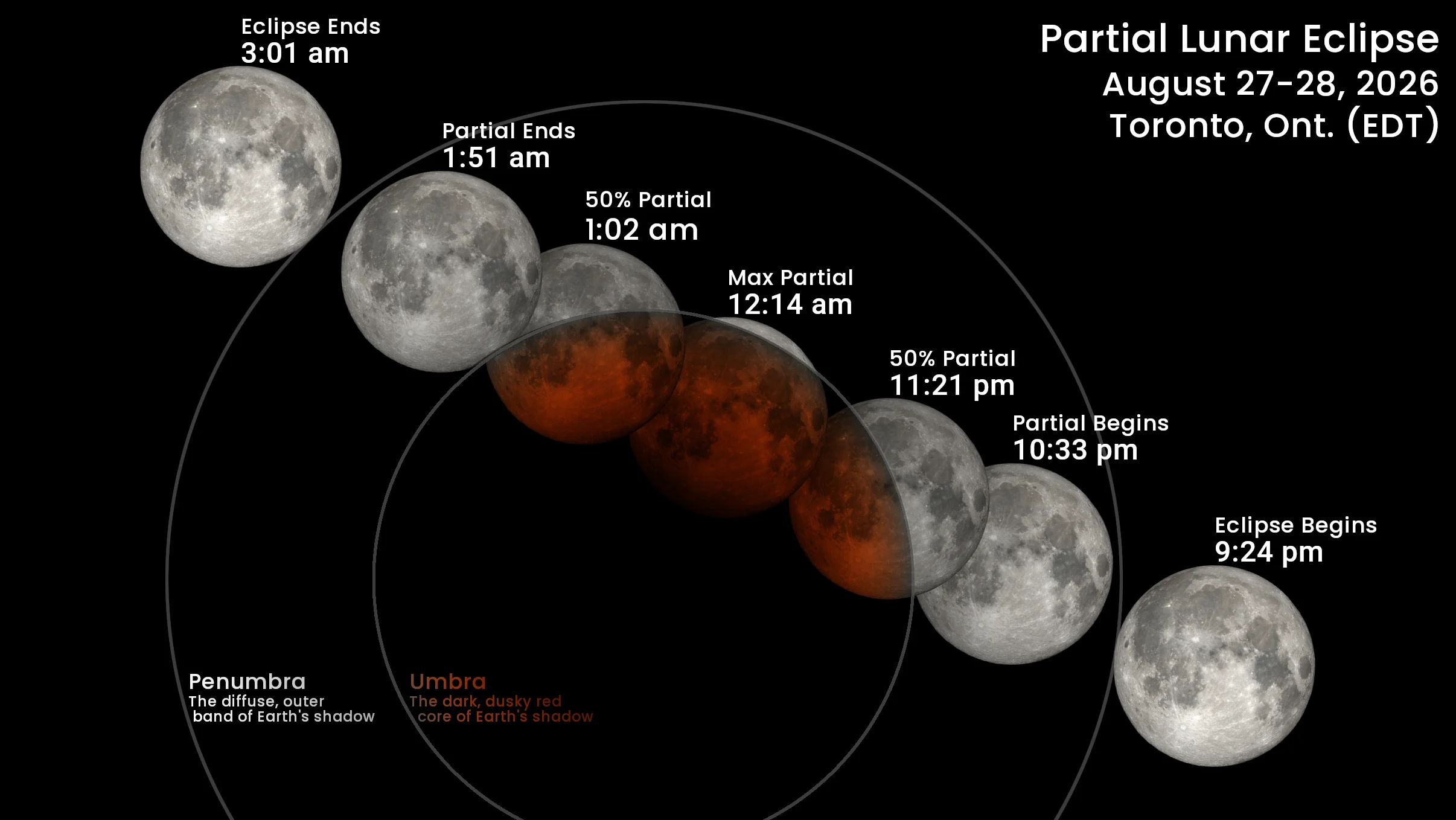
The details and timing of the Partial Lunar Eclipse, for the eastern timezone. (NASA's Scientific Visualization Studio/Fred Espenak/Scott Sutherland)
During the first 90 minutes or so of this umbral journey, the shadow will simply creep across the Moon's face, making it appear as though it is being swallowed by darkness.
Now, the umbral core of Earth's shadow is tinged a dusky red colour, due to the combination of the light from all of the sunrises and sunsets around the world being focused by the atmosphere into that portion of the shadow.
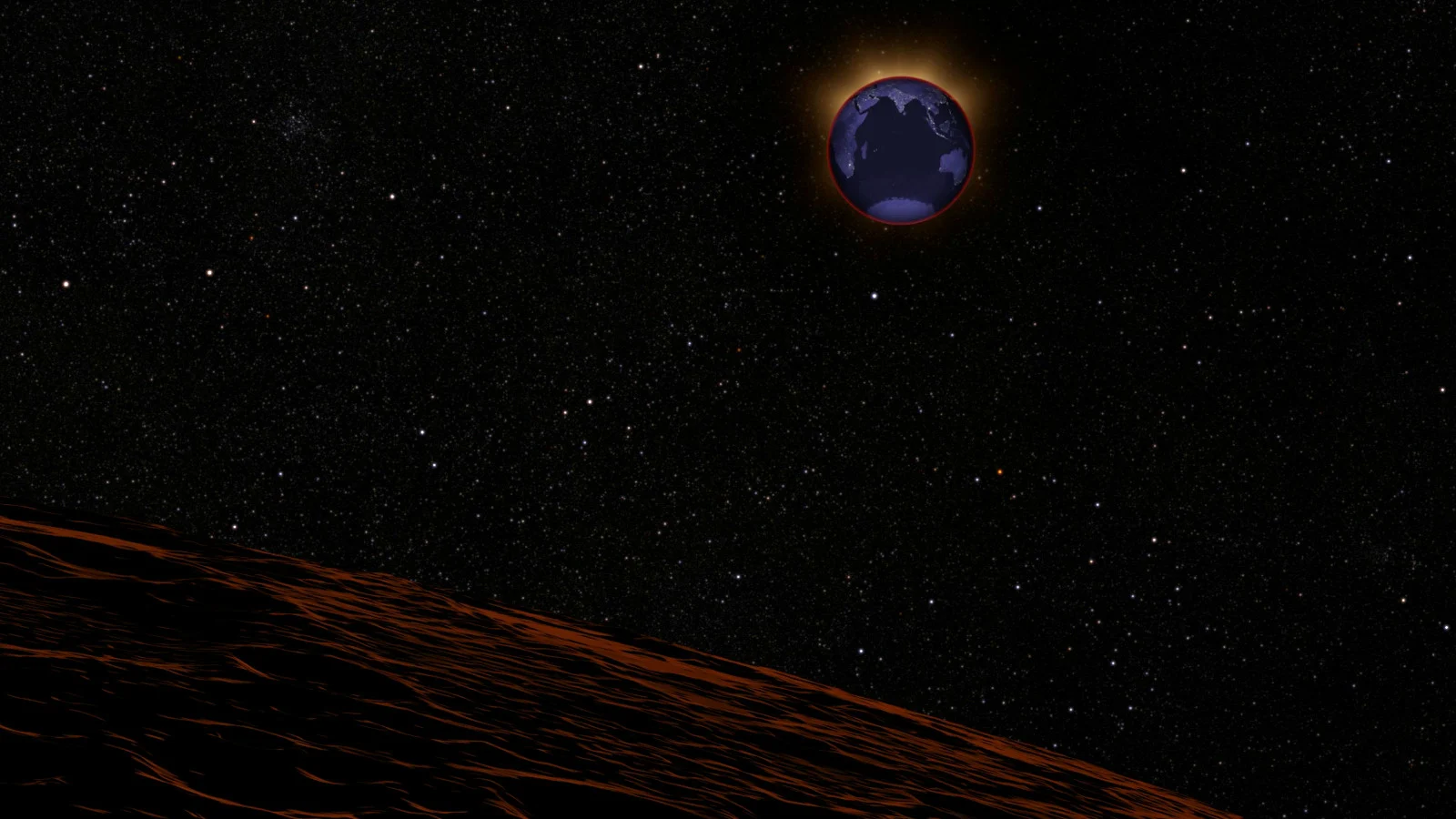
The view of a lunar eclipse from the Moon's surface shows the edges of Earth's atmosphere tinged red due to the Sun's rays. (NASA)
When there is a total lunar eclipse, this red colour becomes obvious once the Moon is completely immersed in the umbra.
However, due to the way the human eye perceives light and colour, it is difficult to notice that redness during the partial phase of the eclipse. The portion of the Moon still in the penumbra can be bright enough to overwhelm our sense of colour, making the rest of the Moon's surface appear simply black as a result.
So, with this being a partial eclipse at maximum, it will be a challenge to notice the colour. Using a camera will help, as the settings can dial down the contrast. To the unaided eye, though, we may only perceive the red for a short period of time, just before and after the eclipse maximum.
Following the eclipse maximum, it will take another 90 minutes for the Moon to completely exit the umbra, and then a little over an hour more for the eclipse to end.
The Timing
Everyone across Canada with reasonably clear skies should be able to see most of this eclipse, including the maximum partial eclipse, when the Moon will be around 93 per cent immersed into the darkest part of Earth's shadow.
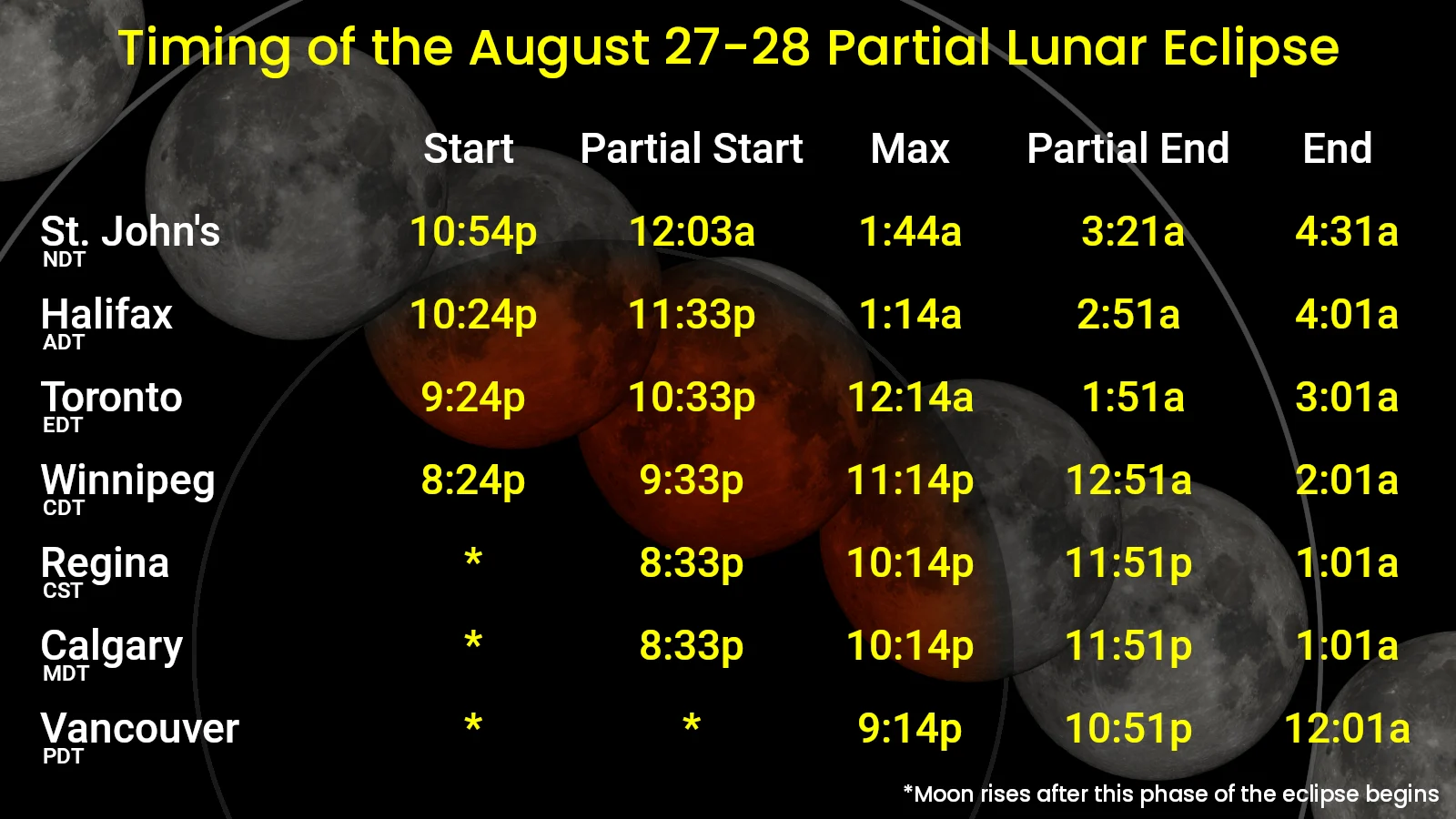
However, for locations farther west, the eclipse will begin earlier in the evening. Thus, for some observers, the eclipse will have already begun by the time the Moon rises.
In Saskatchewan and Alberta, the Moon will rise during the 'penumbral' phase of the eclipse.
For observers in British Columbia, the Moon will already have started its journey across the darker umbra by the time it crests the horizon.
Copy, Moon Joy: Keep the Moon Joy alive with over 12,000 new photos from Artemis 2
Will the skies cooperate?
Besides the timing of the eclipse, another essential factor affecting our enjoyment of a lunar eclipse is whether or not we have an unobstructed view of Moon on that night.
Here are the cloud conditions forecast for overnight on Thursday:
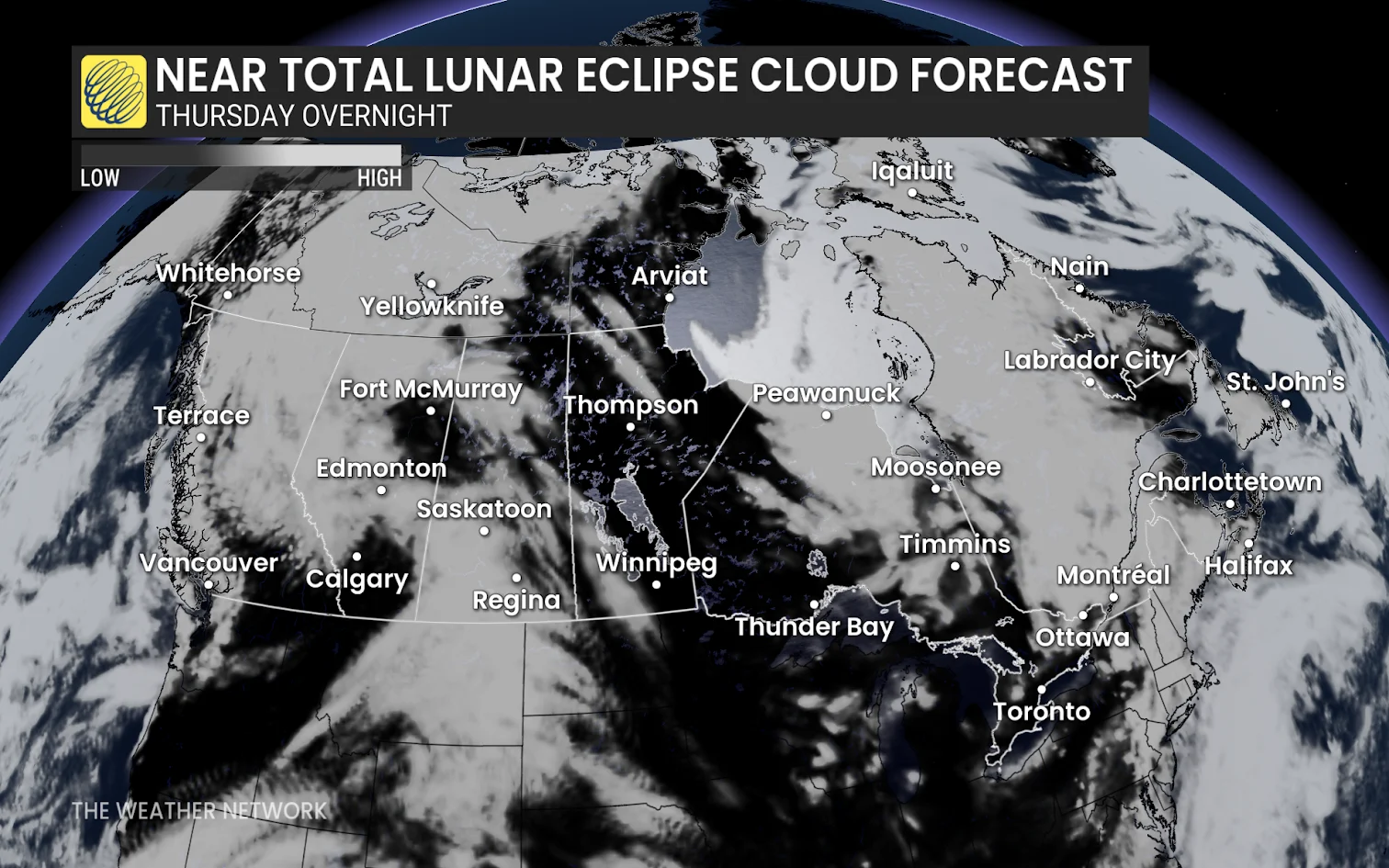
Overcast skies are expected for much of Atlantic Canada, except for the north and eastern coasts of Newfoundland, northern mainland Nova Scotia and Cape Breton Island, and Prince Edward Island.
Most of Quebec is also overcast, with some clear patches possible around Montreal.
Mainly clear skies are expected across most of Ontario and Manitoba, mainland Nunavut, and eastern Northwest Territories.
Cloudy conditions with some clear breaks are forecast across Saskatchewan, northern Alberta, central and northern British Columbia, and the rest of the Northwest Territories.
Clear skies are expected over southern Alberta and southern British Columbia, as well as the western half of the Yukon.
Watch from anywhere
Even if your skies are completely overcast tonight, astronomers are set to live stream the event, for all to see.
Griffith Observatory, located in the mountains just to the east of Los Angeles, California, has scheduled their livestream from 7:25 p.m. to 12:05 a.m. PDT (10:25 p.m. to 3:05 a.m. EDT).
That will cover the start of the partial phase of the eclipse, through until the end, when the Moon exits Earth's shadow until the next eclipse, in February of next year.
Best until the end of 2028
Lunar eclipses occur, on average, once every six months. Now, 2027 and 2028 are somewhat unusual, in that we'll actually see three lunar eclipses throughout each of those years — in February, July, and August of 2027, and then January, June, and December of 2028.
However, all three of the 2027 eclipses will be only penumbral, with the Moon passing through the outer portion of Earth's shadow and completely missing the darker inner umbra.
Plus, in 2028, the first two eclipses will be partial. During the January one, less than 10 per cent of the Moon's edge will pass through the edge of the umbra, while only around 40 per cent of the Moon's disk will be immersed in the umbra for the June one.
After this week's lunar eclipse, with its magnitude of 93 per cent, we have to wait until December 31, 2028, before we see a better one. That's when the next total lunar eclipse occurs, although it will only be visible just before dawn from the western half of Canada. The eastern half of the country is favoured with the total lunar eclipse that follows after, which occurs on June 26, 2029.
Author's note: Apologies to those who came here to tune in to Griffith Observatory's livestream of the lunar eclipse. Although the correct link to the live stream was embedded at the time that the article was published, on the night of August 27, that same link turned out to be the observatory's August 20 "All Space Considered" podcast. The link has now been fixed, above, for those who wish to replay the event.