Africa is splitting apart faster than previously thought, forming a new ocean

While a complete breakup will take millions of years, scientists say some early stages are visible today.
Eastern Africa is breaking up faster than previously thought, according to new research published in Nature Communications.
Scientists say a 500-kilometre-wide region known as the Turkana Rift is thinning and fracturing, a process that could eventually split eastern Africa apart and help form a new ocean basin.
The rift, which spans Kenya and Ethiopia, is drifting at a rate of about 4.7 mm per year.
While a complete breakup will take millions of years, scientists say some early stages are visible today.
Why Africa is slowly splitting apart
The world’s arrangement of continents is continuously changing. It was very different hundreds of millions of years ago, when Earth’s land blended together to form a supercontinent.
Experts believe the world could take on a similar shape 200 million years in the future.
When tectonic plates meet, mountains form, and oceans form where they drift apart.
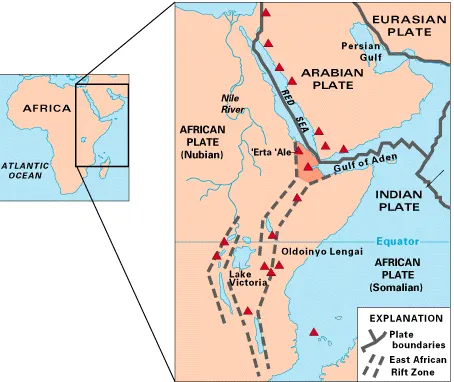
A map of East Africa showing some of the historically active volcanoes (as red triangles) and the Afar Triangle (shaded at the center), which is a so-called triple junction (or triple point) where three plates are pulling away from one another: the Arabian plate and two parts of the African plate—the Nubian and Somali—splitting along the East African Rift Zone. (Source: USGS)
SEE ALSO: Pangolins, the animal kingdom 'oddballs', provide important conservation lessons
The East African Rift System is drifting, causing a fracture between its Nubian plate, which contains much of the continent, and the smaller Somali plate that contains most of the eastern coast and Madagascar.
Breakup further along than expected
Researchers used seismic data to determine the thickness of the crust in the region, discovering it is only about 13 kilometres thick in the centre, far less than the 35-kilometre thickness along the edges of the rift.
When a crust’s thickness measures less than 15 kilometres, it enters a phase called “necking,” where the odds of a continental breakup rise sharply.
“We’ve reached that critical threshold” of crustal breakdown, Anne Bécel, a geophysicist at Columbia University’s Lamont-Doherty Earth Observatory and co-author of the study, said in a statement.
“We think this is why it is more prone to separate.”
The process by which Earth’s crust is stretched horizontally, causing it to buckle, fracture, and release magma from below, is referred to as “rifting.”
Study lead author Christian Rowan, a PhD student in Earth and Environmental Sciences and researcher at the Lamont-Doherty Earth Observatory, said rifting in this zone is more advanced than previously recognized.
How a new ocean could eventually form
While the rifting has passed the theoretical point of no return for a continental breakup, the authors are quick to point out it will unfold in geological time:
“It will take a few million more years before necking gives way to oceanization, the next stage in rifting, when magma will surge through the cracks and create a new seafloor for water that pours in from the Indian Ocean to the north,” the authors said in a statement.
A fossil hotspot
To date, more than 1,200 hominid fossils spanning 4 million years — about one-third of all hominid fossils found in Africa — have been discovered in the Turkana region.
While the region is often thought of as a hotspot of human evolution and history, Rowan said the study may offer another explanation.
“Following widespread volcanism around 4 million years ago, necking initiated subsidence of the Turkana Rift, where fine-grained sediments favourable for fossil preservation rapidly accumulated,” the authors said in a statement.
This may have created what Rowan called the “right conditions” to preserve a continuous fossil record.
Rowan said the theory could help other researchers examine how tectonic processes, climate, and shifting plates may have influenced human evolution.
WATCH: Madagascar's endangered animals would take 23 million years to replace
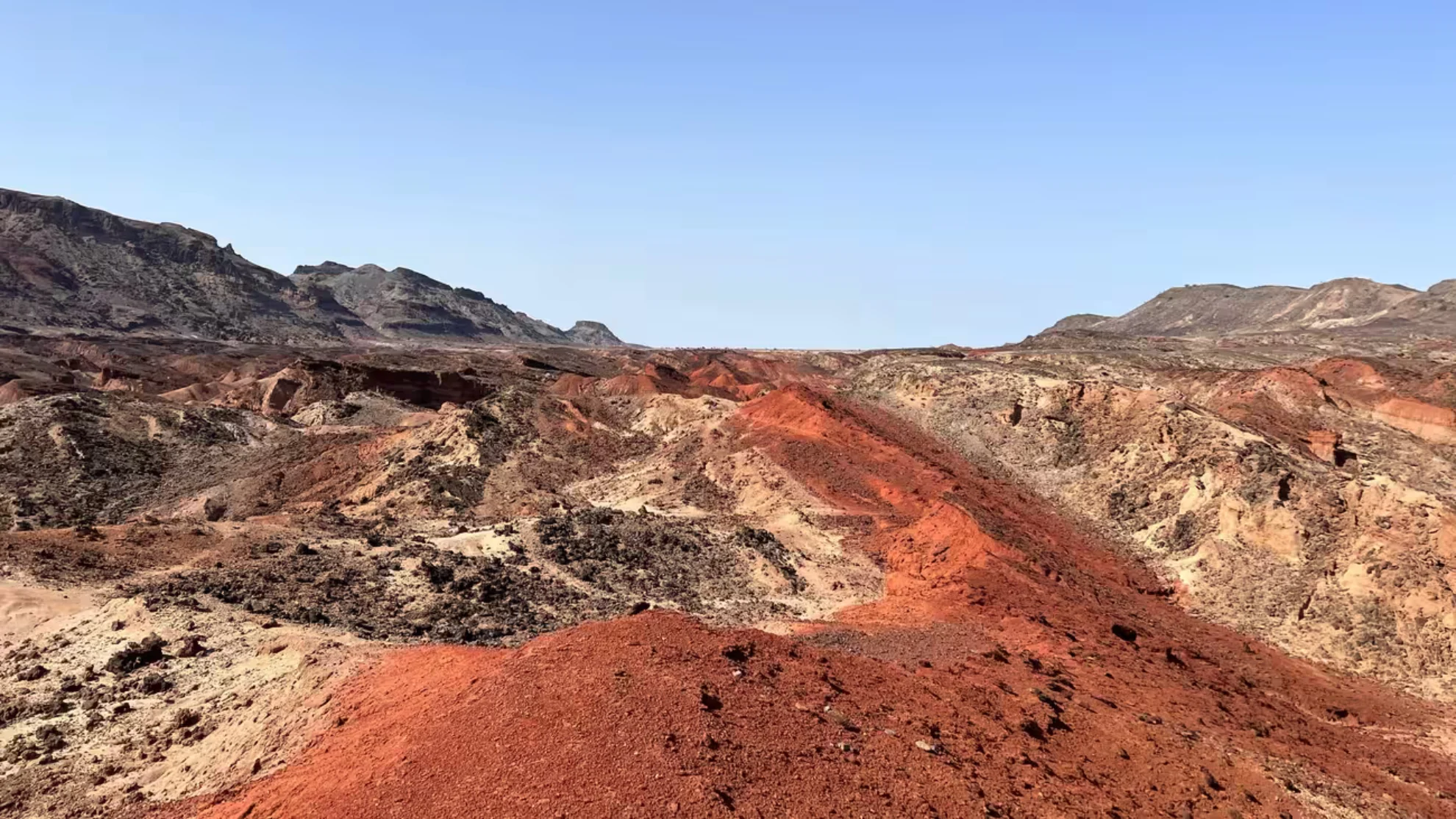
Header photo: West Turkana, courtesy of Christian Rowan