Whirling disease found in another Alberta watershed

A microscopic parasite that attacks the cartilage and nervous system of young fish has been confirmed in the McLeod River, triggering a federal order to designate the Athabasca watershed in central Alberta as a contamination zone.
Earlier this month, the Canadian Food Inspection Agency (CFIA) declared the Upper Athabasca and McLeod sub-watersheds as official infection areas for whirling disease.
RELATED: Deadly whirling disease found in Lake Louise; Mitigation can take 'decades'
The newly designated contamination zone sits adjacent to the Bow, Oldman, Red Deer, and North Saskatchewan River watersheds, which have been declared infected since the disease was first detected in Alberta in 2016.
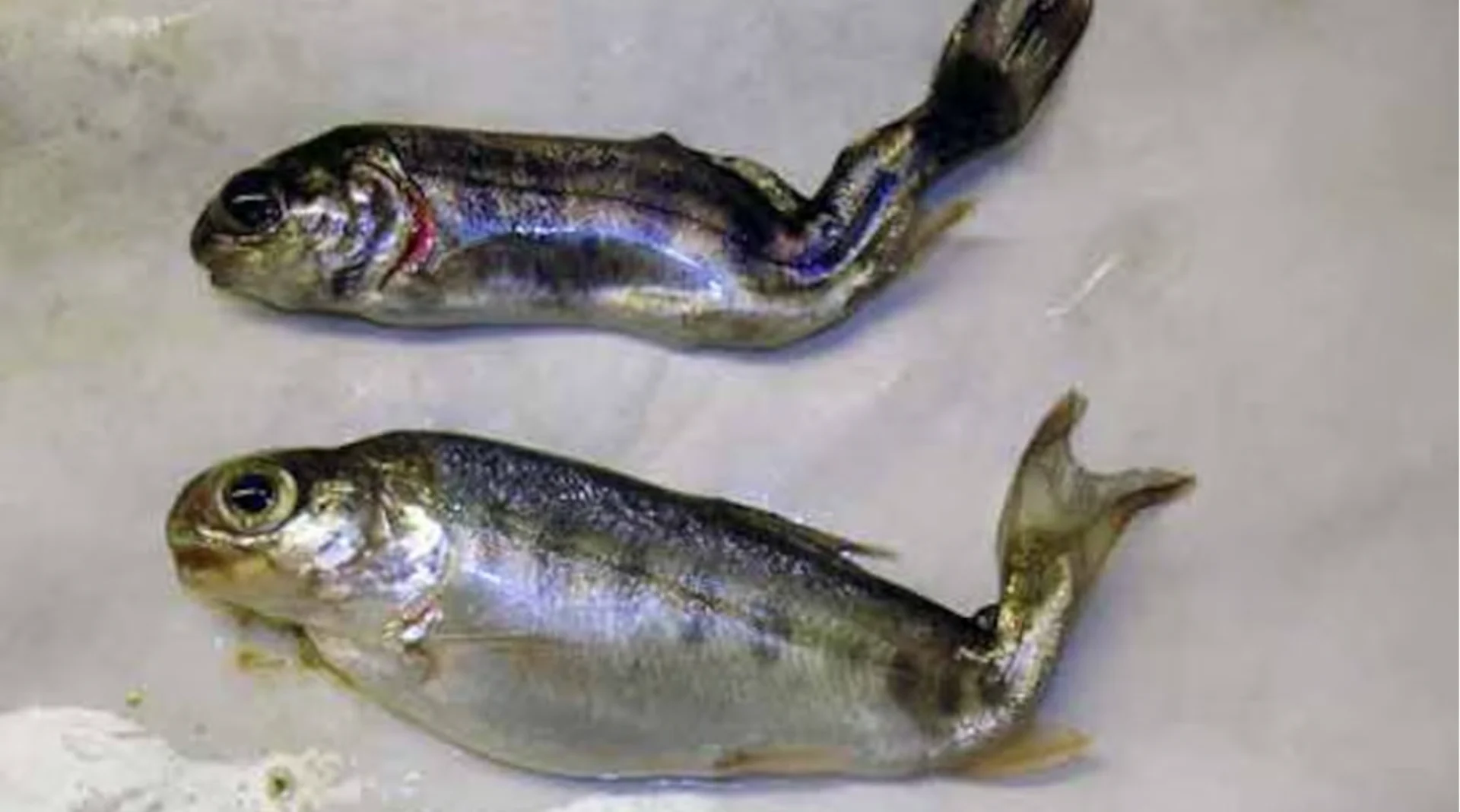
Two fish display classic signs of whirling disease, including spinal curvature and a blackened tail. The disease is caused by a microscopic parasite that attacks the cartilage of young fish before it can harden into bone. (Parks Canada)
The designation means strict regulatory controls are now in place for moving fish and sediment. It does not affect recreational use or fishing.
The order means the CFIA's blanket protocols apply to the entire Athabasca watershed — a 159,000-square-kilometre area covering roughly 24 per cent of Alberta’s landmass.
However, the disease has only been detected in the McLeod River.
The federal update comes on the heels of recent whirling disease discoveries in Banff, Yoho and Waterton Lakes national parks.
A variable, but devastating impact
Whirling disease is caused by Myxobolus cerebralis, a parasite that targets the bone structure of juvenile fish before their cartilage can ossify, or harden into bone.
Affected fish often swim in a tail-chasing "whirling" motion, making it difficult to feed and leaving them vulnerable to predators.
Whirling disease took out 90 per cent of trout populations in Colorado during the 1990s.
A 90 per cent mortality rate is “on the extreme end of what can happen [in Alberta],” said Patrick Hanington, a professor at the University of Alberta who was part of the team that flagged the disease.
“[Officials in Colorado] knew the parasite was there, but it took about 10 years for them to start really measuring such huge declines."
With Alberta now hitting the 10-year anniversary of its first detection, Hanington says the province is entering the window where population-level impacts might begin to manifest.
The complexity of the disease makes tracking it difficult. Species like brown trout and brook trout can act as silent carriers, harbouring the parasite without ever getting sick.
Researchers once believed that northern watersheds like the Athabasca would be spared from whirling disease, based on suggestions that the parasite would struggle to survive in colder temperatures.
But this doesn’t seem to be the case anymore, Hanington said. “Which I think is important because that was sort of an environmental barrier that we had thought might be in place that protected our northern watersheds.”
Now that the parasite is detected, Hanington said he’s now trying to determine which trout and whitefish species will be negatively affected by the parasite and which ones may be unaffected but carry the parasite to new locations.
Endangered trout populations face 'one more threat'
Leslie Peterson, director of conservation at Freshwater Conservation Canada, said she’s disappointed but not surprised with the new discovery.
Peterson said the most concerning part of the McLeod River infection is the effect it could have on rainbow trout, which is listed as endangered both federally and provincially.
“They already face multiple cumulative effects from historic and current land use,” said Peterson. “So this is just one more threat that the Athabasca rainbow trout now face.”
Peterson warned that once the parasite is established in an ecosystem, it is “really difficult to control.”
Parks Canada takes urgent action
Although whirling disease has not yet been detected inside Jasper National Park, the recent discovery in the neighbouring McLeod River sub-watershed is still cause for concern.
In an emailed statement to CBC, Parks Canada wrote that the Athabasca detection of the parasite “underscores the importance of taking urgent action to limit its spread in the region.”
In March, Parks Canada aggressively restricted or entirely banned recreational watercraft in several key lakes across Banff, Yoho and Kootenay national parks.
While the closures have frustrated some recreational park users, Peterson applauded the federal agency's action to prevent the spread.
"They’re in a really difficult position because recreation in the parks is such a big part of what parks are for,” Peterson said.
“But their mandate ultimately is ecological integrity, and it can be difficult for park users to have to come to terms with that."
This article, written by Maggie Kirk, was originally published for CBC News.