
Deadly whirling disease found in Lake Louise; Mitigation can take 'decades'

Eradication is extremely difficult once detected, experts say.
Whirling disease, a non-treatable neurological condition with a fatality rate of up to 90 per cent in juvenile trout, salmon, and whitefish, has been detected in Alberta’s Lake Louise, The Canadian Press (CP) reports.
In response, officials have imposed new rules and restrictions and divided water zones in Banff National Park into three sections.
Paddling, large inflatables, and the use of waders or wading boots while fishing are now prohibited in Minnewanka, Bow, and Moraine Lakes.
Bow and Moraine Lakes are now classified as being in "prevention zones," while Lake Minnewanka is in a "special tactics zone."
Meanwhile, Lake Louise is classified as a "water recreation zone", which means visitors are still allowed to enjoy regular water activities, so long as they clean, drain, and dry their equipment prior to use.
People who do not follow the restrictions can be charged up to $25,000 under the National Parks Act.
"We understand the disappointment that visitors would like to keep recreating on some of these water bodies, but we are trying to find a balance between protection of our sensitive ecosystems as well as finding locations and opportunities for them to continue water body recreation," Marie Veillard, the aquatic invasive species project co-ordinator for Lake Louise, Yoho and Kootenay field unit told CP.
A full list of water zones in Banff National Park can be found on the Parks Canada website.

File photo of Lake Louise. (Getty Images via Canva Pro)
At a Wednesday press conference, François Masse, superintendent for Parks Canada’s Lake Louise, Yoho and Kootenays field unit, said the disease likely entered the lake through mud attached to a watercraft.
“It’s unlikely whirling disease was spread to Lake Louise through natural fish movement because there’s a natural fish barrier between Lake Louise and the Bow River,” he said.
Mitigation can take ‘decades’
Whirling disease was first detected in Canada in Alberta’s Banff National Park in 2016.
Once present, experts say it is difficult to eradicate, but fish may naturally adapt over time.
"What has been happening in more cases is the fish eventually will develop resistance to the parasite, but you do have to have enough fish left in the population to continue reproducing and adapting their genetics over time," Veillard told CP.
"This takes decades for that to happen."
Once the disease is found, officials often opt for preventative strategies, like closures and restrictions.
Veillard told CP there is no set end date to the restrictions they are imposing.
Restrictions elsewhere have proven successful
In March 2024, Parks Canada announced extended closures and restrictions in British Columbia's Kootenay and Yoho National Parks and Alberta's Waterton Lakes National Park after discovering the whirling disease parasite in fish, expanding on measures first implemented in October 2023.
These restrictions — which will stay in place until March 31, 2027 — are showing signs of success: A July 2025 Facebook post from Kootenay and Yoho National Parks said the strategy has helped slow the spread of the disease.
"As we haven't had any new detections in the past few years we're feeling confident that these restrictions are achieving the results that we are looking for," Veillard told CP.
"By creating these restrictions, we are able to target the human mediated spread of aquatic invasive species and slow that spread beyond our known location."
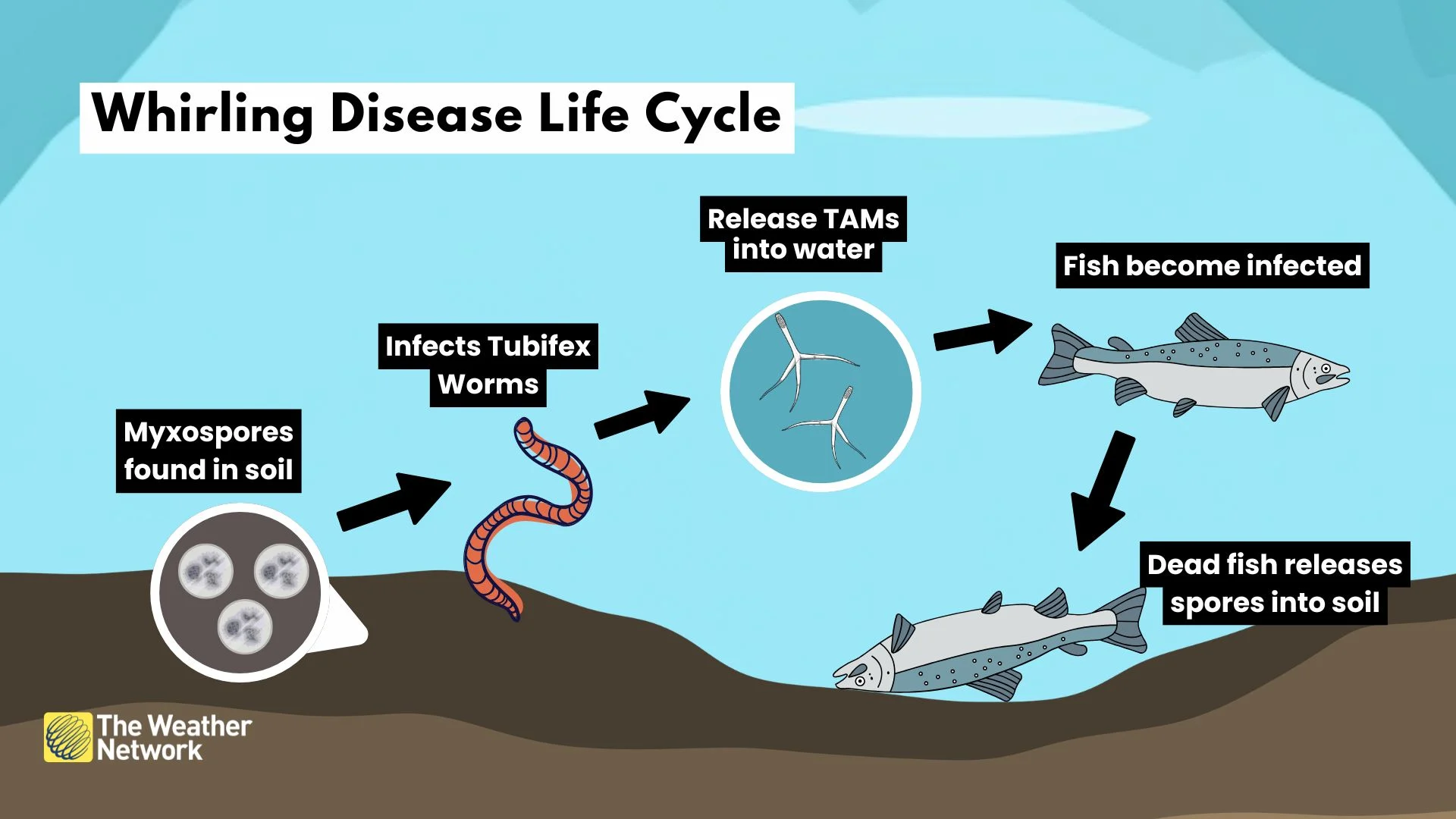
The whirling disease life cycle (April Walker for The Weather Network)
What is whirling disease?

Examples of the deformities cause by whirling disease. (Alberta Invasive Species Council)
Whirling disease is primarily spread through human activity. The spores that spread infection can latch onto fishing or recreational equipment and migrate to other lakes if equipment isn’t properly cleaned before each use. Pets can also carry the spores from one waterway to another.
It also spreads naturally. The parasite that causes it, Myxobolus cerebralis, is an aquatic invasive parasite that moves through spores in the water.
Native to Europe, it was first detected in Pennsylvania commercial fish hatcheries in the 1950s.
According to the Government of Saskatchewan, these spores are highly adaptable and can persist in a waterbody for more than 20 years.
The parasite's life cycle involves two hosts: A tubificid worm (an aquatic worm) and a salmonid fish, according to the Government of Alberta.
Once a fish is infected, the parasite attacks its cartilage and skeletal tissues, causing deformities that include a characteristic "whirling" behaviour. The disease impairs the fish's ability to swim, feed, and evade predators.
Once fish die, spores persist in the water and contaminate the sediment.
It only infects finfish, like trout and salmon. Whirling disease does not infect humans or pets and does not pose a threat to human health, according to the Government of Canada.
Header image: A juvenile fish infected with whirling disease, courtesy of Colorado Parks & Wildlife via BC Watershed Team. Arrows added by The Weather Network to highlight disease-induced deformities.