
Crested caracara's P.E.I. appearance 'just luck.' Bird not so lucky


A crested caracara spotted in Baja California Sur, Mexico. Caracaras are generally equatorial birds, but sightings have become more common in the Maritimes. (Philipp Hoenle/iNaturalist via CBC News)
Birders on P.E.I. are thrilled by a crested caracara that has taken up residence on the Island this summer.
The bird was first sighted in mid-July at East Point in the far northeast. More recently, it's been spending time in Mount Vernon, around the area where Cindy Esau lives.
"It's pretty exciting when you step out your front door and it's there, or the neighbour calls and says it's in the backyard," Esau said.
"You can get not very far from it and just watch it. It's pretty amazing."
The bird is both photogenic — with its bare, red face, black crown, and white neck — and easy to photograph. Esau, who belongs to birding groups on both email and Facebook, has enjoyed sharing the news with other birders.
"It doesn't seem to be scared of people," she said.
SEE ALSO: Oh my pod! Orcas moving en masse near N.L. astonish scientist
Many ways bird could have been pushed to P.E.I.
Caracaras are generally equatorial birds, and the nearest resident population is in Texas, said Prof. Joseph Nocera, an ornithologist at the University of New Brunswick.
Birds such as these, far from their home range, are called vagrants, Nocera said. It is likely a weather event — or combination of weather events — that brought it to P.E.I.
"As we all know, this year's weather has been a bit crazy," Nocera said.
"There have been fires and floods and heat waves and smoke warnings. So all of that combined, throw in a little El Niño and a bit of climate change, and it's probably no surprise that this bird got pushed out of its natural range. How it ended up in P.E.I. would be just luck."
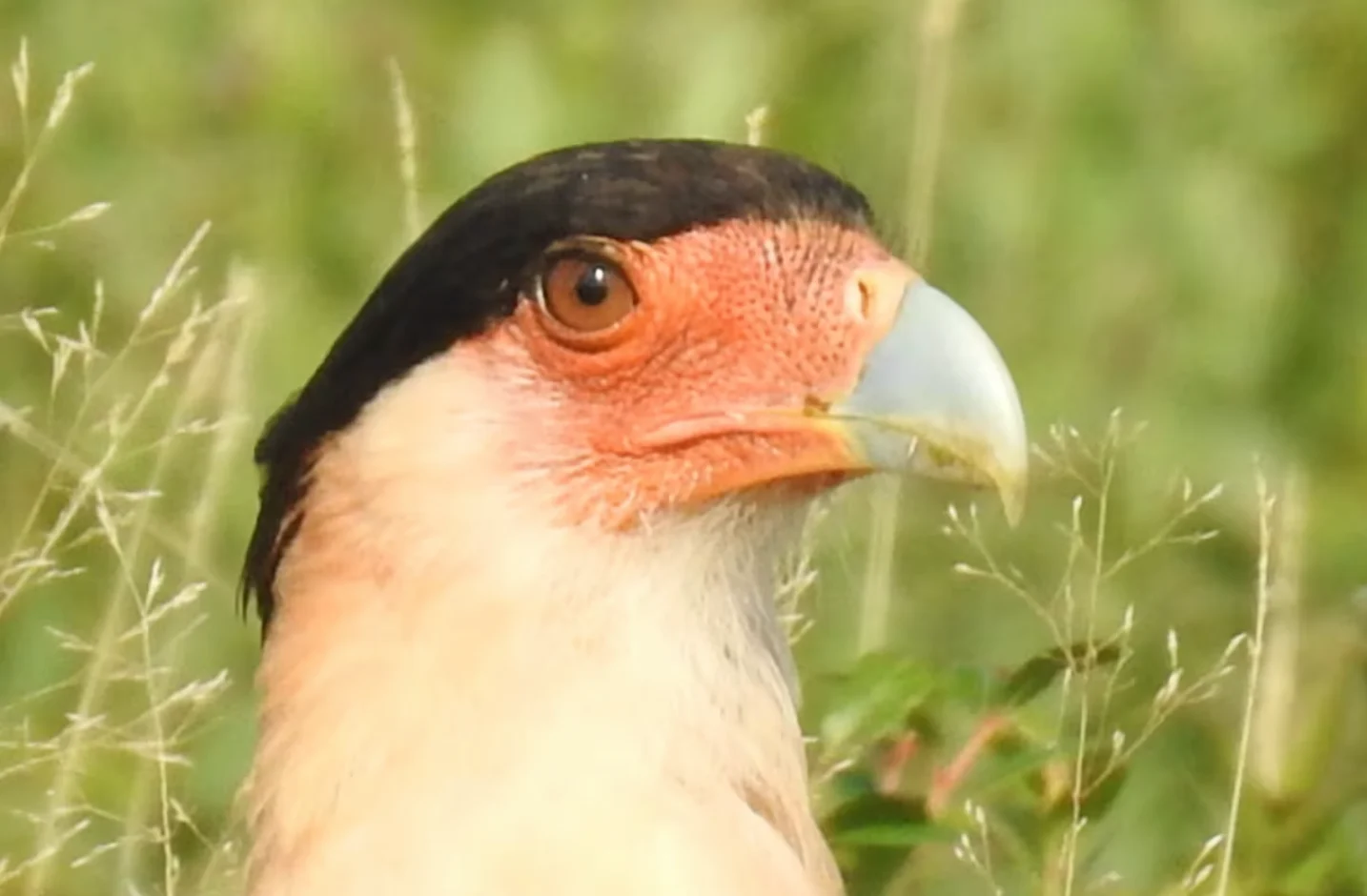
The crested caracara has a very distinctive look. (Cindy Esau via CBC News)
Nocera said sightings of caracaras have become more common in the Maritimes, with one popping up every few years.
A caracara spotted in Maine this spring was likely the same bird, he said.
"If you go back in the literature, you don't tend to see those reportings several decades ago," he said. "This seems to be happening more and more."

This crested caracara has been on P.E.I. since at least mid-July. (Cindy Esau via CBC News)
DON'T MISS: Silky nests in N.B. trees show it's been a good year for the fall webworm
Migration not 'one of their strong points'
Caracaras like to hang out with turkey vultures, and these have expanded their range northward in recent decades and become common in the Maritimes.
It is possible some caracaras are following them, even if they have not established populations north of Texas.
While this caracara has likely been fine on the Island in recent weeks, Nocera said its future is not promising.
"In the summer in P.E.I., it probably is finding adequate food. Things will start to get quite difficult for it quite soon," he said.
"Migration isn't considered one of their strong points. So I'm uncertain whether this bird would find its way home in the fall."
While there are no statistics available for the survival rates of vagrants such as this one, Nocera said the odds of this bird figuring out how to get back to a warmer climate before winter comes are low.
WATCH: Bird migrations are changing as climate change alters food source and habitat
This article, written by Kevin Yarr, was originally published for CBC News.