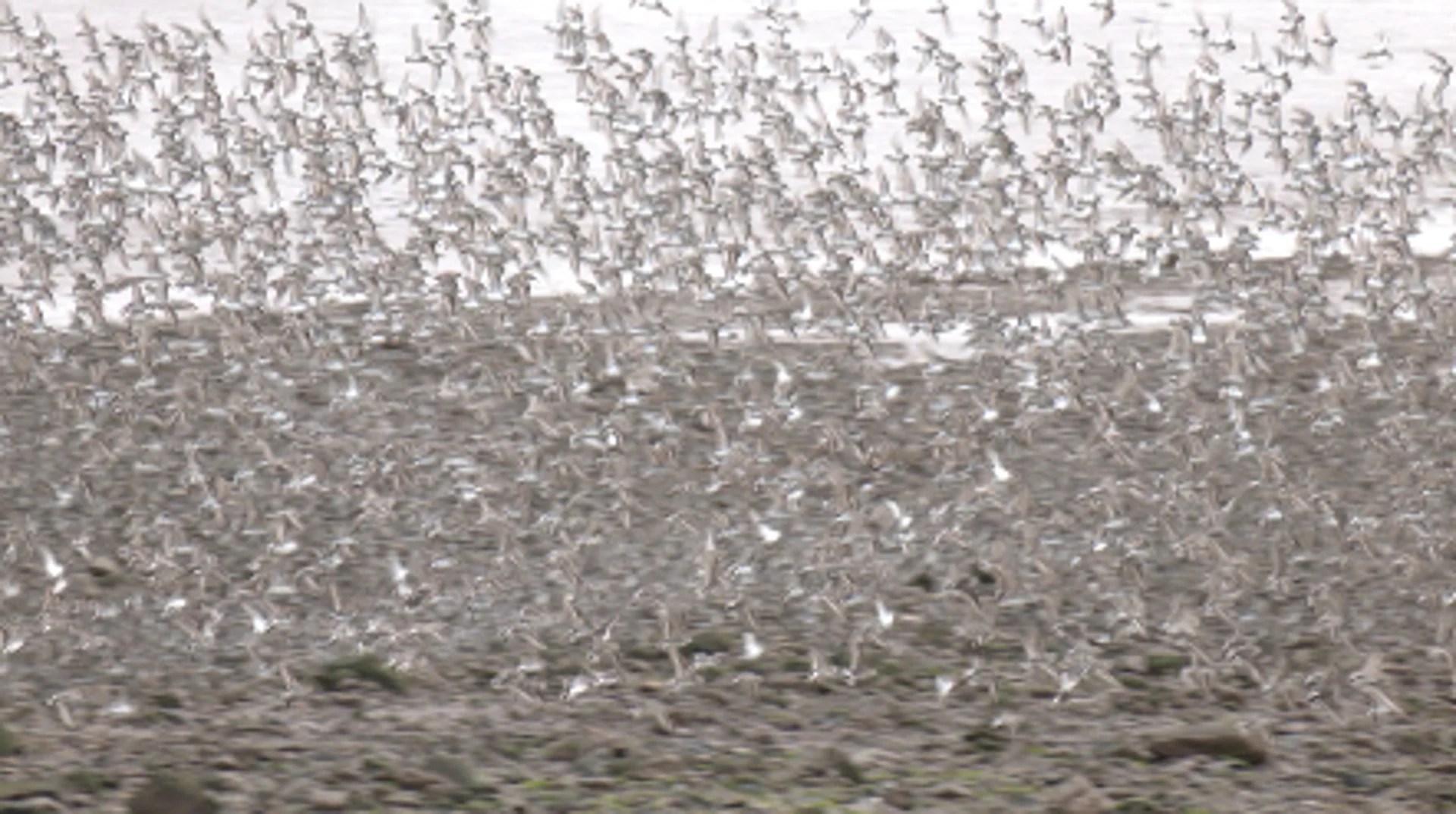
Thousands of shorebirds flock to this beach in New Brunswick during migration

The semipalmated sandpipers spend their summers in the Arctic but come to the Bay of Fundy to feast on the ample invertebrates
Tens of thousands of tiny shorebirds have descended upon the beach in Johnson's Mills, New Brunswick in a spectacle that sees them flying in unison to protect themselves from predators like eagles and falcons.
The semipalmated sandpipers spend their summers in the Arctic but come to the Bay of Fundy to feast on the ample invertebrates when the highest tides in the world go out.
“They are migrating down to South America so they are stopping here for about three weeks and they will double their weight here and do a 72 hour flight to go to South America,” Nature Conservancy Shorebird Interpreter Lea Roybernatchez tells The Weather Network.
The mudflats are a critical stopping point on their journey. The birds will feed at low tide, but at high tide they are resting, saving energy to complete their migration. That is, unless a predator is spotted overhead.
Their murmuration draws crowds with cameras who gather to witness the dazzling display.
When the shorebirds aren't in flight, their tiny figures camouflage in with the mudflats and you might not even notice their presence if looking from afar with the naked eye.
Interpreters from the Johnson's Mills Shorebird Reserve and Interpretive Centre are on hand to keep tally on the shorebirds numbers and to ensure no one gets too close to disturb them.
They’ll need all the rest they can get before setting out on their epic annual flight to South America.
Thumbnail Credit: Photo taken by Nathan Coleman showing shorebirds in Johnson's Mills, NB