Why bad weather can wreak havoc on airline schedules

Delays beget delays in a ripple effect that can upend even the most well-planned itinerary
Airline delays and cancellations are the bane of any traveller’s journey.
Extreme weather is a leading cause of flight disruptions around the world, causing hundreds of thousands of delays and cancellations every year.
It turns out the very model that makes air travel relatively affordable and accessible to so many folks today may be responsible for many of those scheduling hiccups.
DON'T MISS: Six annoying ways weather forces airlines to cancel your flight
Airlines largely operate on the hub-and-spoke model
Airlines ferry hundreds of millions of passengers around the world every year.

Atlanta is the busiest airport in the world, hosting more than 108 million passengers in 2024. That’s more than twice as many as the 47 million passengers who flew through Toronto-Pearson the same year.
This kind of volume is driven by the hub-and-spoke airline model.
Commercial flights in the early days of aviation used to operate on the point-to-point model, which directly connected two cities. Some planes would even make multiple stops like a bus to pick up or drop off passengers along the way.
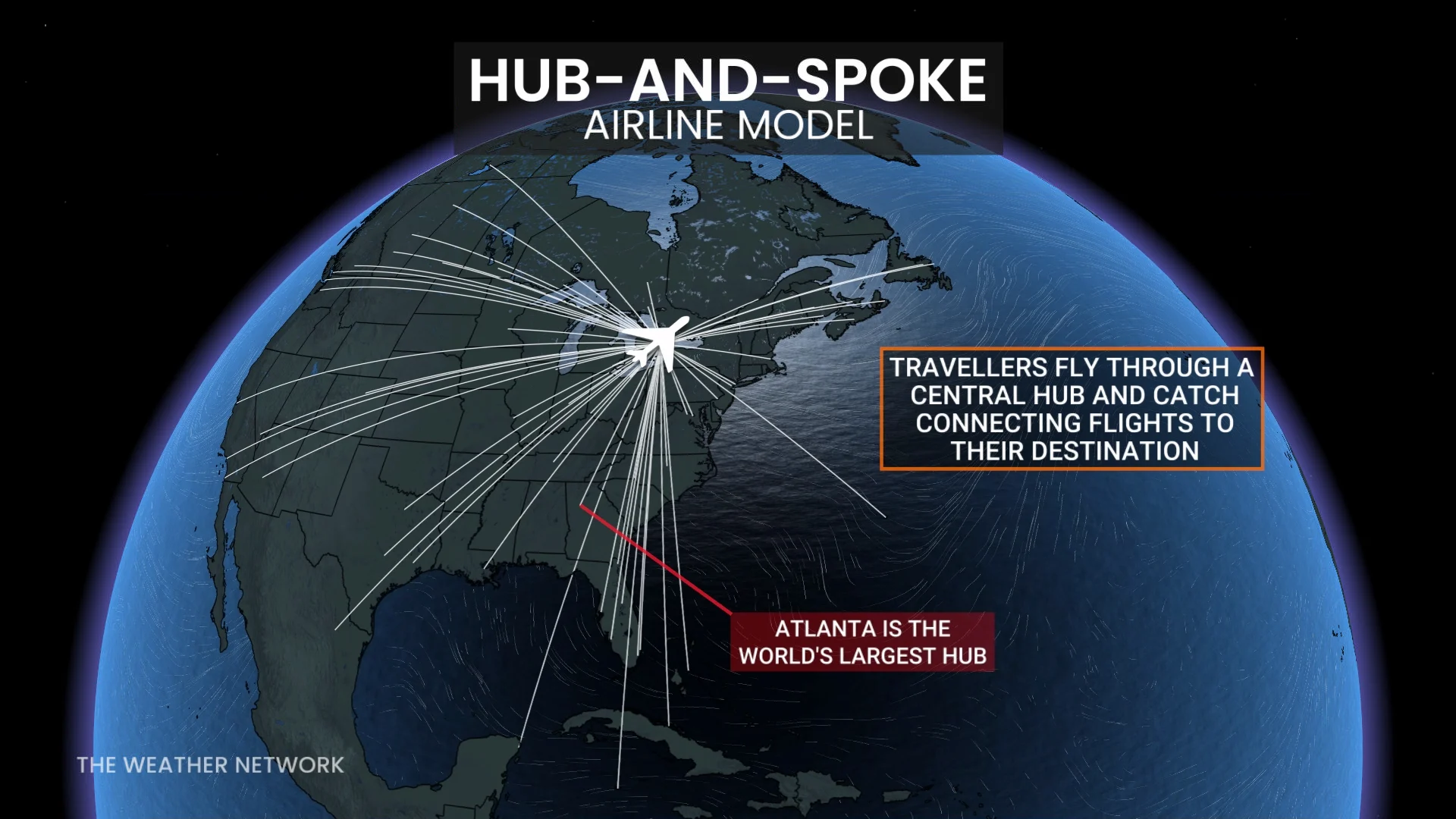
Nowadays, though, many travellers have to switch planes to connect to their destination.
The rise of the hub model allowed air travel to flourish, making long-distance journeys relatively accessible to most folks. One of the major drawbacks of this operation is that delays and cancellations can rack up in a hurry, throwing a wrench in even the most meticulous plan.
Scientists actually study how flight delays multiply
Researchers have conducted extensive studies on airline delay propagation, or how disruptions ripple through an airline’s complex network of flights.
One recent paper explored the root causes of five high-impact extreme weather events across the U.S. in 2017, including three snowstorms, one severe weather outbreak, and a hurricane, comparing all those scenarios to a day considered “business as usual.”
RELATED: What is the longest domestic direct flight in Canada?
The team found that large airports absorb delays while smaller airports are largely responsible for creating delays.
Major airline hubs dominated by a single airline, such as Atlanta or Charlotte, were able to effectively absorb flight delays in their networks...as long as the hub itself wasn’t affected by severe weather.
Delays and cancellations can build in a hurry
Canada’s four biggest travel hubs are Toronto, Vancouver, Montreal, and Calgary. Each of these airports sit in areas vulnerable to extreme weather.
Toronto and Calgary frequently experience severe thunderstorms throughout the warm season. During the cool season, coastal storms can wallop Vancouver and snowstorms bury Montreal.
While hubs have the capacity to absorb delays, extreme weather can switch these bustling centres from receivers to generators in a hurry.
Imagine a cluster of thunderstorms over Toronto-Pearson Airport on a humid summer afternoon. The heavy rain and high winds halt all operations at the hub for several hours.
This prolonged weather delay would have major ripple effects through the system.
RELATED: Six fascinating ways weather affects your daily flights
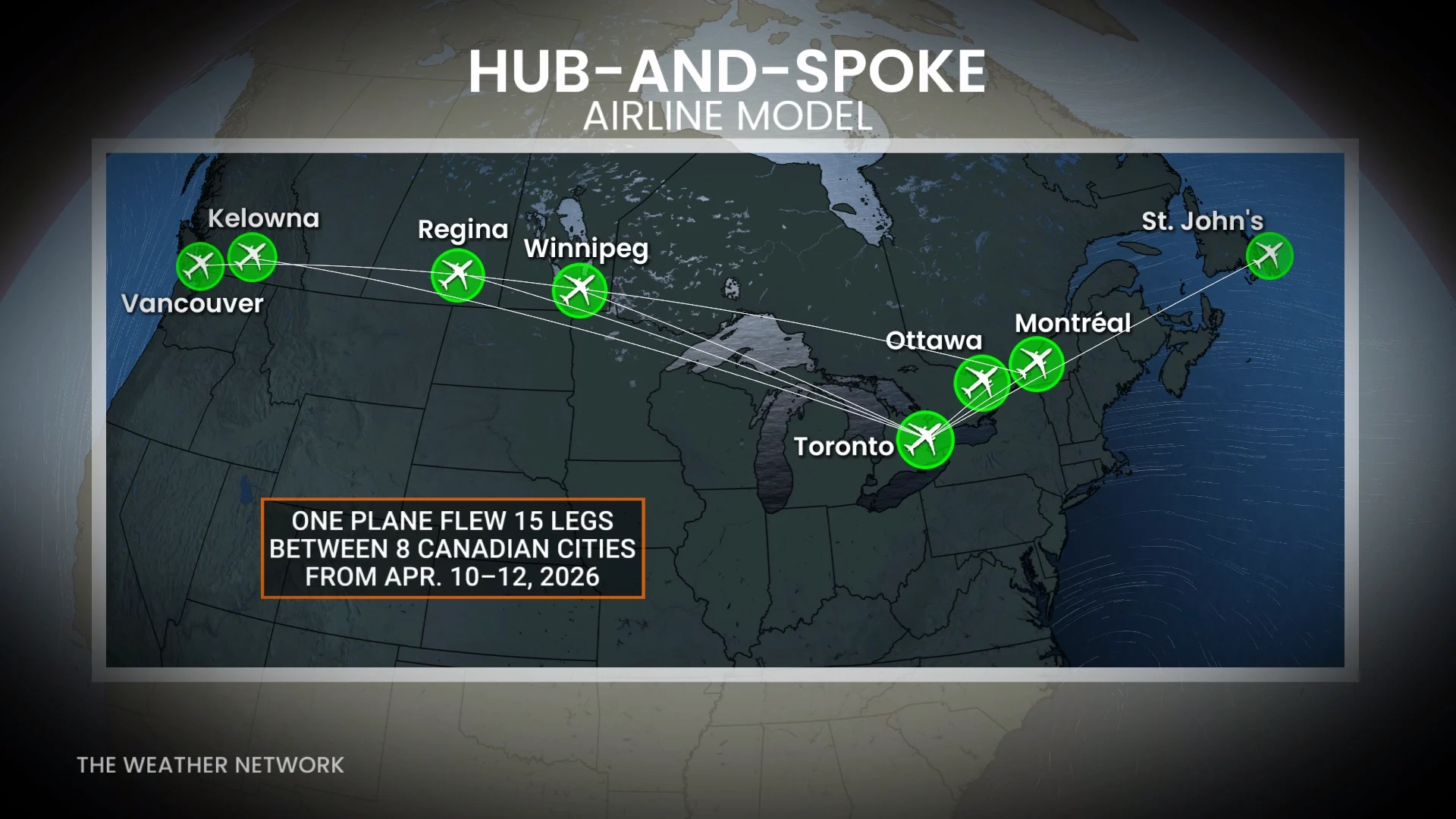
Short-haul domestic aircraft are workhorses, sometimes completing five or more flights in a single day. A scheduling hiccup anywhere along that plane’s itinerary will cause a chain reaction down the line that can take days to recover from.
Pilots and flight attendants often switch from one plane to another after they’ve completed a flight. These professionals are just as vulnerable to delays as we are as passengers; a plane can’t leave on time if the flight crew isn’t there yet.
Making matters worse, airlines have shortened layover periods as they’ve packed more flights into their everyday schedules. Some layovers offer less than 30 minutes between flights, providing travellers almost no grace period for delays.
Fixing the problem is no easy task.
One increasingly common solution is to ‘pad’ the schedule to account for short delays. If a flight that only takes 30 minutes is scheduled for 60 minutes, that extra time provides a buffer for airlines and travellers alike.
Some airlines are also more proactive about rebooking passengers and swapping out flight crews in the effort to alleviate any disruptions that may pop up.
Header image created using graphics and imagery from Canva.