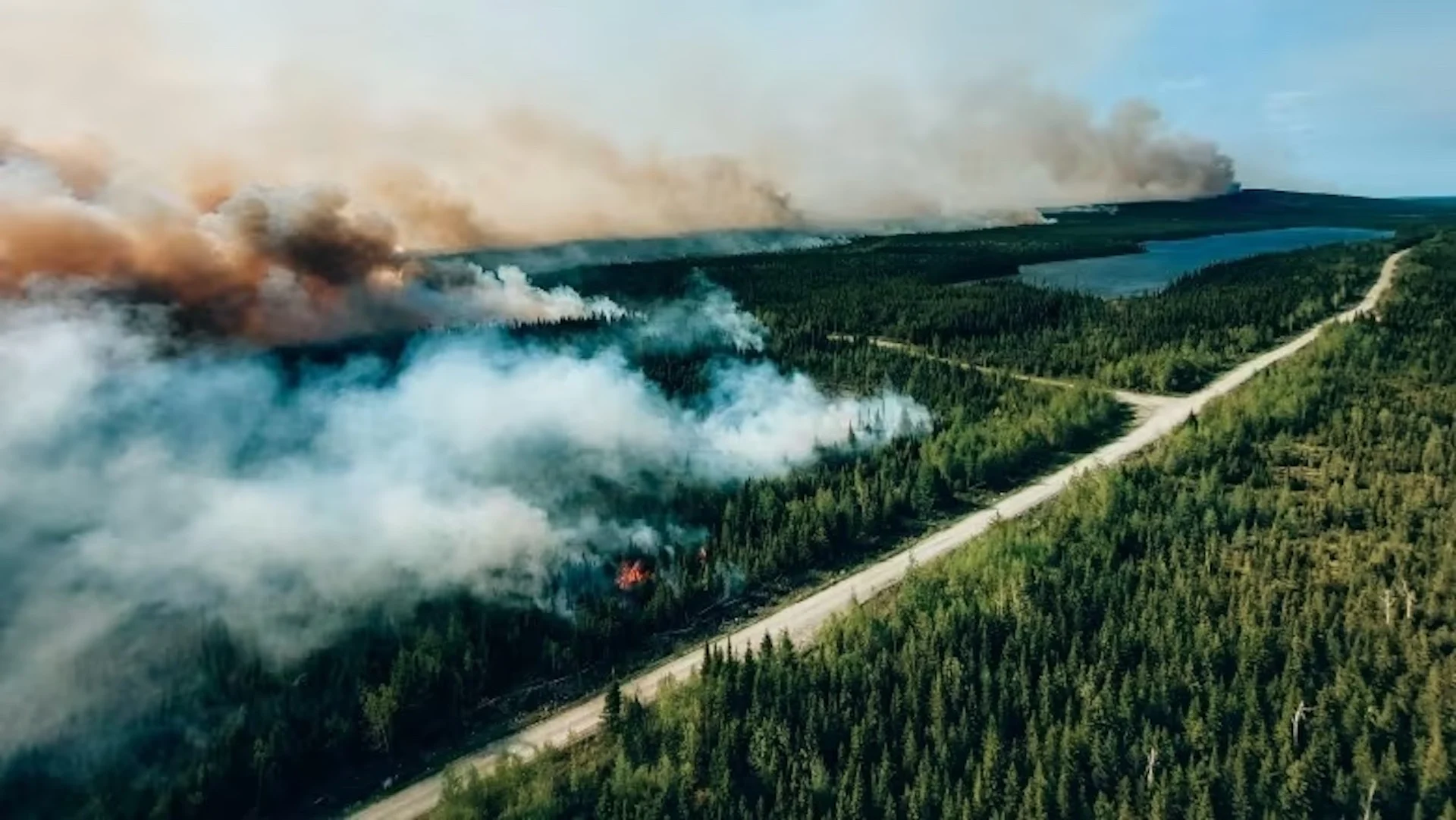
Wildfire smoke will drift toward Montreal, Laurentians late Thursday: Minister

Visit The Weather Network's wildfire hub to keep up with the latest on the active start to wildfire season across Canada.
A large plume of smoke from Quebec wildfires is expected to drift toward southern Quebec over the next 24 hours, Public Security Minister François Bonnardel said Wednesday.
The smoke has a high concentration of fine inhalable particulate matter and can be hazardous to people's health. Right now, Bonnardel said, it is covering parts of northern Quebec, the Eeyou Istchee Cree territory and the Abitibi-Témiscamingue region.
He expects it to be over Montreal, the Laurentians and the Lanaudière region by late Thursday.
"Keep your windows closed, if possible," the minister said. "If it's possible, try to do less physical activity outside."
"It won't be as bad as what we had five or six days ago, but it could be a problem for people with respiratory issues."
RELATED: Out of control, held, out — What the stages of wildfire mean
Bonnardel also said more firefighters from abroad are on their way to help battle Canada's worst wildfire season of the 21st century.
There are currently about 1,200 firefighters on the ground across the province, according to the province's fire prevention agency, the Société de protection des forêts contre le feu (SOPFEU). By Friday, that number should go up to 1,500, said SOPFEU official Sylvain Tremblay.
Quebec's public safety minister says more reinforcements are coming, with 100 firefighters on their way from Portugal and another 140 from Spain.
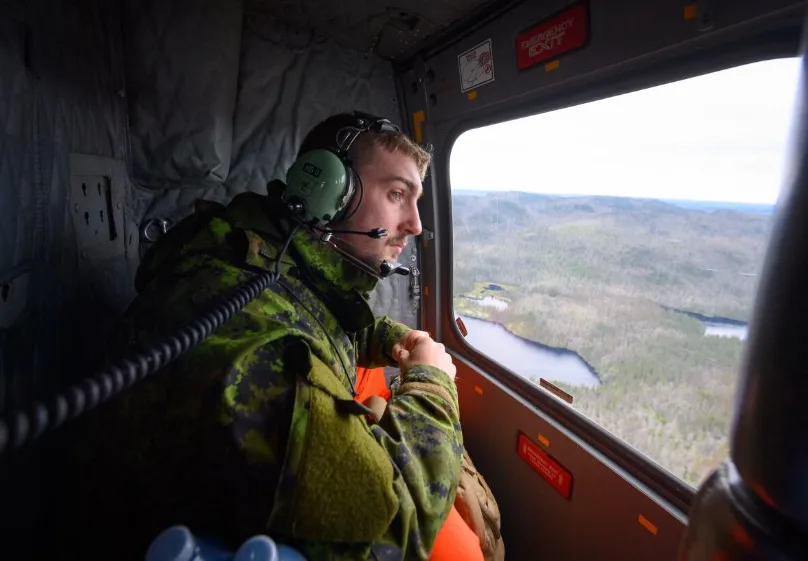
Personnel from the Royal Canadian Air Force are helping battle the fires on the North Shore of Quebec. The prime minister says military personnel will get more training for 'inevitable climate emergencies.' (Royal Canadian Air Force)
Because of wildfires in Western Canada, other provinces have been struggling to support Quebec, though 72 firefighters from New Brunswick are on the ground with 282 Canadian Armed Forces members.
Reinforcements will be targeting Lebel-sur-Quévillon, which is still a fire hotspot with thousands of hectares of land having already burned, and the Val d'Or area, said Tremblay.
"We're in a dynamic situation that can always change," he said.
Hoping for rain
Since early June, Quebec has seen over 300 fires and 111 were still burning Wednesday. Tremblay says about 35 of them are out of control, and SOPFEU is hoping to keep those from igniting new fires.
"The situation is still fragile," Tremblay told journalists Wednesday.
"Some fires that were contained went back out of control and we've contained other fires, and lightning could light new fires."
Storms across the country could bring much needed rain, but meteorologists say it's not enough to stop the wildfire threat. A rainy forecast in Quebec was bringing hope for progress in battling the fires, as more than 7,200 people remained out of their homes due to the fires.
Tremblay said each millimetre of rain offers firefighters a day of grace, but to really bring the wildfires under control, the most affected regions would need 20 millimetres over a few days. That isn't in the forecast, and the only region that saw significant downpour wasn't a fire hot zone.
"Unfortunately the rain we had yesterday and will have in the next days are disorganized and don't offer a uniform cover," said Tremblay.
"With the amount of fires and resources we've expended, we need rain, it's our No. 1 ally. But we don't think the rain will be enough for us to regain control."
WATCH: How animals cope with wildfires — in the days and years after the burn
Federal government's role
Prime Minister Justin Trudeau said Wednesday that it's more important than ever to give municipalities the tools they need to prepare for extreme weather events, and he pointed to the multi-billion dollar national adaptation strategy put in place last year.
"We have to be there, yes to help the communities, the displaced families, the people who were affected by crises. Then we must also invest in infrastructure in preparation for prevention, to minimize the impact that we know is likely to increase in the years to come," he said.
The federal government will work in tandem with provinces to offer disaster assistance programs, he said.
Trudeau also said the government will have to invest into more water bombers and disaster training for the military and the general population to better respond to "inevitable climate emergencies" over the next few years.
"We are currently working on resolving this crisis now," he said. "But it is certain that at the same time, we are thinking about the next steps and how we are going to ensure that for the years, the decades to come, we can properly protect citizens."
Emergency Preparedness Minister Bill Blair said in Ottawa Monday that this is "Canada's worst wildfire season of the 21st century."
WATCH: What you should know about the stages of a wildfire
Thumbnail courtesy of Geneviève Poirier/Société de protection des forêts contre le feu (SOPFEU) via CBC.
This article, written by Erika Morris, was originally published for CBC News. With files from The Canadian Press.