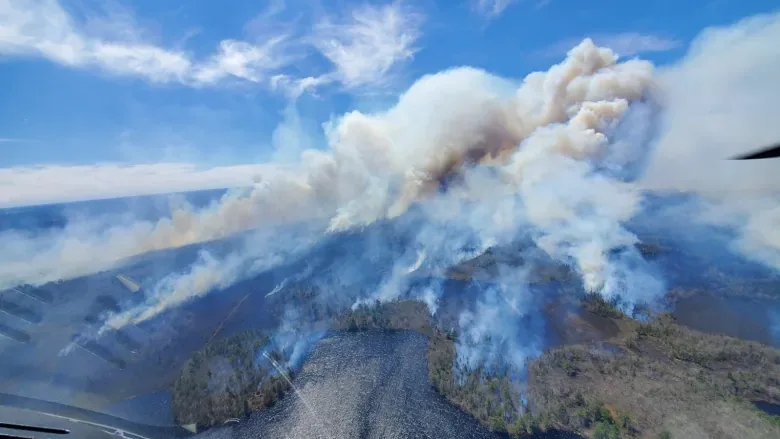
Out-of-control wildfire in Yarmouth County now covers 3,100 hectares

Two helicopters, a CL-415 water bomber from Newfoundland and Labrador, and 40 crew members continue to fight an out-of-control fire in Nova Scotia's Yarmouth County that has grown significantly since it began earlier this week.
The fire near South Horseshoe Lake in eastern Yarmouth County measured roughly 3,100 hectares in size on Wednesday afternoon, according to a provincial official.
That's compared to about 1,000 hectares on Tuesday night, and an estimate of 25 hectares early Tuesday morning.
"The numbers will most likely fluctuate until we knock the smoke down to get a better visual on the fire and can measure it accurately," Kara McCurdy, wildfire prevention officer for the Department of Natural Resources, said in an interview Wednesday with CBC Nova Scotia's Information Morning.
McCurdy said the fire, which began Monday afternoon, is still considered out of control.
The fire is "actively still moving but with the humidity last night, overnight and this morning, it's around 80 per cent, and the light winds, that's going to help decrease the fire spread," said McCurdy.
Satellite images shared on social media showed smoke from the wildfire drifting west across Yarmouth County and into the Gulf of Maine.
"The smoke certainly was an issue across the province and the smoke plume was moving into a lot of the communities down in Yarmouth County," said McCurdy. "I'm not sure today what the situation may be for that with the lighter winds,"
She said in the last two days, there were roughly 15 fires across the province which were the result of low humidity and high winds. However, they were put out fast.
Currently, there are burn restrictions in the counties of Queens, Shelburne and Yarmouth.
HUMAN-CAUSED
The department said Tuesday the fire is in a fairly remote area and at that point there was no risk to homes or businesses.
McCurdy said the province is still investigating the fire but it is confident it was caused by humans since there has been no lightning in the remote area in the past week.
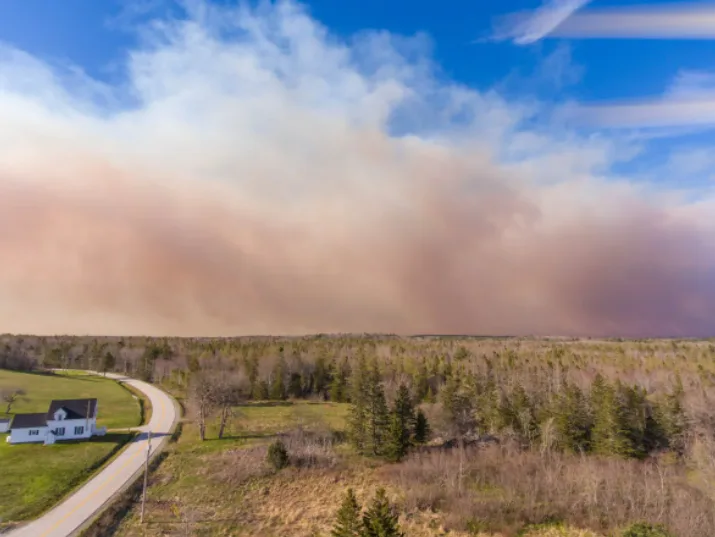
DNR said Tuesday the fire is in a fairly remote area and there as no risk to homes or businesses at this time. (Tim Doucette/Facebook)
"The only access to the area is by all-terrain vehicles. So it would have to be somebody either going out fishing or on an all-terrain vehicle and in the area," she said.
"It could have been somebody stopped for lunch and had a campfire, smoking along the riverbank, or it could have even been accumulation of debris on an exhaust on an all-terrain vehicle."
FIREFIGHTER SAFETY
She said crews were pulled from the line for safety reasons as the CL-415 water bomber helped with firefighting efforts Tuesday.
McCurdy said firefighting gets called off at night because of the increased risks for firefighters and limits on the support available.
"In these circumstances, the crews will often start work at first light and then work till dusk, and then DNR and the fire departments will monitor the active fire overnight and work to protect structures," said McCurdy.
She said the area is mostly peat bog and black spruce, which makes it difficult to walk through.
"It's almost like walking in deep snow, you know it was like walking on pillows. So it can be hard to walk through and get equipment to it and with this limited access, they're having to carry equipment or get it moved in by aircraft," said McCurdy.
WEATHER CONDITIONS
CBC meteorologist Ryan Snoddon said Wednesday's easterly winds are lighter than Tuesday's, and are set to continue to ease through the evening.
"A marine air mass moved in overnight and will remain in place into this evening. The higher relative humidity should help at least somewhat to slow the spread of the fire today," he said.
While there is still a chance of drizzle into Wednesday evening, Snoddon said it's not significant enough to have any real impact on the fire. As the sunshine returns on Thursday, the relative humidity will drop into the 35-45 per cent range in the afternoon.
"As the sun rises, northwest winds in the 10-20 km/h range are on the way for Thursday," Snoddon said. "Those winds will push smoke from the fire towards Shelburne and Queens counties."
This article, written by Anam Khan, was originally published by CBC News on May 11, 2022.