When is the coldest stretch of the year in your corner of Canada?

The heart of winter arrives at different times for different cities across the country
Cold weather is a way of life across Canada. Winter hits hard for most communities across the country, with conditions falling below the freezing mark for months at a time.
We’re always on the lookout for an upside during the heart of the season. When exactly do we reach the coldest point of the year? After all, it’s the point at which (historically speaking) temperatures begin their slow rebound toward warmer readings.
DON’T MISS: What’s the snowiest month in your corner of Canada?
Winter is a long-term guest across Canada
Winter is never far away when you’re in Canada. The northern reaches of the country can endure snow as early as August and well into the month of May.
Conditions in most areas get chilly in September and October, with bursts of solid cold and snow arriving in earnest through November. We’re in the thick of things come December, when snow really starts to pile up from coast to coast.
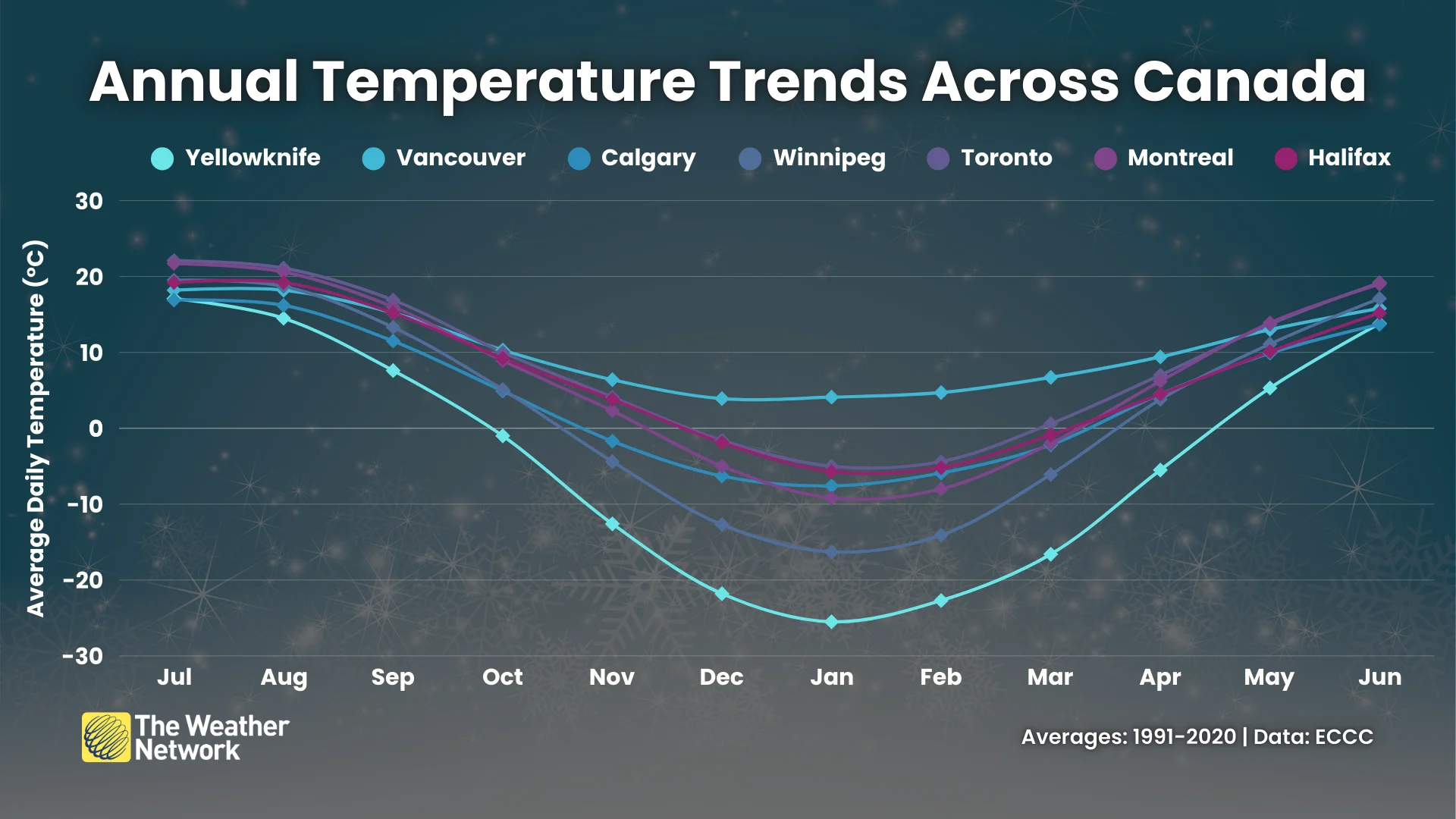
January is the true heart of winter for most of the country.
Based on climatological normals between 1991 and 2020, the coldest stretch of the year typically falls between the second and third week of January for just about every major Canadian city.
Calgary’s coldest days are traditionally between Jan. 9 and Jan. 16. On average, conditions bottom-out in Winnipeg between Jan. 10 and Jan. 16. Vancouver is the outlier among western cities, usually experiencing the season’s coldest temperatures between Christmas Day and Jan. 5.

The season’s coldest air arrives a little later down south, with Toronto registering its lowest daily average temperatures between Jan. 20 and Jan. 28. Give or take a few days, it’s a similar story up the road in Ottawa, Montreal, and Quebec City.
Cold air takes a little longer to filter toward the East Coast, where Charlottetown and Halifax see their coldest periods of the year during the end of January into the opening days of February. Folks in St. John’s usually see the bottom of their temperature curve during the second week of February.
Weather doesn’t always follow history
Even though history tells us the coldest stretch of the year occurs between late January and early February, that’s not always the case every year.

The coldest day recorded in the City of Toronto saw a low temperature of -32.8°C on Jan. 10, 1859. Calgary Airport’s all-time low temperature was a frigid -36.1°C reading on Feb. 15, 1943.
Along the East Coast, the airport in Halifax saw its coldest-ever reading on Dec. 31, 1993, when the temperature plunged down to -28.5°C.