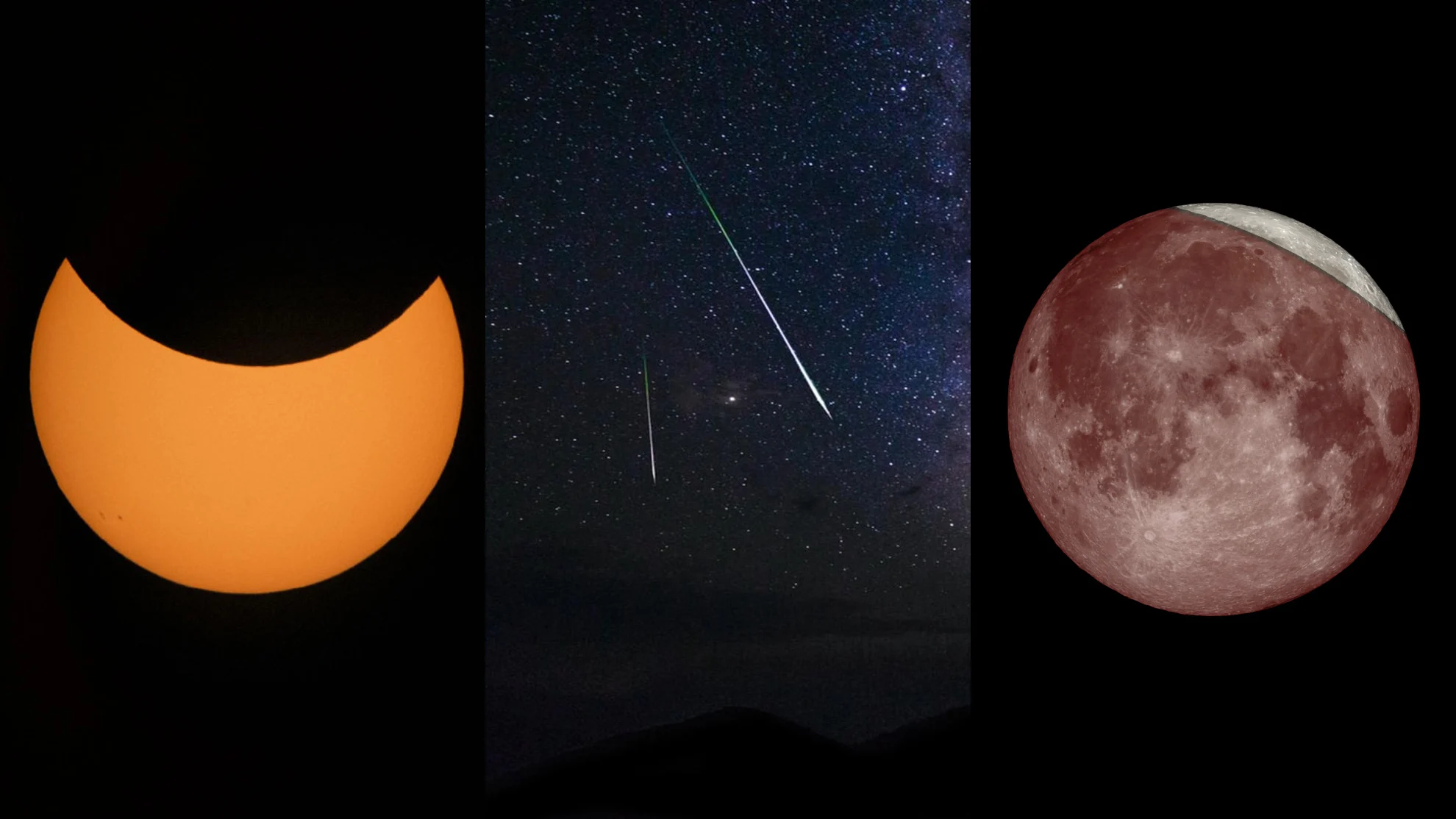
Two eclipses and a meteor shower are the 'don't miss' sky events for Summer 2026

Fingers crossed for clear skies in August, as the season's major astronomical events all seem to be clustered in that single month!
A partial solar eclipse across Canada sets us up for what could be the best Perseid meteor shower in years, to be followed up by another close planetary conjunction in the predawn sky, and a spectacular lunar eclipse at the end of August.
Summer has the shortest nights of the year, but that shouldn't stop us from getting out to see the night sky. In fact, there are some amazing things to see, day and night, throughout the season.
Here are the major astronomical events for Summer 2026:
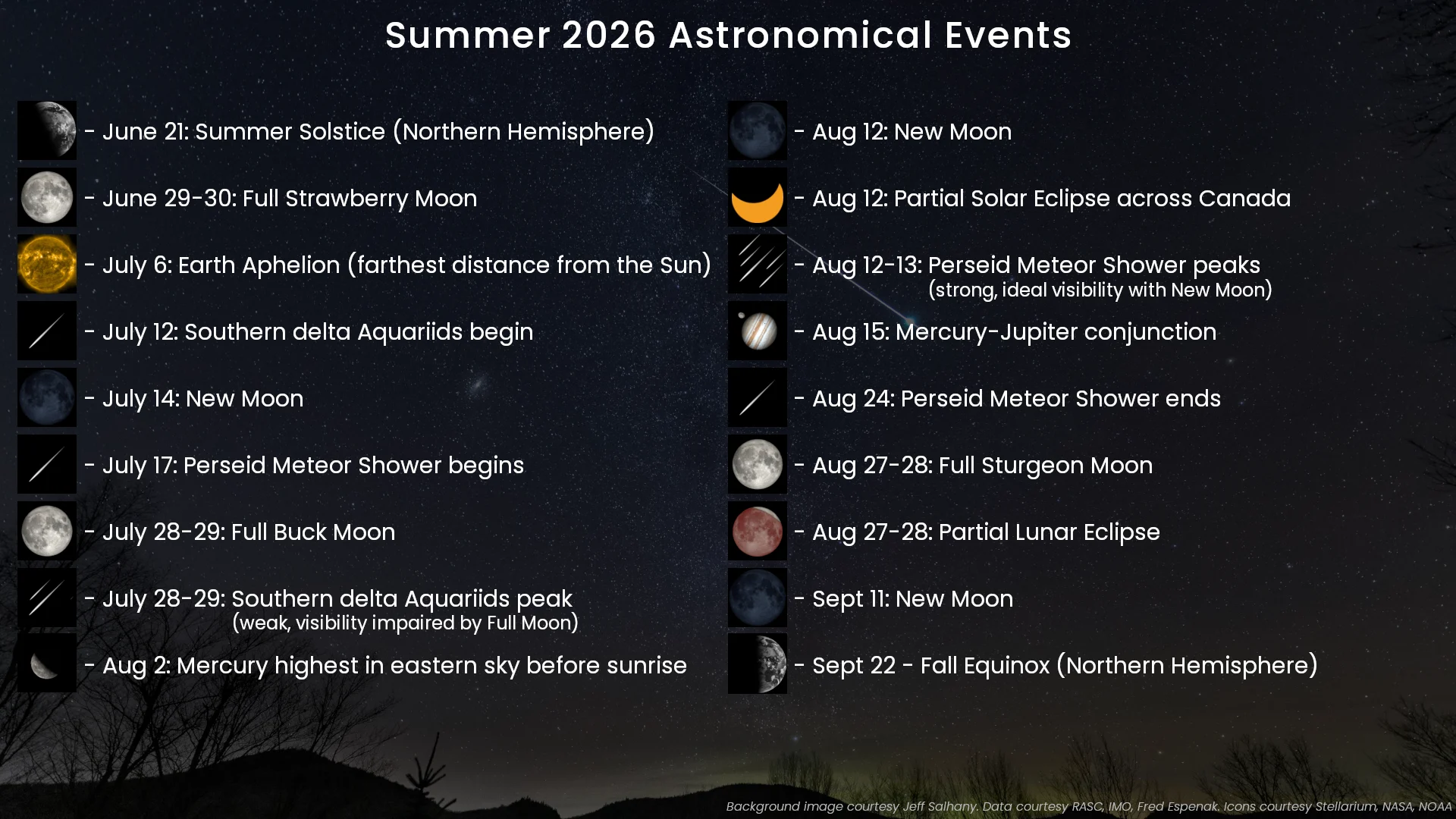
Visit our Complete Guide to Summer 2026 for an in-depth look at the Spring Seasonal Forecast, tips to plan for it, and much more!
Summer Solstice
On June 21, at 8:25 UTC (4:25 a.m. EDT), the Sun will reach its highest point in the sky in the northern hemisphere for this year.
This 'pause' in the position of the Sun in the sky will mark the start of northern Astronomical Summer for 2026.
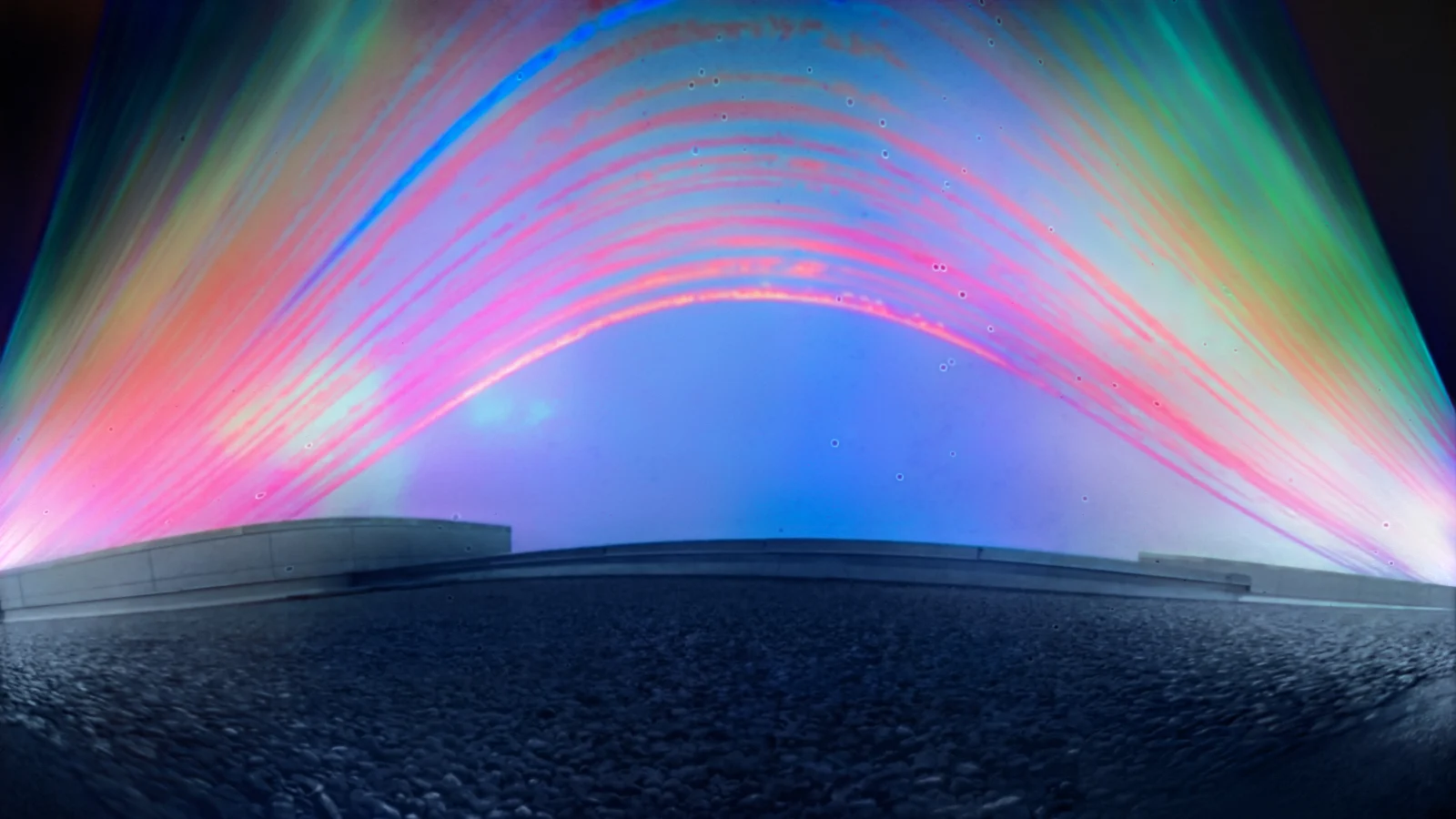
This solargraph image records the path of the Sun across the sky each day from summer solstice to winter solstice in 2023, interrupted only by cloudy skies. (Bret Culp)
Read More: Solargraphy: The art, science, and chaos of capturing the Sun's path in the sky
Most years, the Summer Solstice is the single longest day of the year, at least with respect to how much daylight we see.
According to timeanddate.com, though, if you track sunrise and sunset down to the second, your longest day of the year for 2026 will depend on exactly where you live.
Across Canada, from coast to coast to coast, June 21 is decisively the longest day of the year. However, scattered communities within each time zone have not one longest day, but two, and something unusual occurs in the far northwest.
In Atlantic Canada, Sydney, N.S., and Moncton, N.B., for example, both have their longest days on June 20 AND June 21. Same goes for Granby and Montreal, in Quebec, as well as Ottawa, Peterborough, Hamilton, Kitchener, Guelph, London, North Bay, Sault Ste Marie, and Thunder Bay in Ontario.
In the western half of the country, Gimli and Flin Flon, Man., have their longest days on both the 20th and 21st, despite communities to the north and south having it only on the 21st. Also, while Regina, Saskatoon, and Edmonton have their longest day on the 21st, Calgary has it on the 20th and 21st, along with most of British Columbia.
Strangely, some communities throughout northern B.C., as well as Whitehorse and Dawson City, Yukon, actually have June 20 as their longest day!
The Planets
The planets put on a couple of excellent shows throughout spring, especially in June, with the Venus-Jupiter Conjunction, and the lineup the pair settled into with Mercury.
To start off the summer season, Venus, Jupiter, and Mercury will still be visible in the evenings, alongside the bright stars Pollux and Castor of the constellation Gemini. In the morning, both Mars and Saturn will be in the eastern sky in the hours before sunrise.
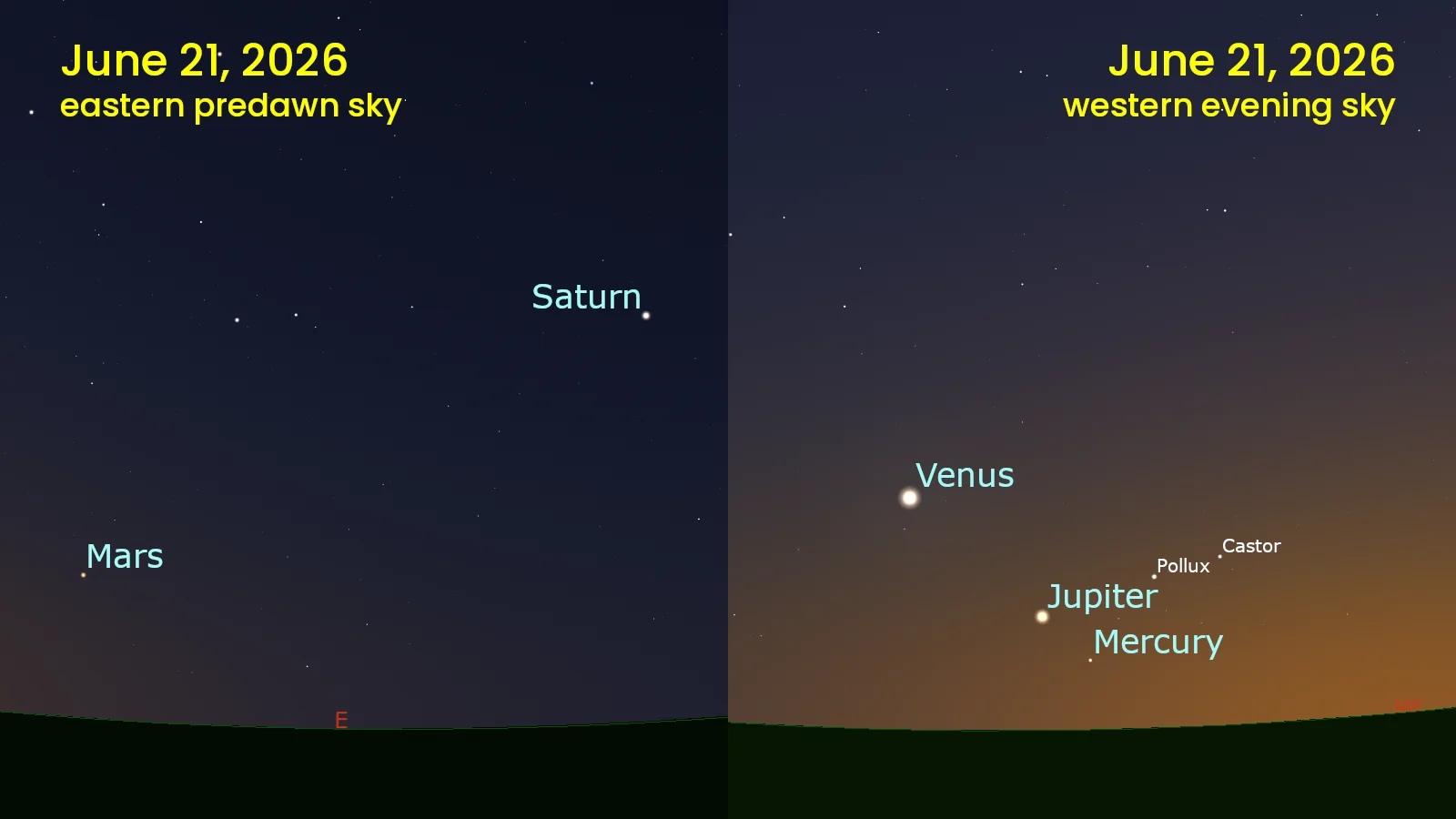
Mars and Saturn rise in the morning, before sunrise. Venus, Jupiter, and Mercury are still visible in the evening sky after sunset. (Stellarium/Scott Sutherland)
Throughout the season, Mercury and Jupiter will get closer to the horizon each night, and will eventually be lost in evening twilight, while Venus will track towards the southwestern sky. Meanwhile, each morning, Mars and Saturn will rise earlier and earlier, and thus climb higher into the sky by the time the Sun crests the horizon.
Although Jupiter and Mercury will be gone from our dark skies for some time, they will eventually return, appearing in the predawn sky. Read on for details on their mid-August close conjunction!
The Moon
Three Full Moons will shine in our skies during the summer of 2026.
Throughout the first half of the year, nearly all the Full Moons were at the beginning of the month.
However, due to the May 30 Blue Moon, that dynamic has now shifted. As a result, the rest of this year's Full Moons are at the end of their respective months.
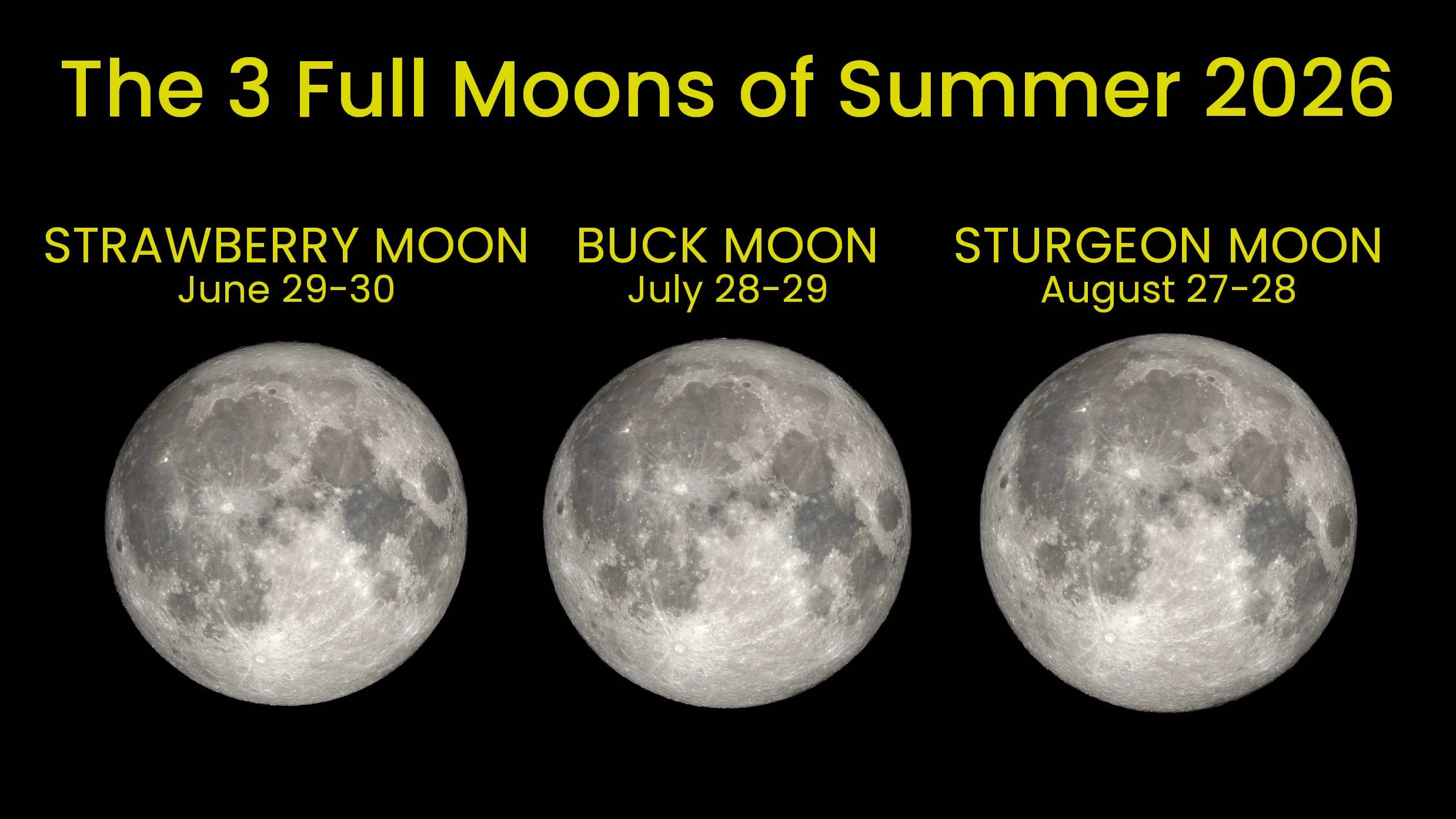
The Three Full Moons of Summer for 2026. (NASA's Scientific Visualization Studio/Scott Sutherland)
Touching Tribute: Artemis 2 crew names lunar crater after mission commander's late wife
So, look for the Full Strawberry Moon on June 29-30, the Full Buck Moon on July 28-29, and the Full Sturgeon Moon on August 27-28.
The timing of the Full Moons during the season also sets up some excellent astronomical events for the month of August.
Earth at Aphelion
As Earth travels around the Sun, it does not trace out a perfect circle. It's close. However, our planet's orbit is slightly elliptical. That means we don't orbit around the exact centre of the Sun, but instead a point inside the Sun that is slightly offset from centre.
As a result, each year, in early January, we reach our closest distance to the Sun, known as perihelion. Then, in early July, we swing through our farthest distance from the Sun, which is called aphelion.
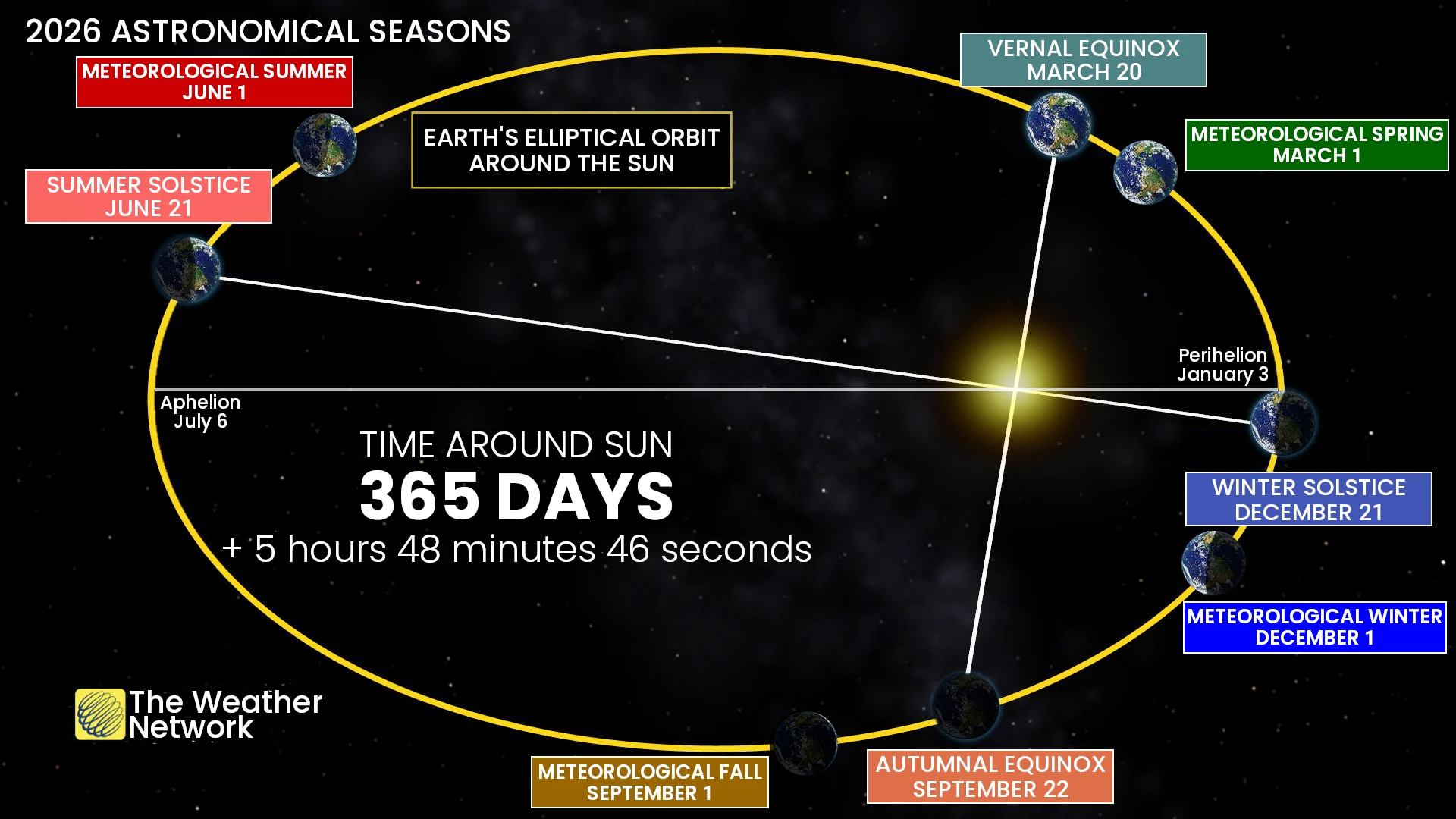
Earth's elliptical orbit is highly exaggerated in this diagram, for emphasis.
Due to the influence of the Moon's gravity (mainly), the exact day and time of perihelion and aphelion changes from year to year. However, perihelion always happens sometime between the 2nd and 5th of January 2, and aphelion occurs between the 3rd and 7th of July.
Earth's distance from the Sun at those two points also varies from year to year. Perihelion distance ranges between 147,083,346 km (closest closest) and 147,112,452 km (farthest closest), while aphelion distance is between 152,083,061 km (closest farthest) and 152,112,126 km (farthest farthest).
For 2026, aphelion occurs on July 6, at 1:31 p.m. EDT, and we will be roughly 152,087,777 km away from the Sun at that time.
Solar Eclipse!
During the day on August 12, the Sun, the New Moon, and Earth will line up perfectly to produce a total solar eclipse, where the Moon will completely block the Sun for up to 2 minutes and 18 seconds.
Unlike the April 2024 solar eclipse, the path of totality for this event does not pass over any part of Canada. Instead, it tracks from the Arctic down through Greenland, Iceland, the Atlantic Ocean, Portugal, and Spain, before ending in the Mediterranean Sea.
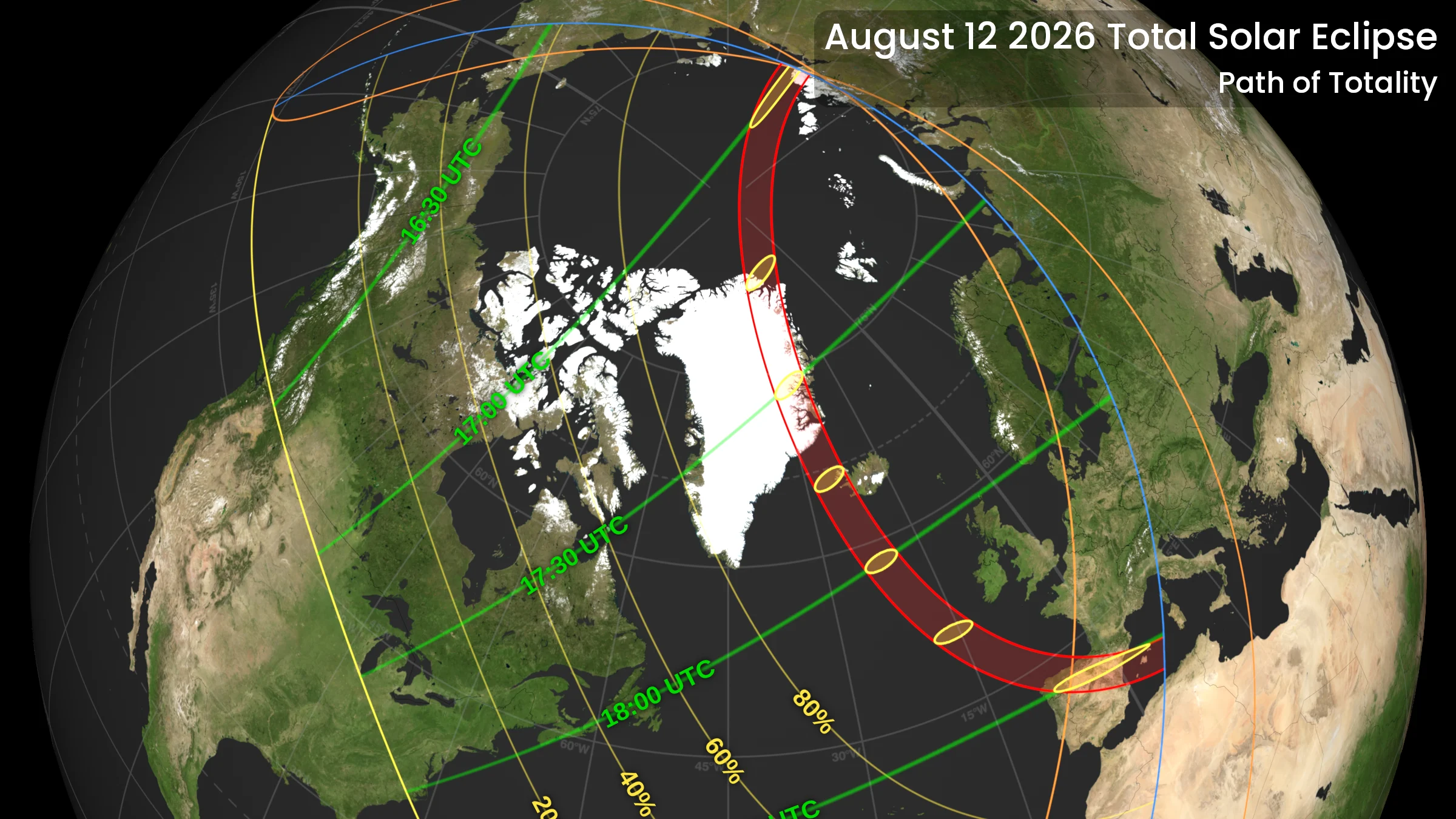
The red "path of totality" of the August 12 solar eclipse stretches from the northern shore of Siberia to the Mediterranean Sea. The green and yellow lines represent partial solar eclipse visibility. (NASA)
Mark your calendar: The Moon 'takes a bite' out of the Sun this summer
However, most of Canada will see a partial solar eclipse throughout the day.
The magnitude of the partial eclipse — the amount of the Sun covered by the Moon — is greatest the farther north and east the observer is. Thus, provided there are clear skies that day, locations on Ellesmere Island and Baffin Island, coastal regions of Labrador, and along the northern and eastern shores of the island of Newfoundland will likely provide the best viewing of this astronomical alignment.
The farther west and south the observer is from there, the smaller the magnitude of the partial eclipse.
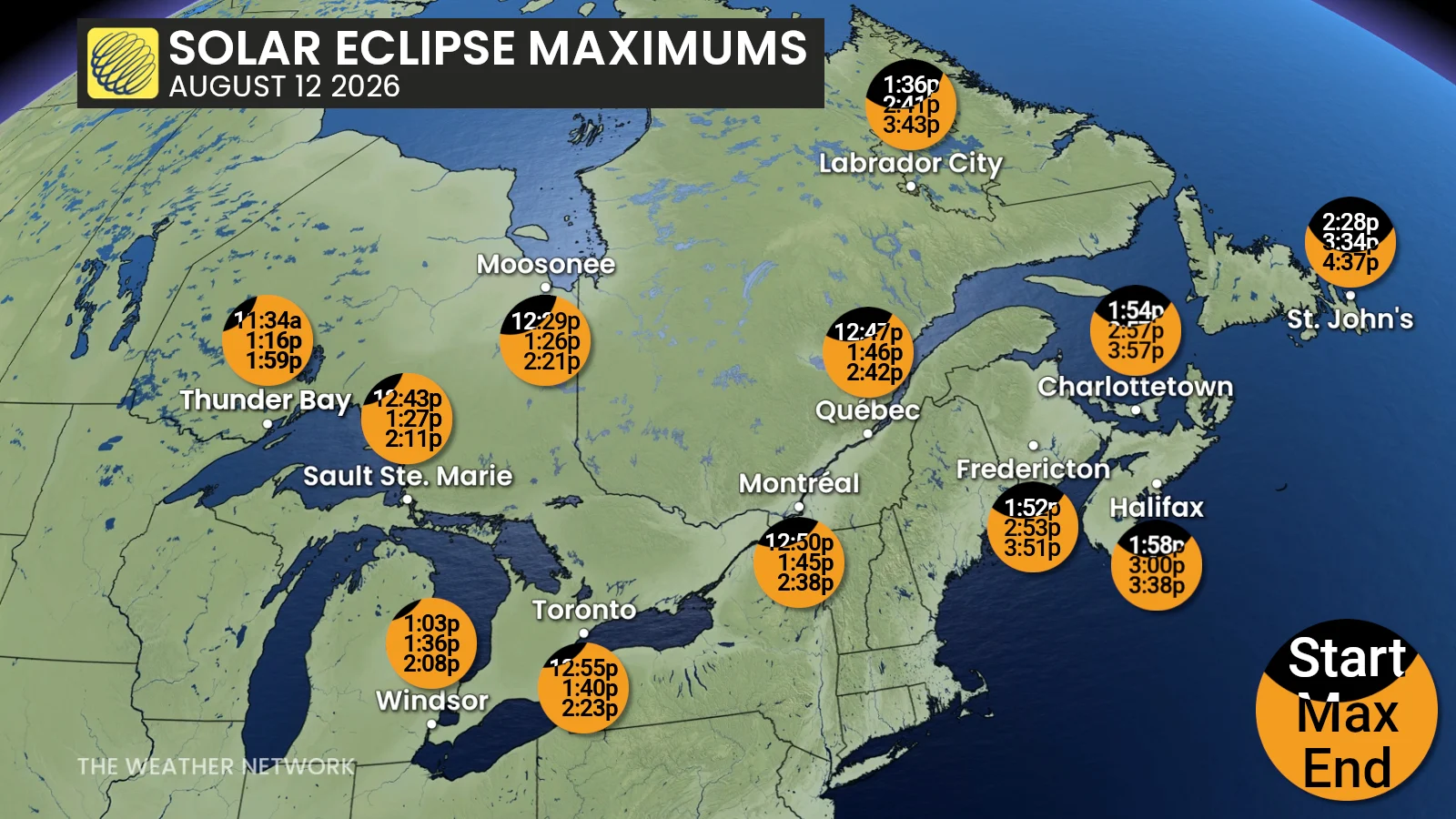
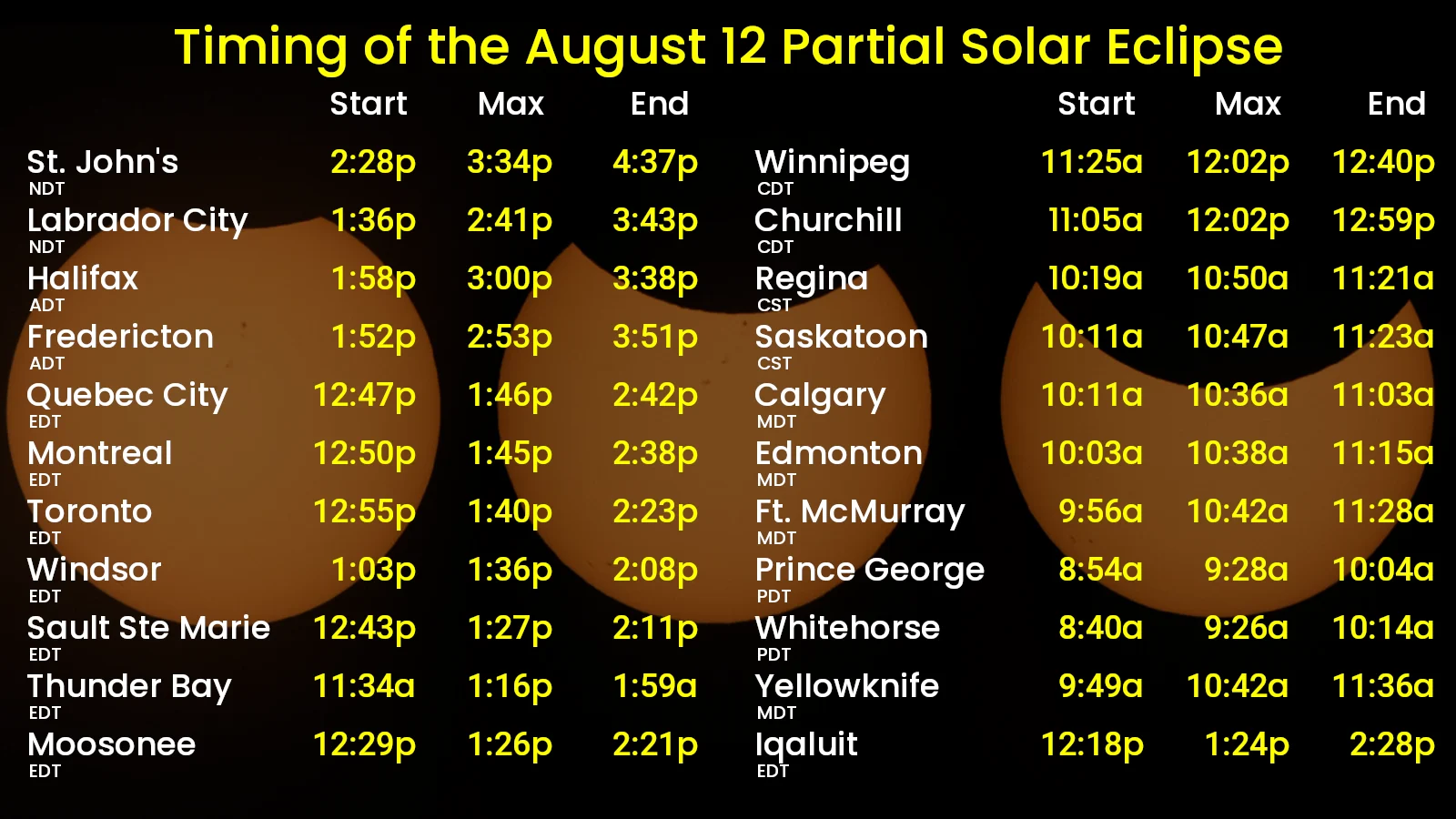
The timing and maximum partial eclipse for locations across eastern Canada. All listed times are local to that location's time zone.
For Atlantic Canada, the eclipse will start in the early afternoon, peak mid-afternoon, and end late afternoon.
Farther west, the timing shifts earlier due to the change in time zone, but also based on the specific location and its distance from the path of totality.
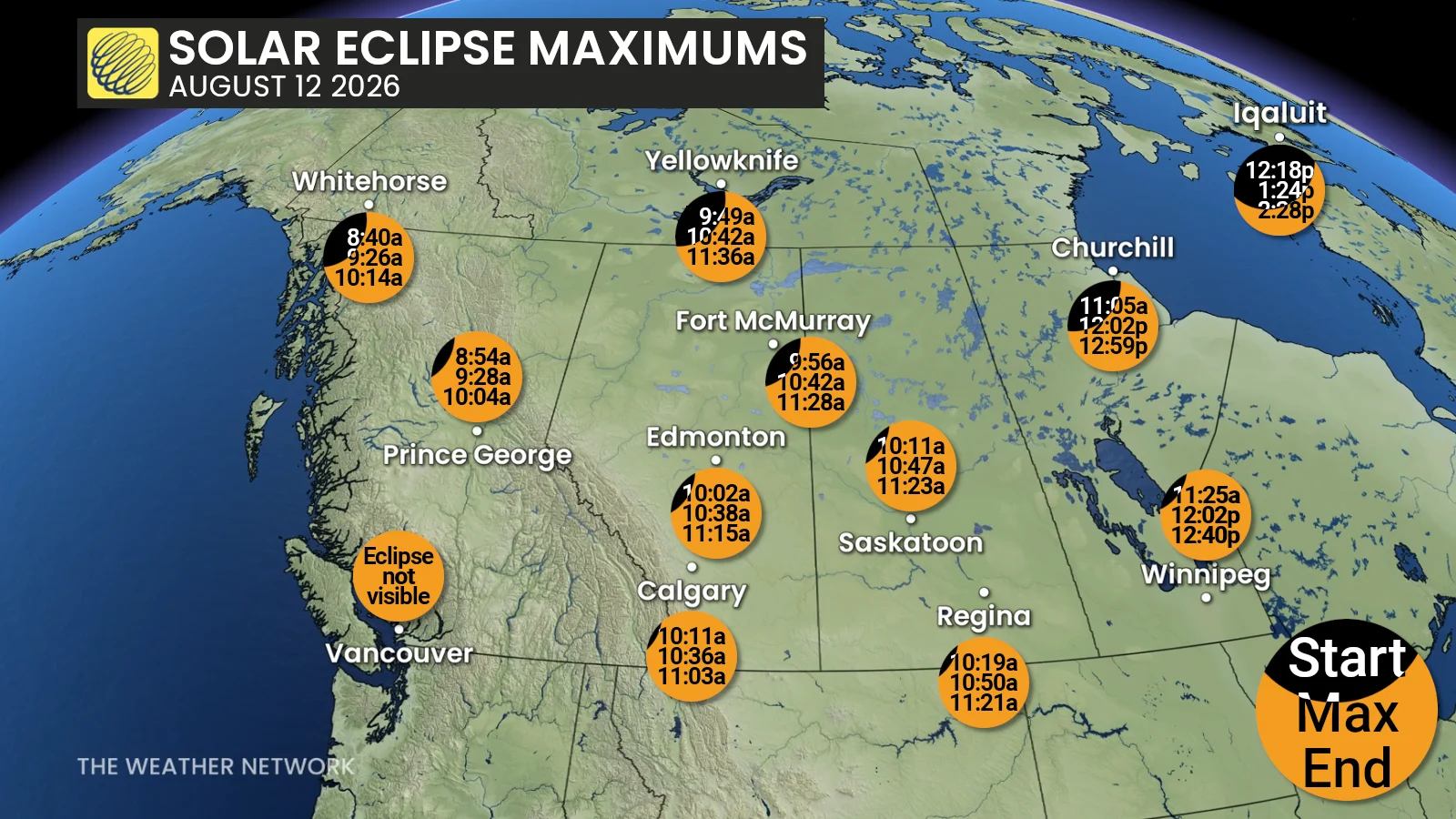
The timing and maximum partial eclipse for locations across western Canada. All listed times are local to that location's time zone.
Even so, for locations where only a sliver of the Moon will pass over the very edge of the Sun, the partial eclipse can still last for over an hour.
(Background image courtesy NASA/Noah Moran)
As there is no safe time to view this eclipse from across Canada without eye protection, be sure to use your eclipse viewing glasses to watch this event.
Perseid Meteor Shower
With the New Moon passing in front of the Sun during the day on August 12, we are expected to have perfect conditions for another event that very same night — the Perseid meteor shower.
Meteor showers occur when Earth passes through streams of debris in space, left behind by comets or asteroids. The bits of ice, dust, and pebbles in these streams (collectively known as meteoroids) plunge into the planet's atmosphere at high speed, each compressing the air in its path to the point where that air glows, white hot. This shows up as streaks of light in the sky, which we call meteors.
Every year, from mid-July through late August, we cross the debris stream of a comet named 109P/Swift-Tuttle, which is the source of the Perseid meteor shower.
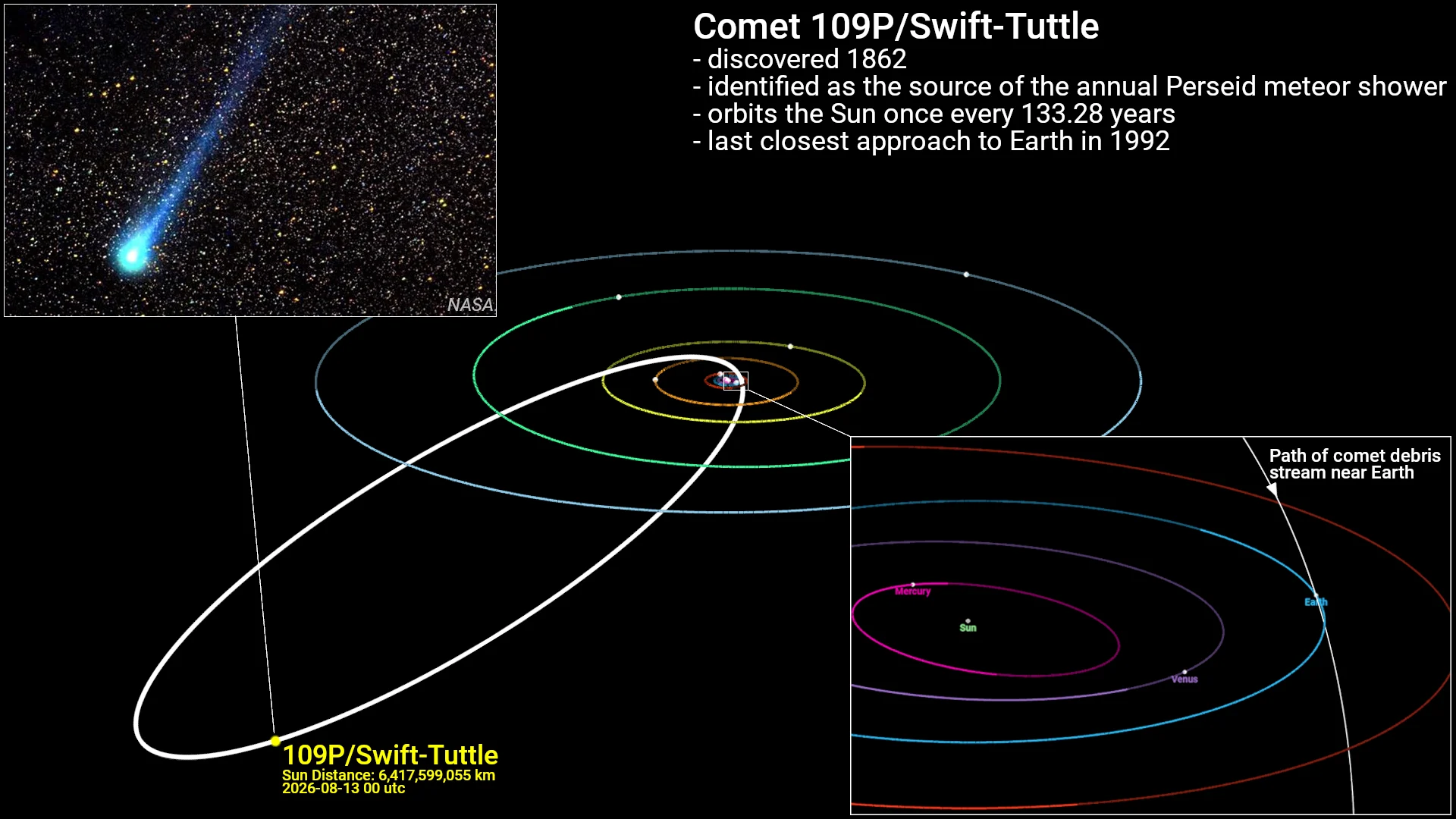
Comet Swift-Tuttle's orbit, an image of it from NASA (top left), and the path of its debris stream past Earth each August (bottom right). (NASA, NASA/JPL-Caltech, Scott Sutherland)
Of the dozen or so significant meteor showers throughout the year, this is one of best, usually producing between 75-100 meteors every hour during the night of its peak.
Perseid meteors originate from near the constellation Perseus, which is where the meteor shower gets its name. However, the streaks of light can appear at any point in the sky overhead.
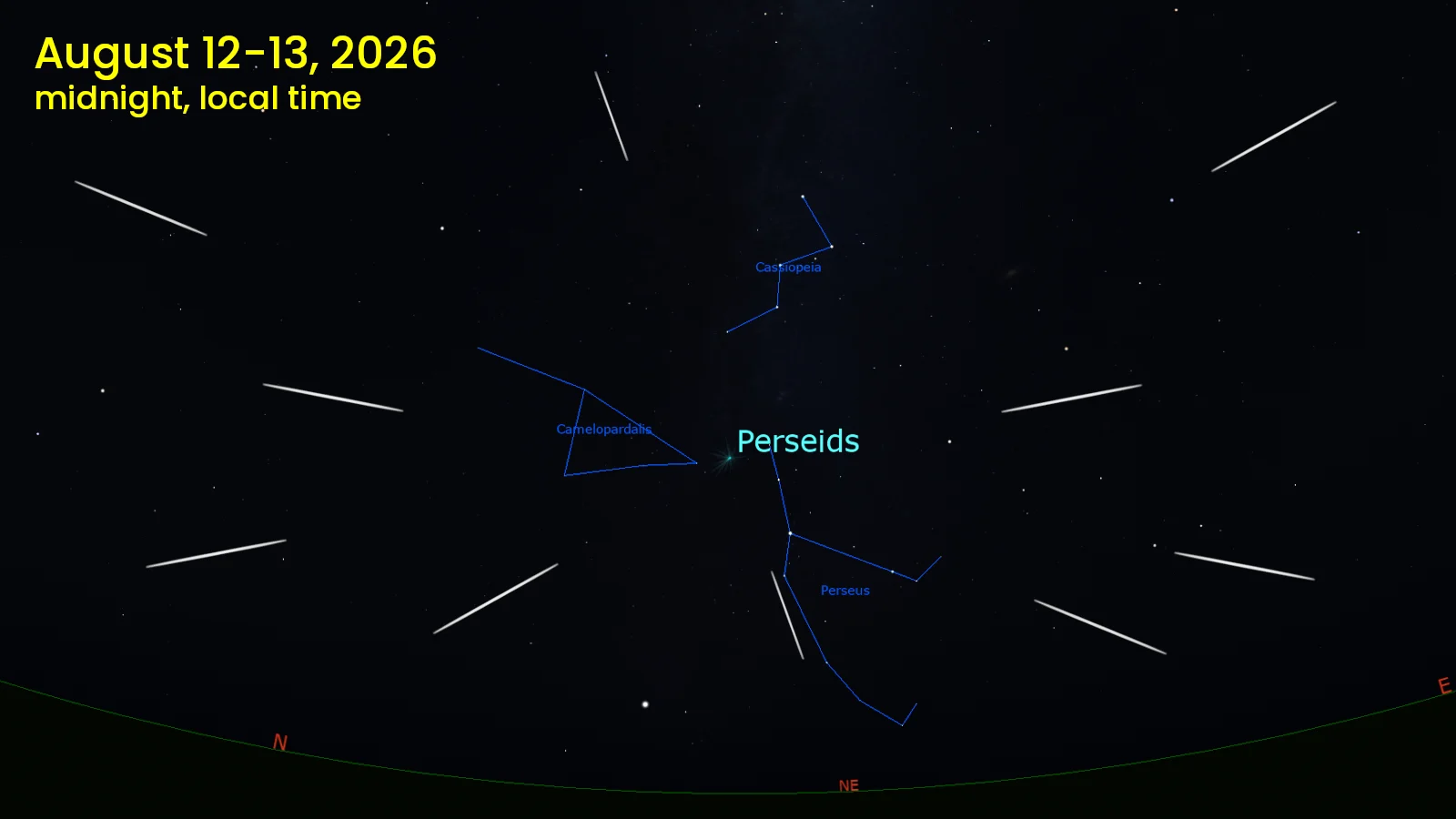
The radiant of the Perseid meteor shower (the spot in the night sky where the meteors appear to originate from) lies between the constellations of Perseus, Camelopardalis, and Cassiopeia, in the northeast sky. (Stellarium)
The Perseids also produce the greatest number of exceptionally bright meteors, known as fireballs. The visibility of normal meteors varies, and spotting them is highly dependent on local light pollution. Fireballs, on the other hand, can be easily seen even from the densest urban centres, and are often witnessed by people hundreds of kilometres away. Some can even light up the night sky as if it was daytime for a brief moment.
The radiant of the Perseid meteor shower can be found in the northeastern sky after sunset. It then climbs higher throughout the night. Thus, meteors can be spotted as soon as it becomes dark enough to see them, and the shower tends to be best in the hours before morning twilight, when the radiant is highest in the sky.
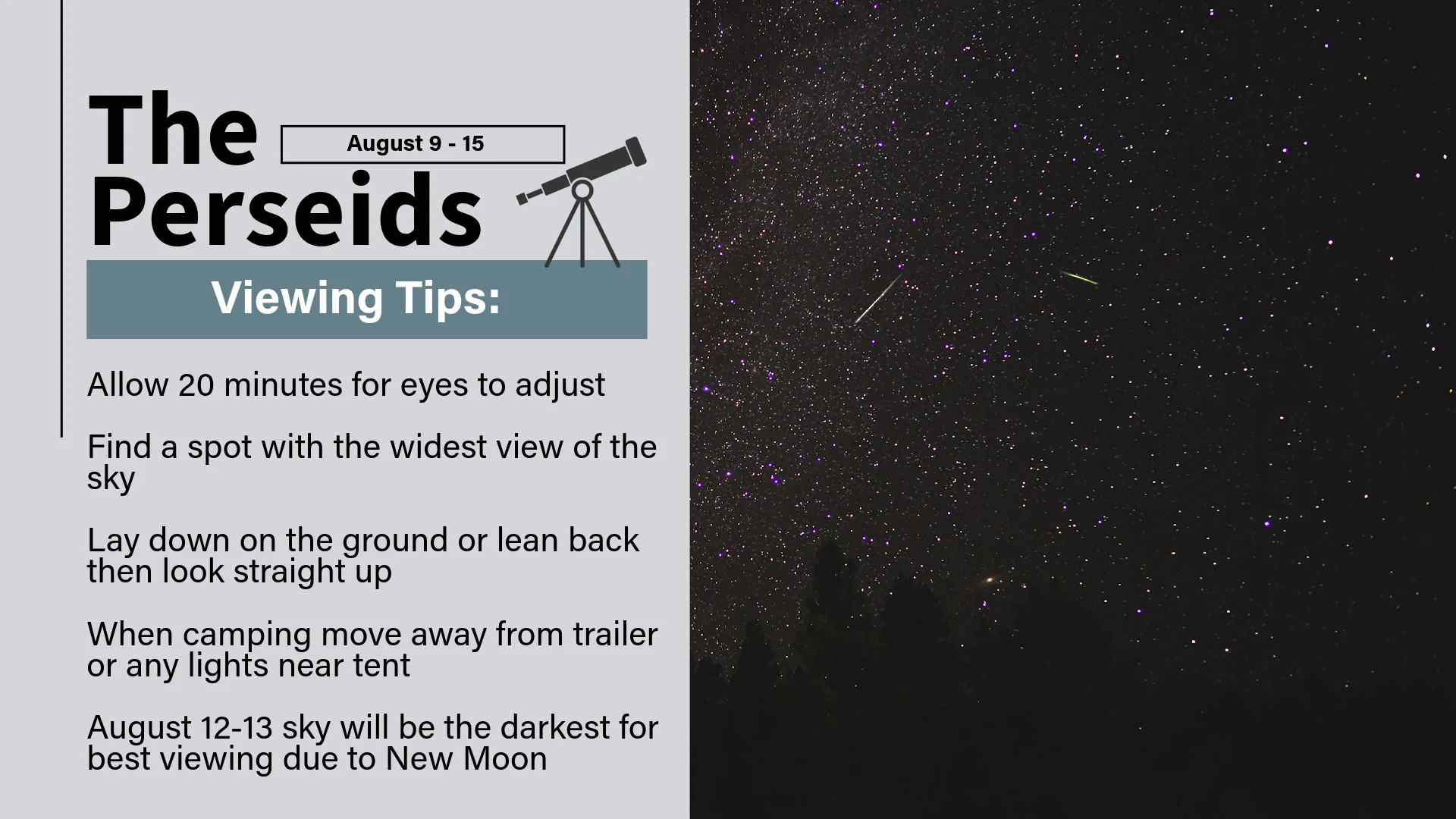
Read More: How to get the most out of meteor showers, auroras, and other night sky events
The meteor shower begins on or around July 17. For roughly three weeks after, the number of meteors ramps from a few every night, up to a few per hour during the first week of August. Then, around August 9, the numbers increase more dramatically, reaching up to 100 or more per hour by the night of the meteor shower's peak on August 12-13.
Afterwards, the numbers ramp down again, to about half the peak rate on the night of the 13th, and slowly tapering off on the nights following. The meteor shower then ends around August 24.
Normally, there would be some need to factor in the light from the Moon for the number of meteors we might see. However, with the New Moon occurring on the day of the peak, we will only need to consider cloud conditions and urban light pollution when picking a location from where to watch.
LEARN MORE: Why this year's Perseid meteor shower is a must-see event
Mercury-Jupiter Conjunction
By mid-August, Jupiter and Mercury will have swung around the Sun from us, and thus will have switched from setting the western evening sky to rising in the east, predawn.
On the morning of August 15, the two will be very close together, forming another planetary conjunction.
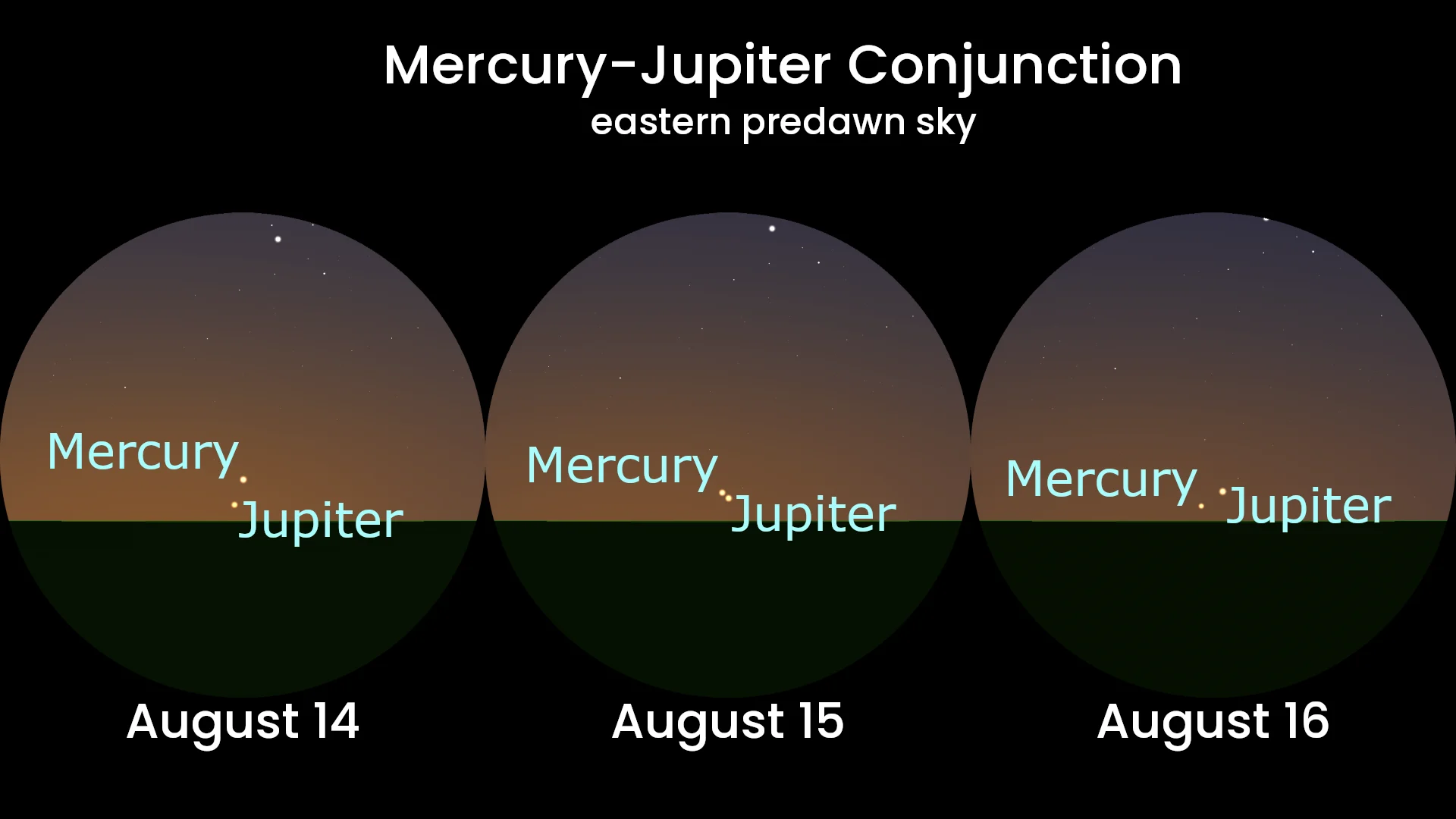
Mercury-Jupiter conjunction, as seen through binoculars or a telescope, in the eastern sky from August 14-16, 2026. (Stellarium/Scott Sutherland)
Don't Miss: The largest 3D map of the cosmos may alter the ultimate fate of the universe
This pairing will not be quite as easy to see as the Venus-Jupiter conjunction.
The time of day will require us to be early-risers for the event, as the two only crest the eastern horizon around 5:15 to 5:20 a.m., local time.
Plus, morning twilight will offer a challenge, as the two will vanish from sight as the dawn brightens, giving us only a short window for spotting them. Having access to a telescope or binoculars will make them easier to see.
Partial Lunar Eclipse
Roughly two weeks after the August 12 Partial Solar Eclipse, the Sun, Earth, and the Full Moon will again line up, this time causing the Moon to pass through Earth's shadow.
This will result in a Partial Lunar Eclipse.
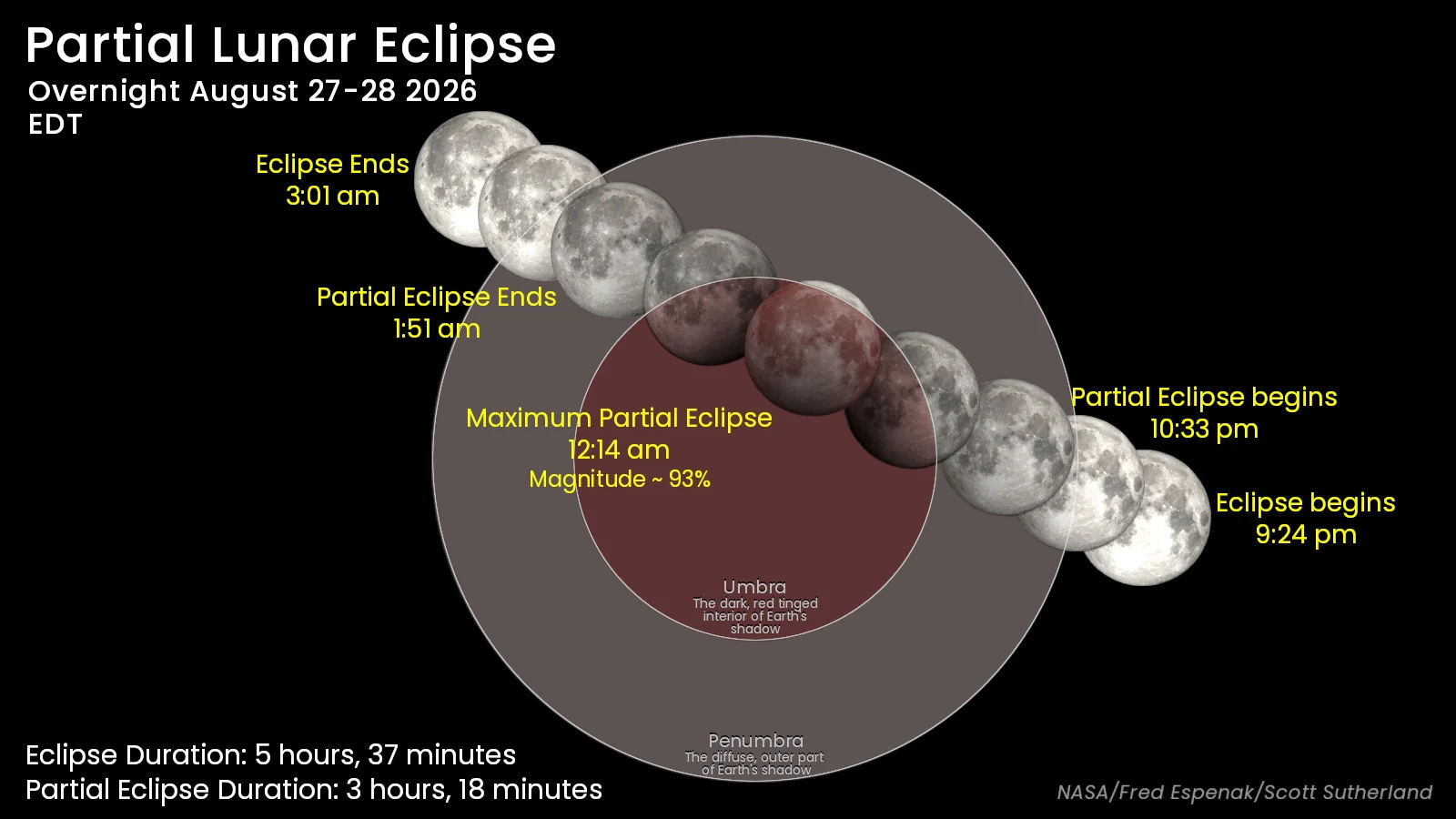
The details and timing of the Partial Lunar Eclipse, for the eastern timezone. (NASA's Scientific Visualization Studio/Fred Espenak/Scott Sutherland)
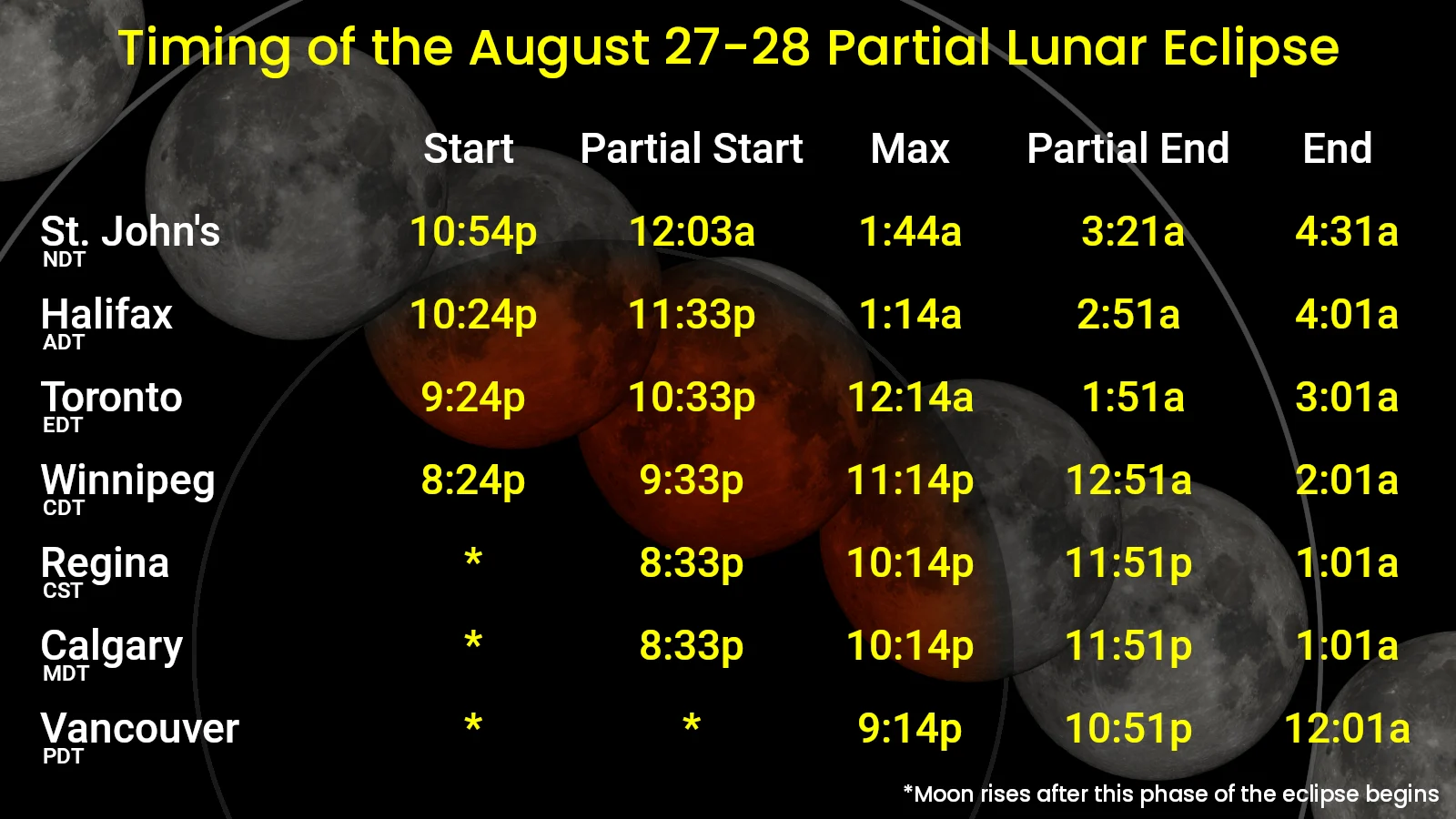
Similar to the Partial Solar Eclipse, this one focuses more on the eastern half of Canada, as the Moon rises after the eclipse has begun in the west.
For Saskatchewan and Alberta, the Moon will rise during the Penumbral portion of the eclipse. Farther west, the Moon will already have started its journey across the darker Umbra by the time it crests the horizon.
Copy, Moon Joy: Keep the Moon Joy alive with over 12,000 new photos from Artemis 2
Given reasonably clear skies, all of Canada will be able to see most of this eclipse, including the Maximum Partial Eclipse, where the Moon will be roughly 93 per cent immersed into Earth's dark umbra.
The Galactic Core
Summer is an excellent time of the year to spot the bright core of our home galaxy!
"This is the time of year when the Milky Way is visible as a faint band of hazy light arching across the sky all night," says NASA. "You just need to be under dark skies away from bright city lights to see it."
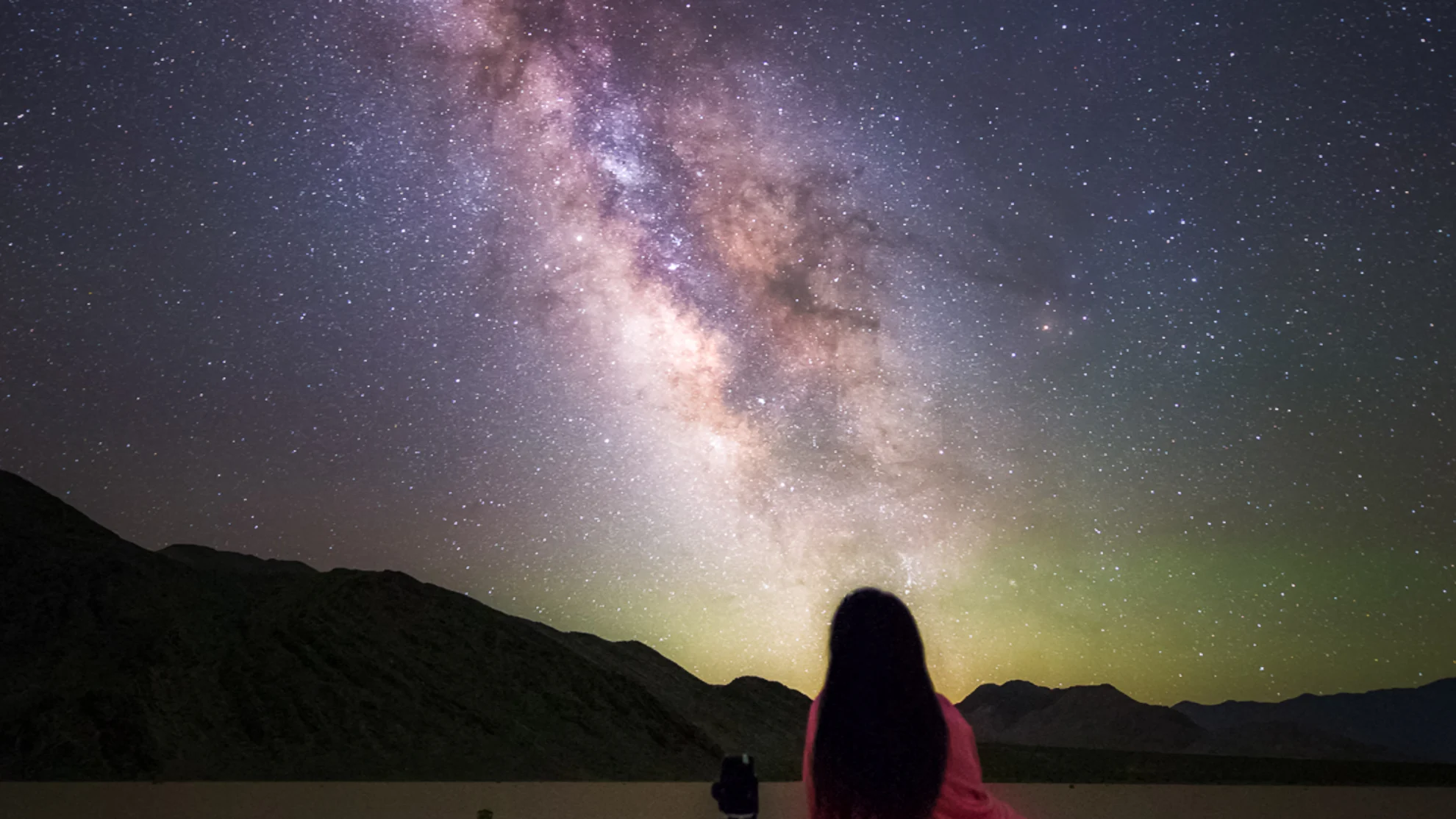
The central core of our Milky Way galaxy is a mixture of bright stars and dark bands of dust in this photo captured from one of the best dark-sky locations on Earth. (Kerry-Ann Lecky Hepburn, used with permission)
More From Space: NASA is now planning a permanent Moon Base at the lunar south pole
"What you're looking at is the bright central core of our home galaxy, seen edge-on, from our position within the galaxy's disk," NASA explained.
The galactic core is visible in our skies throughout much of summer. You don't need to travel to the Atacama Desert in northern Chile to experience it, though. A trip out of the city, to get out from under urban light pollution, and a bit of time to let your eyes adjust to the dark, might be all you need. Also, look up your local chapter of the Royal Astronomical Society of Canada (RASC), and check out any star parties they have on their calendar of events.
Fall Equinox
On September 23, at 00:05 UTC (8:05 p.m. EDT on the 22nd), the Sun crosses the celestial equator headed from north to south. This marks the fall equinox and the beginning of Astronomical Autumn for the northern hemisphere.
Fall is known as meteor shower season, and for good reason. Of the dozen major meteor showers we see each year, over half take place during this season. In fact, starting in early October, there's at least one meteor shower active each night until the season ends on the Winter Solstice!
(With files from The Weather Network)