Friday's Vernal Equinox ushers in astronomical spring for 2026

The Sun crosses the Celestial Equator this week, but what exactly does that mean?
This week, we finally see the end of Winter, as the Vernal Equinox arrives to kick off the new season of Spring for this year.
Friday, March 20, is the first day of spring for 2026!
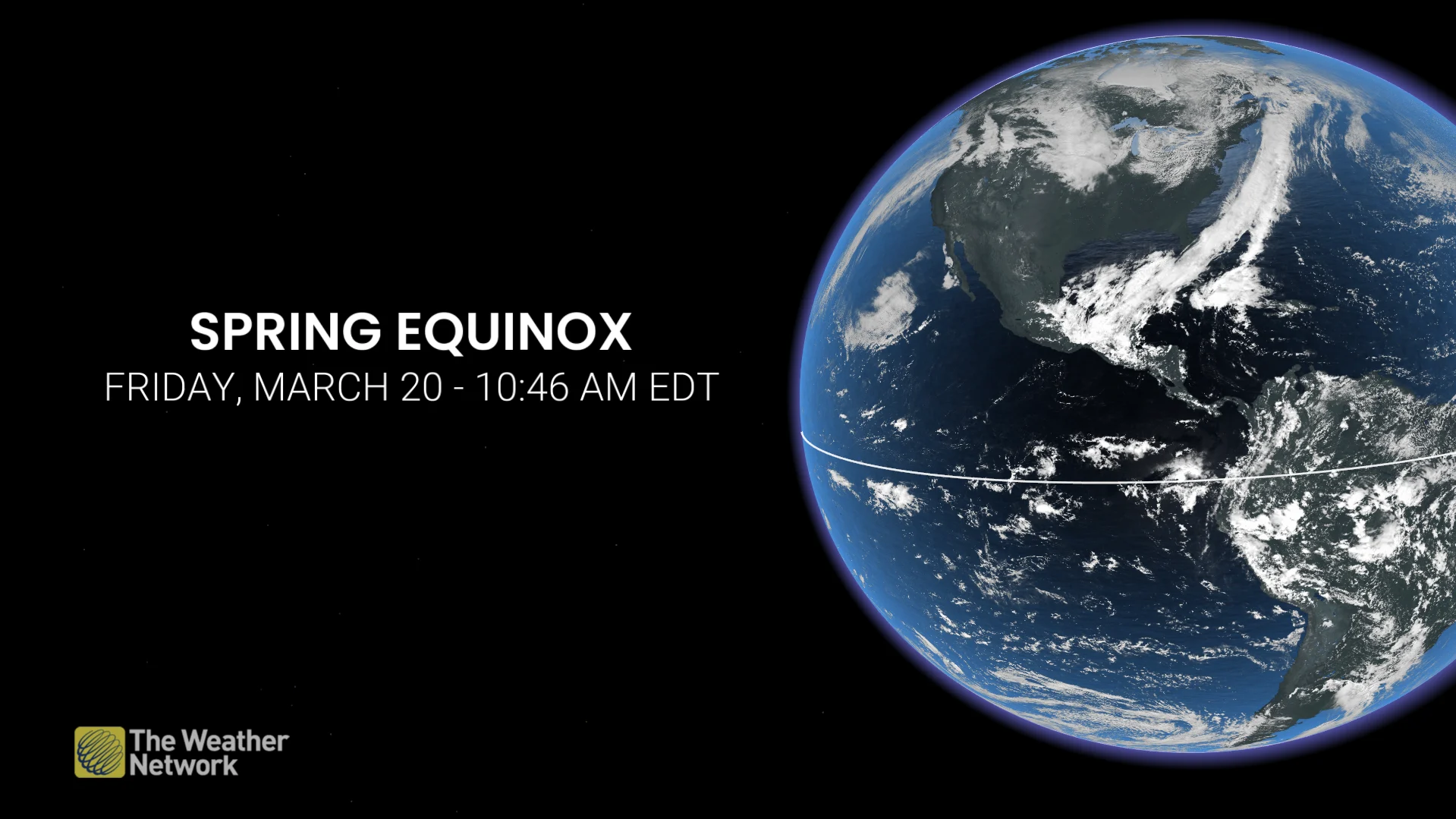
On that day, both the northern and southern hemisphere will be equally illuminated by the Sun.
The exact timing of this event depends on what time zone you're in:
12:16 p.m. NDT,
11:46 a.m. ADT,
10:46 a.m. EDT,
9:46 a.m. CDT,
8:46 a.m. MDT/CST, and
7:46 a.m. PDT.
Visit our Complete Guide to Spring 2026 for an in-depth look at the Spring Forecast, tips for planning for it and much more!
Astronomically speaking
At this moment of 'equal illumination', the Sun is said to be crossing the celestial equator, headed from south to north.
So, what does "crossing the celestial equator" mean, exactly?
As Earth travels around the Sun, the planet is tilted to one side, by around 23.4°. So, as Earth maintains this constant orientation of its axis as we go around our elliptical orbit, it changes the angle of the Sun in our sky.
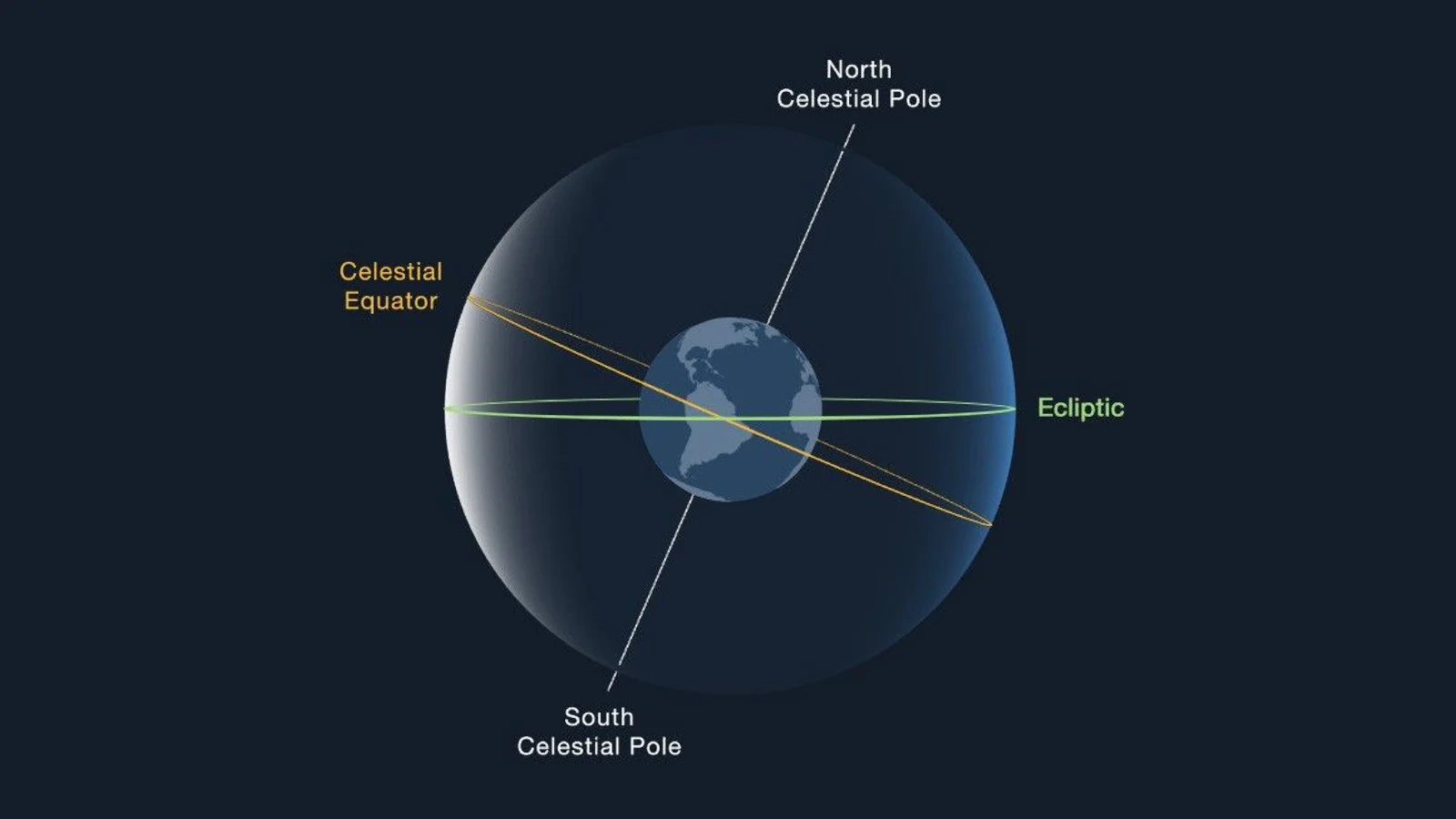
This diagram shows the celestial sphere and celestial equator, as they relate to Earth's axes and the plane of the ecliptic around the Sun. (NASA)
MORE SCIENCE: What's the difference between "astronomical spring" and "meteorological spring"?
Earth's orbit is usually drawn with the ecliptic flat and the planet tilted, as shown above.
However, the relationship of our orbit to the seasons can be seen much easier if we shift our perspective, ever so slightly, as shown below.

This tilted view of Earth's orbit around the Sun perfectly aligns the planet's axis. A small yellow dot on each Earth represents the 'subsolar' point, where the Sun is directly overhead at that time, which is south of the equator for the December solstice, north of the equator for the June solstice, and directly on the equator for the equinoxes. (NASA/GSFC/Genna Duberstein/Scott Sutherland)
In the above view, Earth's axis is straight up and down, and our orbit around the Sun is tilted to align with it.
From this perspective, when we are on the "left side" of the orbit, as presented above, the Sun is north of the celestial equator. With sunlight mostly focused on this hemisphere, it brings us warmer weather here in Canada.
When we are on the "right side" of the orbit, the Sun is south of the celestial equator. This focuses its light more on that hemisphere, which brings colder weather to us in the north.
At the equinoxes, the Sun sits directly on the celestial equator, crossing from south to north in March, and crossing from north to south in September.
DON'T MISS: A new Great Comet may shine along with meteor showers and bright planets this spring
Myths about the Equinox
There are a few urban myths that tend to make their rounds on the internet at this time of year, no matter how often they're debunked.
Equilux
Although the name equinox means "equal night", the times we experience equal day and night don't actually fall on the equinoxes.
Meteorologist Tyler Hamilton gives a great explanation for this in the video at the top of this article. I also highly recommend reading his article (linked below), which goes into more detail on the subject.
READ MORE: The equinox myth - Day and night aren’t actually equal
Balancing act
Whenever we reach an equinox, spring or fall, word spreads that this is the day to perform a "fantastical feat" of egg balancing.
While balancing an egg along its long-axis is challenging at any time, the equinox in no way makes that task easier.
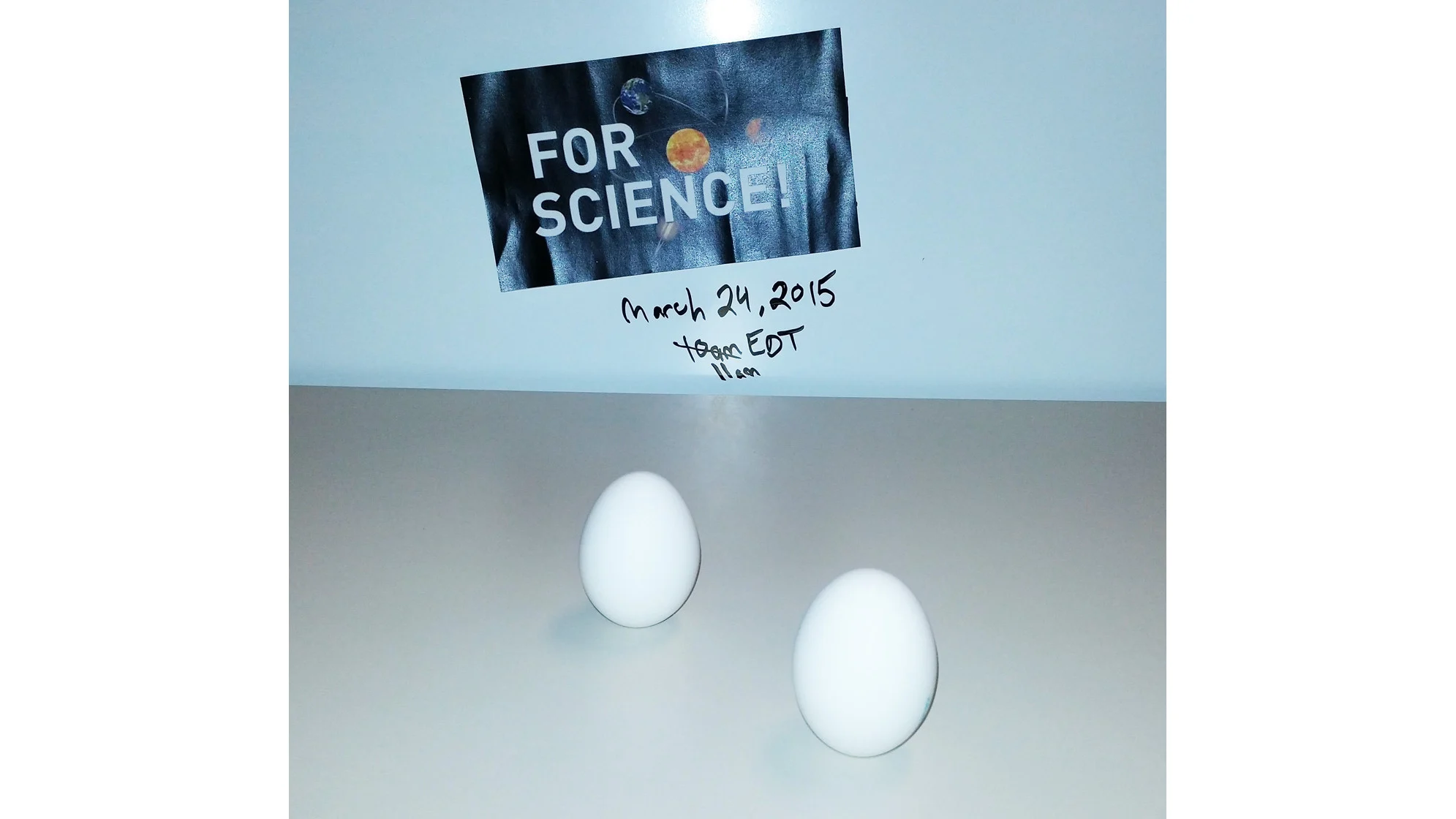
These two eggs were balanced on their ends on March 24, 2015, four days after the equinox. (Scott Sutherland)
The reason for this? Basically, while it is true that every object in the universe gravitationally affects every other object, here on Earth's surface, our planet's gravity completely overwhelms any other gravitational forces we — or the eggs we are balancing — might experience.
Sure, the Moon and the Sun extert some influence, but their effect is tiny compared to the force pulling downward towards the core of our planet.
Only three factors matter in balancing eggs, regardless of the date: the stability of the surface you are using, the 'bumpiness' of the eggs' shells, and the steadiness of your hands.
Shadows stick to us
It's difficult for us to escape from our shadow, even during the equinox.
Occasionally, claims circulate that you will not cast a shadow, even on a sunny day, if you stand on the equator during the equinox. Unfortunately, this takes some precise timing and very specific conditions to even be almost true.
First you have to locate the exact subsolar point, which changes with the exact timing of the equinox each year.
In 2026, with the equinox occurring at exactly 14:46 UTC, the subsolar point is in the Atlantic Ocean, off the northeast coast of Brazil.
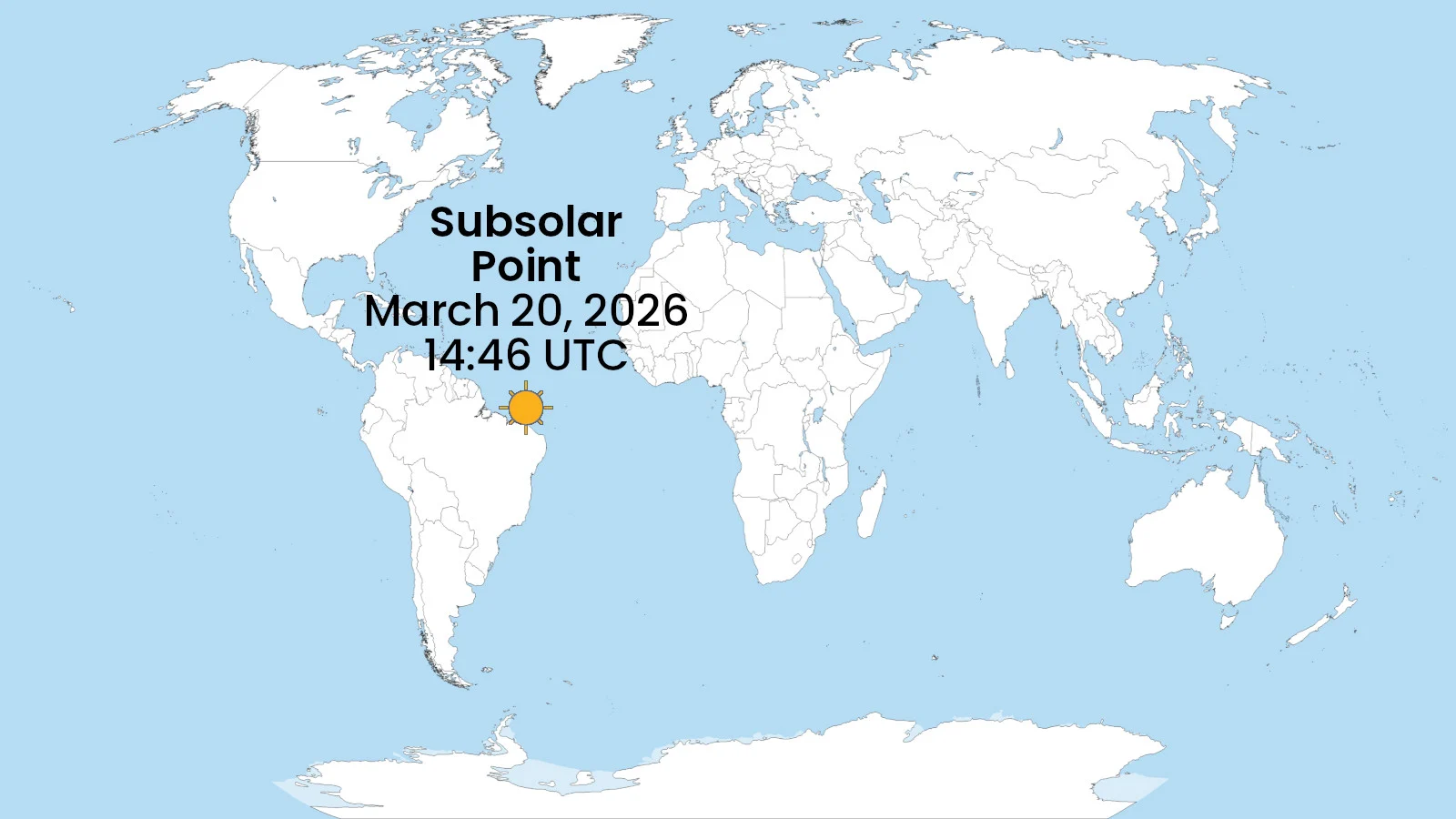
The subsolar point during the March 20, 2026 Equinox. (Scott Sutherland/Wikimedia Commons (CC BY-SA 3.0))
However, even if you were standing on a boat at that exact spot at that exact moment, with a completely clear sky and calm waters, you'd still see your shadow cast on, between, and around your feet. Sorry.
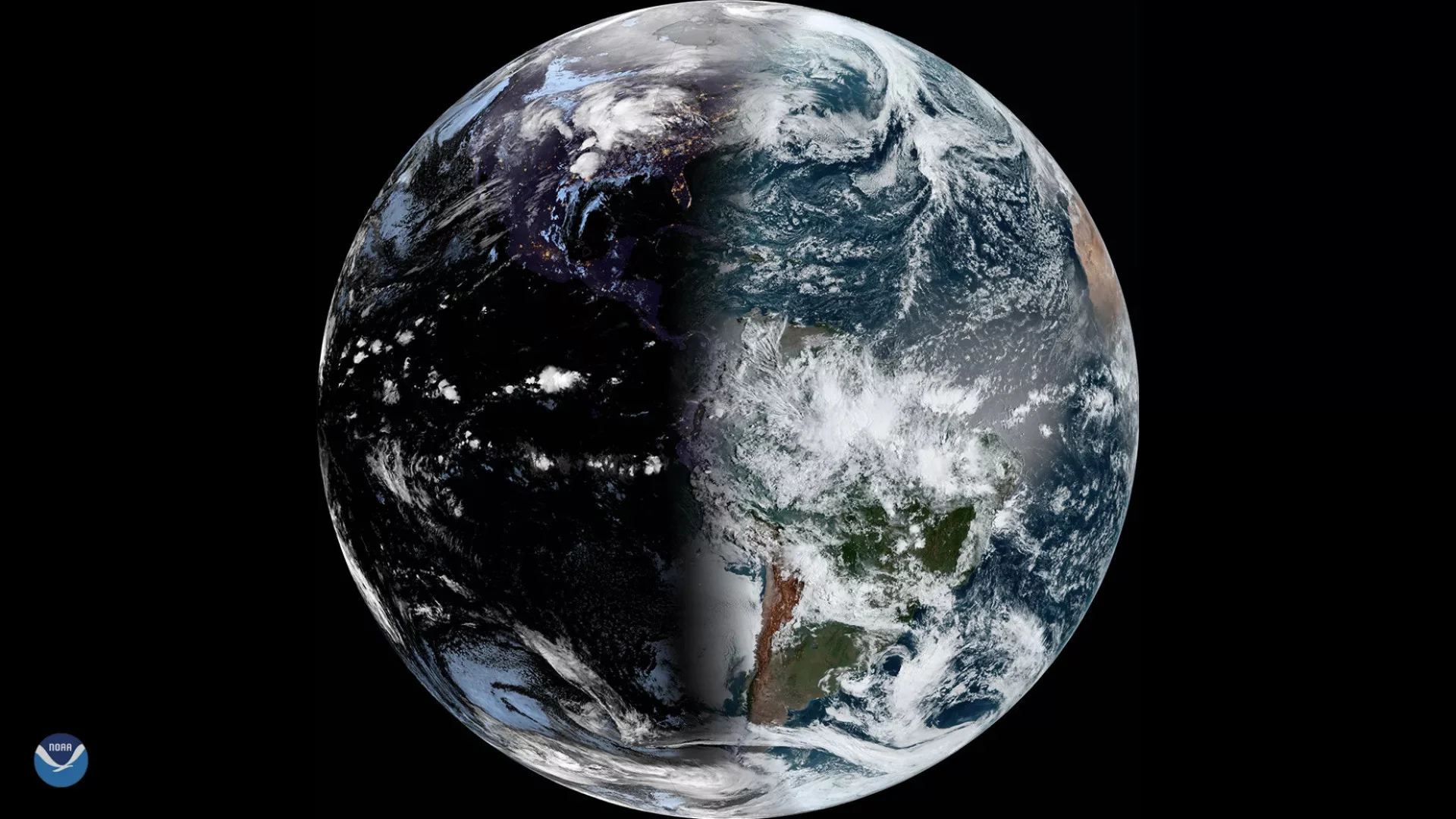
(Thumbnail image shows the moment of the vernal equinox, on March 19, 2020, as seen from the GOES-East geostationary weather satellite. Courtesy: NOAA)