
Alberta considers scrapping time change, but not Ontario

Ontario says it won't make the change unless its time zone neighbours do as well.
Alberta is considering scrapping seasonal time changes following B.C. Premier David Eby’s Monday announcement that residents in his province will move their clocks forward an hour on Sunday, March 8, and then never change them again, transitioning to a new time zone that will be called “Pacific Time,” or “PT.”
Meanwhile, Ontario has no plans to end its time change.
For Alberta, B.C.’s shift means it will be in sync with B.C. from November to March, which will now be on permanent daylight time, and align with Saskatchewan from March to November.
The majority of Saskatchewan does not change its clocks and observes standard time year-round.
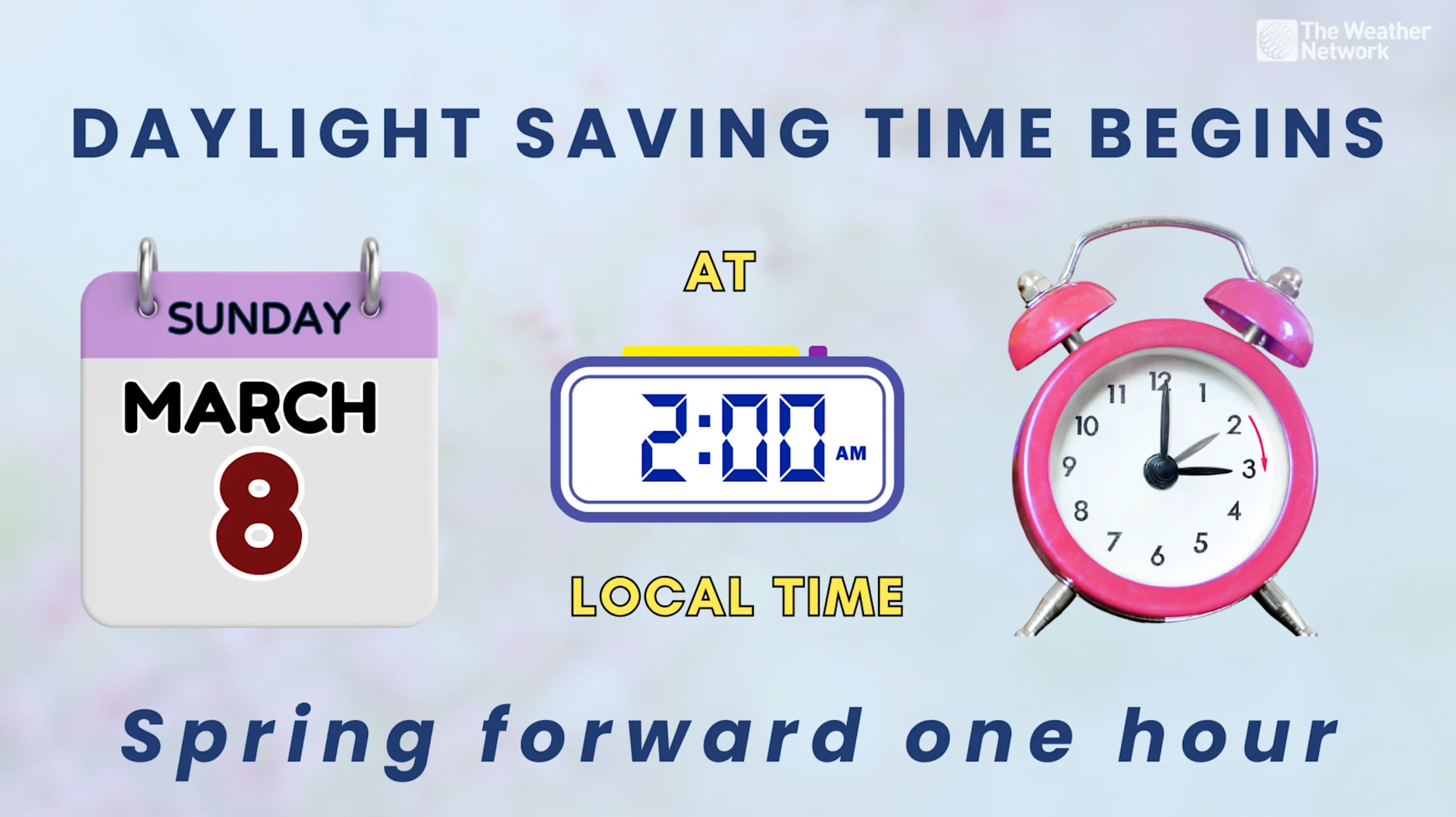
Clocks move forward one hour on Sunday, March 8. (Canva/The Weather Network)
In 2019, 93 per cent of B.C. respondents voted in favour of scrapping time changes, but Albertans appear to have a more mixed opinion. A 2021 referendum on the subject failed, with 50.2 per cent of respondents voting to keep seasonal time changes in place.
"Our government will take these recent developments under consideration and evaluate whether a similar change would be in the best interest of Albertans," Alberta Premier Danielle Smith said in a Monday statement obtained by the Canadian Press.
Ontario waiting on its neighbours
Ontario introduced a time amendment act in 2020, also proposing the province switch to permanent daylight time — but said it would only act if Quebec and New York, its time zone partners, did the same.
On Monday, a spokesperson for Ontario Premier Doug Ford confirmed to the Toronto Star that their position remains the same, even in light of the recent developments in B.C.
What is Daylight Saving Time?
Daylight time is a practice that involves changing the time to maximize the use of light available during the summer so that darkness falls at a later time on the clock.
The switch is often associated with farmers wanting more light for harvesting, but it was first introduced to save energy during the First World War.
Daylight time hasn’t been federally mandated since 1987.
In addition to most of Saskatchewan, the Yukon, eastern Quebec, some regions in Ontario, and most of Nunavut also do not adjust their clocks twice a year.
Header image: Graphic elements from Canva Pro. Doug Ford image: Bruce Reeve/Wikipedia CC BY-SA 2.0. Danielle Smith image: Manning Centre/Wikipidia CC BY-SA 2.0