Hailstorm, landslide force a halt to the famed Tour de France

The rare weather-related stoppage left Colombian cyclist Egan Bernal in the lead.
The famed Tour de France suffered a rare weather-related setback Friday, with a hailstorm and landslide prompting organizers to call a halt.
Friday's stage, the 19th, runs through the Col de l'Iseran pass in France's southeastern Savoie region. The brief storm took place ahead of the riders, but bulldozers' failed attempts to clear the hail off the road ahead of their expected arrival, coupled with the landslide, made continuing the race unsafe.
"What a day. The landslide was 20-metres long and 50-cm thick so the organizers and the race jury decided to stop the race,” Tour de France director Christian Prudhomme told Reuters.
It was a premature halt to what had been a dramatic and emotional stage in the three-week-long bicycle race around the country.
France's Julian Alaphilippe began the day a minute and a half ahead of Colombia's Egan Bernal, but the 22-year-old challenger managed to make up the deficit and overtake Alaphilippe while ascending the Col de l'Iseran.

Team INEOS rider Egan Bernal of Colombia, wearing the white jersey for best young rider, in action on the descent of the Col de l'Iseran. REUTERS/Christian Hartmann
The Frenchman made up some of the lost time on the descent, but the stage was halted before he could fully catch up.
Though race organizers did not declare a "winner" of Friday's stage, Bernal was awarded the yellow jersey, given to whomever completed the day's stage first, and will start 45 seconds ahead of Alaphilippe on Saturday. Bernal aims to be the first Tour de France winner from Colombia, while Alaphilippe will look to win the tour for France for the first time since 1985.
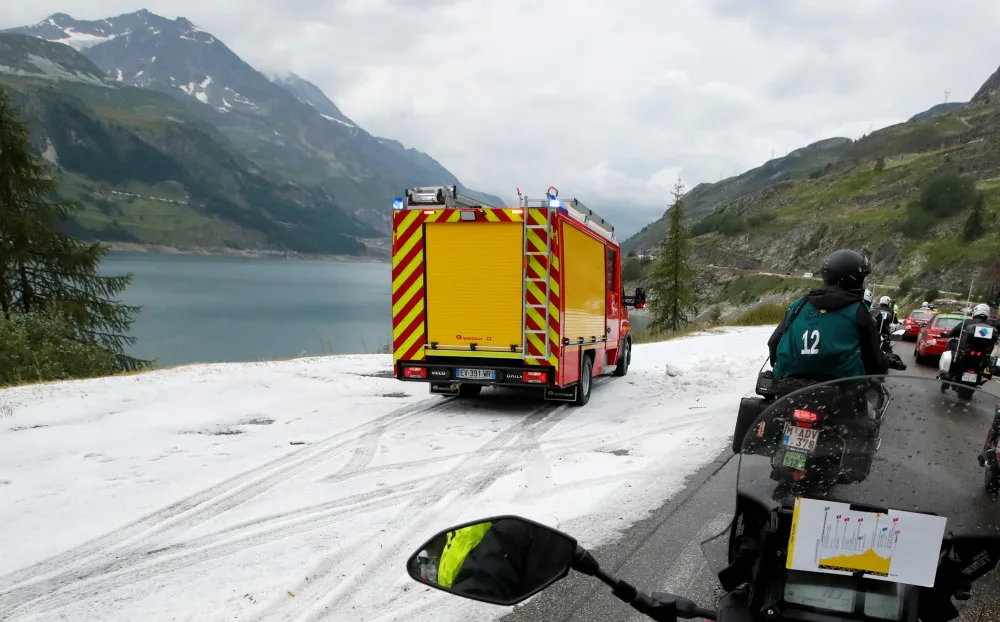
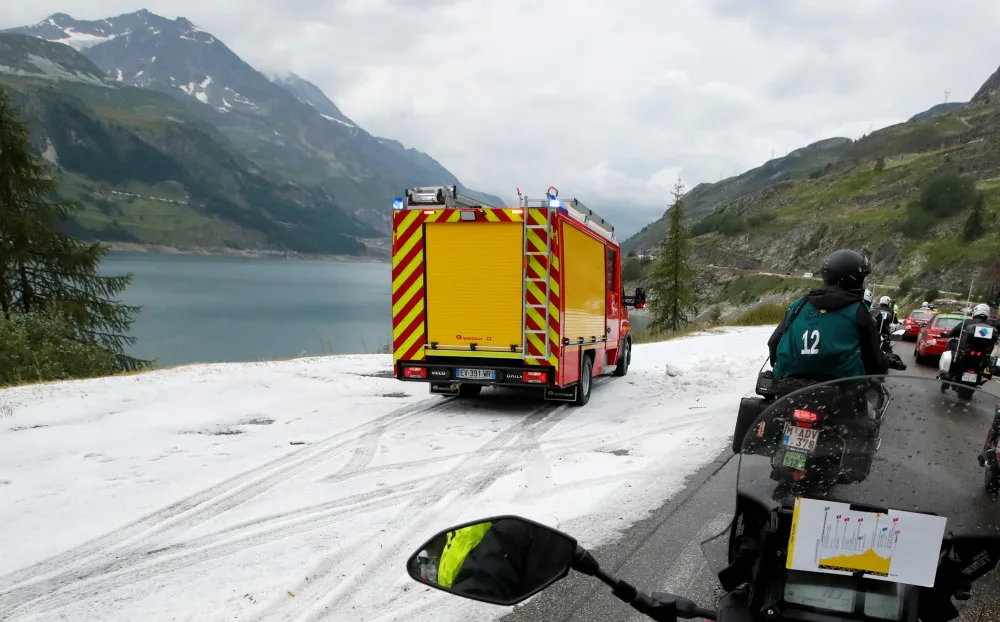
The convoy makes its way to the finish line as a fire truck is parked in the snow, after the race was stopped. REUTERS/Christian Hartmann
Friday marked the first time in the Tour's 116-year history that a stage did not have a declared winner.
Weather doesn't always have such a drastic effect on the tour, but it does happen occasionally. Most famously, in 1996 organizers scaled one mountainous stage back from 176 km to 46 km due to a snowstorm (according to Velo News). More recently, in 2016, expected 120 km/h winds at the summit of Mont Ventoux, the planned finish to the 12th stage, prompted organizers to shorten the stage by six kilometres (according to the BBC).
2016 saw some of the first applications of a new Extreme Weather Protocol put together by the Union Cycliste Internationale, which governs sports cycling, which calls for mandatory meetings by race organizers and stakeholders, including the doctor and security chief of a given race, to assess the conditions and decide whether to modify or cancel the race. Aside from traditional weather hazards such as snow, hail or winds, air quality is also considered.