
The polar vortex is on the move! Canada’s winter forecast update

Winter started quickly across most of Canada! Will a classic Canadian winter pattern hold through January and February?
After a very mild fall across most of Canada, many places experienced one of their coldest starts to December in 35 years. Colder-than-normal temperatures dominated the first half of December from the Yukon to Newfoundland.
What’s in store for the rest of the season across the country? Read on for your updated winter forecast.
DON'T MISS: La Niña to continue into 2026, leaving thumbprint on winter weather
Strong start to winter moderates to end December
The various shades of blue and green on the temperature anomaly map below show how widespread the colder-than-normal temperatures were during the first half of December.

The one region that has avoided frigid conditions has been southern and central British Columbia, where very mild temperatures have dominated, including some record-shattering warmth.
However, we are in the midst of a major shift in the weather pattern. While southern B.C. is finally seeing more typical early-winter conditions, spring-like temperatures are taking over across the U.S. and those mild conditions are pushing across the border at times.
Here is a look at what we can expect across Canada for the final 10 days of December, according to the forecast model that appears to have the best handle on the pattern change.

Much milder weather will surge north into the eastern half of Canada at times, especially across Ontario and into southern and western Quebec. Also note the sharp temperature contrast on the southern Prairies where we will continue to see a temperature yo-yo as this region will be the battleground between frigid Arctic air to the north and record-breaking warmth to the south.
So, what can we expect for the rest of winter?
Winter’s fury will shift back and forth this season
We think that December is giving us a preview for the rest of the season.
Widespread colder-than-normal conditions will continue to dominate, but the focus of winter’s fury will shift back and forth, alternating between Eastern Canada and Western Canada. This will allow for winter breaks with periods of very mild weather, including thaws, for areas that are not under the influence of the Arctic air.
RELATED: Canada looks forward to a ‘January thaw’ every year. What is it?
One of the key reasons for the widespread cold start to winter has been the position of the polar vortex. So far it has taken up residence over Northern Canada, a position that makes frigid Arctic air readily available to plunge south into lower latitudes.

During the first half of December, the polar vortex was centred near Hudson Bay, which is why Central and Eastern Canada were so cold.
But the feature is currently shifting west and retreating north, taking the focus of the severe cold back across northwestern Canada and allowing very mild Pacific air to flood across the U.S. and spread into parts of southern Canada.
WATCH: Breaking down the infamous 'polar vortex'
MUST SEE: What is the polar vortex? How it’s responsible for dangerous cold
While the polar vortex is retreating north, we do not expect that it will lock into a position right over the North Pole or that it will flip to the other side of the North Pole and take up residence over Asia.
If either of those two scenarios were to happen, then mild Pacific air would flood across Canada and much above-normal temperatures would dominate the season.
However, all current evidence points to a polar vortex that will continue to move around but remain on the Canadian side of the North Pole.

We expect that at times it will return to its early December location near Hudson Bay with widespread cold conditions for Central and Eastern Canada.
However, at times the polar vortex will shift back to the western side of Northern Canada and the focus of winter’s fury will be across Western Canada with milder conditions across Eastern Canada.

Both scenarios will deliver frigid conditions to the Prairies, but temporary relief will still be available, especially near the southern border of the region.
A chilly, classic Canadian winter remains likely
Putting it all together, here is our updated forecast for the winter season. Despite the occasional mild spells and thaws, we expect that most of Canada will see near-normal or colder-than-normal temperatures overall.

We also expect that an active storm track will continue to deliver near-normal or above-normal precipitation to most of the country.
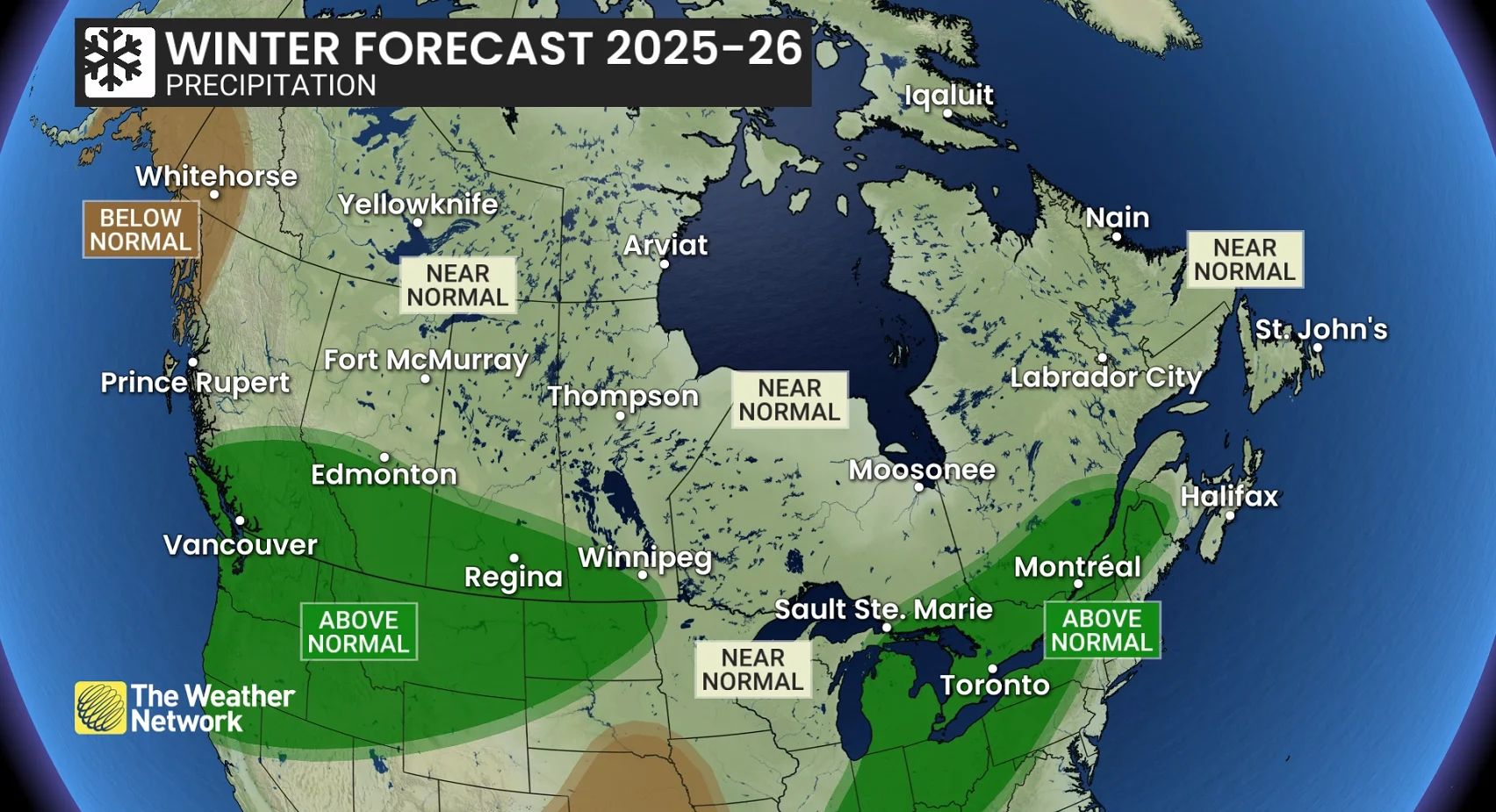
Moisture-laden systems are expected to continue to impact southern B.C., and clippers are expected to track from the Rockies to Atlantic Canada. Later in the season we also expect several Colorado Lows will track into the Great Lakes region and up the St. Lawrence.

Some of these storms will bring rain and a messy mix of snow, ice and rain to southern Ontario, southern Quebec and into Atlantic Canada during the periods of milder weather.
For more details on what we expect during the month of January, be sure to catch our monthly outlook on Jan. 4.