
Evacuation orders issued for hundreds in Abbotsford, B.C., amid flood warnings

Fraser Valley Regional District declared local state of emergency Wednesday afternoon
Evacuation orders have been issued for 371 properties in Abbotsford, B.C., as heavy rains inundated southern B.C. and led to all major highways leading out of the Lower Mainland to be closed.
Just after 11 p.m. PT, the City of Abbotsford said that residents of hundreds of properties in the Sumas Prairie West area must leave immediately due to the risk of flooding.
FORECAST: B.C. faces risk of 10- to 20-year flood levels after multi-day rainfall event
Officials said the orders were issued after talks with the province and neighbouring Whatcom County south of the border, where the Nooksack River was among numerous waterways in Washington state to reach flood levels.
"Flood water is expected to arrive at the border in the early hours of Thursday morning," reads a statement from the city.
A reception centre has been set up at the Abbotsford Recreation Centre (2499 McMillan Road) for those needing assistance. A corresponding state of local emergency, and evacuation alerts for the eastern Sumas Prairie area, have also been issued.
DON’T MISS: Atmospheric rivers becoming so intense we need to rank them like hurricanes
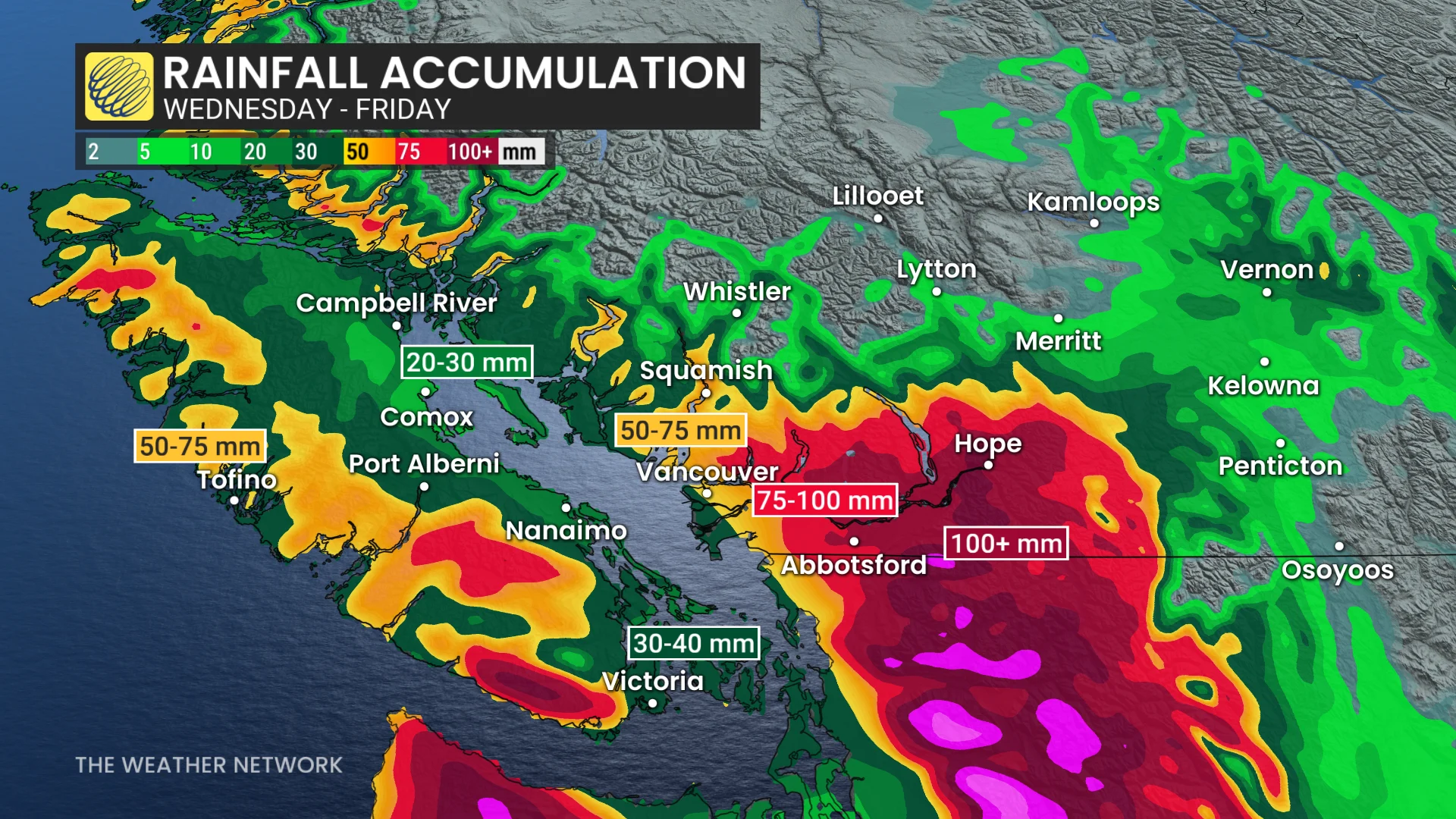
It comes as an atmospheric river is bringing a torrent of rain across the southern portion of British Columbia, with much of the Fraser Valley facing the threat of flooding and all major routes leading out of the Lower Mainland closed late Wednesday.
The City of Abbotsford had earlier issued evacuation alerts late Wednesday afternoon for properties in the western Sumas Prairie and Clayburn Village areas and is encouraging residents to plan in case they have to leave suddenly.
The Fraser Valley Regional District (FVRD) declared a local state of emergency Wednesday afternoon and issued an evacuation order for some properties in the Chilliwack River Valley.
As of 4:45 p.m. PT, the evacuation order affects eight properties along Wilson Road and two others on the Chilliwack Lake Road due to the high risk of flooding. People living in the area must leave immediately.
Ten other properties along Chilliwack Lake Road under under evacuation alert.
FVRD is urging residents in the alert area to prepare to leave on short notice.
The system moved into B.C.'s South Coast Tuesday evening, but Environment and Climate Change Canada meteorologist Ken Dosanjh told CBC News the precipitation is expected to peak late Wednesday afternoon and into the early evening.
"It's that time frame when we can anticipate the real heavy rain," he said.
DON'T MISS: Here are Canada's worst winter roads and the riskiest times to drive
Dosanjh said there are two high pressure systems, one over Yukon and one off the coast of California, that are acting like "the bread of a sandwich" to create "a storm highway" over southern B.C.
He said Washington state is actually getting the worst of it, while B.C. is seeing "mostly the northern extent of it," but that it's still enough to warrant the warnings that have been issued.
WATCH: High water levels as rain creates flooding conditions in B.C.
Environment and Climate Change Canada has placed central and eastern parts of the Fraser Valley — including Chilliwack, Hope, Hope Slide, and Highway 3 from Hope to Princeton — under an orange level warning, with 90 to 130 millimetres of rain expected to fall by Wednesday night.
Areas under yellow alert, with 40 to 70 millimetres of rain in the forecast, include Vancouver Island, Metro Vancouver and the western portion of the Fraser Valley, as well as Howe Sound, the Sunshine Coast and the Sea-to-Sky Highway to Whistler.
Further yellow alerts issued Wednesday cover the Coquihalla Highway from Hope to Merritt and the South Fraser Canyon area from Hope to Boston Bar, where 60 to 80 millimetres of rain is expected.
Swathes of the Interior, encompassing areas in the Kootenays and Elk Valley near the Alberta boundary, such as Fernie, are also under yellow alerts. Forecasters estimate rainfall amounts there between 40 to 60 millimetres.
The same system is also expected to bring 20 to 40 centimetres of snow to higher elevations in the Interior. There is a yellow alert in place for the stretch of the Trans-Canada Highway from Eagle Pass to Rogers Pass, as well as in Yoho and Kootenay national parks.
Flooding warnings in Fraser Valley
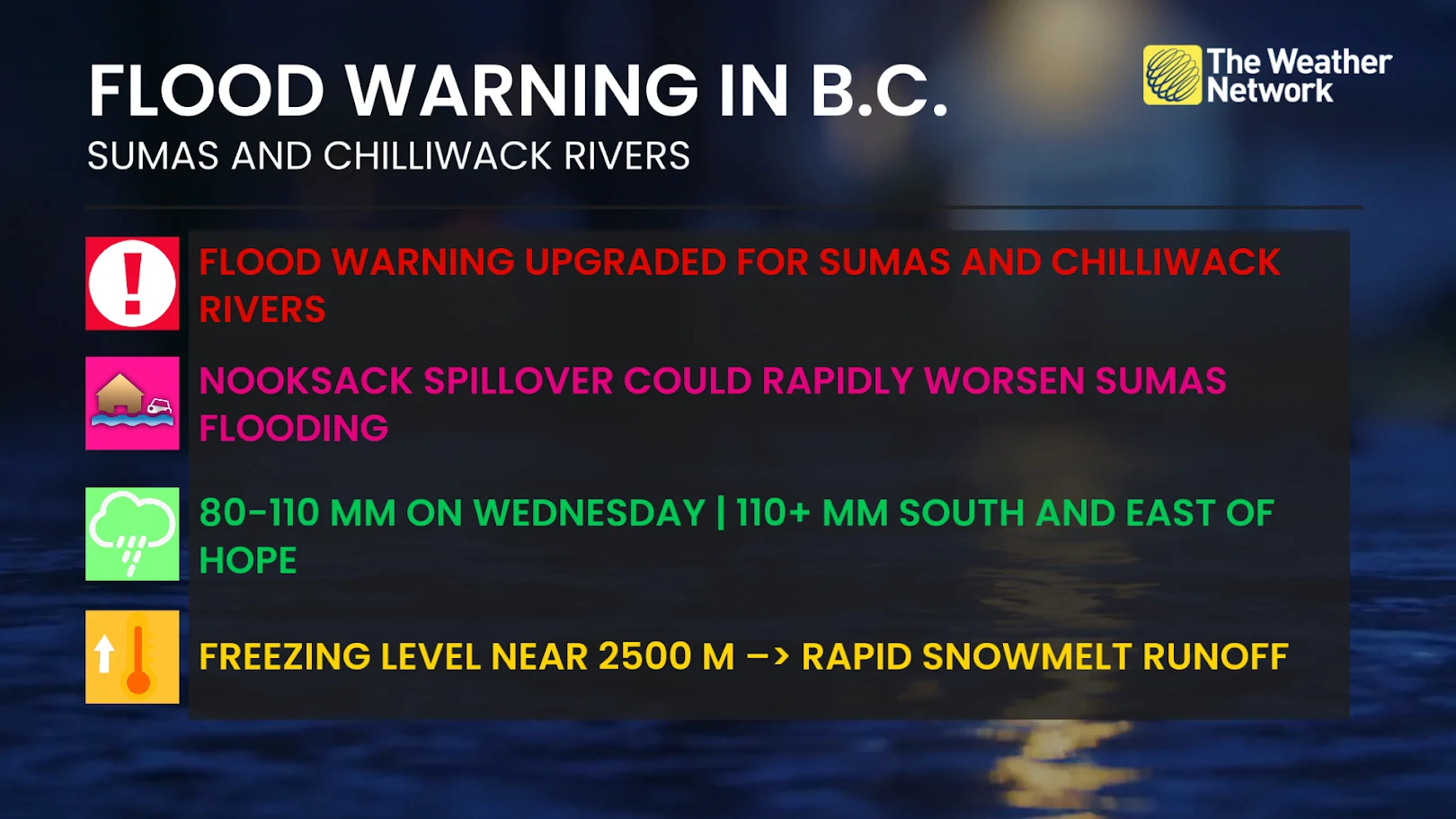
Earlier in the day, the B.C. government issued flood warnings and watches for Abbotsford, Chilliwack, Hope and other parts of the eastern Fraser Valley along the lower Fraser River tributaries and the Sumas River.
The River Forecast Centre says the heavy rain also brings the potential for spillover from the Nooksack River in Washington state, the same problem that set off devastating and costly flooding in November of 2021.
Flood watches and high stream flow advisories are also in place across much of the southern portion of the province.
Extra caution in avalanche-prone areas
Avalanche Canada says the mild, stormy weather will bring added risks in backcountry alpine areas.
Avalanche Canada has warned the risk is high (red) or considerable (orange) in many areas of southern B.C. affected by the atmospheric river and that the avalanche hazard is expected to increase throughout the day on Wednesday.

Avalanche Canada warns the mixed precipitation from an atmospheric river across southern B.C. is expected to increase the risk of avalanche as the storm system moves through the province on Wednesday. (Avalanche Canada)
Colin Garrity, a forecaster and field technician with the agency, told CBC Radio's The Early Edition that avalanche season is underway.
RELATED: Avalanche risk in northern B.C. closes Pine Pass along Highway 97
But he said there are local variations that need to be considered.
"At the moment, it pretty much comes down to the stormier it is, the more dangerous."
What do the colour-coded warnings mean?
Environment and Climate Change Canada updated its weather warning system last month with a risk-tiered, colour-coded system that aims to offer a clearer picture of the weather's impact — and indicate how the public should prepare.
The alert level will be based on an assessment of both the potential impacts of the weather event and also the forecast confidence.
The changes align with recommendations from the World Meteorological Organization and follow updates already implemented by 31 weather agencies across Europe.
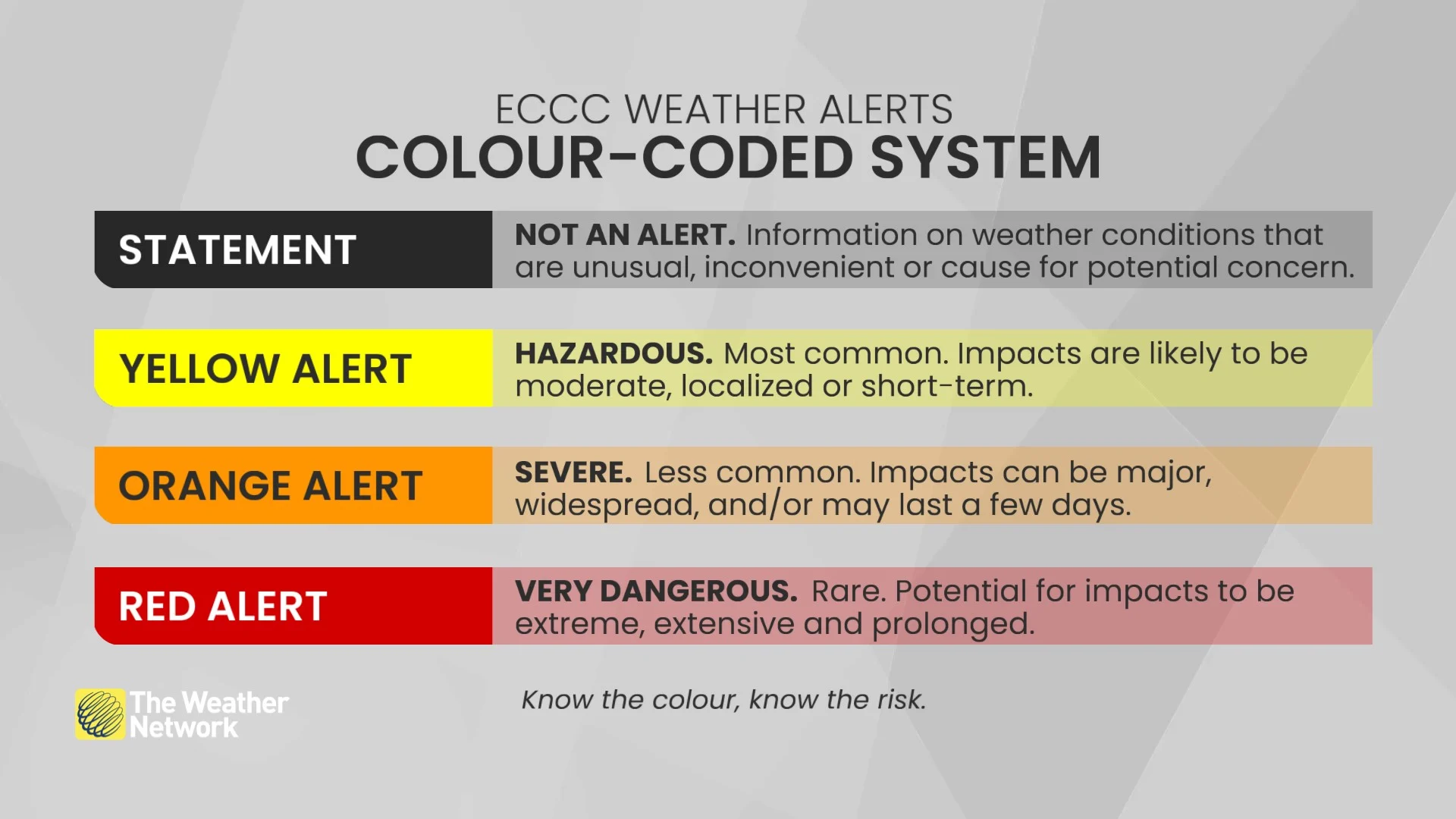
The most common alert is yellow, which indicates hazardous weather that could cause moderate or localized effects — such as damage, service disruptions and/or health impacts — in the short term.
Orange alerts are uncommon but are issued when forecasters have high confidence that severe weather is likely to cause significant damage, disruption or health impacts that are widespread and could last for a few days.
SEE ALSO: ECCC launches new colour-coded Canadian weather alerts
Red alerts are rare but will be issued when very dangerous and possibly life-threatening weather is forecast and expected to cause extreme damage and prolonged disruption.
WATCH: Canada is getting its own atmospheric river rating scale
This article, written by Nick Logan, was originally published for CBC News.
With files from Stephen Quinn, CBC Radio's The Early Edition, Ryan Snoddon and The Canadian Press