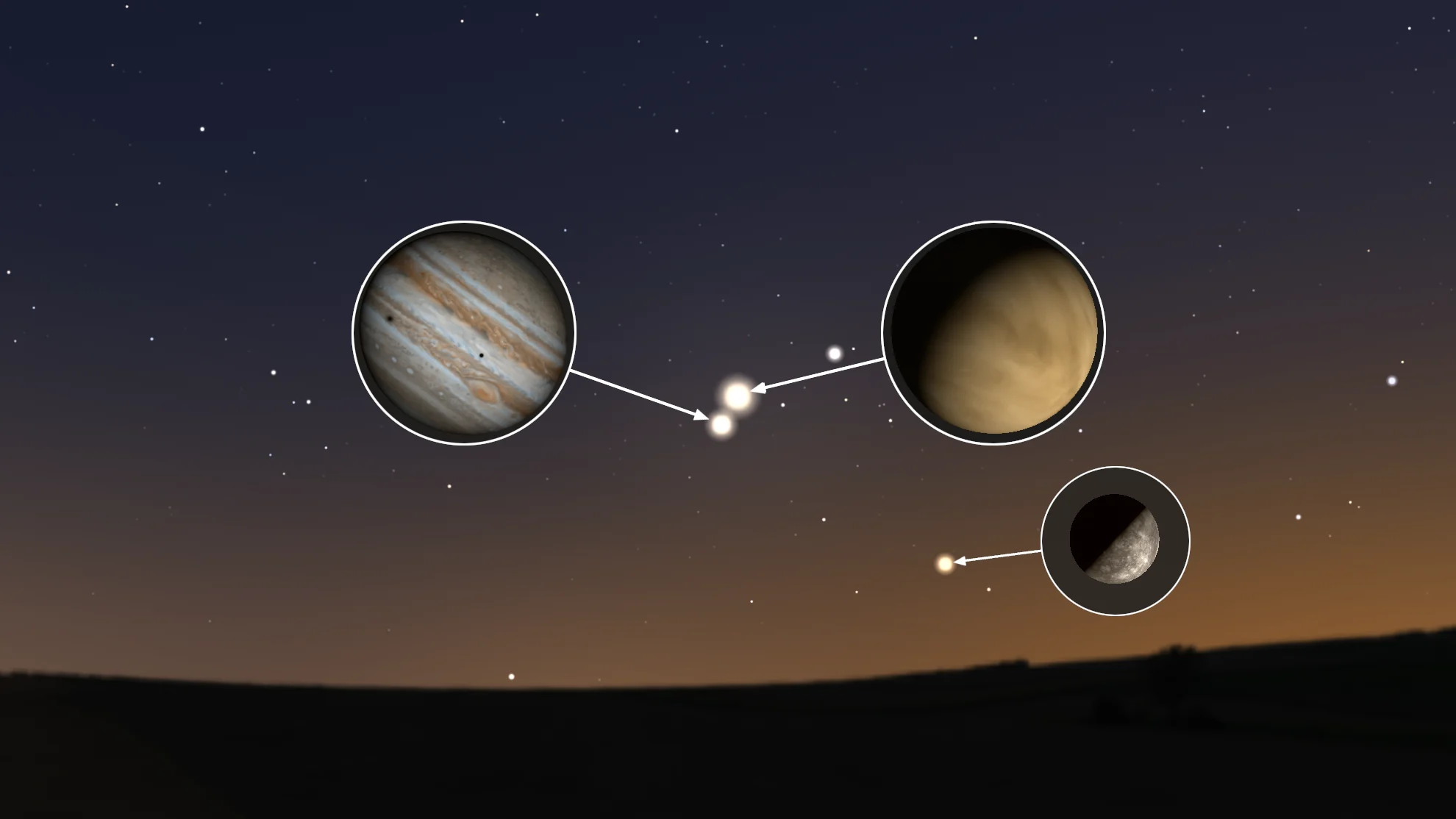
Look up! The two brightest planets converge in the sky in June

The planets are the 'stars' of the night sky throughout the month.
The brightest planets of the night sky are split into two 'friend groups' in the evening and predawn sky, and don't miss the two brightest — Jupiter and Venus — as they swing past each other during their close conjunction.
Despite the shortening nights, warmer weather is making it easier for us to stay up late to watch the wonders of the night sky.
Here is the astronomical guide for the month of June 2026:
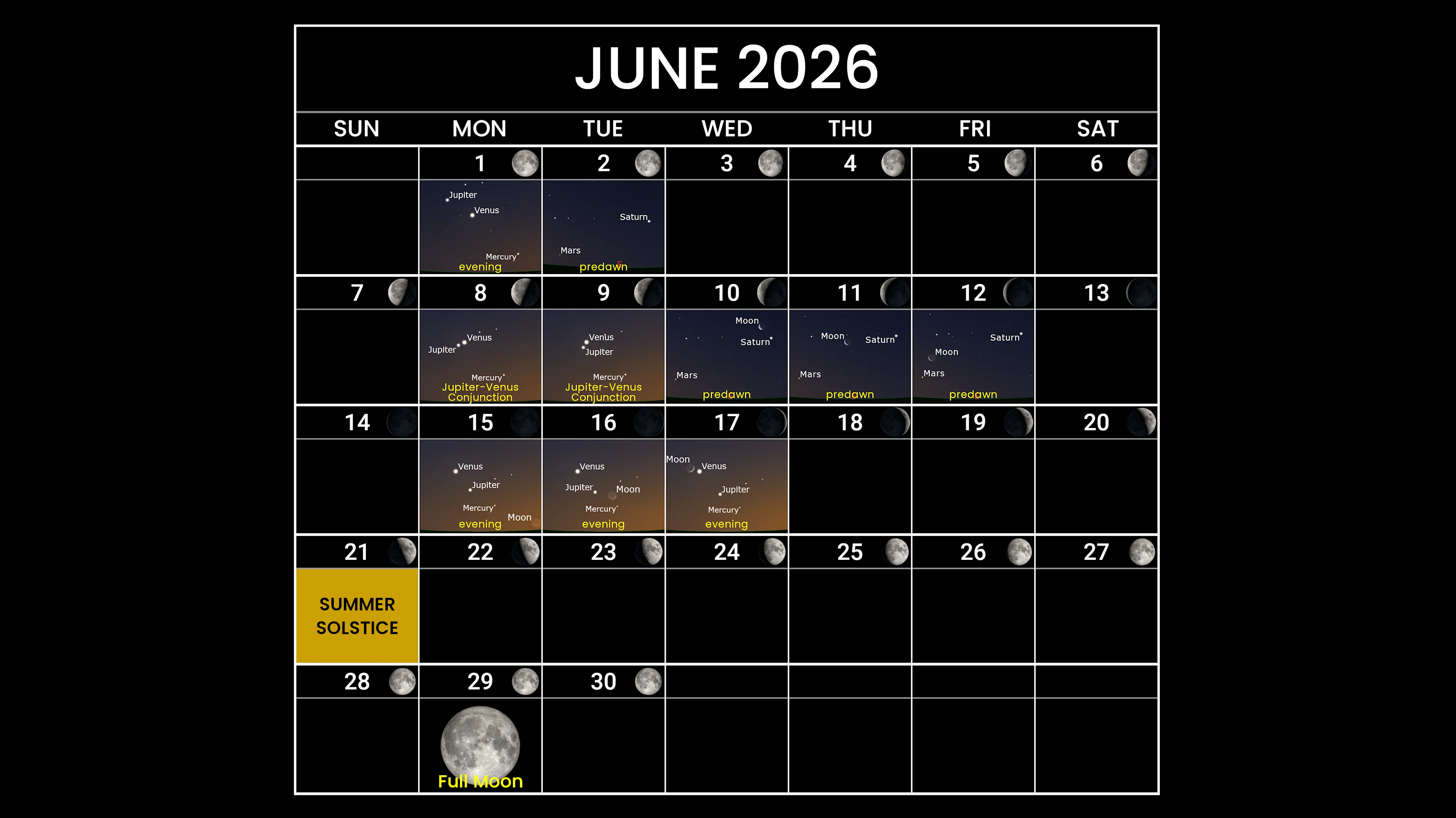
Click here for a zoomable version of the above calendar.
The Moon
So far this year, the Moon's lunar cycle has been timed to give us Full Moons towards the start of each month. However, after the rare Blue Moon that shone in the sky in the last nights of May, this cycle is now flipped!
We will see a Waning Gibbous Moon to start off the month of June. The shadow over the left side of the Moon will grow from the 1st through the 7th, until it covers half of the near-side, during the Last Quarter Moon on the 8th.
We will then have a Waning Crescent Moon from the 9th through the 14th, followed by the New Moon early in the day on the 15th. We typically only mention supermoons when they are associated with a Full Moon. However, this June 15 New Moon is actually one of the closest supermoons of the year, rivaled only by the December 24 Cold Moon.
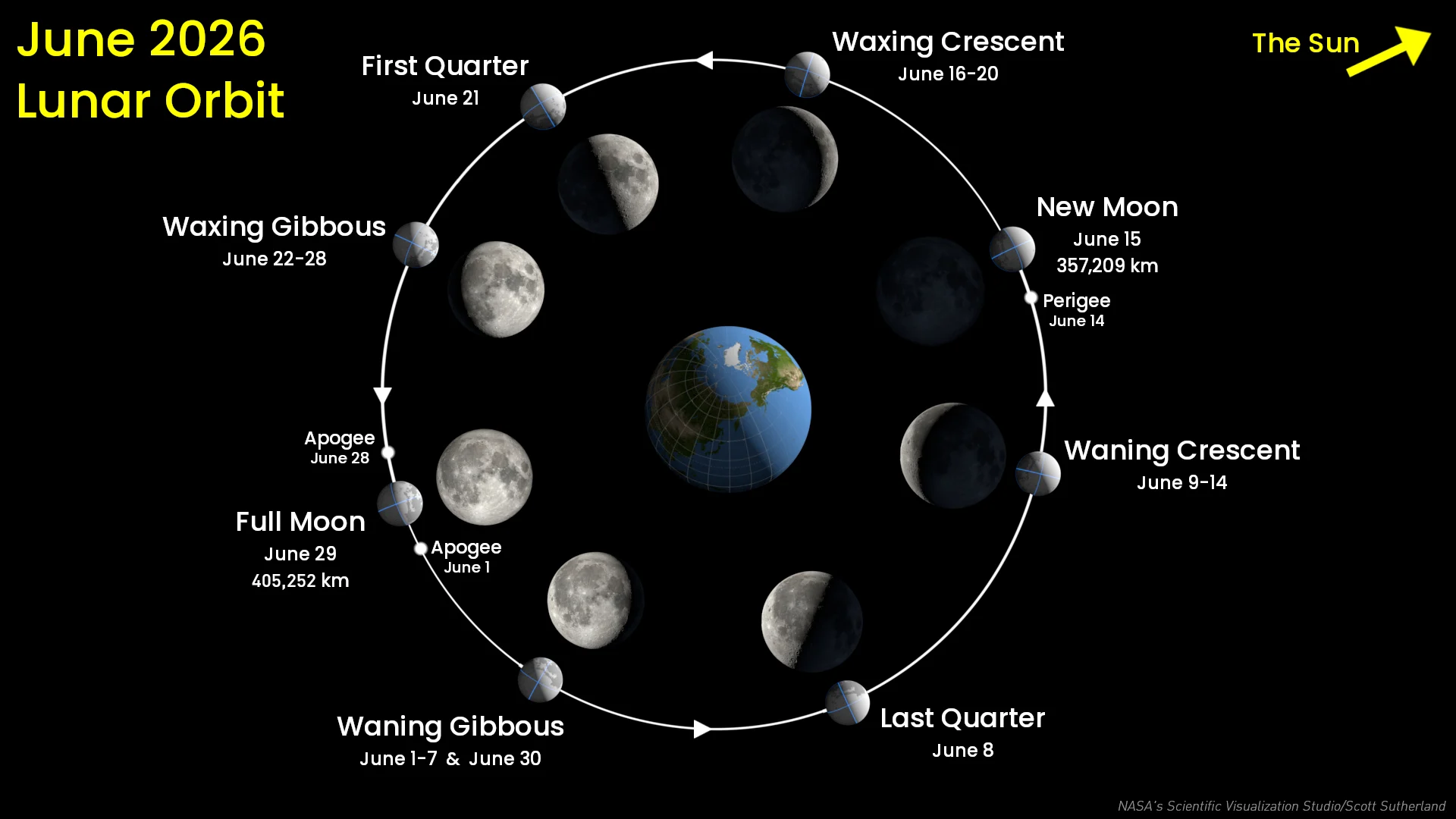
The Moon's orbit in June of 2026. (NASA's Scientific Visualization Studio/Scott Sutherland)
DON'T MISS: NASA is now planning a permanent Moon Base at the lunar south pole
We may catch a very thin Waxing Crescent Moon just above the western horizon after sunset on the night of the 15th, and this phase will grow each following night, up until the First Quarter Moon on the 21st.
Then, the Waxing Gibbous Moon will grow brighter from the 22nd until the Full Strawberry Moon rises on the night of June 29-30, and we finish off the month with another Waning Gibbous Moon crossing the sky.
The Planets
Throughout the month of June, there are two 'friend groups' of planets visible in the sky, split by daylight.
Each evening, Jupiter, Venus, and Mercury will be above the western horizon just after sunset.
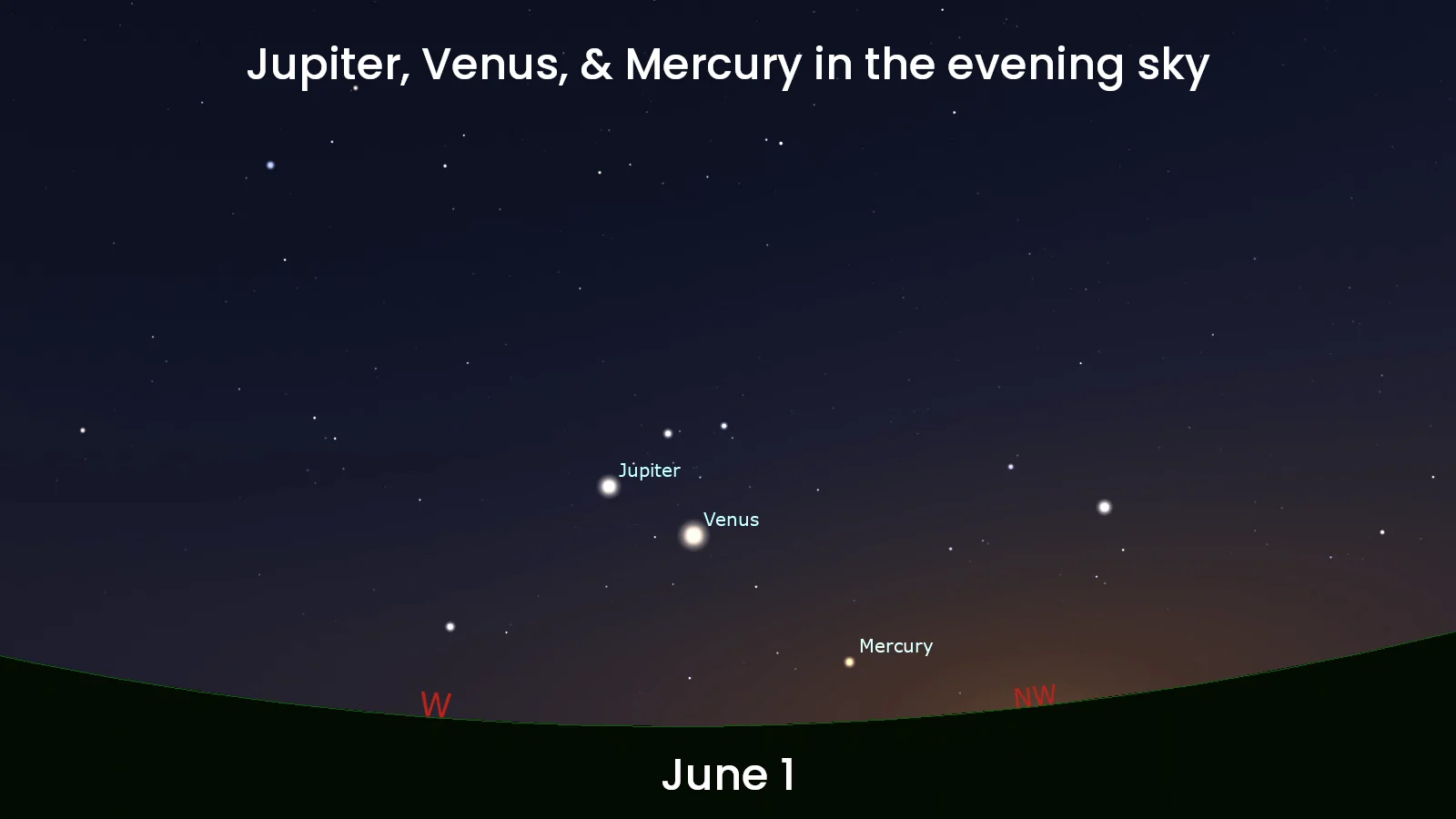
The alignment of planets in the western sky after sunset, on June 1, 2026. (Stellarium/Scott Sutherland)
Throughout the month, Jupiter will appear farther to the west each evening, while Venus and Mercury will be higher above the horizon.
Meanwhile, every morning, we can see two other planets — Saturn and Mars — just above the eastern horizon before sunrise.
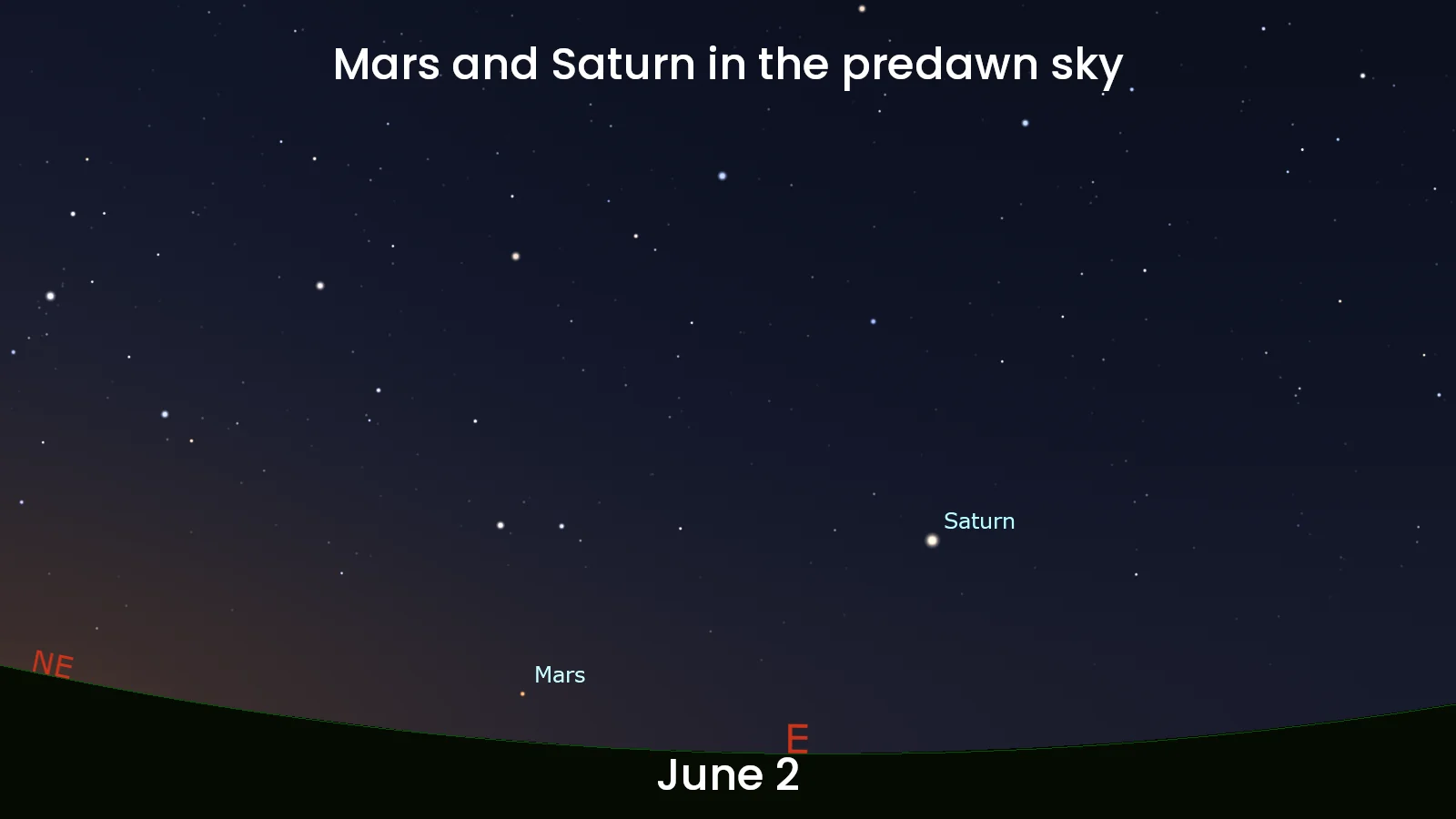
Two planets shine in the eastern sky before sunrise, on June 2, 2026. (Stellarium/Scott Sutherland)
For these two, both will rise slightly earlier, with Mars slowly tracking higher above the horizon each morning, and Saturn pulling away towards the southeastern sky before every sunrise.
In particular, watch Jupiter in Venus each evening, as those two brightest planets will draw closer and closer to one another over the first week or so.
Then, on both June 8 and June 9, these two will be at their closest together in the sky.
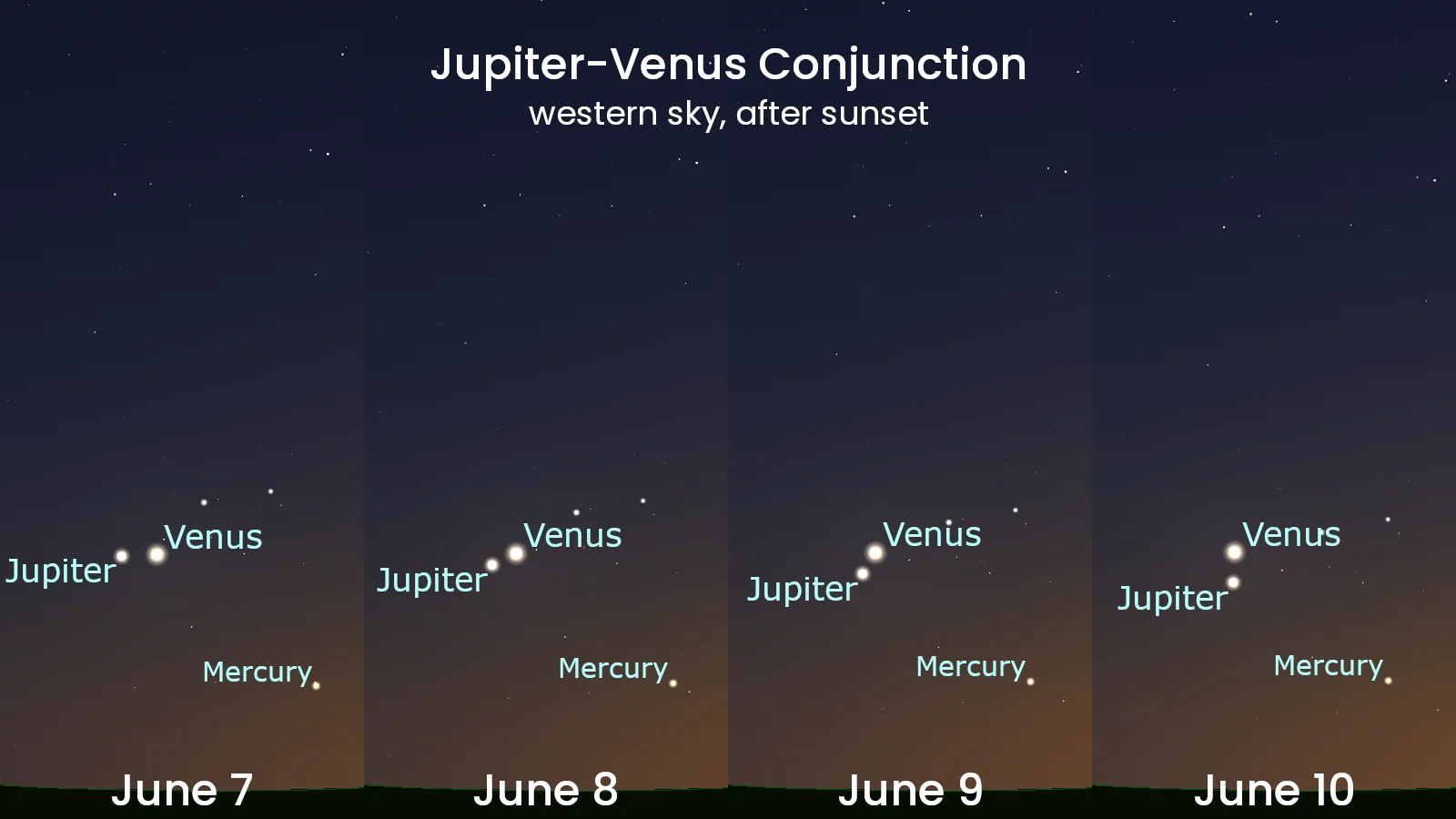
The positions of Jupiter, Venus, and Mercury, before, during, and after the Jupiter-Venus Conjunction on June 9, 2026. (Stellarium/Scott Sutherland)
According to the Royal Astronomical Society of Canada, the pair reach their closest conjunction, with Venus just 1.6°N of Jupiter, at around 8 a.m. EDT, when they will be 'lost' in the daytime sky.
Thus, both the evenings of the 8th and 9th are best to catch this close approach.
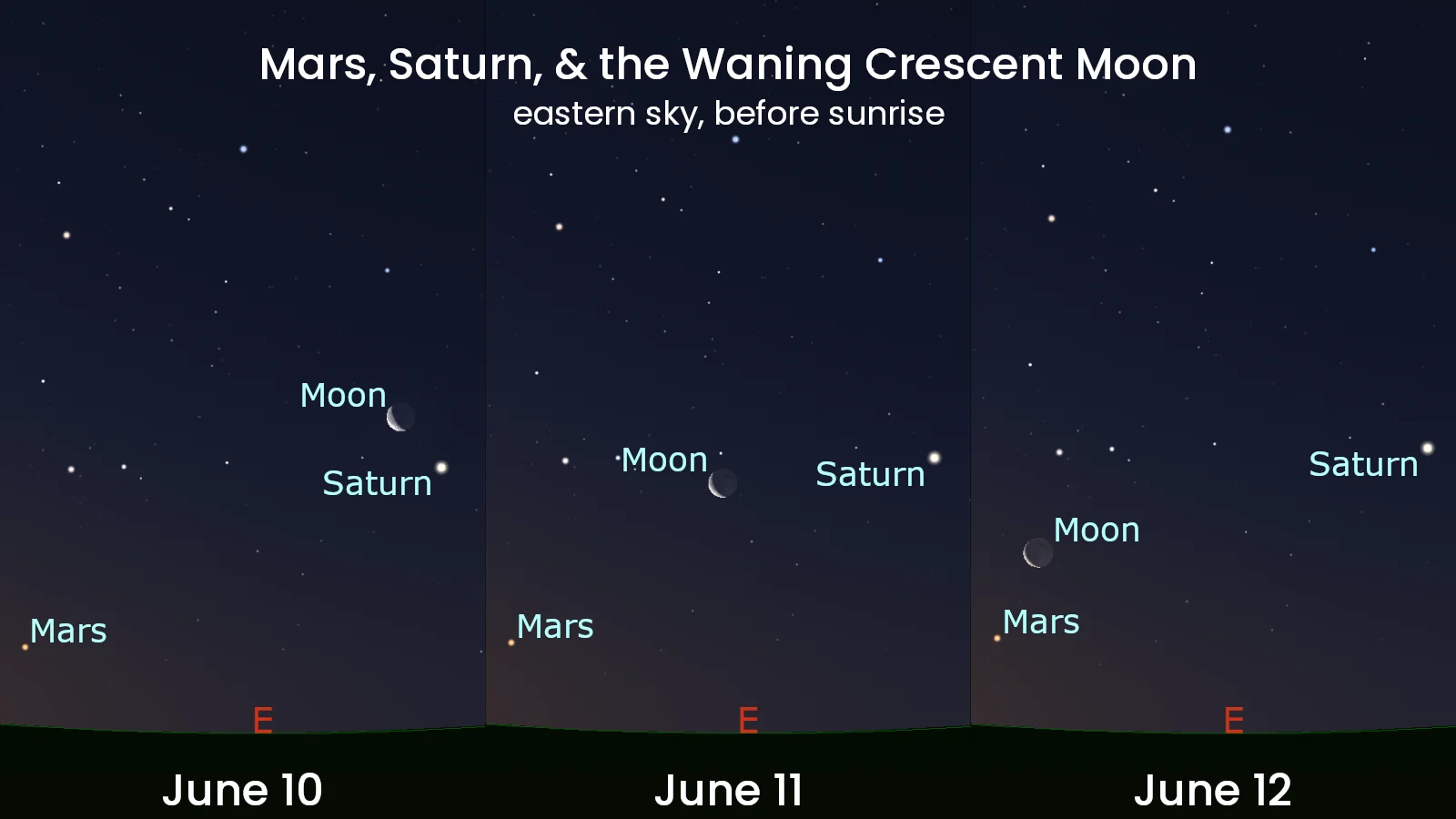
The Waning Crescent Moon passes Saturn and Mars on the mornings of June 10-12, 2026. (Stellarium/Scott Sutherland)
After this, early risers can watch the Waning Crescent Moon pass by Saturn and Mars between the 10th and the 12th.
Then, once we pass through the New Moon, and the Waxing Crescent Moon emerges in the evening sky on the 15th, we can watch it swing past Mercury, then Jupiter, and then Venus, each night until the 18th.
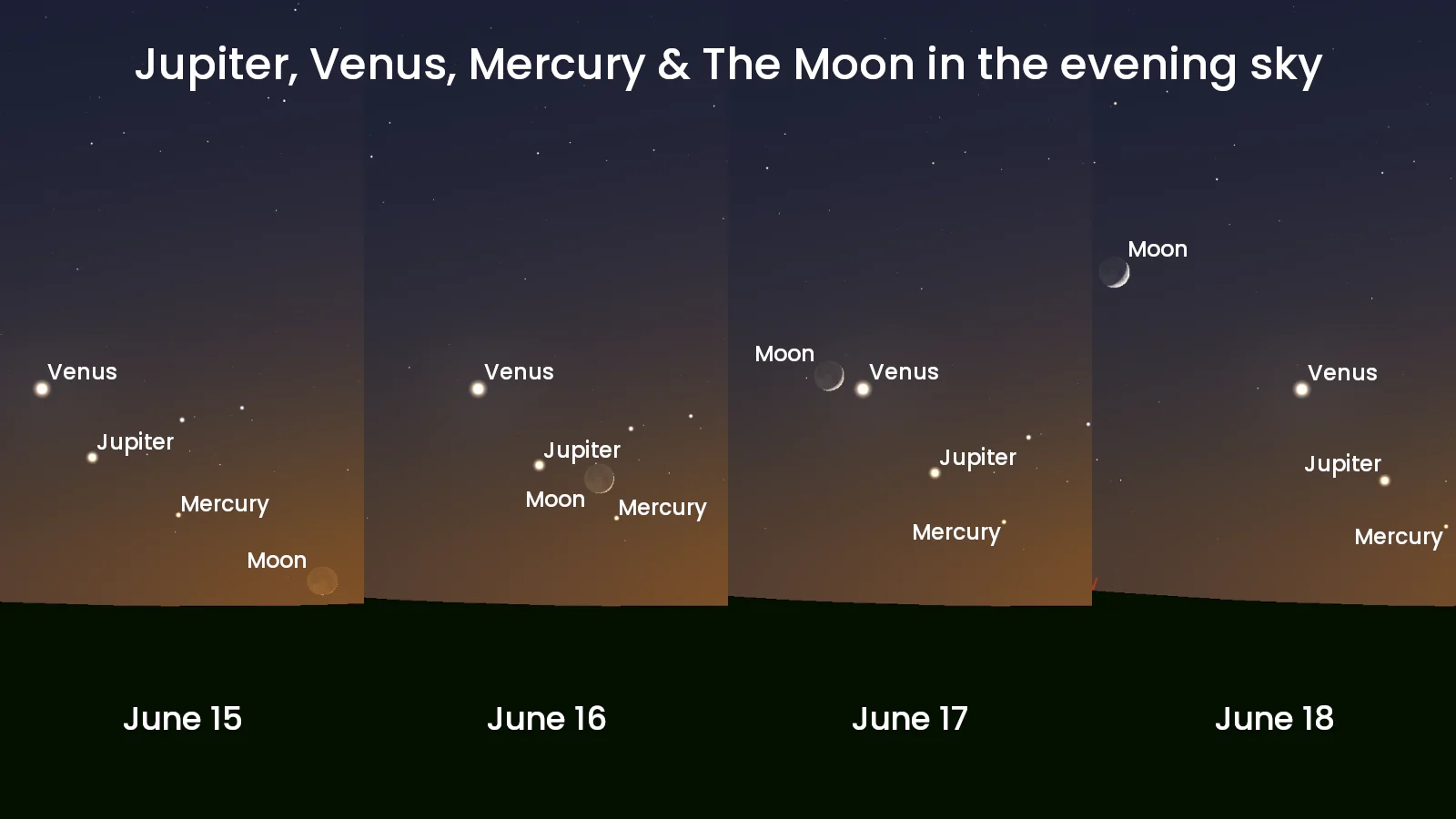
The positions of Venus, Jupiter, Mercury, and the Moon, in the evening hours on June 15-18, 2026. (Stellarium/Scott Sutherland)
READ MORE: How to get the most out of meteor showers and other night sky events
Summer Solstice
On June 21, at 08:25 UTC, the Sun will reach its highest point in the northern hemisphere sky. This signals the Summer Solstice, ushering in Astronomical Summer for 2026.
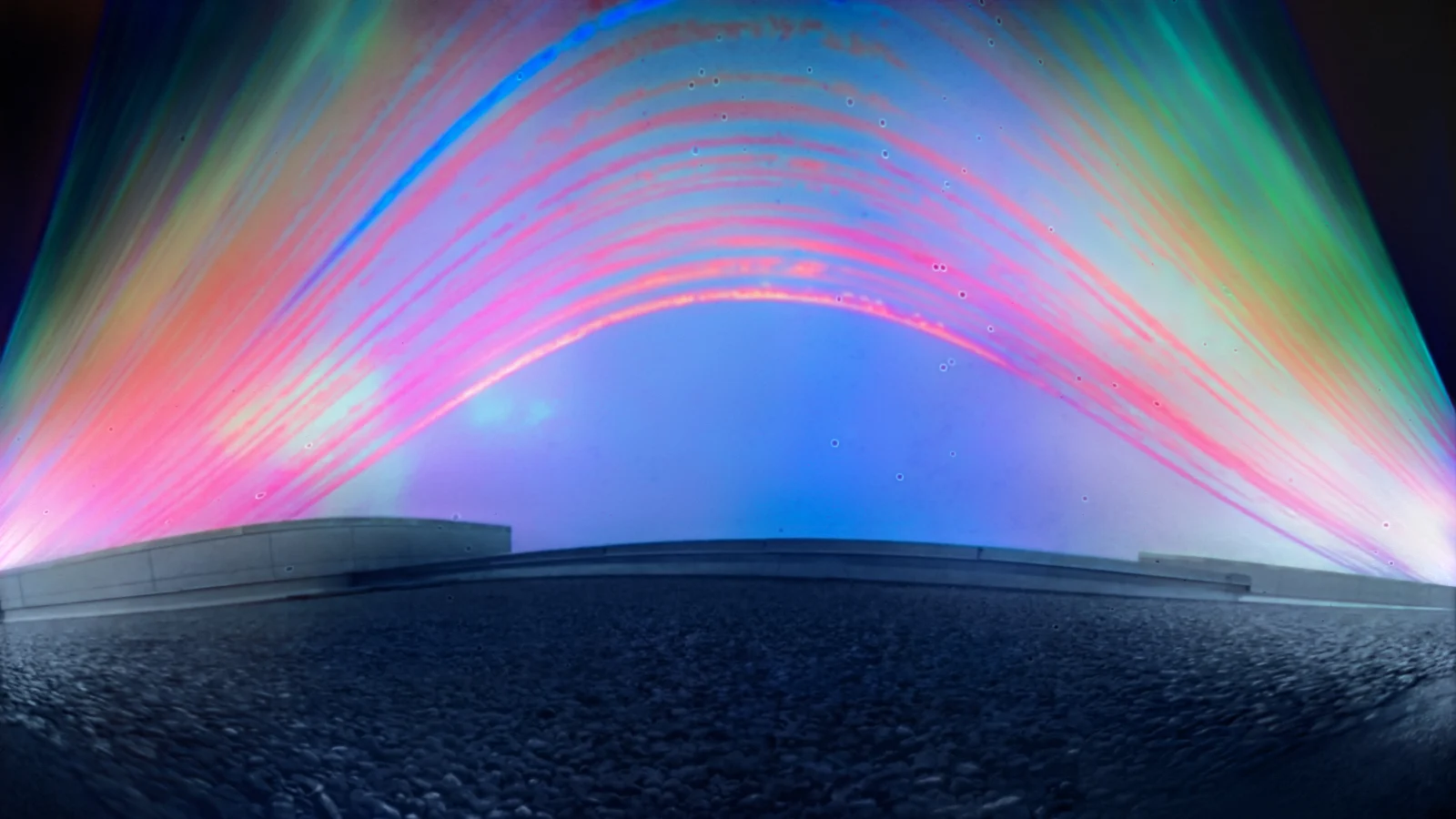
This 'solargraph' shows the path of the Sun through the sky from June 21 to December 21, 2023. (Bret Culp)
Here in Canada, most of us won't see the Sun at that exact moment, as it will be either minutes to hours before sunrise.
The only places that can see the Sun exactly at Solstice are across the northern territories, Newfoundland and Labrador, Cape Breton Island, the eastern half of mainland Nova Scotia, and Prince Edward Island.
The exact timing of this solstice, early in the day, also has an interesting effect in the length of the day.
Most years, the day of the Summer Solstice is the single longest day of the year.
However, according to timeanddate.com, when you see your longest day of the year in 2026 will depend on exactly where you live.
For much of Atlantic Canada, June 21 is the longest day of the year. For some communities within that region, though, such as Sydney, N.S., and Moncton, N.B., there are two longest days, on June 20 AND June 21.
While Quebec, Sherbrooke, and Drummondville also have only June 21 as their longest day. For Granby and Montreal, though, it's both the 20th and 21st.
In Ontario, there's an odd split. Ottawa, Peterborough, Hamilton, Kitchener, Guelph, London, North Bay, Sault Ste Marie, and Thunder Bay all have both June 20 and 21 as their longest days. Toronto, Windsor, and Sudbury, though, only have June 21 as the longest.
Going farther west, the longest day is June 21 for Winnipeg and Thompson, Man., but for Gimli (in between them), it's both the 20th and 21st.
And while Regina, Saskatoon, and Edmonton have their longest day on the 21st, Calgary has it on the 20th and 21st, along with most of British Columbia.
However, throughout northern B.C. and up to Whitehorse, YK, they have June 20 as their longest day!
DON'T MISS: Visit our complete guide to Summer 2026 for an in-depth look at the Summer Forecast, tips to plan for it and much more!
June Constellations
The transition to summer constellations continues during the month of June.
In the southern sky, Gemini can be found along the western horizon after sunset, with Cancer, Leo, Virgo, Libra, Scorpius, Serpens/Ophiuchus, and Aquila in a loose lineup across the evening sky. Hydra stretches across much of the horizon as well, while higher up, we can see Ursa Major, Boötes, Hercules, and Cygnus.
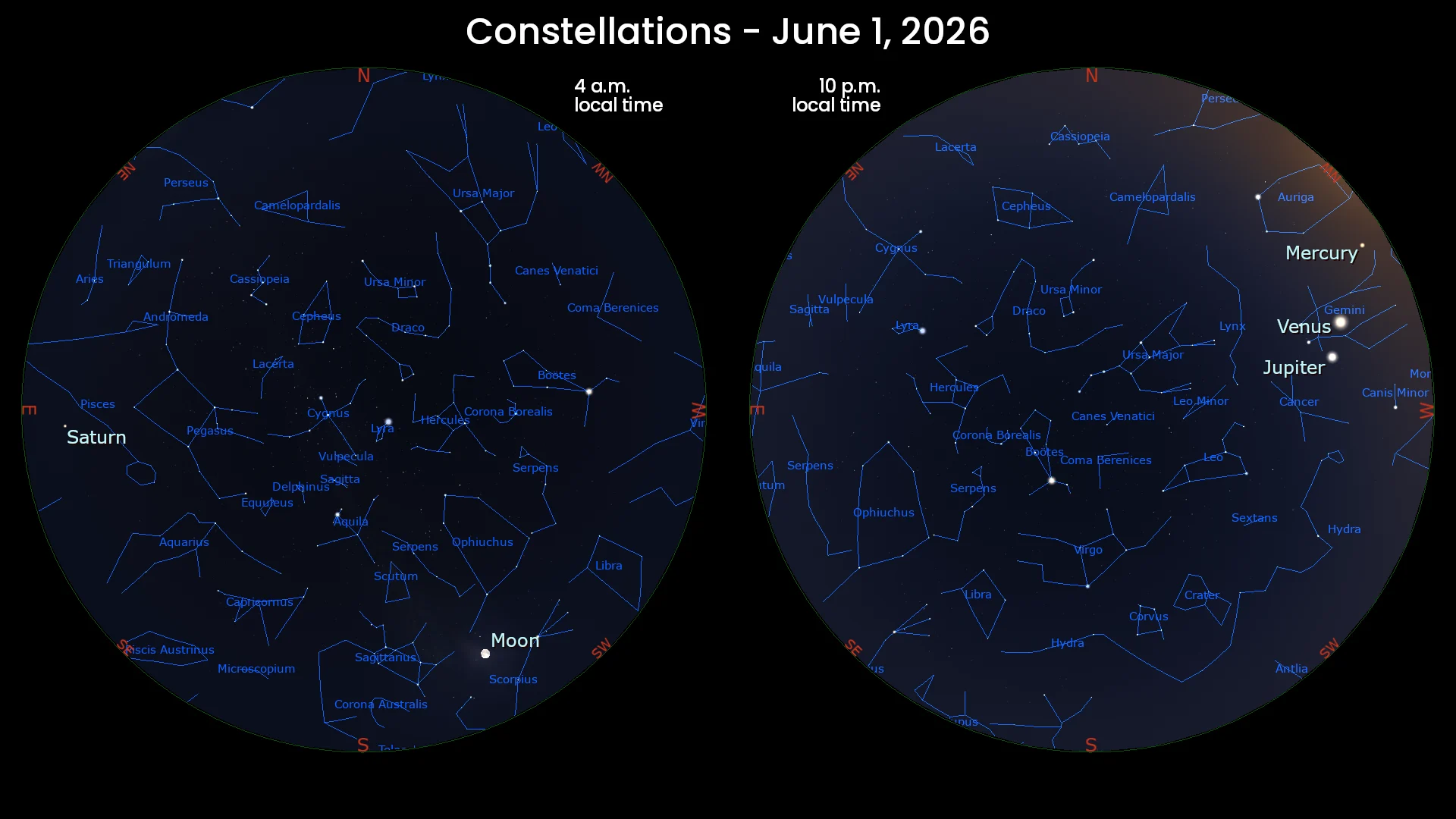
The constellations in the predawn and evening skies on June 1, 2026. (Stellarium/Scott Sutherland)
Meanwhile, facing north, Auriga, Camelopardalis ("The Camel"), Cassiopeia, Cepheus, and Cygnus are visible along low in the evening sky, with Ursa Major ("The Big Dipper"), Ursa Minor ("The Little Dipper") and Draco circling the north celestial pole.
By the end of the month, Gemini will have mostly set in the west as evening arrives, while Sagittarius will be rising in the east.
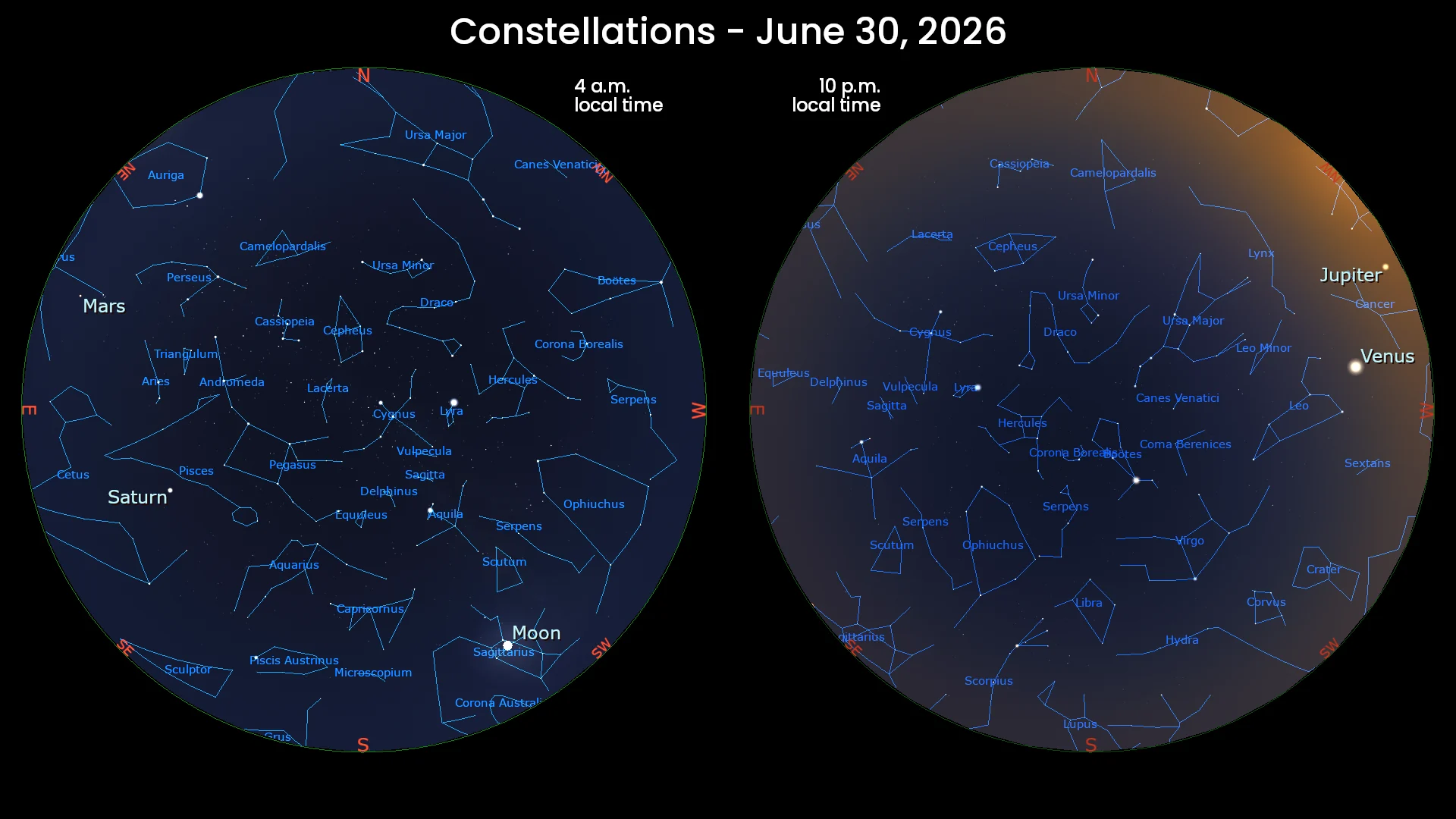
The constellations in the predawn and evening skies on June 30, 2026. (Stellarium/Scott Sutherland)
In the predawn hours, Libra and Scorpius will have slipped beyond the western horizon, as Cetus and Sculptor rise in the east.