Look up! The Ursid meteor shower peaks on the Winter Solstice

Check your forecast for clear skies on Sunday night, and then turn your gaze to the stars!
Eyes to the sky on the night of the Winter Solstice, to see pieces of an odd 'binary' comet streak through the sky, as the annual Ursid meteor shower reaches its peak.
Sunday, December 21 is the longest night of the year. Across Canada, we'll have at least 15 hours of darkness once the Sun goes down, and what better way to put that extra nighttime to good use than to watch a meteor shower!
Fortunately, it just so happens that there is a meteor shower perfectly timed for that night, as the Ursids reach their yearly peak.
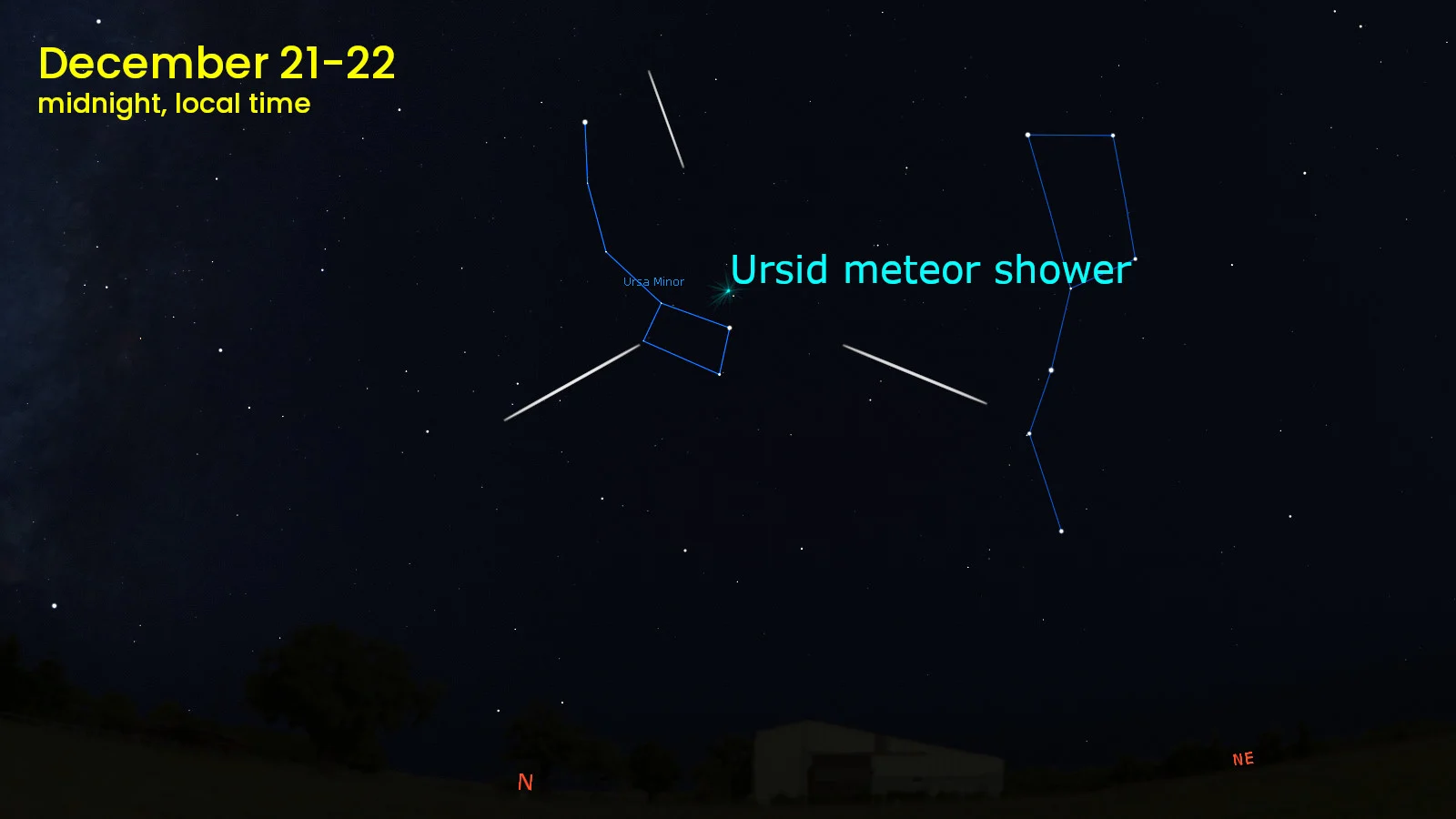
The radiant of the Ursid meteor shower, located near the Little Dipper in the northern sky, on the night of December 21-22, 2025. (Stellarium/Scott Sutherland)
The Ursid meteor shower is relatively short and weak, running from the 17th to 24th of December each year, and only producing around 10 meteors per hour when it peaks on the night of the 21st-22nd.
However, Ursid meteors stream out of a point high in the northern sky. Thus, observers only need to wait until it is sufficiently dark after sunset for meteors to show up, and they will continue to streak by overhead until morning twilight ends the show.
This year, in 2025, the length of the night isn't the only thing well-timed for the Ursids.
On Sunday night, just after sunset, an extremely thin Waxing Crescent Moon will be low in the western sky. It won't remain there for long though, as it sets around 6 p.m. local time, leaving the rest of the night moonless and dark. In fact, just based on the phases of the Moon, this will be the darkest Winter Solstice night since 2014!
Since bright moonlight can wash out the sky, making it much more challenging to spot meteors, this is a great boon for the Ursids this year!
Also, according to the International Meteor Organization, there is a chance we may see a minor outburst of activity from the Ursids this year.
The Ursids originate from an odd 'peanut-shaped' comet named 8P/Tuttle. As this contact-binary comet travels around the Sun, it ejects dust and ice into space, which forms a stream that orbits along the comet's path. The meteor shower occurs when Earth flies through that stream, and the shower peaks when we reach the densest part of it.
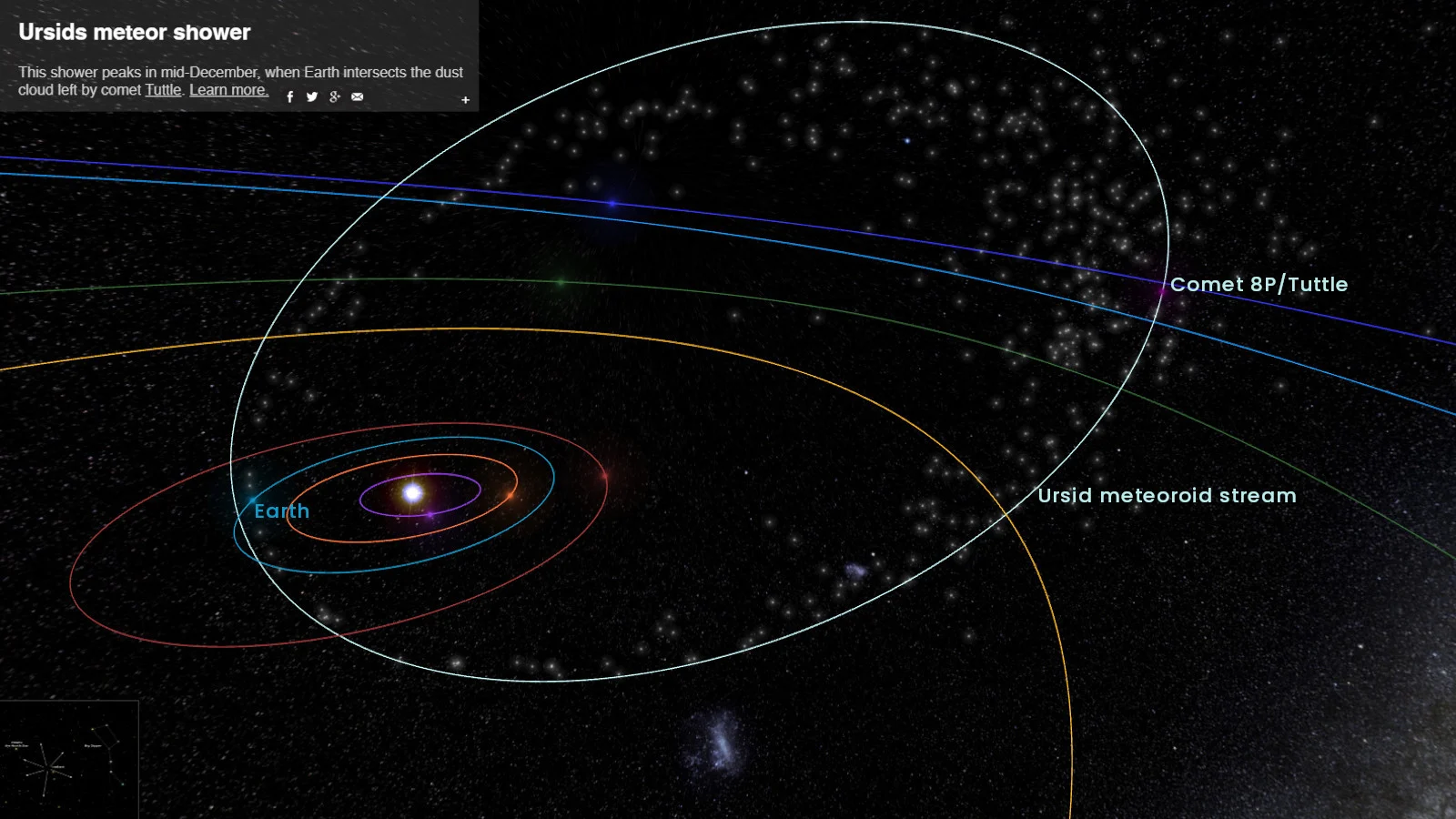
The Ursid metoroid stream. (meteorshowers.org)
READ MORE: How to get the most out of meteor showers and other night sky events
While even the most concentrated region of the Ursid stream is still fairly sparse, astronomers have found 'filaments' embedded within. These are ultra-dense bands within the stream, which result either from the gravitational pull of the planets, or an extraordinary burst of activity from the comet, or both.
When Earth encounters one of these filaments, it causes an outburst — a brief increase in the number of meteors we see in the sky.
Just such an outburst is predicted to occur after midnight (EST) on the night of the 21st to 22nd. At that time, number of meteors could jump to around 25 per hour.
When observing the Ursids, observers can maximize their chances of spotting meteors by getting as far away from city lights as possible. Even a dark backyard in the suburbs can offer a good view, if sheltered from streetlights by buildings and trees.
Also, no extra equipment is needed to view a meteor shower. Bring along a telescope or binoculars to check out other targets in the sky from time to time (Jupiter, the Pleiades, or the Orion Nebula are excellent choices right now). However, to view the meteor shower, just find a good place without any light directly in your field of view, tilt your head back, and take in as much of the sky as possible at once.
Although the meteors can be traced back to a point near the Little Dipper, they appear randomly and at any point in the sky overhead. So, be sure to scan around the sky, to give yourself the best chance of spying these brief flashes of light.