Auroras may spark across parts of Canada tonight due to speedy solar wind

G1 geogmagnetic storm levels are in the forecast for Friday night.
Earth is about to plunge into a blustery flow of the solar wind, and that means there's a decent chance of the Northern Lights showing up across parts of Canada Friday night.
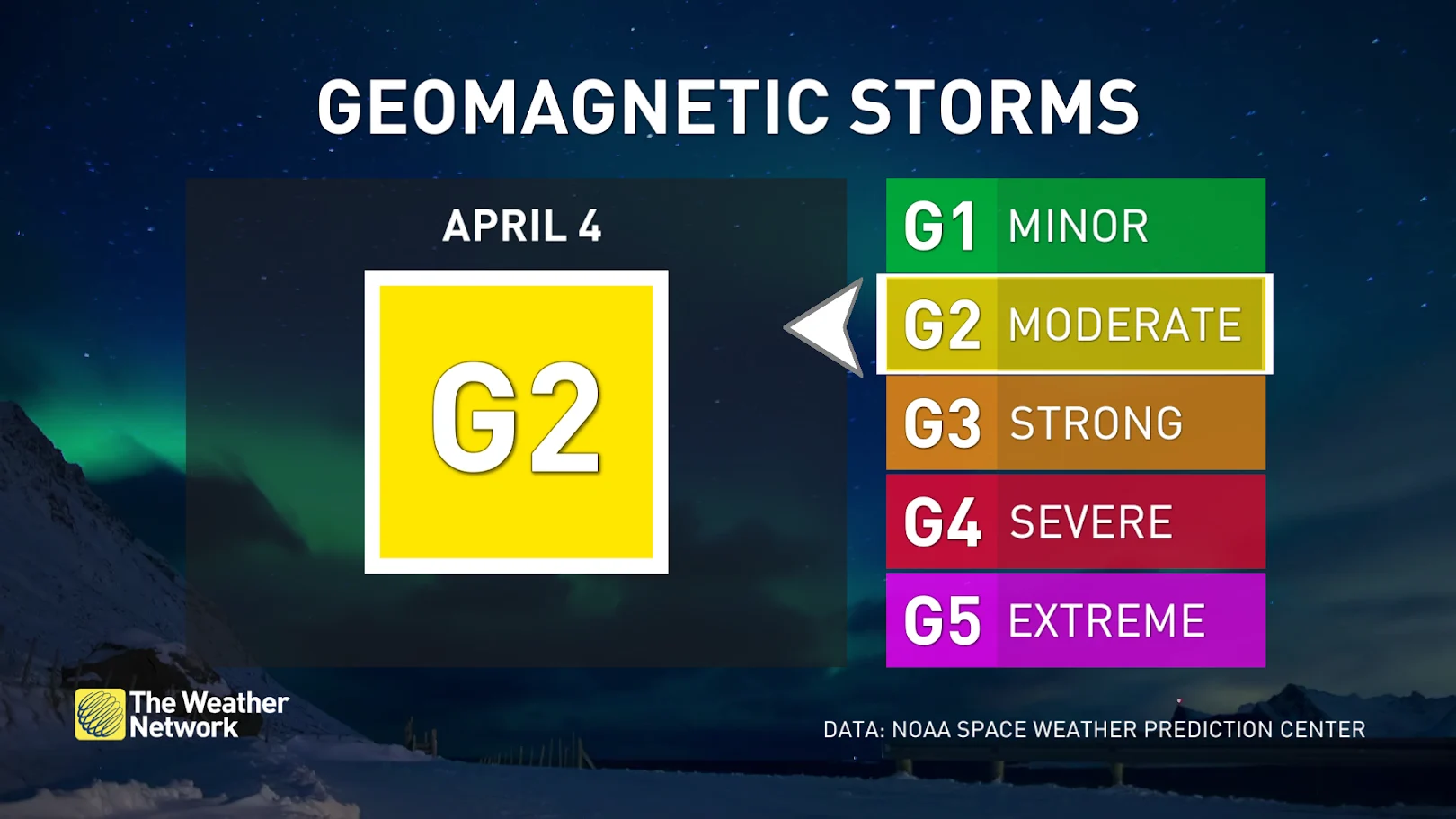
According to NOAA's Space Weather Prediction Center, a fast, energetic flow of solar particles is about to sweep past Earth. As a result, we could see G1 (minor), or possibly up to G2 (moderate) geomagnetic storm conditions on the night of Friday, April 4.
DON'T MISS: Weather Network meteorologist's name is now written among the stars
This updated forecast from SWPC has bumped up the impact from a G1 to G2 geomagnetic storm. This could be due to G1 geomagnetic storm levels already being observed Thursday night, before any higher activity wasa expected. This increases the potential for stronger impacts as we plunge into the coming high-speed solar wind stream. As a result, the Northern Lights could put on a great display for parts of Canada overnight.
Observers across the Prairies, as well as anyone in the northern territories, have the best chance at spotting the Northern Lights. With the increase in geomagnetic storm level, though, the auroras may also be visible along the northern horizon from as far south as the shores of Lake Huron and Georgian Bay.
Clear skies are essential for getting the most out of the auroras. The map below shows the forecast cloud conditions across Canada for Friday night.
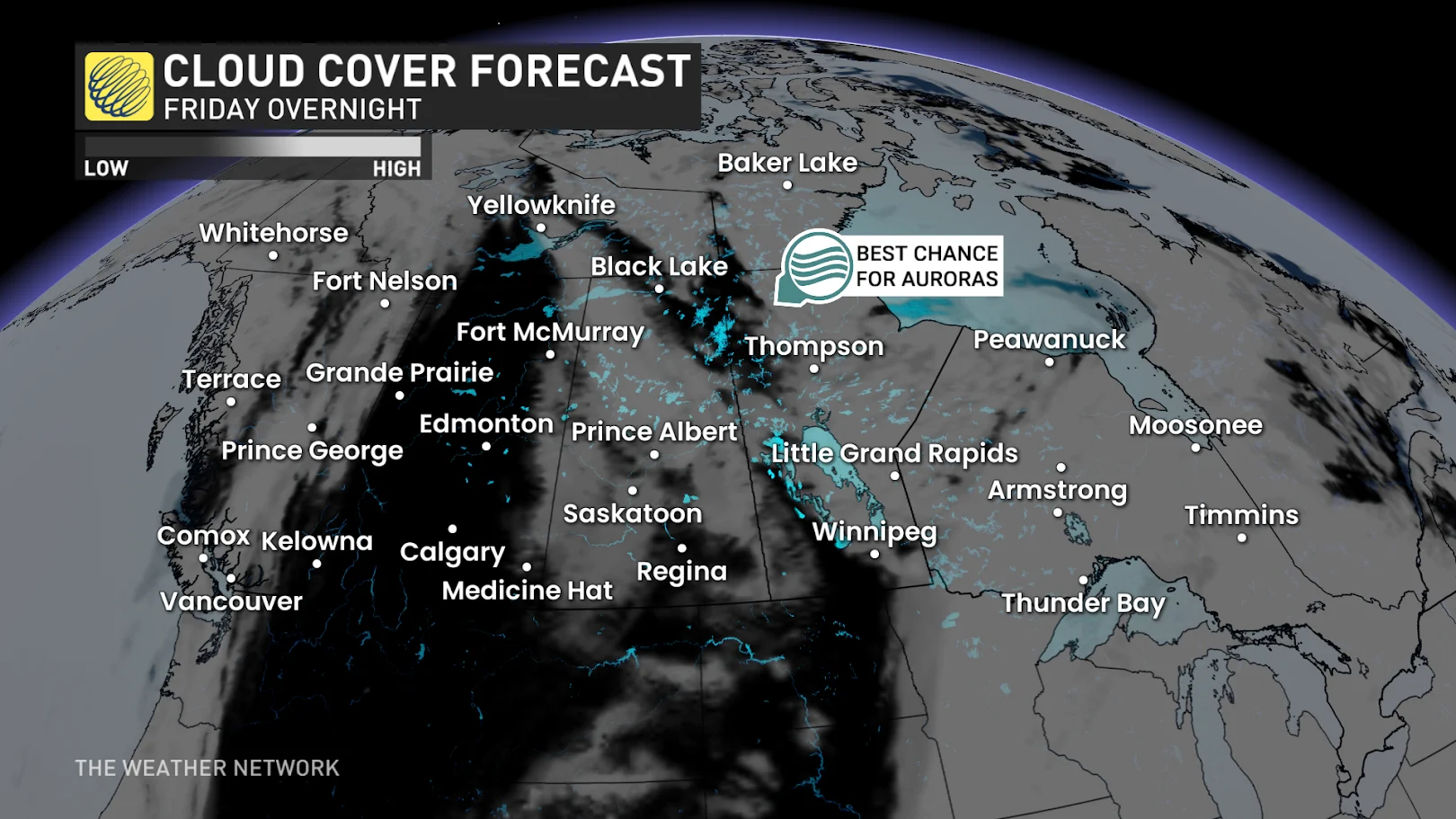
The best places to potentially see the Northern Lights from this geomagnetic storm, based on the forecast, appear to be southern and western Manitoba, parts of southern Saskatchewan, most of Alberta, and southeastern British Columbia.
READ MORE: Geomagnetic storms: When should we look up and when should we worry?
What's going on?
The solar wind is composed of charged, magnetically-infused particles (mostly protons and electrons) flowing away from the Sun. While the normal solar wind flow is fairly sedate, faster streams, containing higher-energy particles, are emitted from holes in the Sun's atmosphere, appropriately called 'coronal holes'.
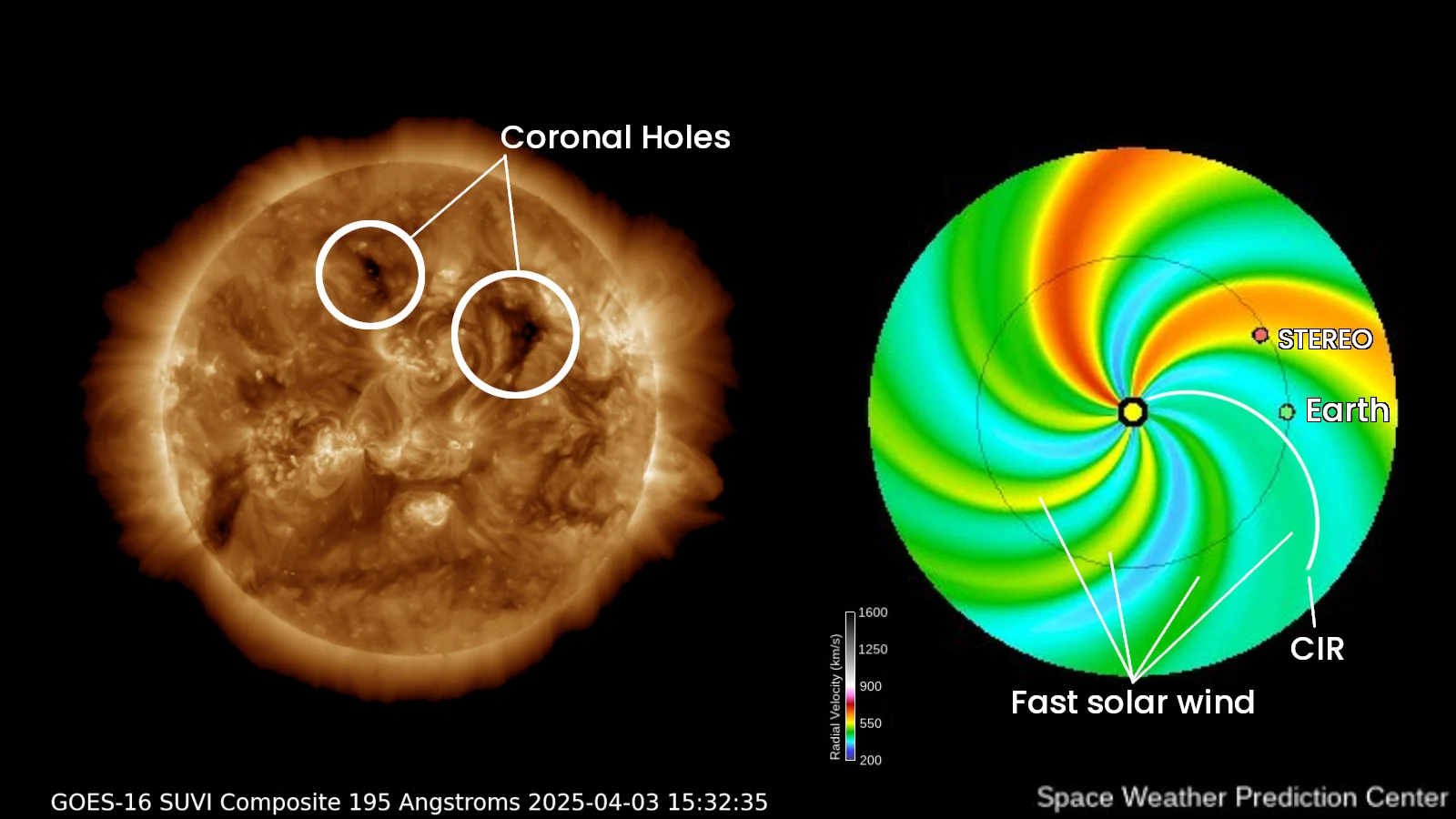
The Sun, as imaged in extreme ultraviolet by the GOES-16 geostationary weather satellite's SUVI instrument on April 3 shows two dark coronal holes in the northern hemisphere. Emitted from those holes are fast streams of the solar wind, which show up as the colours green through yellow in the computer model run shown to the right (which tracks the speed of the flow away from the Sun), which is dated for late on April 4. Earth (green dot) is right on the transition between a slow flow (blue) and a fast flow (green) at that time, where a co-rotating interaction region often forms (CIR), which can spark auroras as it sweeps past us. NOAA SWPC/Scott Sutherland)
As shown on the right side of the above image, the two types of solar wind streams form a 'pinwheel' pattern around the inner solar system, which rotates in a counter-clockwise direction along with the Sun.
READ MORE: How do the Northern Lights shine? Here's the science behind auroras
At the leading edge of each of the fast streams, high-energy particles within the flow suddenly run into the denser normal flow and are nearly stopped in their tracks. This results in a buildup of those high-energy particles all along the leading edge of the stream, which space weather scientists call the co-rotating interaction region or CIR (the white arc in the image).
When a CIR sweeps past us, there's a sudden uptick in the number of charged particles interacting with Earth's geomagnetic field. This sets off a reaction that we call a geomagnetic storm. Meanwhile, a large number of those solar particles become trapped by the geomagnetic field, which funnels them down towards the north and south poles.
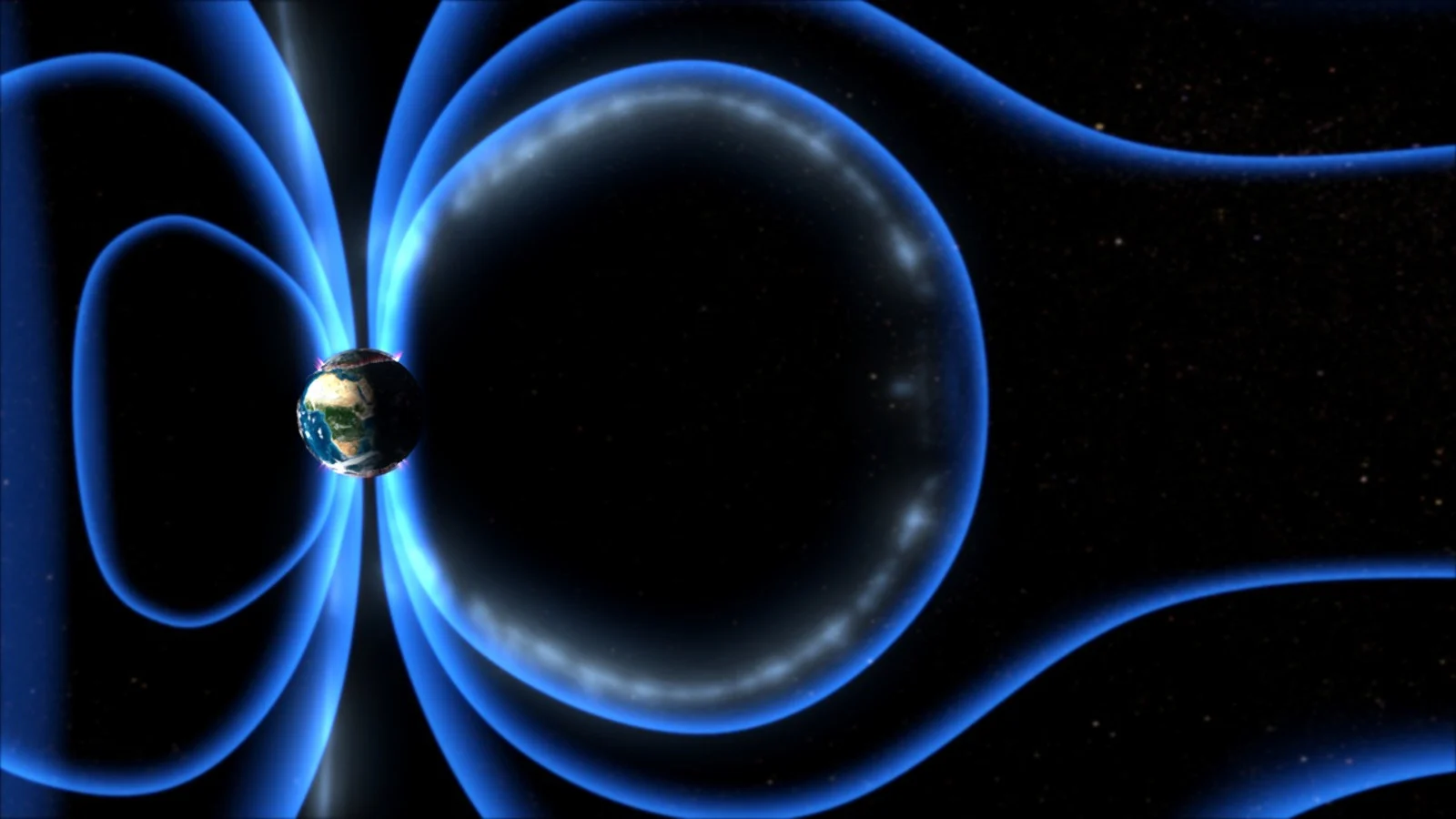
An idealized representation of Earth's geomagnetic field is shown here, compressed on the sunward side (left), and drawn out into a long 'tail' on the anti-sunward side (right). White solar particles are trapped by the field, which then funnel down to produced auroras. (NASA)
When those particles encounter oxygen and nitrogen in the air, they energize those atoms and molecules, causing them to emit flashes of coloured light, which results in the auroras.
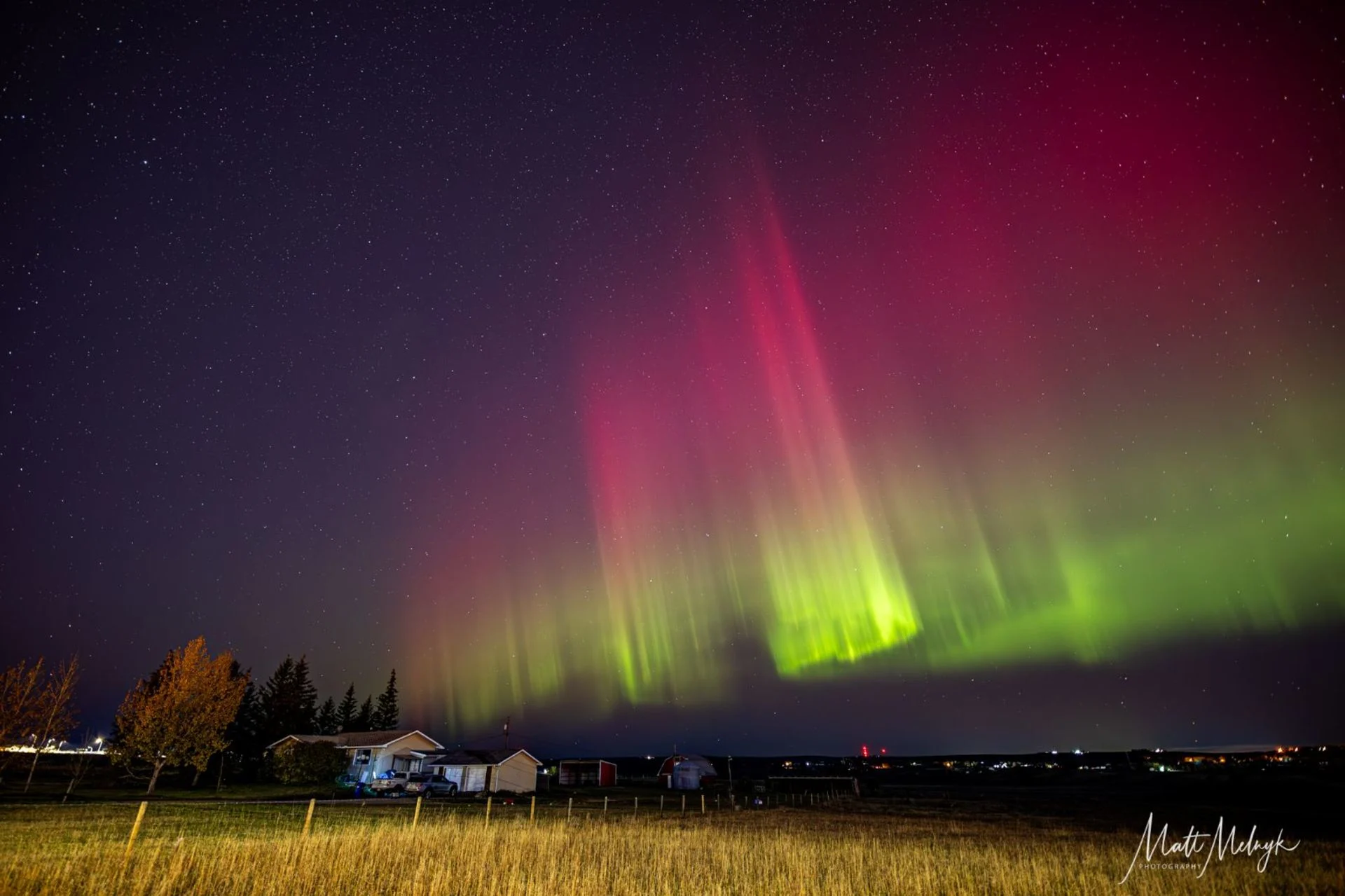
(Thumbnail image courtesy Matt Melnyk, who captured this view of the Northern Lights from north of Calgary on October 6, 2024, and shared it on The Weather Network's UGC Gallery.)