Eyes to the sky! A rare Blue Moon lights up the night this weekend

We have a long wait before we see this rare combination again!
Saturday night's Full Moon is not only the second one we'll see this month, it is also an exceptionally rare type of Blue Moon that we won't see again for at least another 27 years!
On the night of May 30, 2026, a Full Moon will cross the sky, rising at sunset and setting as the Sun rises on the morning of the 31st.
Despite this still being the fifth month of the year, this will be the sixth Full Moon we've seen in 2026. Due to the timing of the Full Moons so far, the Full Flower Moon rose on the night of May 1-2, and this will be the second Full Moon of this month — a Blue Moon.
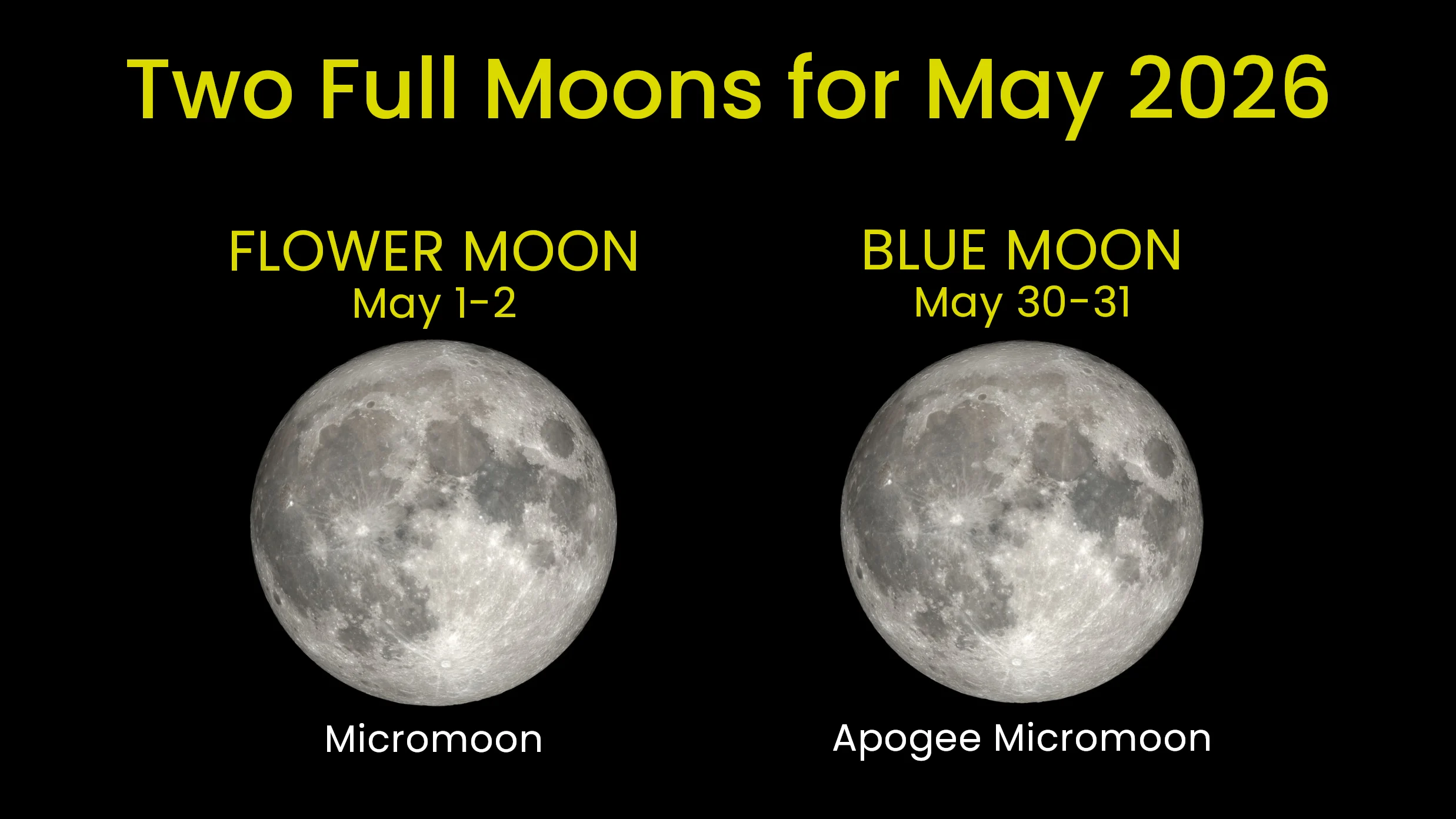
The two Full Moons of May 2026. (NASA's Scientific Visualization Studio/Scott Sutherland)
The last time we saw a Blue Moon such as this was nearly 3 years ago, on August 31, 2023. The next one will occur on December 31, 2028.
If you miss this on Saturday night, for whatever reason, the Moon will appear full (with the near side at least 98 per cent illuminated) between midnight and sunrise on Friday the 29th, plus all night long on Sunday the 31st, as well.
What is a Blue Moon?
Every one of the typical 12 Full Moons we see during the year has its own popular name. These are drawn from a list collected from Indigenous, Colonial, and European sources, by the Farmer's Almanac in the early 20th century.
What happens, though, when you have an 'extra' Full Moon?
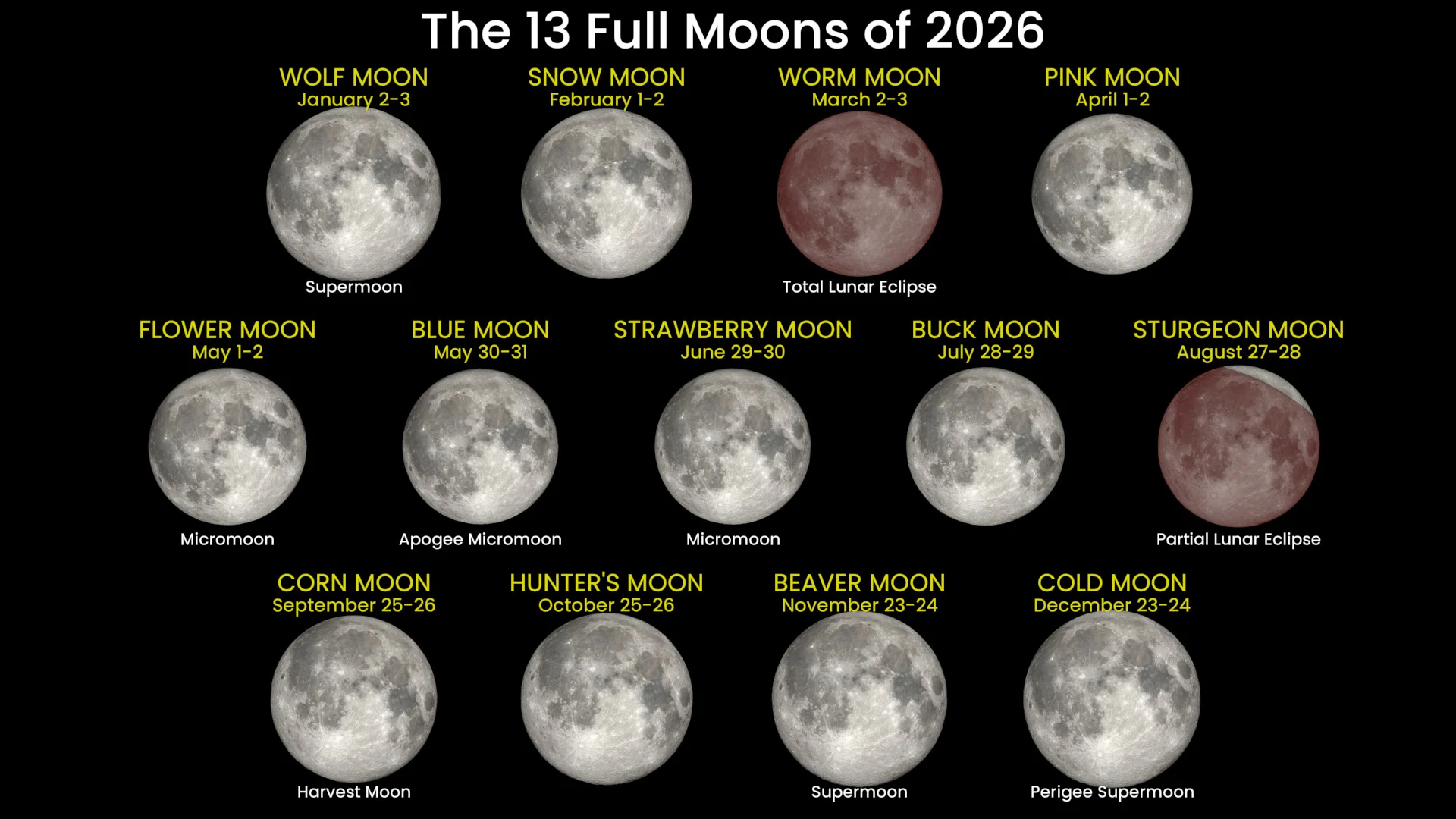
The 13 Full Moons of the calendar year 2026. (NASA's Scientific Visualization Studio/Fred Espenak/Scott Sutherland)
Although we tend to see one Full Moon every month, for a total of 12 throughout the calendar year, once every two-and-a-half to three years there are instead 13 Full Moons.
Due to their specific timing, one month of that year will have two Full Moons — one at the beginning of the month and one at the end. Since a lunar cycle is 29.5 days long, this can occur in any month except February (even in a leap year).
The second of those two Full Moons — the 'extra' one — is then called a Blue Moon.
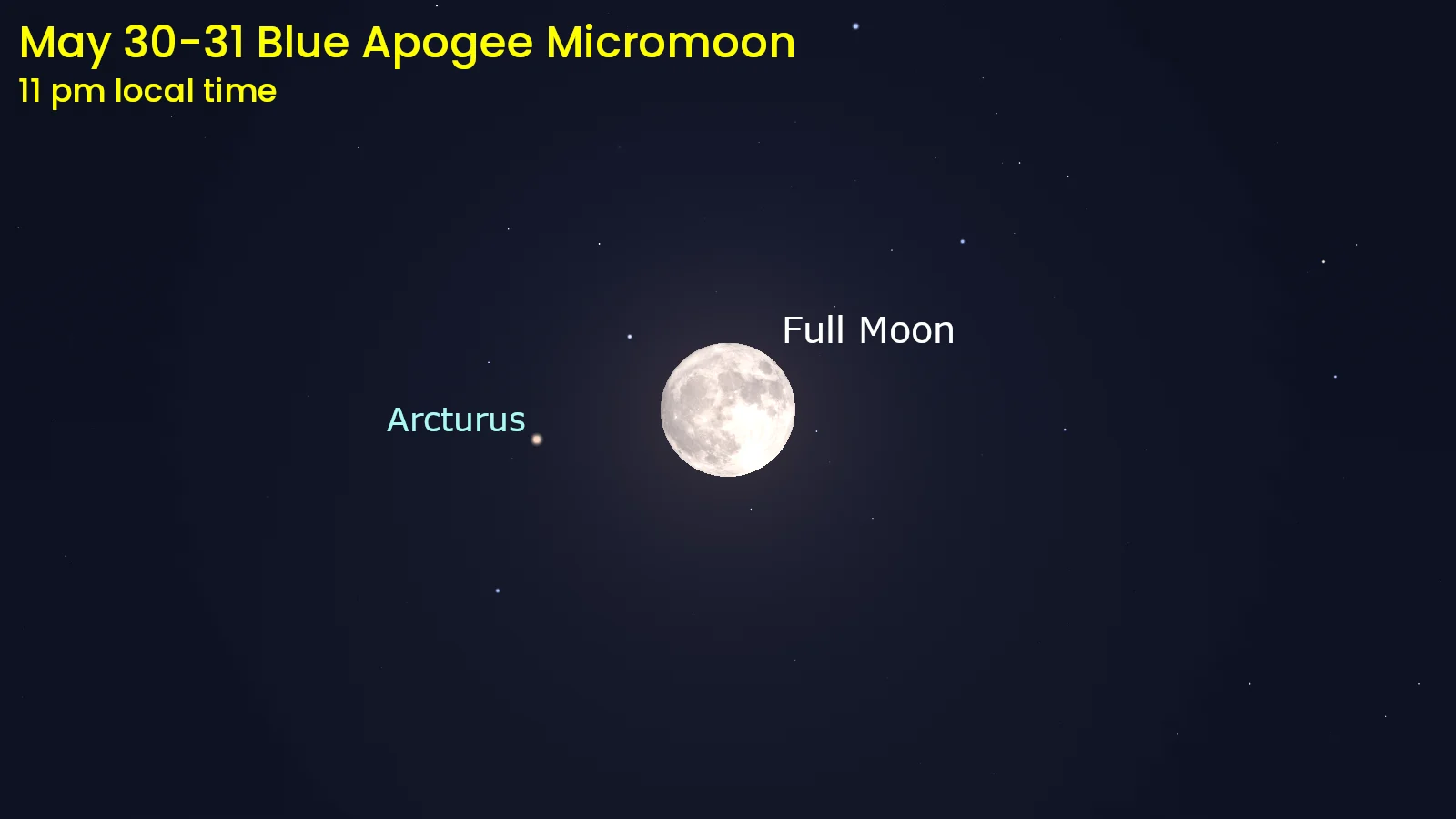
The May 30 2026 Blue Moon crosses the sky in the constellation Scorpius, with the bright star Arcturus nearby. (Stellarium/Scott Sutherland)
There's another kind of Blue Moon, as well, known as a 'seasonal' Blue Moon.
This occurs during a calendar year which has 12 Full Moons, with one each month, but the timing of them results in four of them being clustered within a single season, typically spring, summer, or fall. Winter seasonal Blue Moons are possible, but they are also exceedingly rare. The last one was on February 19, 2000, but we apparently won't see another until the same night in 2287!
The third of those four Full Moons in the season is the Blue Moon, with "Blue" being added to its usual name. Thus, 2024's August 19 Full Moon — the third of four Full Moons for the summer season — was the Blue Sturgeon Moon. Also, 2027's May 20 Full Moon — the third of four for that spring — will be the Blue Flower Moon.
Like with calendar Blue Moons, seasonal Blue Moons also happen once every two-and-a-half to three years. However, the two types are usually offset from each other by a year or so, with rare instances where you will see both in a single year. For example: 2048 has a calendar Blue Moon on January 31, and then a seasonal Blue Moon on November 20.
Why is this one so special?
There's nothing about Blue Moons that make them particularly distinct. They are uncommon, for sure, but hold no significance, other than being an excellent reminder of the variability of lunar cycles.
What sets this specific Blue Moon apart from others is its distance from Earth.
The timing of the Moon's phases isn't the only thing that changes from orbit to orbit. The exact shape of the Moon's elliptical orbit around Earth also shifts, due to the gravitational interaction between the Moon and Earth, the Sun, and the other planets in the solar system. The result is that each time there is a Full Moon, it will be at a slightly different distance from us than any other Full Moon.
This follows a pattern, so that every 13th or 14th Full Moon is a Perigee Supermoon — occurring when the Moon is closest to us in its orbit, and is thus the largest and brightest Full Moon of the cycle. The Full Moon that occurs nearest to the middle of that cycle happens when the Moon is at its farthest distance from Earth in its orbit. That makes it the smallest and dimmest Full Moon of the cycle, which is known as the Apogee Micromoon.
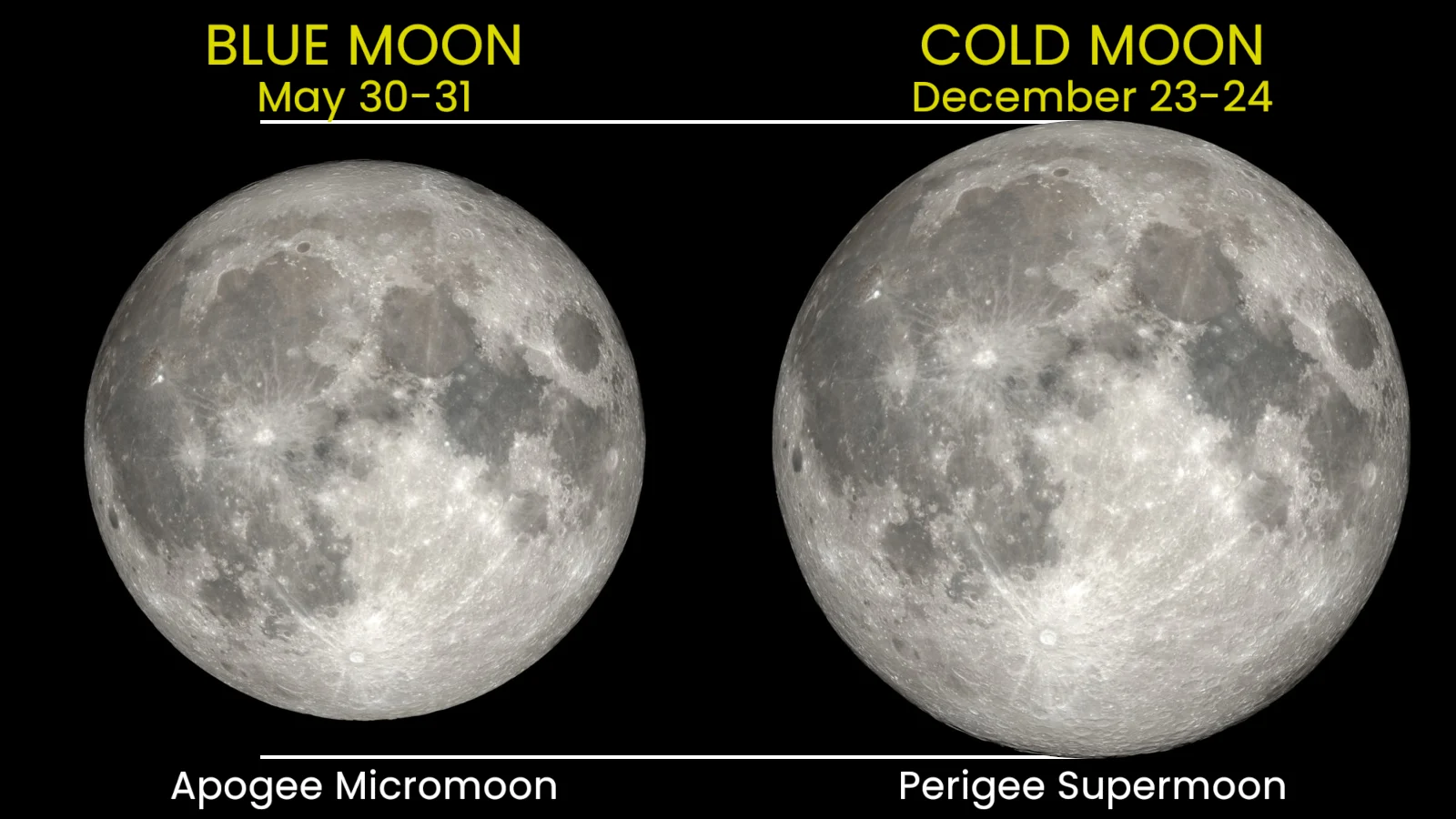
The Apogree Micromoon vs the Perigee Supermoon. (NASA's Scientific Visualization Studio/Fred Espenak/Scott Sutherland)
By itself, this also doesn't have any particular significance, although an Apogee Micromoon does result in smaller tides around that date, for those living in coastal regions.
However, combining these two aspects together, so that you have a Blue Moon that is also the Apogee Micromoon, is far more rare.
The last one wasn't so long ago, as we saw a Blue Apogee Micromoon on October 31, 2020. However, we have quite the wait for the next one.
For those of us in North America, the next Blue Apogee Micromoon occurs over 27 years from now, on the night of June 30, 2053.
Due to the exact timing, at 10:03 p.m. EDT on that night, the rest of the world doesn't see 2053's Blue Moon until July 30, which is not that cycle's Apogee Micromoon. So, they won't experience the next Blue Apogee Micromoon until at least December 31, 2066!
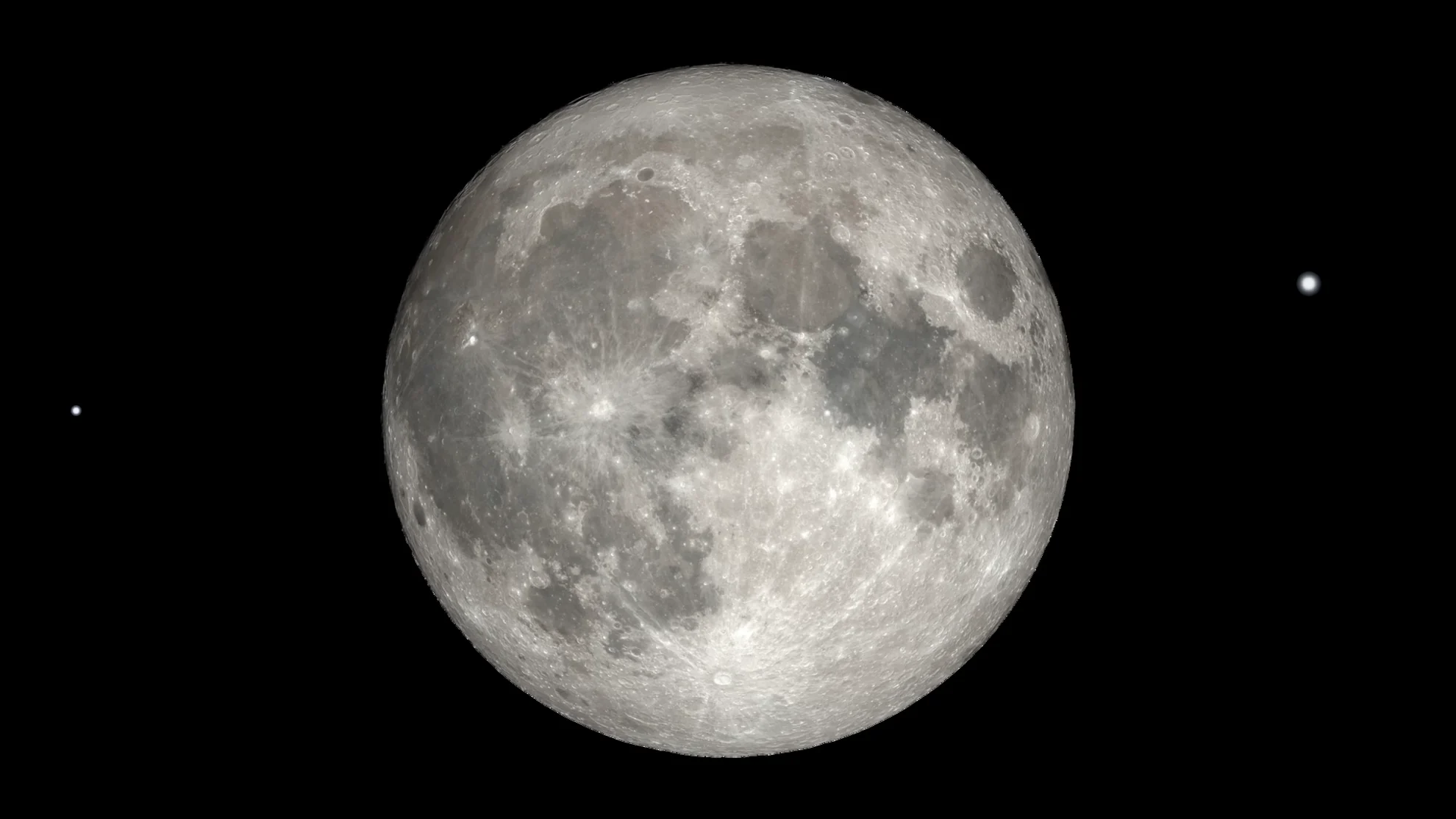
(Thumbnail image is a view of the May 30 2026 Full Moon composed from data gathered by NASA's Lunar Reconnaissance Orbiter, combined with some of the stars in the Moon's vicinity on that night, courtesy the astronomical simulation software Stellarium)