Look up! Halley's comet meteors light up our night skies this week!

Tiny bits of Halley's comet are raining down from space, sending flashes of light across our night sky!
Although Halley's Comet won't return for another 35 years, right now, tiny meteoroids left behind in its orbit are producing streaks of light across our skies, and the best time to see this is this week.
Every 76 years, bright comet 1P/Halley sweeps through the inner solar system, wowing observers as it crosses our night skies. The last time this happened was in early 1986, and the next time we see it will be in the summer of 2061.
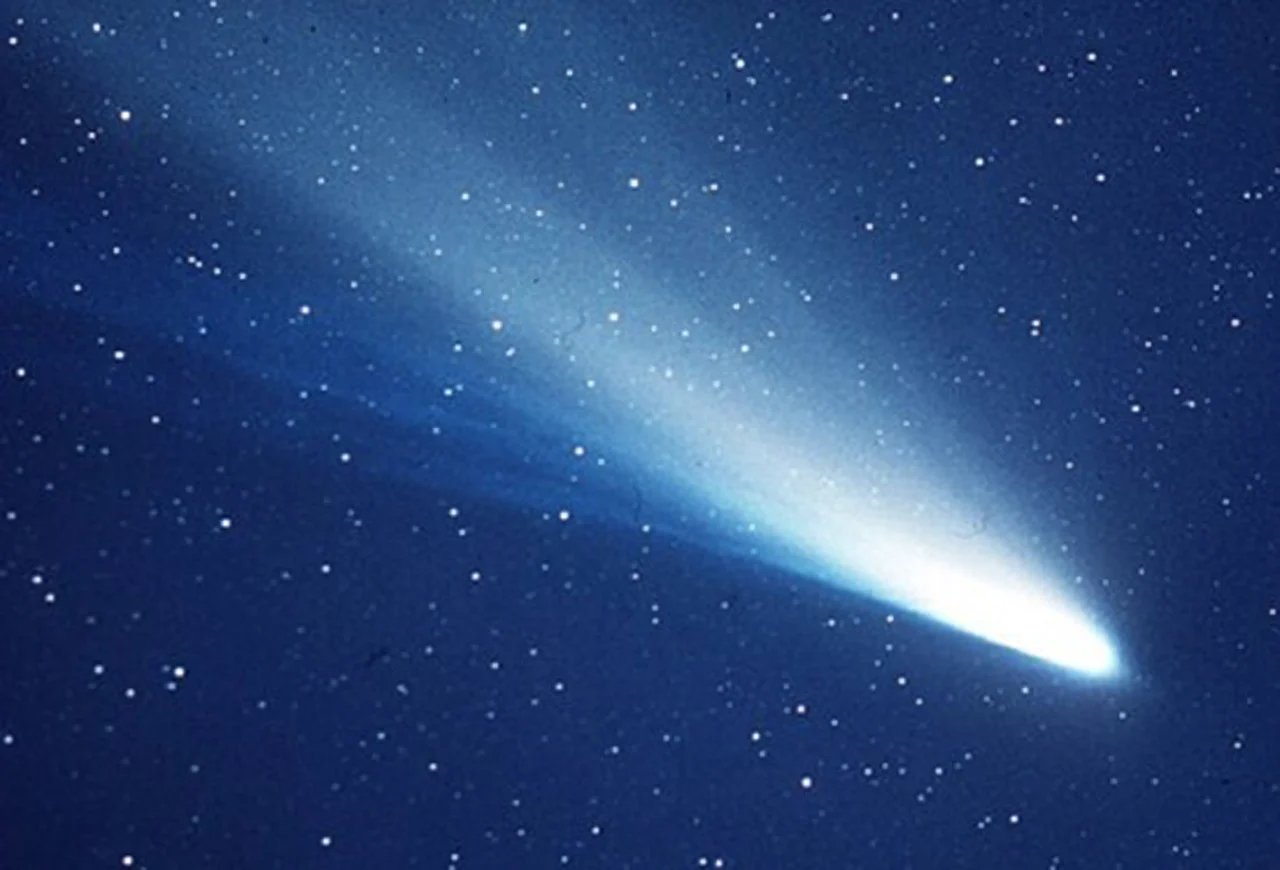
Comet 1P/Halley as it was captured by a joint American-Canadian observing program at the Canada-France-Hawaii Telescope on Mauna Kea, Hawaii, in December 1984. (NASA JPL)
READ MORE: Halley's Comet meteors flash across the sky in October
Although there is a long wait in between direct sightings of the comet, each year, due to the exact path it takes around the Sun, we receive two reminders of its existence.
The first is the eta Aquariid meteor shower, which occurs in April and May. And now, in October, we are seeing the second, in the form of the Orionid meteor shower.
These showers are caused by tiny pieces of debris (meteoroids), which were once part of the comet, but were ejected by plumes of vapourized ice as the Sun heated its surface. These meteoroids then followed along behind the comet, and over time, a near continuous stream of debris has formed along Halley's orbit.
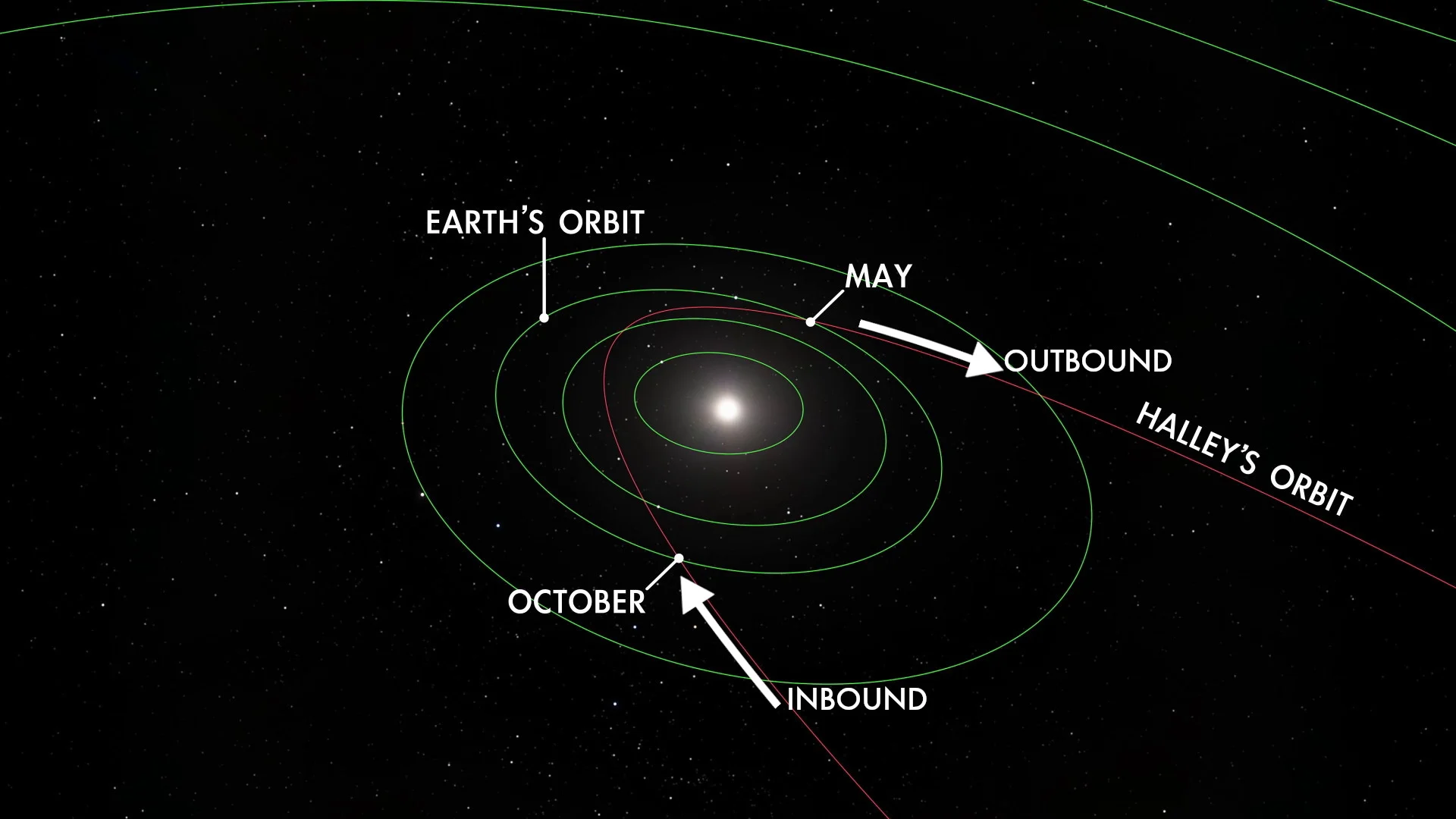
Comet Halley's retrograde path through the inner solar system, which it follows once every 76 years, carries it near Earth's orbit twice. When Earth intercepts the comet's debris stream, in both April-May and September-November, it results in the eta Aquariid and Orionid meteor showers, respectively. (NASA/Scott Sutherland)
DON'T MISS: See why Fall is the season of meteor showers!
Earth passes through that debris stream along two specific regions of our orbit, from mid-April to late May, and from early October through mid-November. Each time, meteoroids from the stream get swept up, plunging into the atmosphere from space and producing streaks of light across our night skies.
During the first pass, we encounter the outbound stream, with the resulting meteors appearing to originate from the constellation Aquarius, in the eastern sky during the hours just before sunrise. Then, we pass through Halley's inbound stream in October, and the meteors switch over to the constellation Orion, starting after sunset and continuing until dawn each night.
Orionids peak!
Look up on any night from October 2 through November 12, and you might spot a handful of meteors between dusk and dawn that can be traced back to the vicinity of Orion.
On the night of October 20-21, though, especially between midnight and dawn on the 21st, the Orionid meteor shower reaches its yearly peak.
At that time, observers under clear, dark skies typically spot around 15-20 meteors every hour. Although the meteors appear randomly, on average, that comes out to one every three to four minutes.
Additionally, past observations have revealed that we can potentially see between 10-15 meteors per hour during the nights just before and just after the Orionids peak.
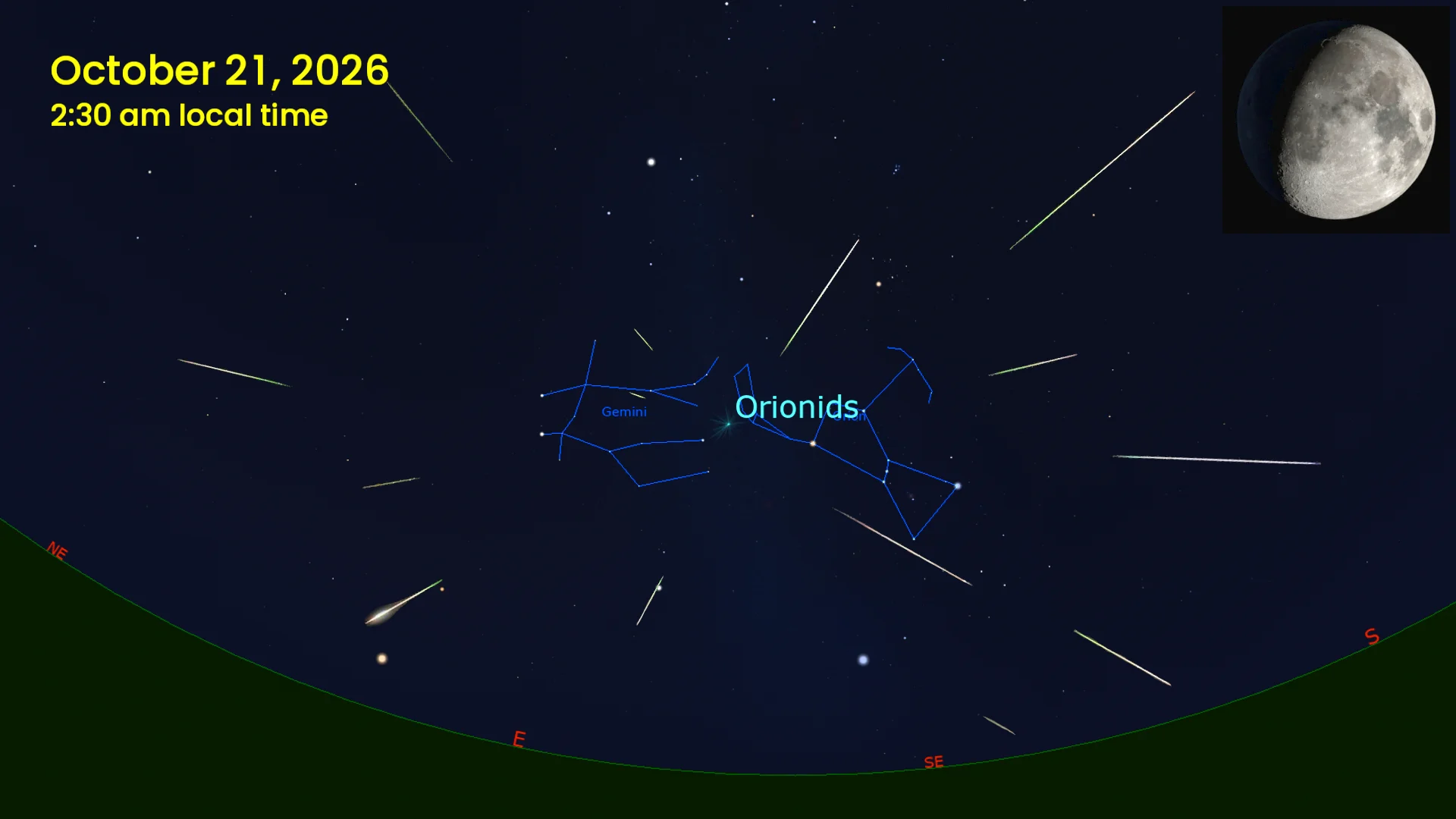
The radiant of the Orionid meteor shower is located between the constellations Orion and Gemini, in the eastern sky, on the night of October 20-21, 2026. Inset, top right: A Waxing Gibbous Moon will be shining in the sky that night. (Stellarium/Scott Sutherland)
TIPS AND TRICKS: How to get the most out of meteor showers and other night sky events
For the best chance to see Orionid meteors, find somewhere far from city lights, with a good view where you can see as much of the sky as possible. The meteors may originate from near the constellation Orion, but they can appear at any point in the sky overhead.
In order to spot them, first give your eyes about 20 minutes to adjust the dark. During that time, avoid any bright lights in the area, including streetlights, car headlights, and even your cellphone screen. To pass the time, you can certainly look up at the sky, and might even spot any particularly bright meteors while you wait!
If getting out of the city isn't possible, pick a safe, reasonably dark suburban area, where you can see at least the brightest stars of Orion in the sky above. A backyard with trees to block nearby streetlights will do fine. This can still be a good place to watch from, although the effects of urban light pollution on the sky will reduce the number of meteors you see.
Unfortunately, the timing of the Orionids along with the phases of the Moon is not ideal this year. Due to the Waxing Gibbous Moon in the sky that night, bright moonlight will likely make it more challenging to spot the dimmer meteors. However, keeping the Moon out of your direct field of view as you look up can minimize its impact.
Persistent trains!
When you spy an Orionid meteor flash by overhead, keep a close eye on that same location afterward. You might catch a glimpse of a mysterious phenomenon known as a persistent train!
These wispy glowing trails are sometimes left behind after a particularly fast meteor winks out. Some last for minutes, while others can remain visible for hours!
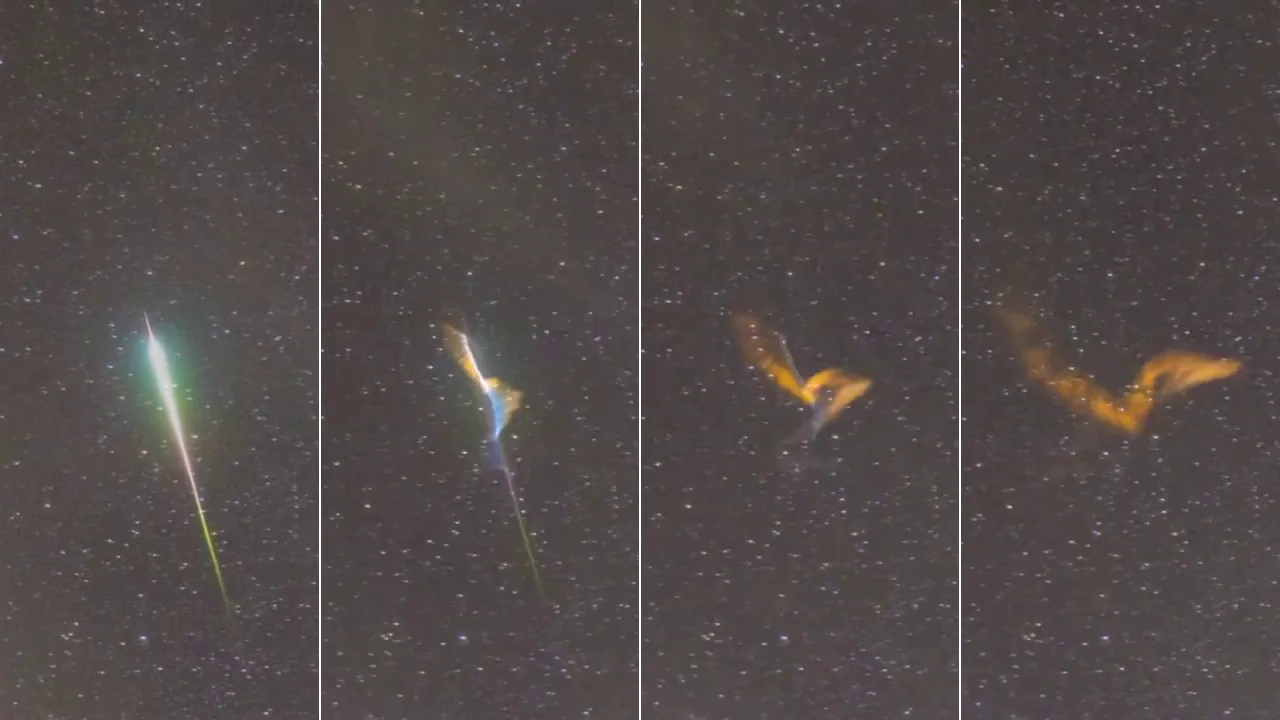
This persistent train was captured during the Orionid meteor shower, on October 21, 2022. (Brenda Tate/Tim Doucette)
MORE FROM SPACE: Our Sun is capable of producing devastating superflares; should we worry?
Comet Halley meteors, from both the eta Aquariids and the Orionids, are well known for producing this phenomenon. Even so, they are only rarely captured in images and videos, so they are still poorly understood.
Some scientists hypothesize that the fast-moving meteoroids produce so much energy as they plunge through the atmosphere that they strip electrons off of the atoms in their path. Those ionized atoms then float along on the winds in the wake of the meteor, and each emits a small flash of light as it picks up a free electron and cancels out its ionization.
Meanwhile, others say that the vapourized cloud of meteoroid material left behind after the meteor winks out could be chemically reacting with the air around it, producing light in a process known as chemoluminescence.
More study is needed to tell which of these is the more likely explanation, or if they both play a part in producing this fascinating phenomenon.
(With files from The Weather Network)