Northern Lights may shine in the sky over Canada Wednesday night

Check your sky forecast and turn your eyes to the north, as the Northern Lights may shine in our skies in the nights ahead.
The Sun has woken up again with the appearance of an immense string of sunspots, and we may see the first impacts, sparking displays of the Aurora Borealis, on Wednesday night.
Early on Monday, December 1, a powerful X-class solar flare exploded from the eastern limb of the Sun. In the aftermath of this intense flare, solar-observing satellites captured the eruption of an immense coronal mass ejection into space.
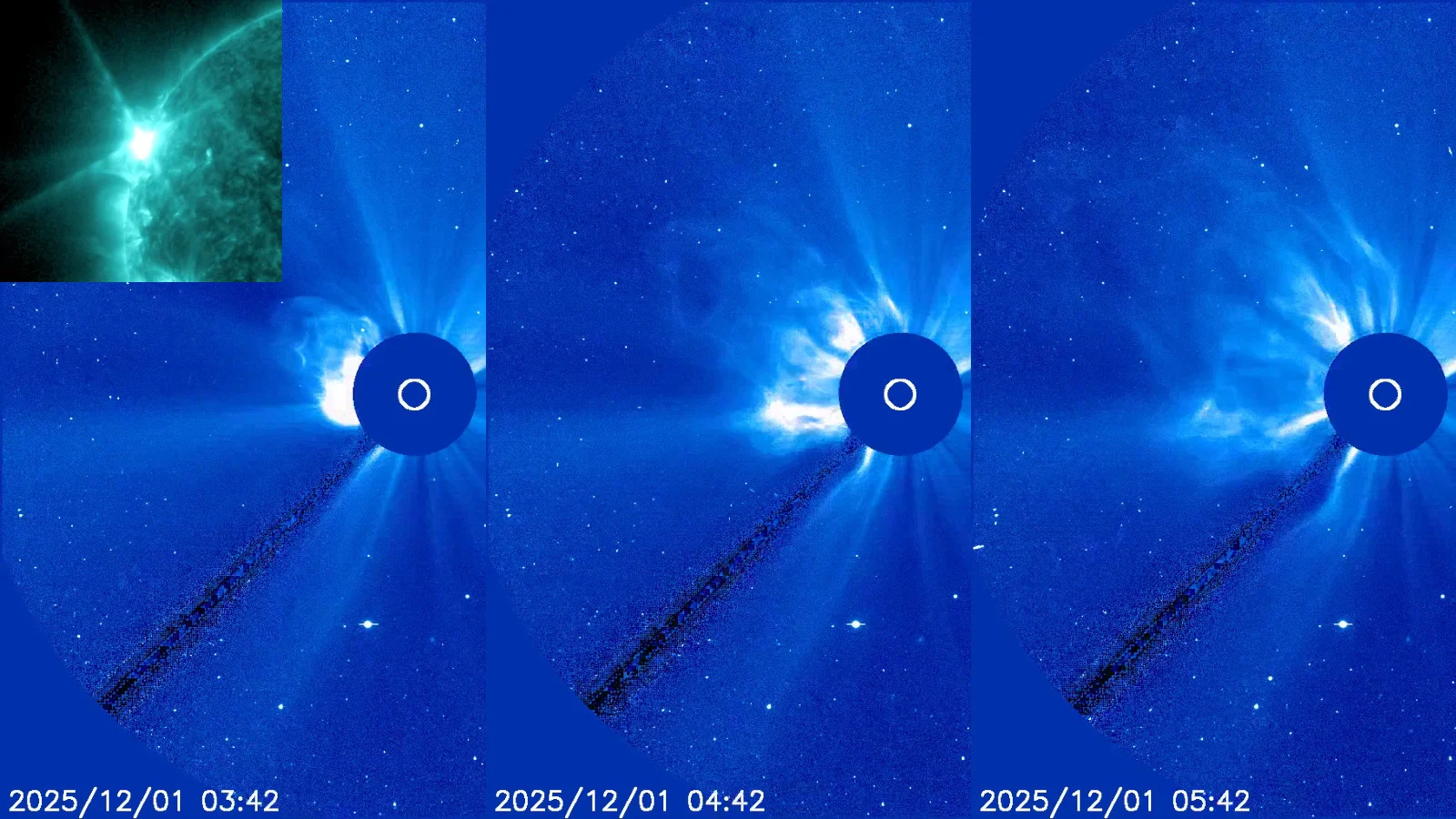
Top left: a view from NOAA's GOES-19 satellite reveals the X1.95-class that exploded at 2:50 UTC on Sunday, December 1. Three views from the NASA/ESA Solar and Heliospheric Observatory are arrayed from left to right, showing the progression of the coronal mass ejection as it erupted into space over the next five hours. (NOAA, NASA/ESA)
The vast bulk of the solar storm cloud produced by this CME eruption is aimed away from Earth.
However, according to forecasters with NOAA's Space Weather Prediction Centre, there is a chance the very edge of the cloud may sweep past Earth on Wednesday.
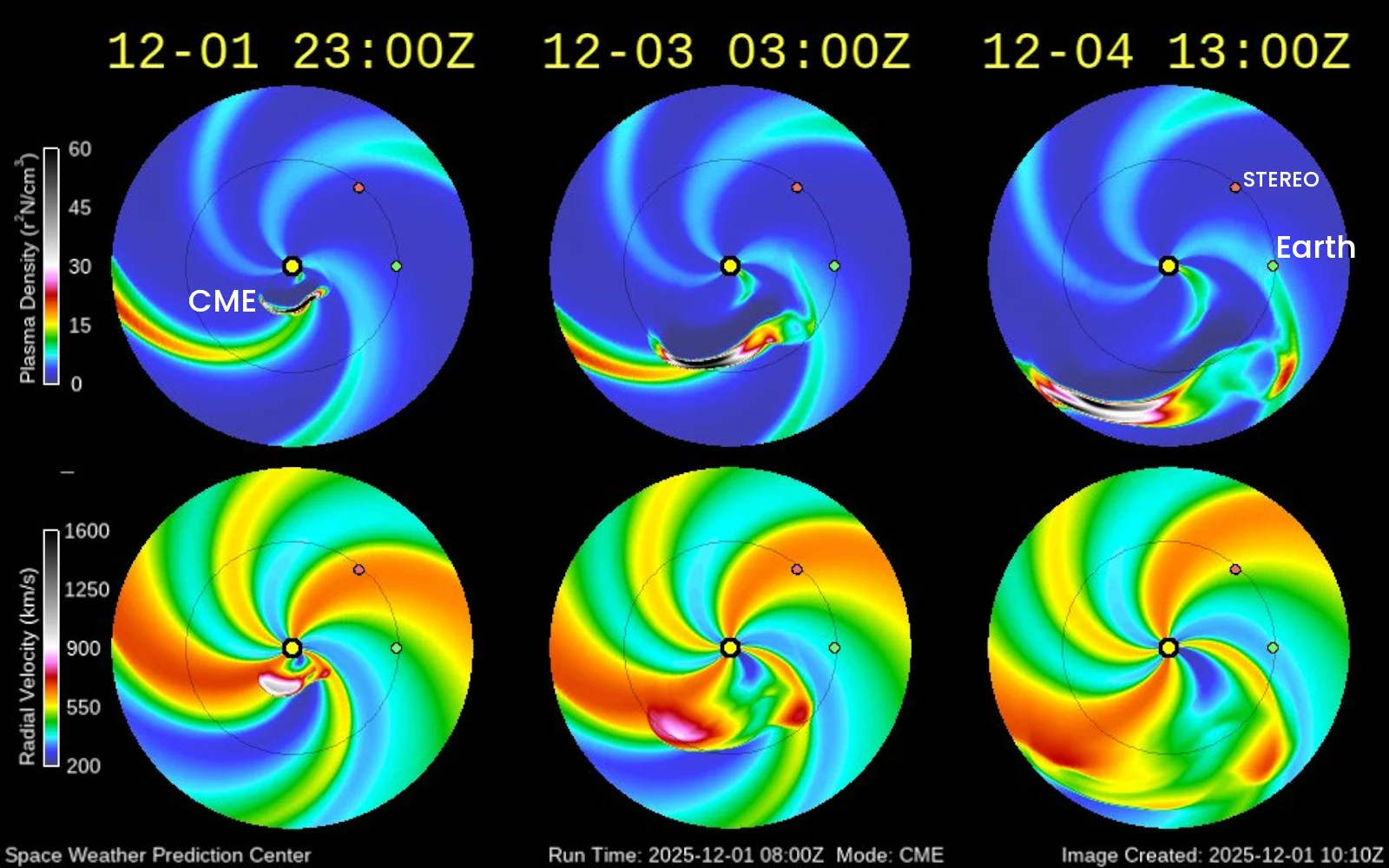
Three panels from the WSA-Enlil solar wind model depict the density (top) and speed (bottom) of the December 1 coronal mass ejection, shortly after it erupted (left), 28 hours later (centre), and on December 4, when the edge of the solar storm cloud may affect Earth (green dot). (NOAA SWPC)
According to SWPC, the CME is likely to make a 'glancing blow' on Earth's geomagnetic field as it passes by later on Wednesday.
As a result, they have issued a G2 (moderate) geomagnetic storm watch for Wednesday evening, through overnight into Thursday morning.
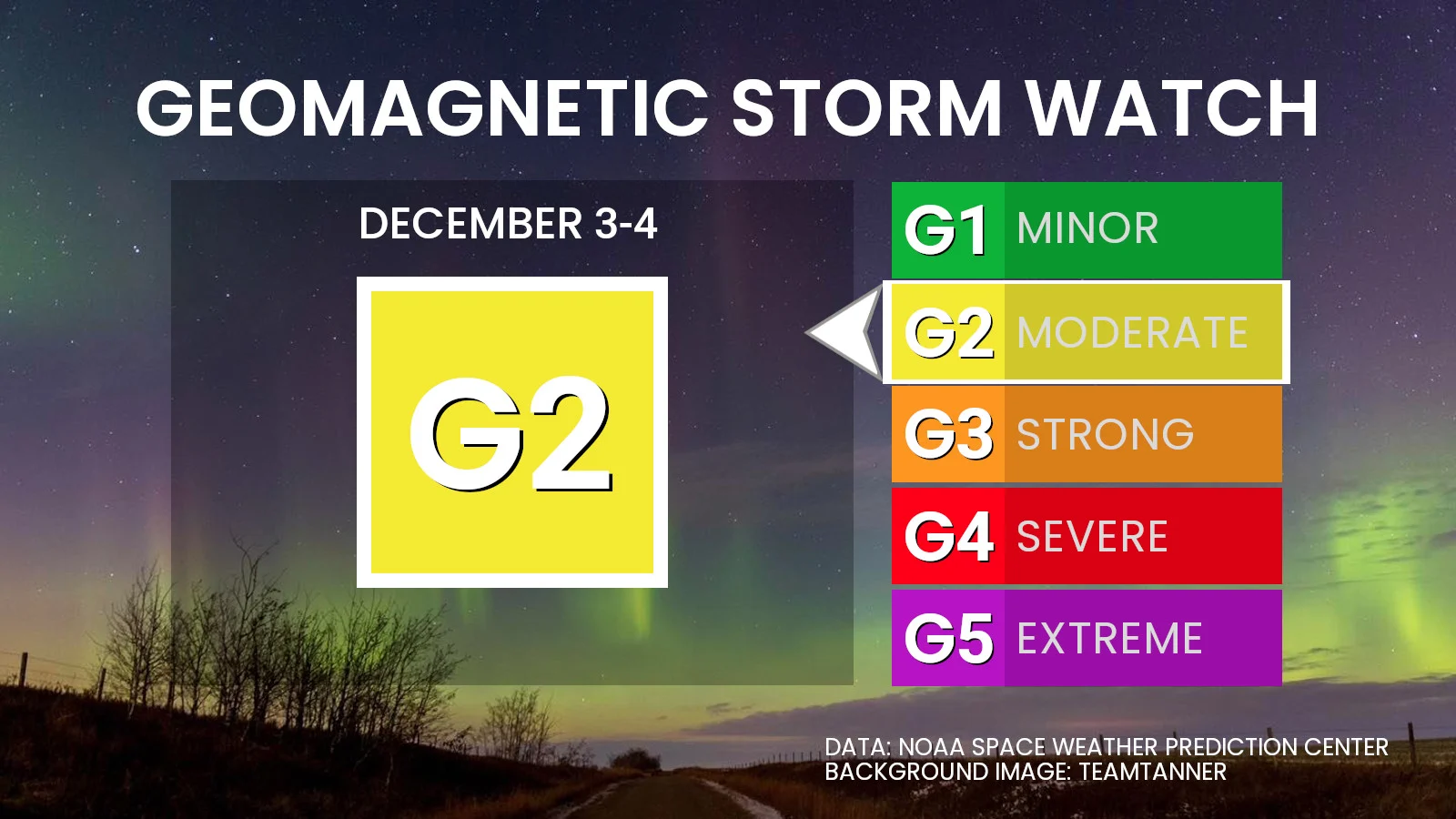
SWPC forecasters also note that there is even a chance (about 25 per cent) that there could be periods of G3 (strong) level storming during this encounter.
This is due to the possible arrival of a fast stream of the solar wind at the same time that the CME brushes past us.
The exact timing of the G2 storm conditions is a bit uncertain, at this time. However, SWPC's forecast is calling for one episode at around 22-00UTC (between 4 p.m. and 7 p.m. EST), with storm levels then dropping to G1 (minor) from 00-06 UTC (7 p.m. to 1 a.m. EST), and ramping up to G2 again from 06-09 UTC (1 a.m. to 4 a.m. EST).
That would favour eastern Canada and the northeastern U.S. for the first part, with the Prairies being in the best position for the second show.
Unfortunately, the weather does not appear to be cooperating with us for this event. Based on the current forecast, as of Tuesday afternoon, much of Canada will have cloudy skies.
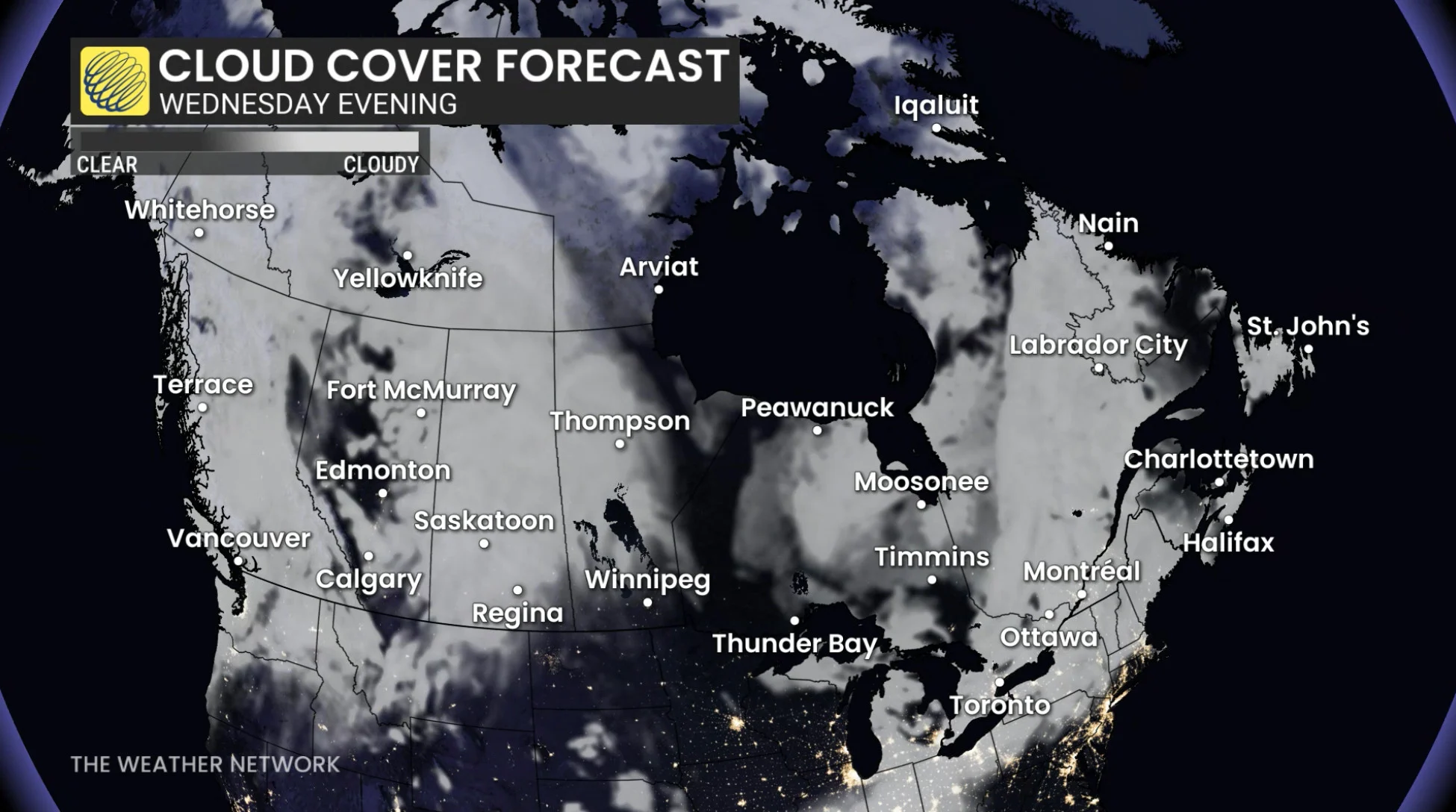
There are some clear or partly clear conditions indicated for parts of New Brunswick and Prince Edward Island in the evening hours. Northwestern Ontario and southern Manitoba also look to have reasonably clear skies at that time, and Alberta appears to have a mix of clear and cloudy conditions.
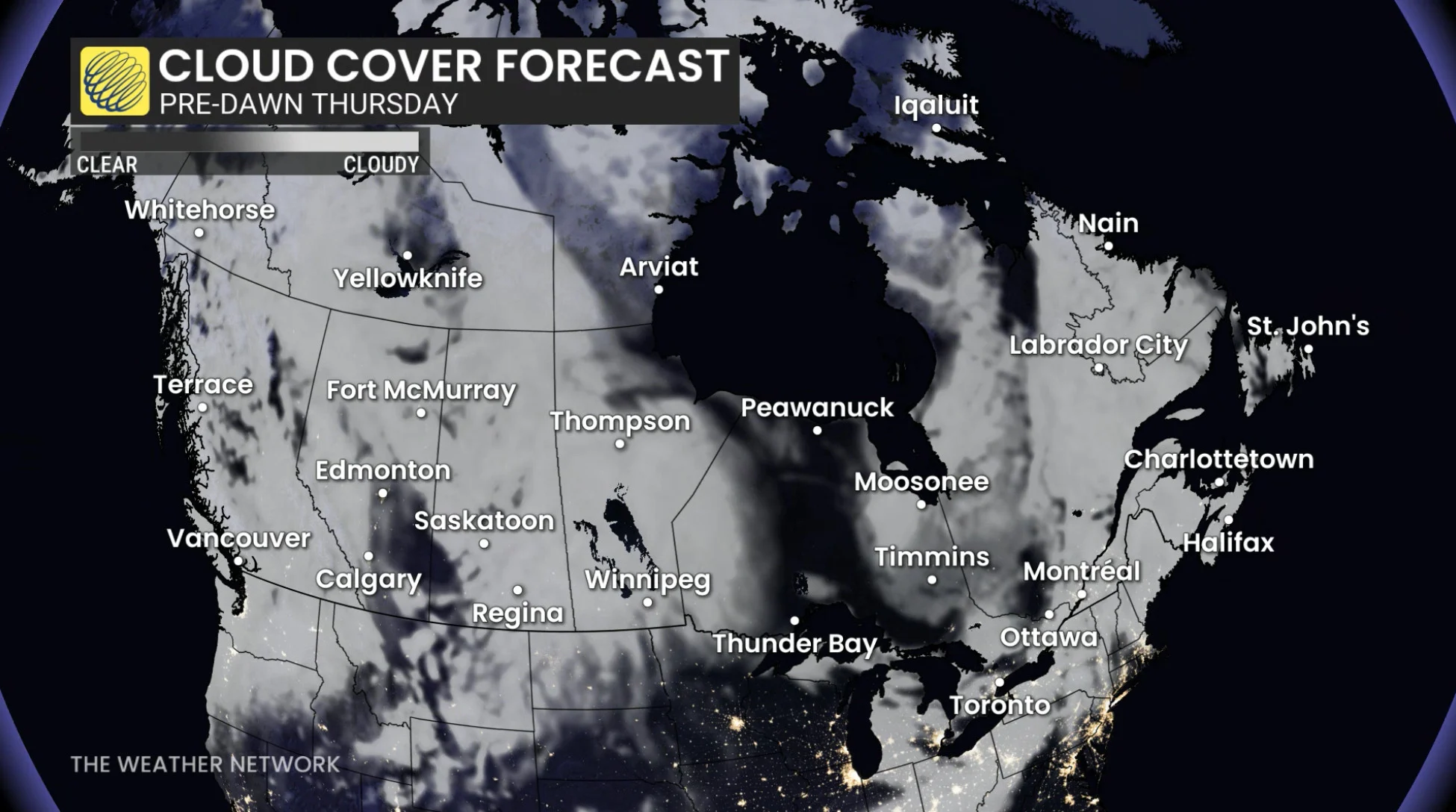
For Thursday morning, the weather patterns shift farther west, with the only potentially clear skies being north of Lake Huron and Lake Superior, and over southern Alberta.
Check your local forecast Wednesday afternoon and overnight into Thursday morning, to see if conditions improve.
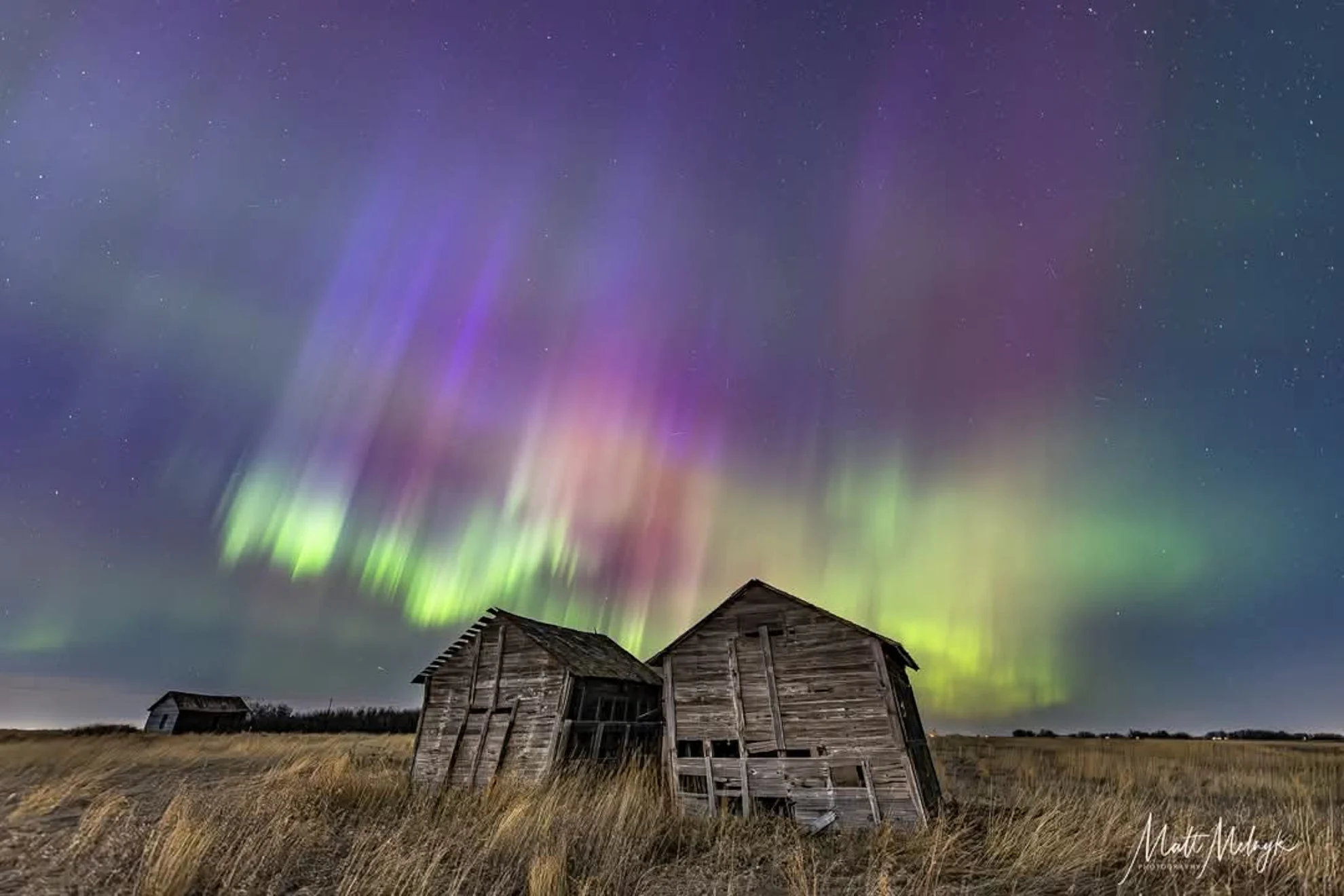
(Thumbnail image was captured by Matt Melnyk, north of Calgary, on March 22, 2025, during a G2 geomagnetic storm)