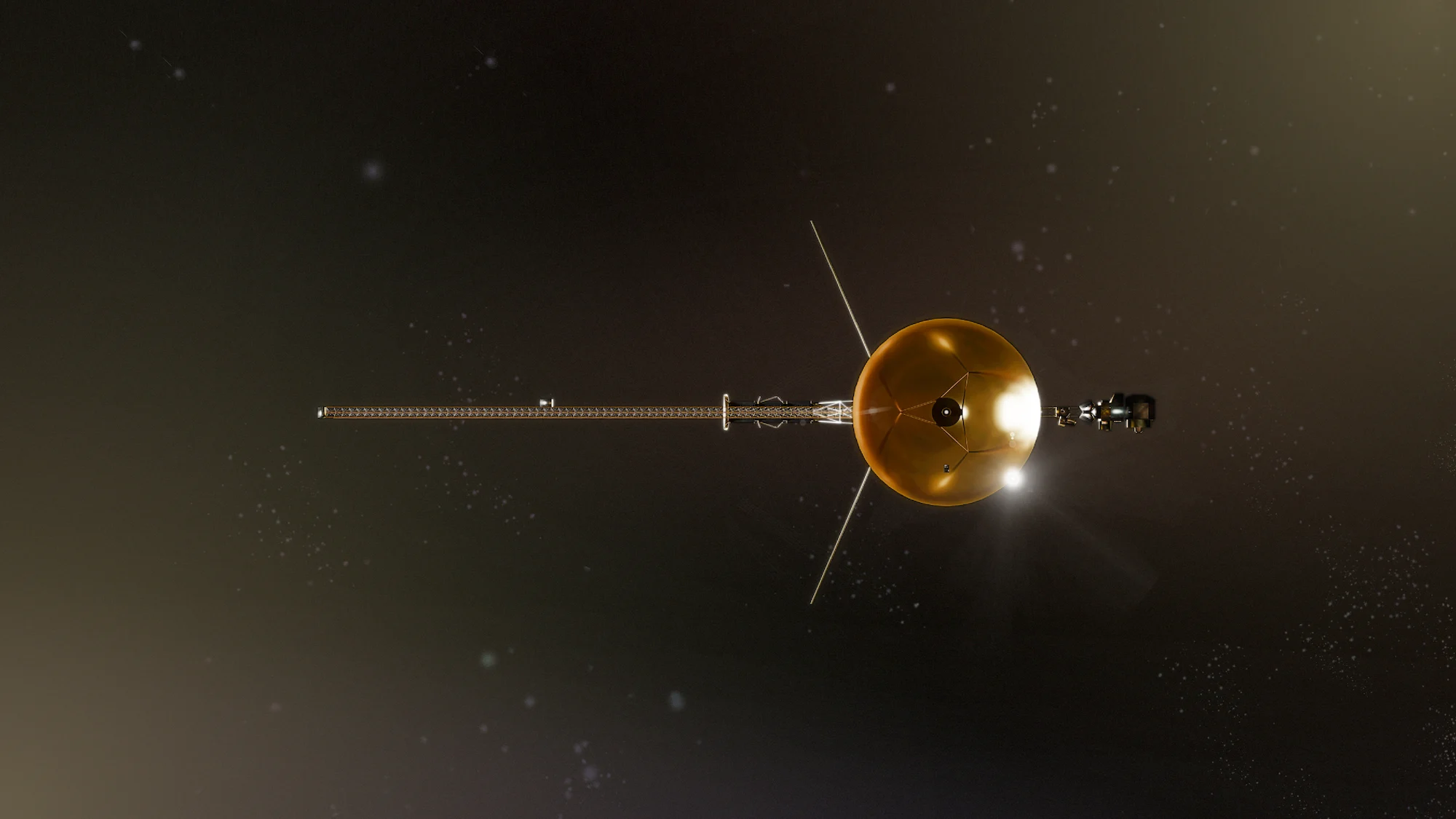
Voyager 1 space probe expands humanity's reach to 'one light-day' this week

Voyager 1, already humanity's farthest-flung creation, passes an amazing milestone this week.
After more than 49 years of travelling in space, Voyager 1 will soon be far enough away that communications between the spacecraft and Earth will take a full day, each way!
On September 5, 1977, NASA's Voyager 1 probe blasted off from Cape Canaveral, bound for deep space. Exactly a year and six months later, the spacecraft made a close pass by Jupiter, providing us with some of our best views of the planet's clouds and moons. The year after, it did the same for Saturn and its rings.
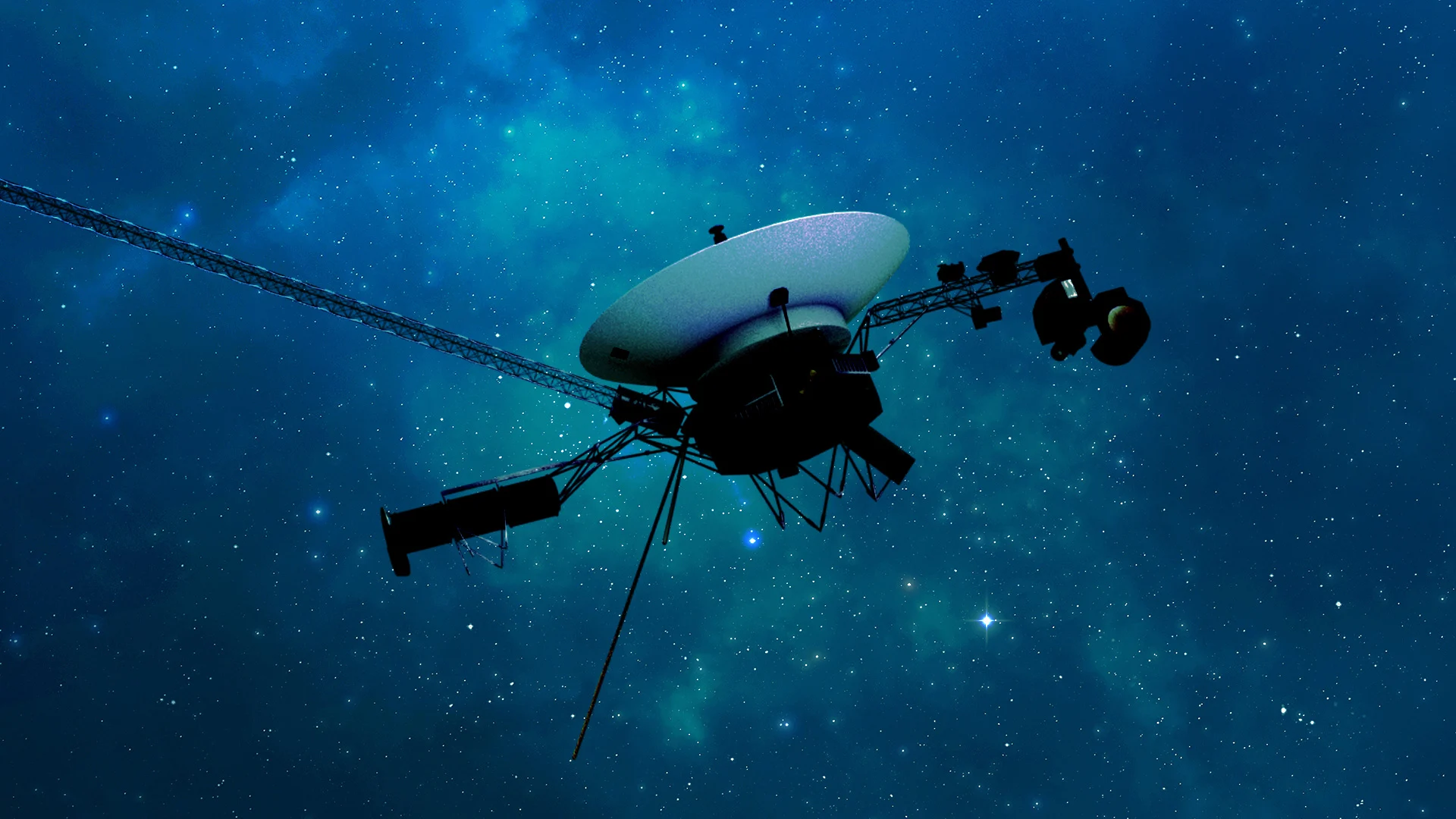
An artist's impression of the Voyager 1 probe in space. (NASA/JPL-Caltech)
Although its twin, Voyager 2, had launched a little over two weeks earlier, Voyager 1's higher velocity propelled it farther, faster. This put it on a trajectory to be the first spacecraft to pass some incredible milestones.
Already the farthest-travelled human-made object at the time, on August 25, 2012, it became the very first to exit the heliosphere — the farthest extent of the Sun's magnetic field — and thus enter interstellar space.
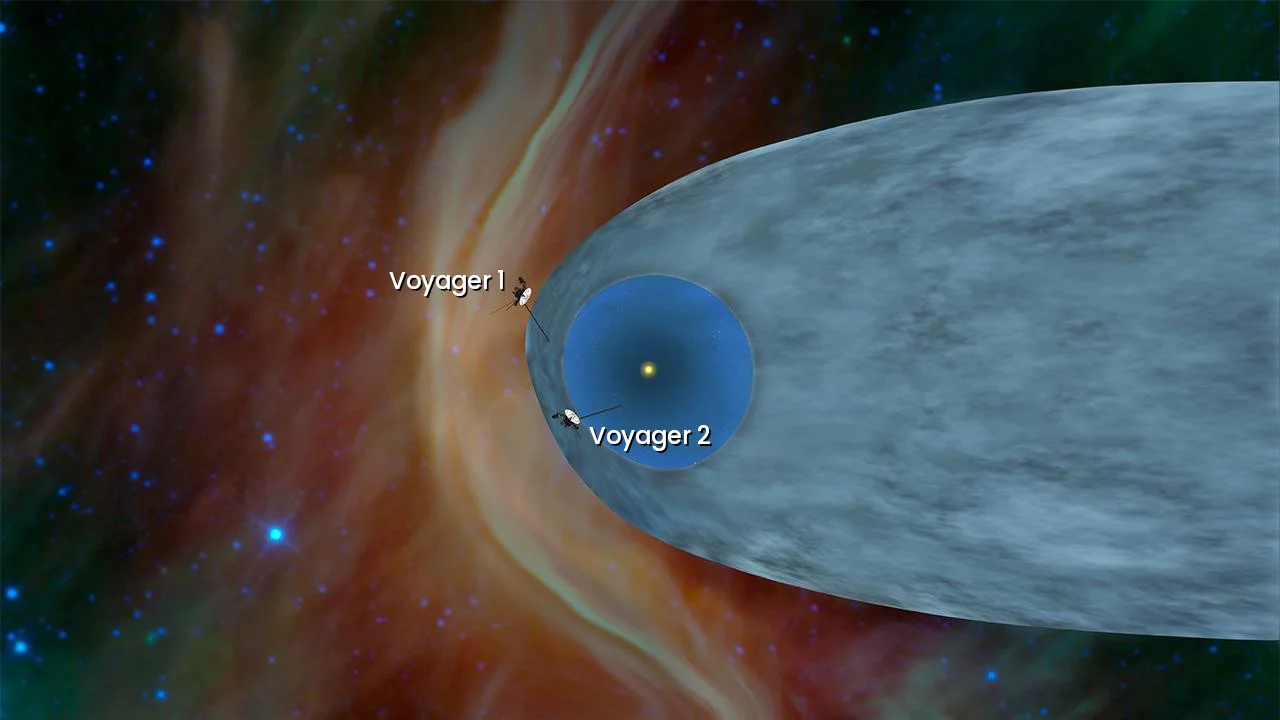
The positions of Voyager 1 and 2, relative to the Sun and the heliosphere, are shown in this diagram from September 2012. (NASA/JPL-Caltech)
Now, Voyager 1 is about to set a new milestone.
On Wednesday, November 18, 2026, at 5:16 a.m. EST, it will reach a distance of 25,902,068,356 kilometres from Earth, otherwise known as 'one light-day'.
What that means is, the spacecraft will be so far away from Earth that its radio signals, travelling at the speed of light, will take a full 24 hours to reach us. Then, when NASA sends information back, it will take those signals a full 24 hours to reach Voyager 1.
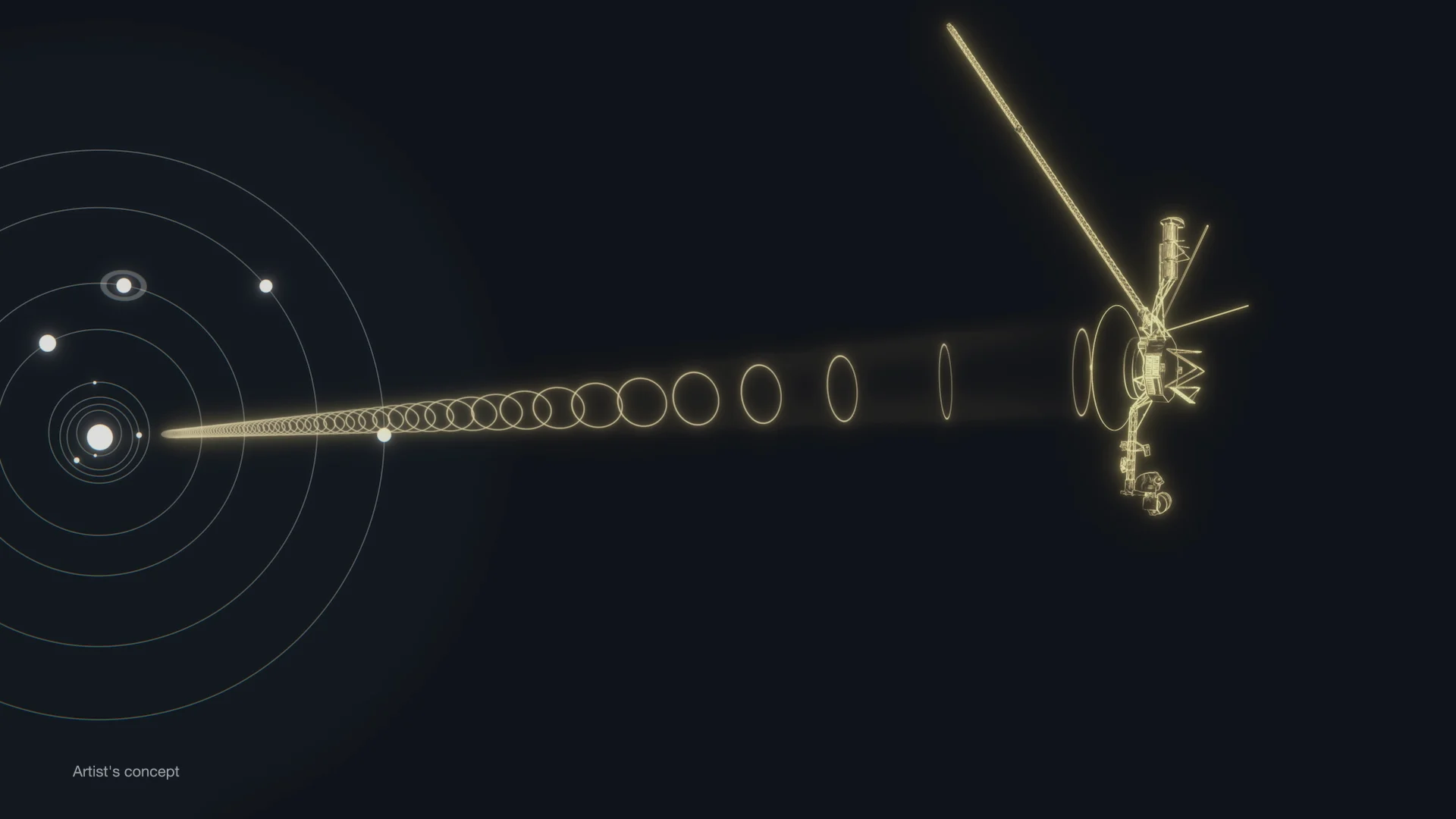
Signals travelling between Earth and Voyager 1 are making a nearly 26 billion kilometre journey, one-way, as the probe reaches this new milestone. (NASA/JPL-Caltech)
According to NASA, using light as a way to measure distance works well when those distances become very large. One of the most common 'light' units of measurement is the light year, which we use to express the distance to other stars and galaxies. However, when working in our own solar system, we can also use smaller units.
For example, when the Artemis 2 astronauts travelled to the Moon, earlier this year, it was 404,800 km away. That's 1.35 light-seconds for their communications, though. For spacecraft on and orbiting Mars, we can talk in light-minutes, because it can take between 3 and 22 minutes for their signals to reach Earth, depending on where the two planets are in their orbits at the time.
Meanwhile, for spacecraft in the outer solar system, we switch to light-hours. When Voyager 1 took its Solar System Family Portrait, on February 14, 1990, the spacecraft was around 6 million kilometres away. Thus, each bit of data transmitted back that contained those images took about 5.5 hours to arrive here.
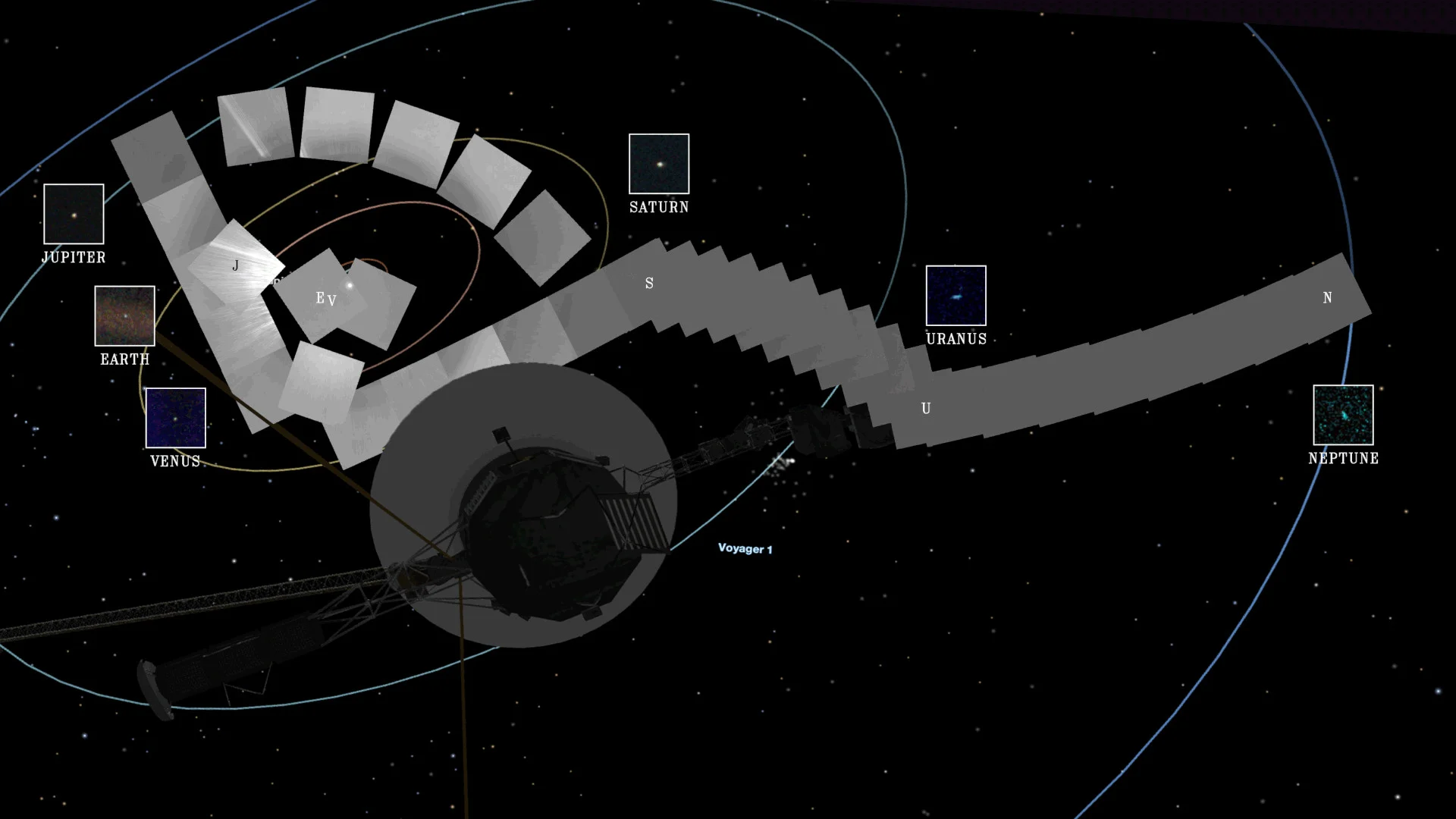
Voyager 1's Solar System Family Portrait, with images the spacecraft captured of all the major planets, superimposed on a computer simulation of the probe, showing its perspective as it took the images. (NASA/JPL-Caltech)
Now, with this new milestone, we're up to light-days!
Want to participate?
If you would like to help celebrate this achievement, NASA has planned a "Shine Bright for Voyager's Light Day" event, scheduled for November 17.
After sunset on Tuesday, visit NASA's "automated flasher" site in the web browser of a smartphone or similar device, and point the screen skyward.
If you'd like to be more exact, face west, towards the constellation Ophiuchus. That is where Voyager 1 is currently located in the sky.
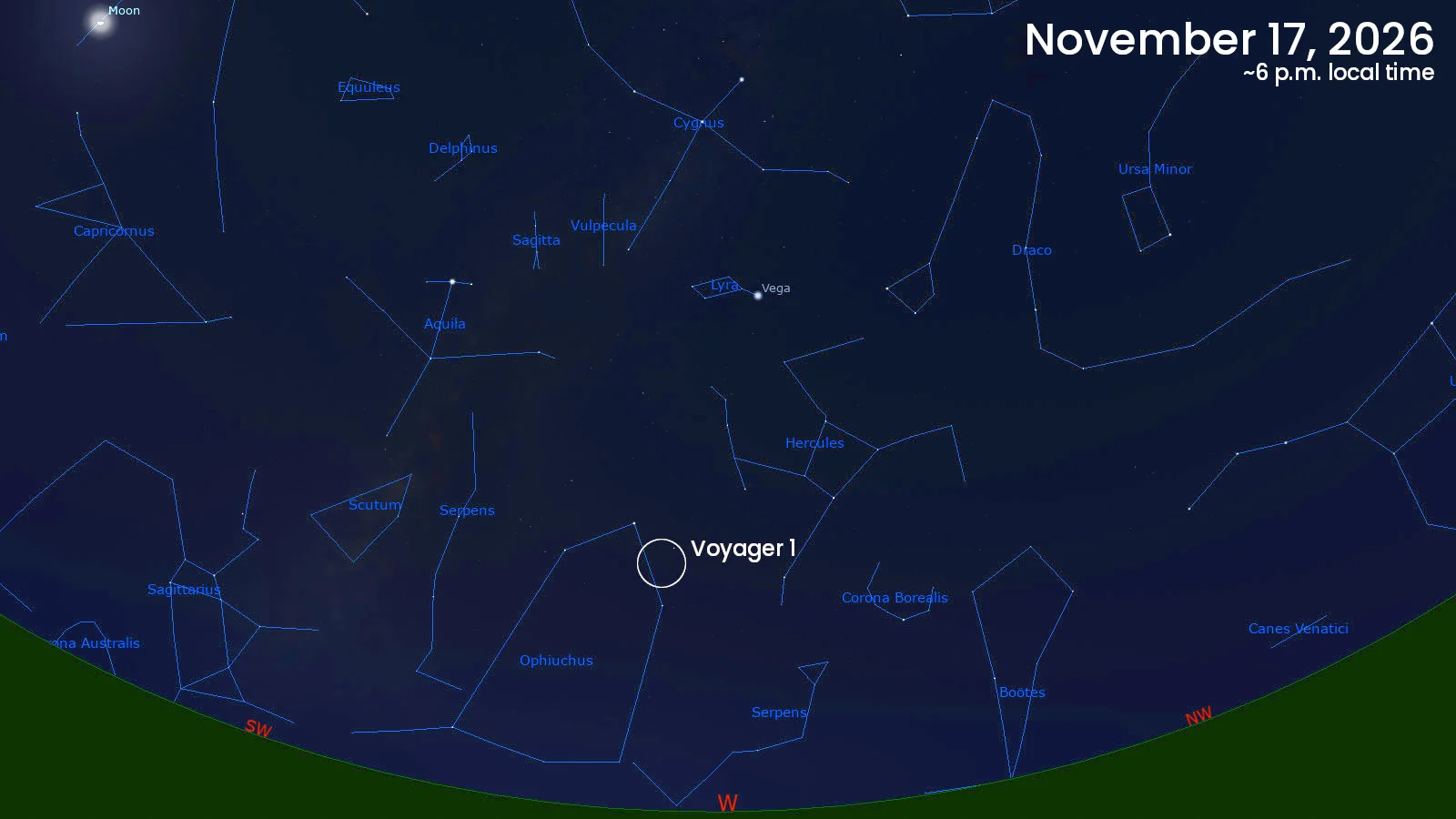
Voyager 1's location, in the western sky after sunset, near the constellation Ophiuchus, on November 17, 2026. (Stellarium/Scott Sutherland)
Alternatively, use a flashlight, and signal the letters V-G-R in Morse code:
V is three short flashes of light, each 1 second long, followed by a three-second-long flash,
G is a three-second flash, followed by another three-second flash, and then a one-second flash, and
R is a one-second flash, a three-second flash, and another one-second flash.

V-G-R in Morse code. (NASA)
As NASA calls it: "A simple act. A shared moment. A celebration of humanity's farthest reach."