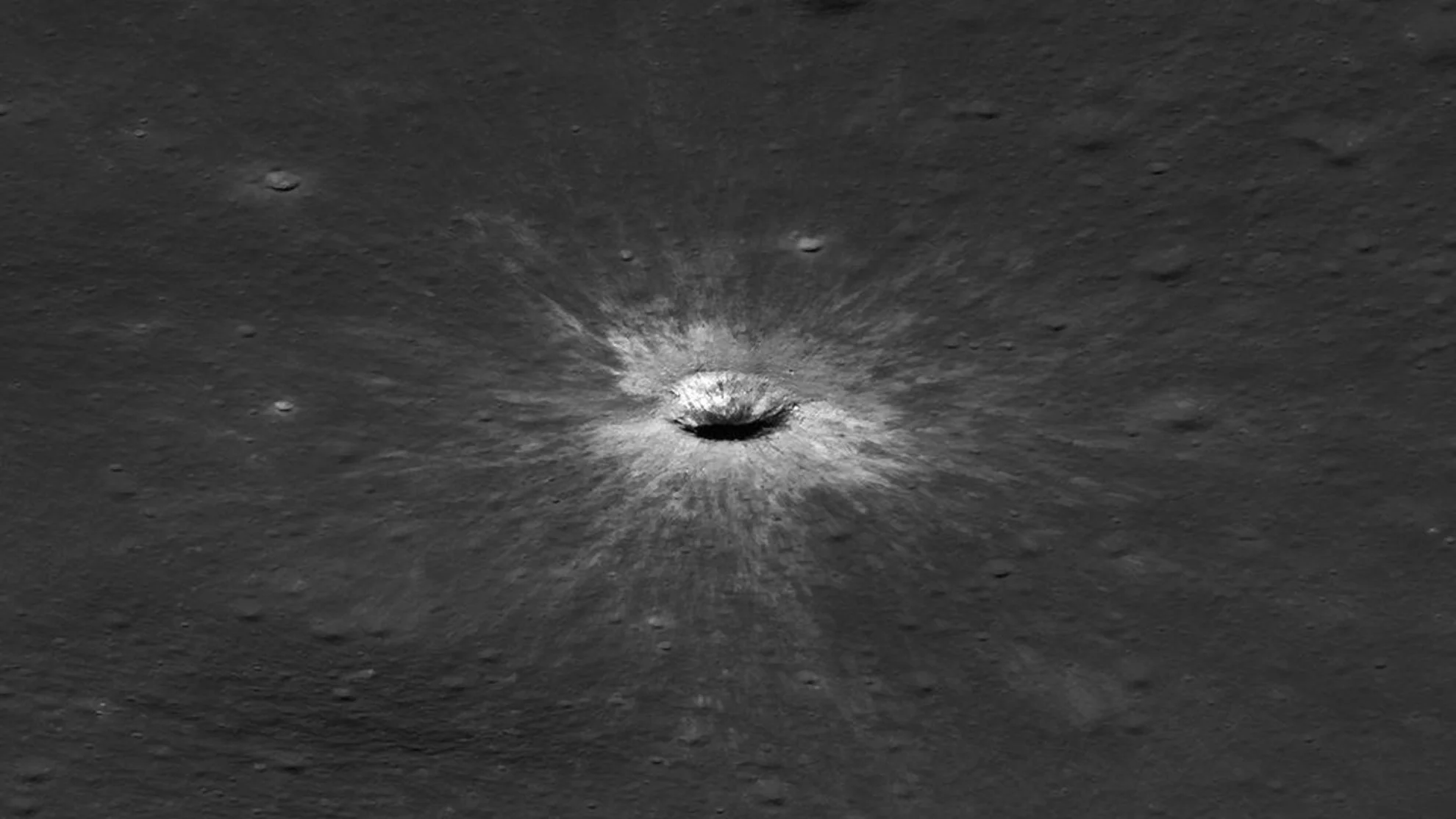
NASA satellite spots a new once-in-a-century crater on the Moon

Imagery sent back by a satellite orbiting the Moon has revealed the largest, newly formed crater ever found in the solar system.
NASA's Lunar Reconnaissance Orbiter has found at least 1,000 newly formed craters on the Moon over the past 17 years, but McGetchin sets a new record as the largest discovered so far.
The Lunar Reconnaissance Orbiter, or LRO, was launched back in 2009, on a mission to provide NASA with high-resolution imagery of the Moon's surface. In the process, over the past 17 years, the satellite's cameras have located at least 1,000 new craters, including a few 'artificial' ones, produced by human-built hardware striking the Moon.
Now, NASA scientists working on the mission are reporting the discovery of a new crater that formed between April 11 and May 22, 2024.
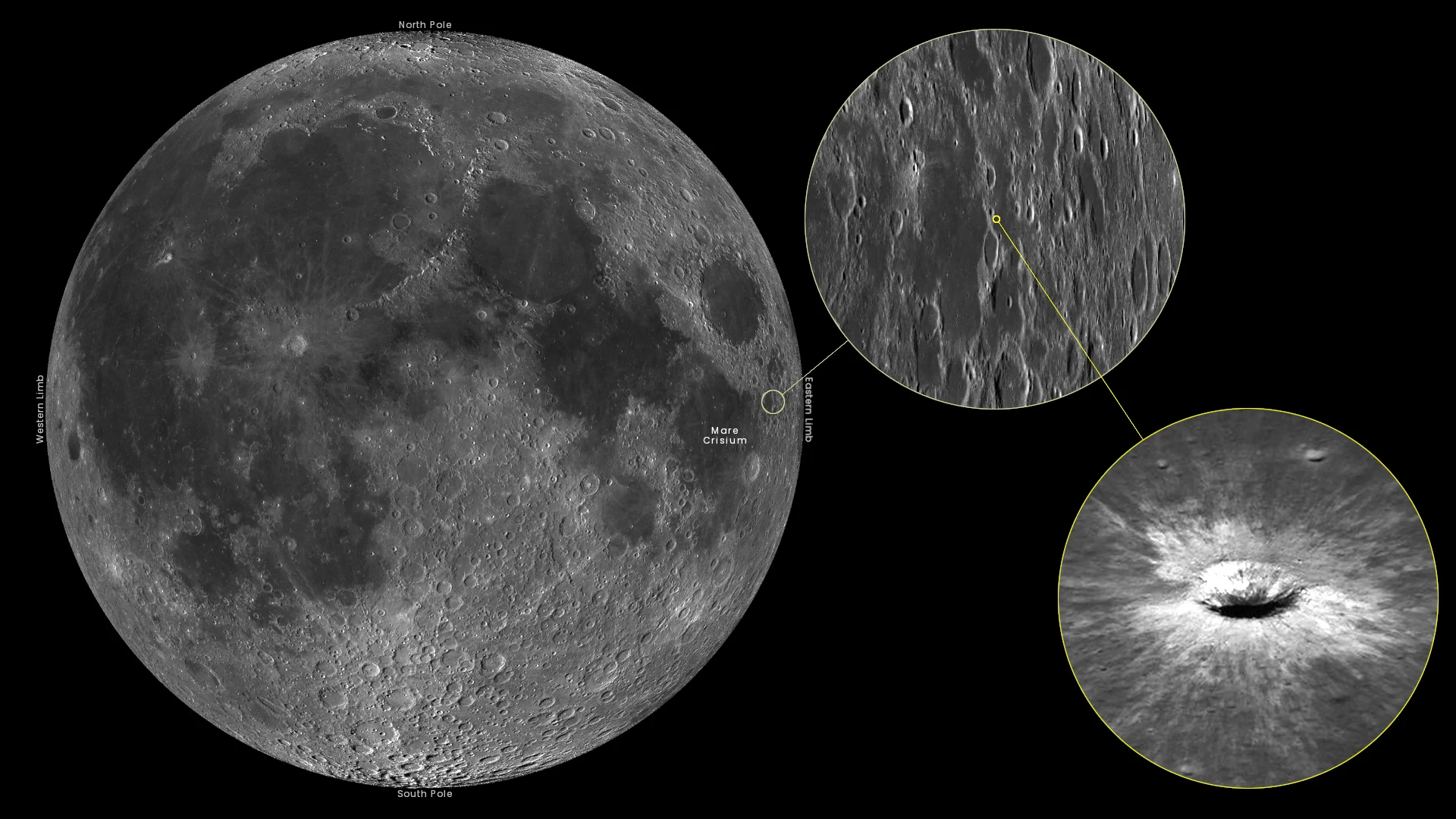
A map of the Moon's near-side highlights and zooms in on the region where this new crater formed (inset, upper right), and shows an oblique view of McGetchin taken as LRO flew past. (inset, lower right). (NASA/GSFC/LROC/Scott Sutherland)
DON'T MISS: Look up Saturday to celebrate International Observe the Moon Night
At some point between those dates, as LRO was imaging the rest of the Moon, an object NASA says was the size of a 3-story to 6-story building (around 10-20 m wide) slammed into the lunar surface just east of Mare Crisium, close to the Moon's eastern limb.
The impact obliterated several preexisting craters, and blanketed the surrounding area, out to a distance of over 350 metres with freshly excavated material. At the centre of that 'ejecta blanket' was a newly-carved crater, 222 metres wide and 43 metres deep. That's roughly the length of two Canadian football fields, and deep enough to vertically stack four yellow schoolbuses, end to end.
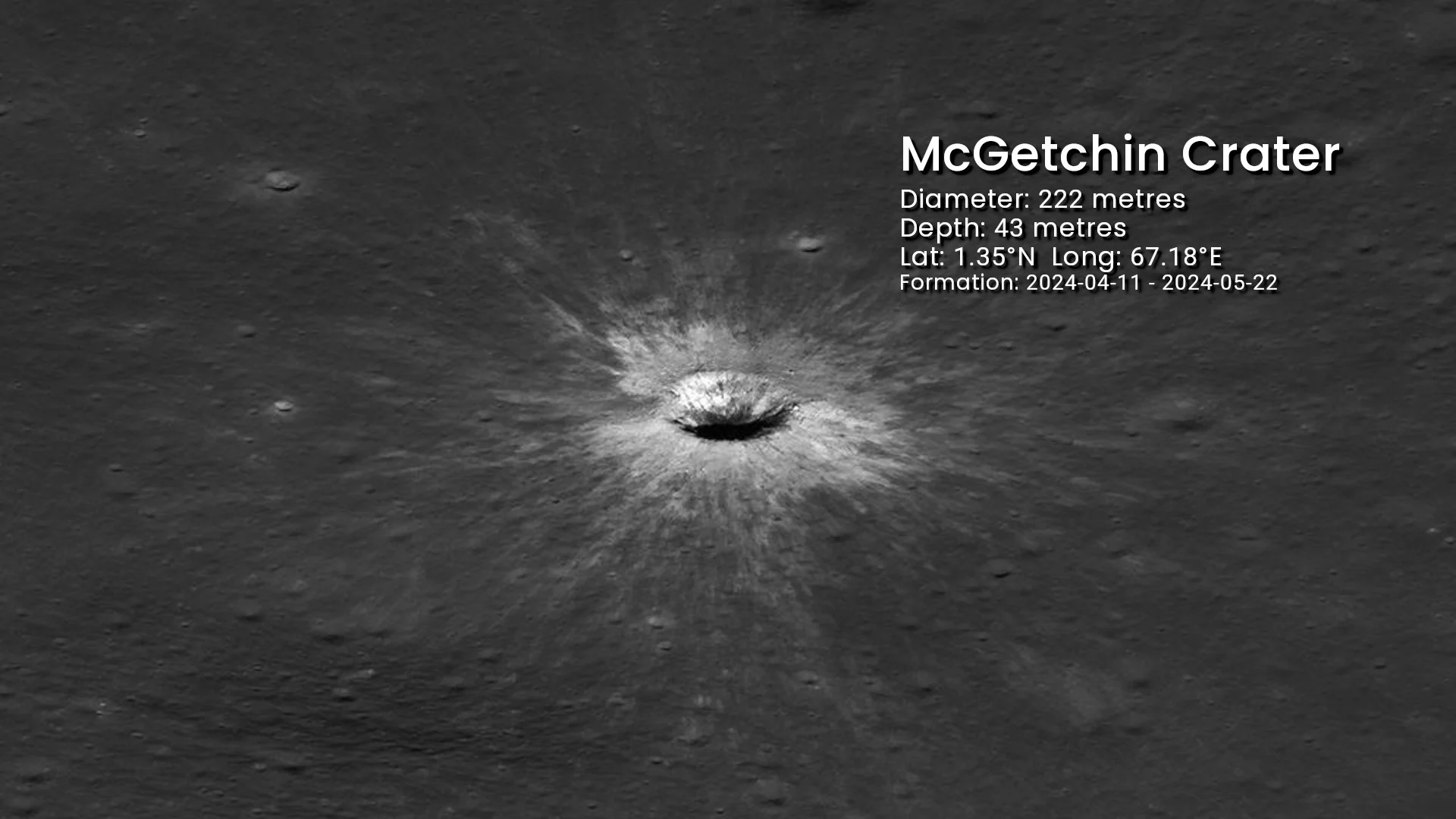
An oblique view of McGetchin crater, taken on a flyby of the Lunar Reconnaissance Orbiter on March 3, 2026. (NASA/GSFC/LROC/Intuitive Machines)
The crater is now named McGetchin, after Tom McGetchin, the director of the Lunar and Planetary Institute in the late 1970s. During his time at the Institute, he led the research there to expand beyond just the Moon, to all planetary bodies in the solar system. This resulted in the name being changed from the Lunar Science Institute to the Lunar and Planetary Institute. For his passion and leadership, McGetchin was awarded NASA's Exceptional Public Service Medal in 1979.
Unnoticed for nearly 2.5 years
Despite the flash of light that this impact would have created at the time, it apparently went completely unnoticed by spacecraft and observations from here on Earth. The most likely reason for this is poor timing, as it probably occurred either when that region of the Moon was in full daylight, or when observatories that watch for lunar impact flashes were not operating.
The crater was only discovered on October 24, 2025, when Robert Wagner, an image processing specialist with Intuitive Machines, was running software to compare sets of 'before' and 'after' maps of the lunar surface.
According to NASA, while high-resolution images from the LROC Narrow-Angle Camera are used on a regular basis to look for changes, every few years, full maps of the Moon are stitched together using images from the LROC Wide-Angle Camera. These maps are then compared to older versions, looking for major changes in the surface.
After a new map was generated and compared to one from before the impact, Wagner noticed a distinct bright spot that was surrounded by a dark halo.
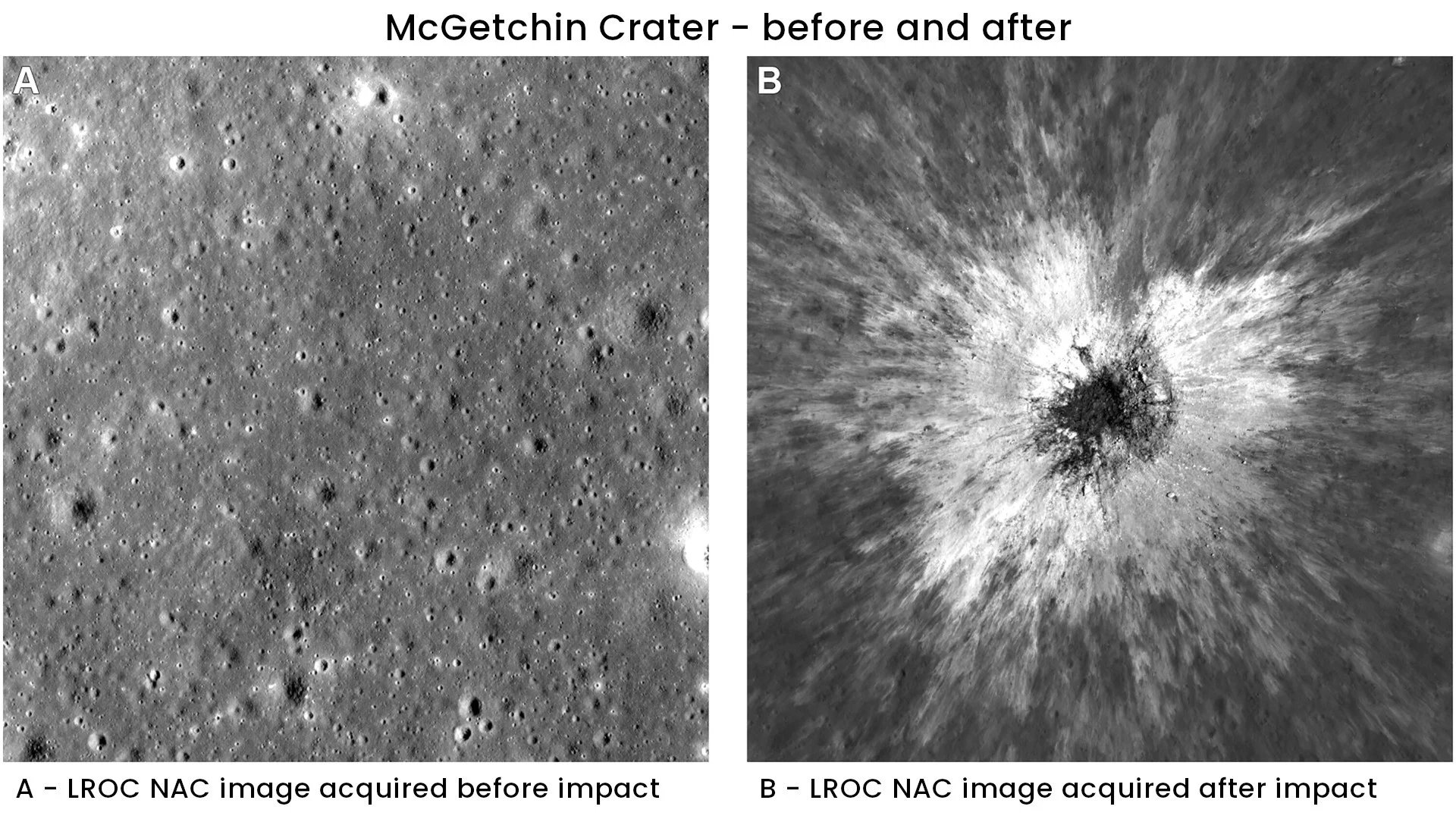
Before and after images of the image zone where McGetchin formed. (NASA/GSFC/LROC)
RELATED: Intuitive Machines' Odysseus Moon lander tucks in for the frigid lunar night
"I just stopped, dropped everything, and started looking into what that spot was," Wagner told NASA.
"It was by far the most obvious impact debris pattern I've ever seen in one of these images," he explained.
Images from LRO's LROC Narrow-Angle Camera were then used to fully document the crater size and depth, as well as examining the material and boulders thrown out by the impact blast.
McGetchin is now the largest new impact crater ever discovered in the solar system. It is over three times the size of the previous record-holder — an unnamed 70-metre wide crater that formed within Mare Humorum, in the southwest of the Moon's Earth-facing side, sometime around October 20, 2012.
As Wagner and his colleagues at Intuitive Machines and the Lunar and Planetary Institute wrote in their research paper, models of crater production in the solar system show that an impact of this magnitude only occurs on the Moon once every 132 years.
That makes this a once-in-a-lifetime discovery!
New crater = New cold spot
Additionally, this lunar impact produced a new lunar cold spot roughly 7 kilometres wide, centred on the new crater.
Lunar cold spots are thought to occur when the material of the Moon's surface is disturbed. The idea is that undisturbed lunar regolith becomes packed down over time, and with more of the particles in direct contact with each other, they trap heat more easily. However, recently disturbed material — such as the rock and dust blasted out of a newly-formed crater — is more loosely packed.
Here on Earth, when something like dirt or snow is loosely packed, more air becomes trapped between the particles, increasing its heat-trapping ability. On the airless Moon, though, the opposite is true. The material more easily radiates its heat into space, making it cooler than the surrounding surface by a few degrees. LRO picks up these temperature differences using its Diviner Lunar Radiometer instrument as it passes over the lunar night side.
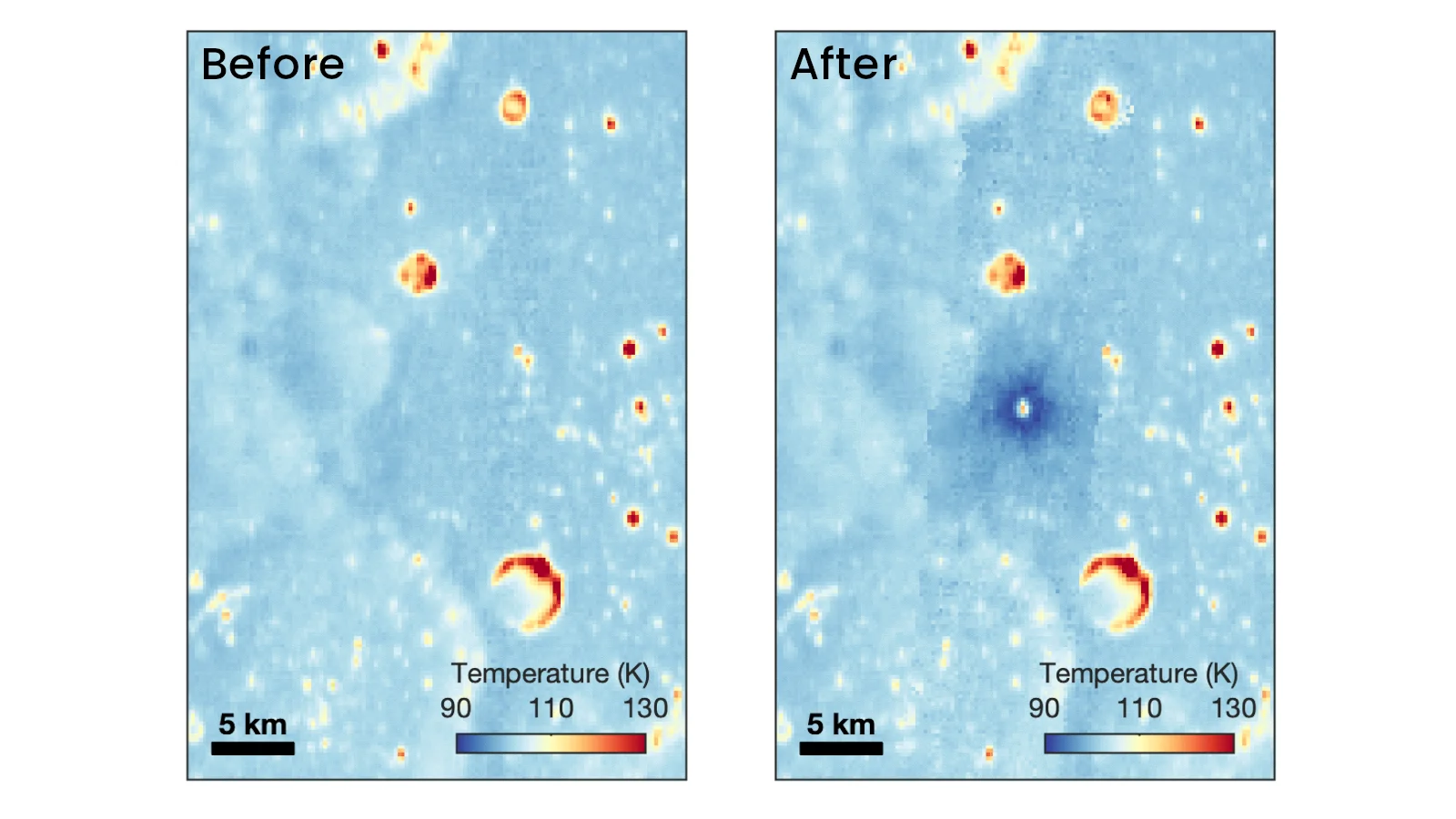
Temperature maps of the area around McGetchin from before and after impact. After impact, the area around the crater was up to 9 degrees C cooler than what was recorded in the same materials prior to impact. (NASA Goddard/UCLA/JHU APL)
Although there are only sparse details about the impactor that carved out McGetchin, NASA reports that the size and shape of the crater, as well as how the surrounding terrain was affected, all offers clues as to how large this asteroid or comet fragment was, and with how much force it struck the surface. We will likely see more details about the object in an upcoming research paper.