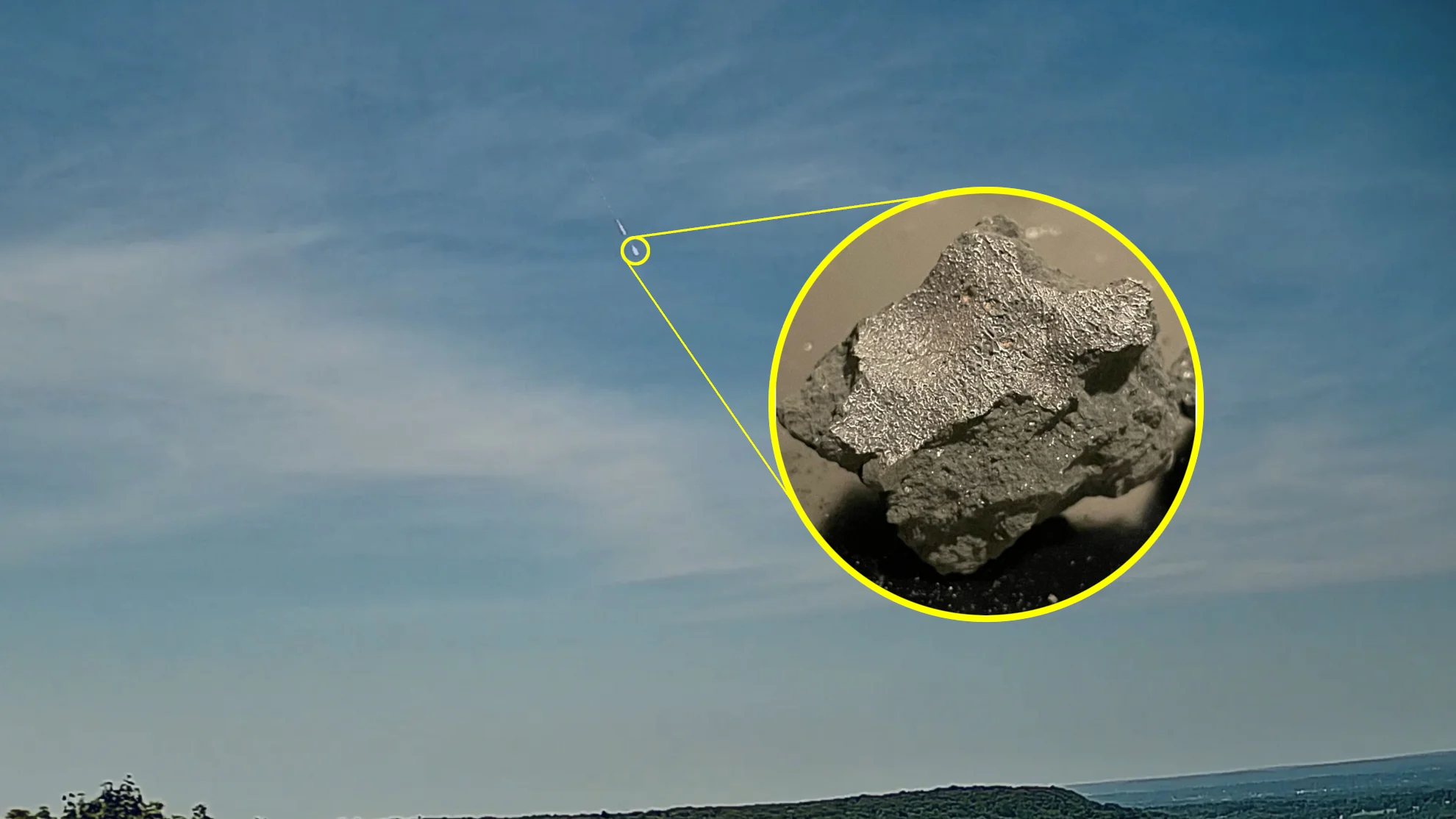
Rare meteorite that hit New Jersey home came from a briny alien world

Scientists are calling this find one of the most scientifically valuable meteorites ever recovered.
Meteorite fragments recovered from a daytime fireball over New York and New Jersey in 2024 have turned out to be some of the rarest ever found.
On July 16, 2024, eyewitnesses from across the US Northeast spotted a rare sight above their heads — a daytime fireball blazing across the relatively clear, blue sky.
The meteor passed from east northeast to west southwest across New York City and the northern end of New Jersey before it winked out. Once a meteor flash ends, that is not always the end of the object that caused it, though.
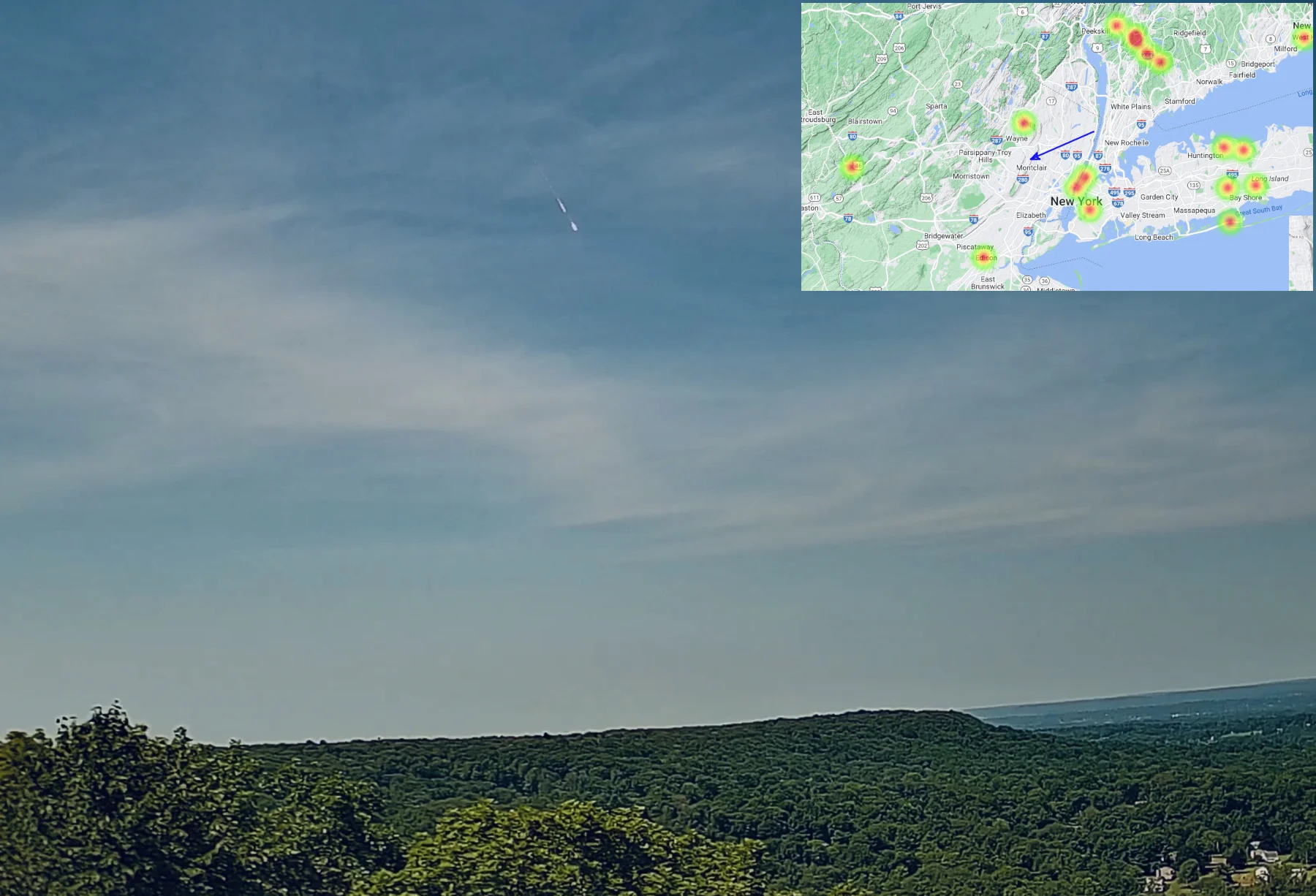
The July 16, 2024 daytime fireball, captured in an image from Northford, Connecticut. Inset is a map from the American Meteor Society showing the likely trajectory of the meteor, and concentration of eyewitness reports. (Mark Kirschner/AMS)
READ MORE: Rare daytime fireball spotted over New York, New Jersey
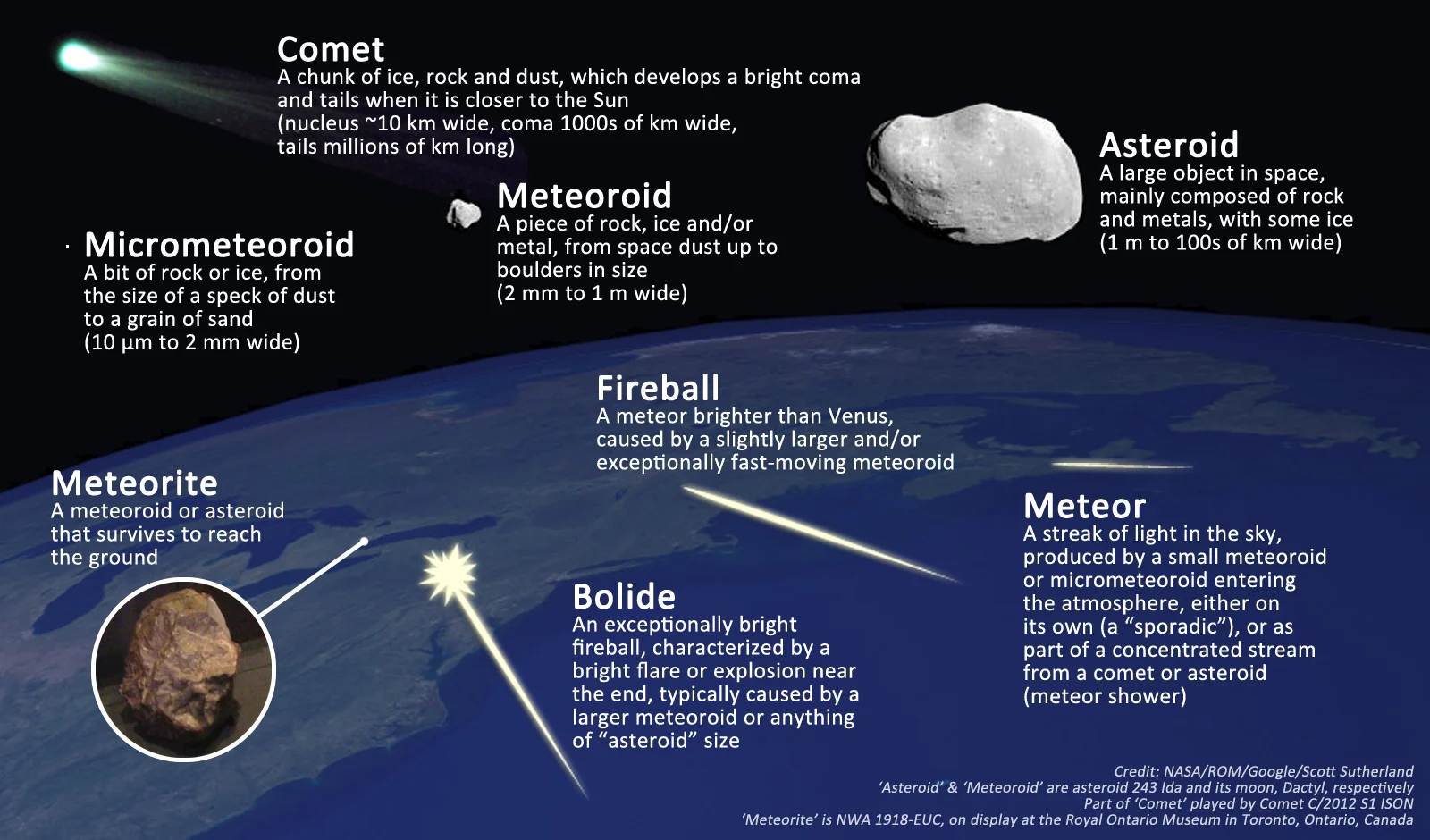
When a meteoroid enters Earth's atmosphere, it is travelling anywhere from 11-72 km/s, or between 40,000 and 260,000 kilometres per hour. At those speeds, the object compresses the air in its path, squeezing the air molecules together so tightly that the air glows, white hot. This is the source of the meteor flash we see in the sky. At the same time, those air molecules push back on the meteoroid, slowing it down and reducing the amount of force it exerts on the air.
All of this typically happens in the blink of an eye, but it can last for a few seconds for larger meteoroids.
The meteor flash 'winks out' when one of two conditions is met — either the meteoroid vapourizes due to the extreme heat, or it slows down enough that it can no longer compress the air molecules to the point of incandescence.
RELATED: Got your hands on a meteorite? Here's how to know for sure
At that point, any surviving pieces of the space rock will enter 'dark flight'. They will have lost nearly all of their initial velocity, and fall from the sky at around terminal velocity, simply due to gravity, until they hit the surface.
Meteorite found!
A meteoroid's chances of survival mainly depend on its speed. According to meteor scientist Denis Vida, who manages the Global Meteor Network from the University of Western Ontario, any meteoroids travelling at speeds of more than 20 km/s (72,000 km/h) tend to vapourize high up in the atmosphere.
Based on the speed of this particular fireball, estimated at "only" 17 km/s (61,000 km/h), it was speculated at the time that fragments of the meteoroid could have survived their passage through the atmosphere.
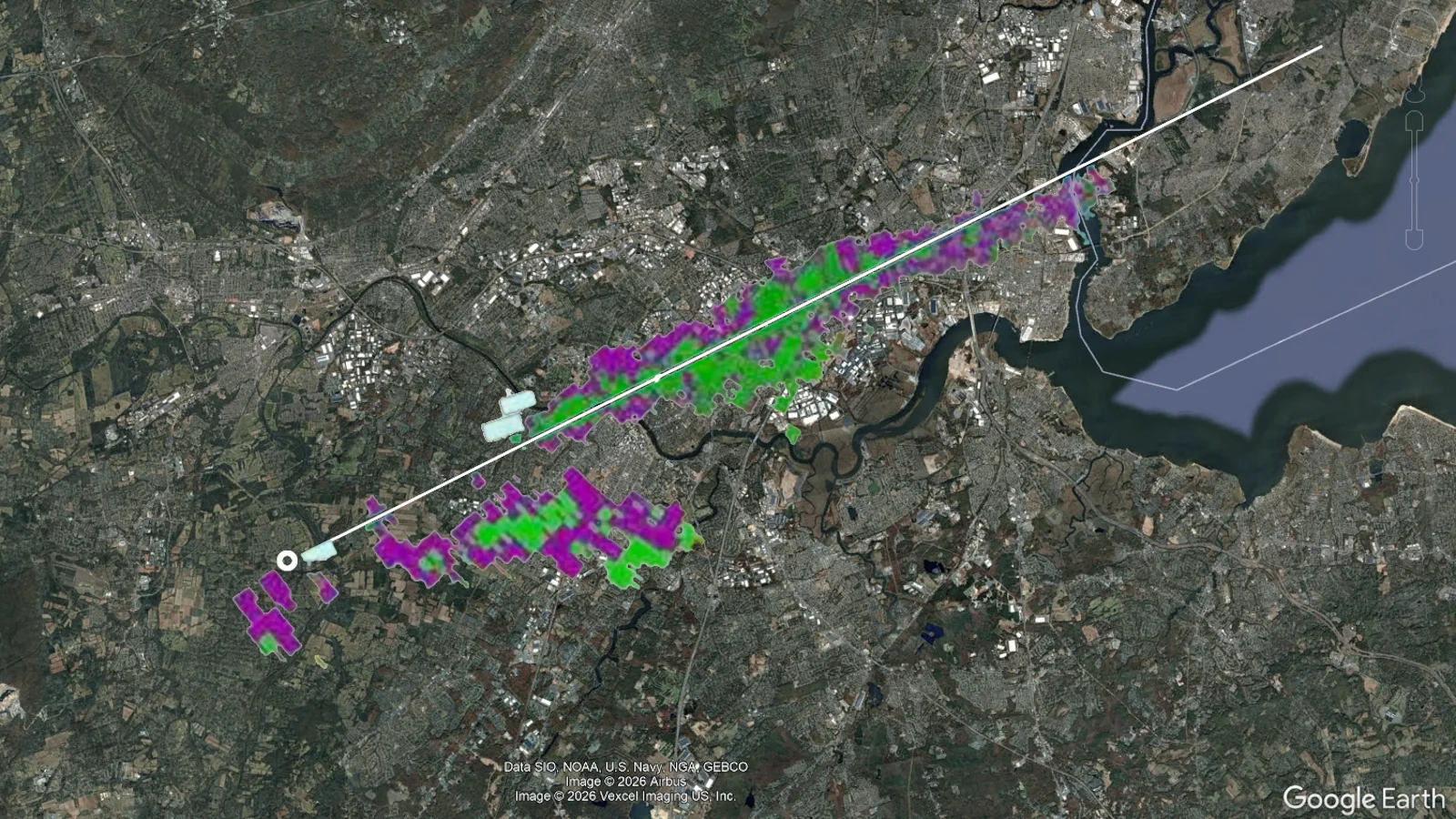
This map shows radar reflections from the Hillsborough meteorite fall, as weather radar picked up fragments of the object as they drifted with the prevailing winds. (NASA/Mark Fries, reconstructed by Scott Sutherland)
NASA scientists turned to weather radar from the US National Weather Service to determine the most likely spots to search.
Fortunately, one fragment punched through the roof of a house in Hillsborough, New Jersey, which was owned by someone well-versed in what to do if you discover a meteorite.
According to SETI,org, the homeowner quickly put on protective gloves and collected the fragments, wrapping them in aluminum foil before putting them in glass jars.
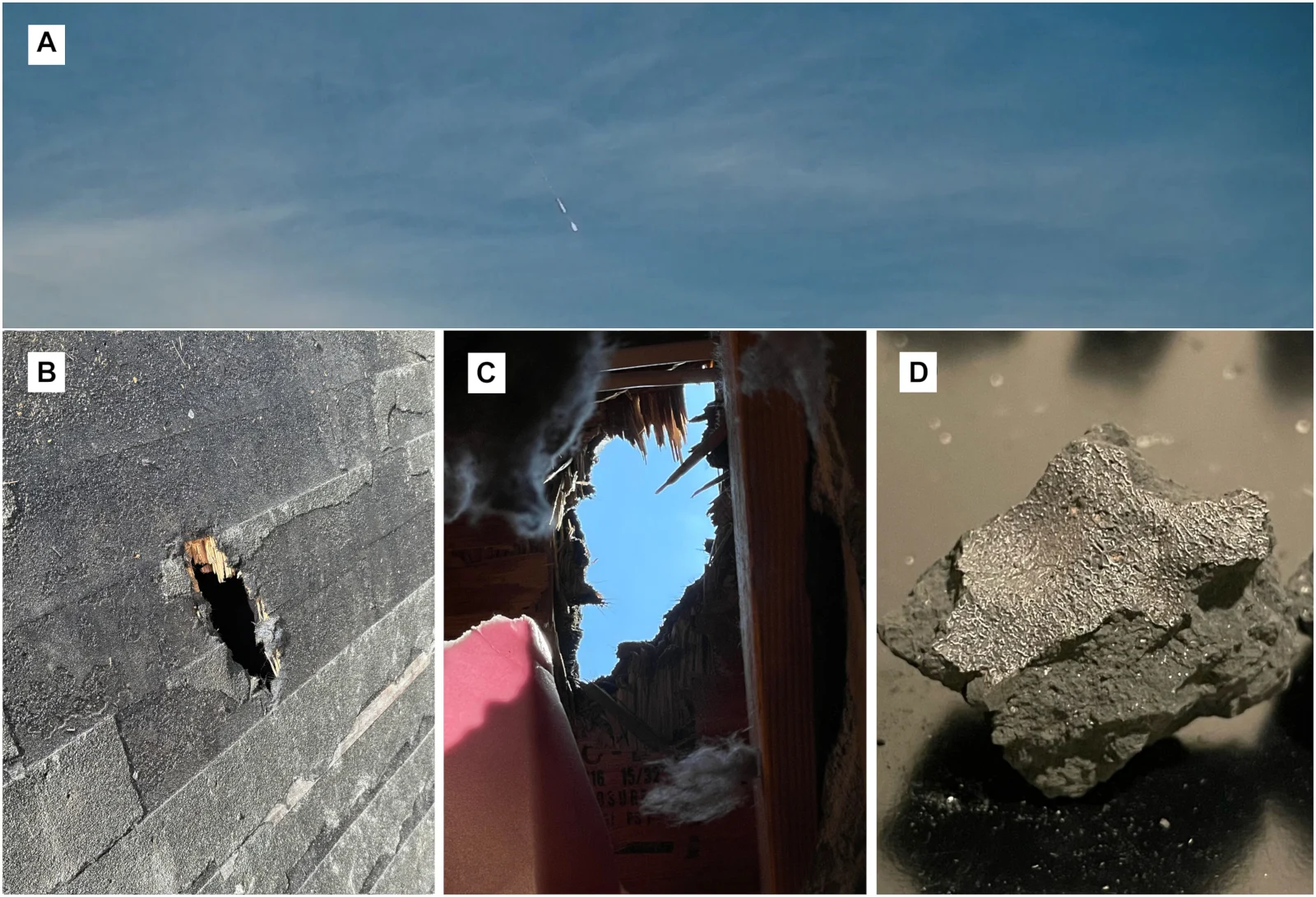
An image of the daytime fireball from July 16, 2024 is shown here (top), with pictures of the damage to the Hillsborough, NJ, roof (bottom left and bottom centre), and a picture of one of the meteorite fragments (bottom right). (Mark Kirschner, A. Gordon, courtesy Science Advances)
DON'T MISS: Astronomers detect 'raspberry sugar' near the Milky Way's galactic core
The homeowner's quick thinking was very important in this case.
Evidenced by the hole it punched in this roof, a falling meteorite can pose a safety risk. However, after the object has landed, it is perfectly safe to handle. Despite the meteor flash reaching thousands of degrees Celsius, once the meteoroid enters dark flight, it cools rapidly. When it reaches the ground, a meteorite can even be found coated in frost, as the deep cold at the core of the rock causes surrounding moisture to condense and freeze on its outer surface.
However, the point of isolating the fragments as quickly as possible, without touching them with your bare hands, is to prevent them from becoming contaminated. As this example demonstrates, pristine meteorite samples can hold extremely valuable scientific information.
DON'T MISS: Asteroid Apophis' 2029 flyby of Earth will be visible to billions of people
A rare discovery
According to SETI, the Hillsborough meteorite, as it is now called, is one of the rarest ever found. It belongs to a class of carbon-rich meteorites known as CM1/2 carbonaceous chondrites. While those classified as CM1 have minerals that have been heavily altered by water, the minerals in CM2 have undergone less alteration. This particular meteorite, as a CM1/2, has both types. The rarity of it comes from the fact that it is only the second CM1/2 meteorite to be recovered from a witnessed fireball, and also that is the most pristine CM1/2 meteorite to ever be found.
Analysis of the fragments turned up tiny fractures in the rock filled with concentrations of sodium. Based on this, the researchers believe that the meteoroid originated from an asteroid that had brine — water with a very high concentration of salt — just under its surface.
"A forensic study of the fragments revealed that they contained preserved bits from near the surface of a small primitive asteroid where it experienced concentrated salty fluids — a process not previously known from this type of proto planet world," said meteor astronomer Peter Jenniskens of the SETI Institute and NASA's Ames Research Center, who was the lead author of the research study on this meteorite.
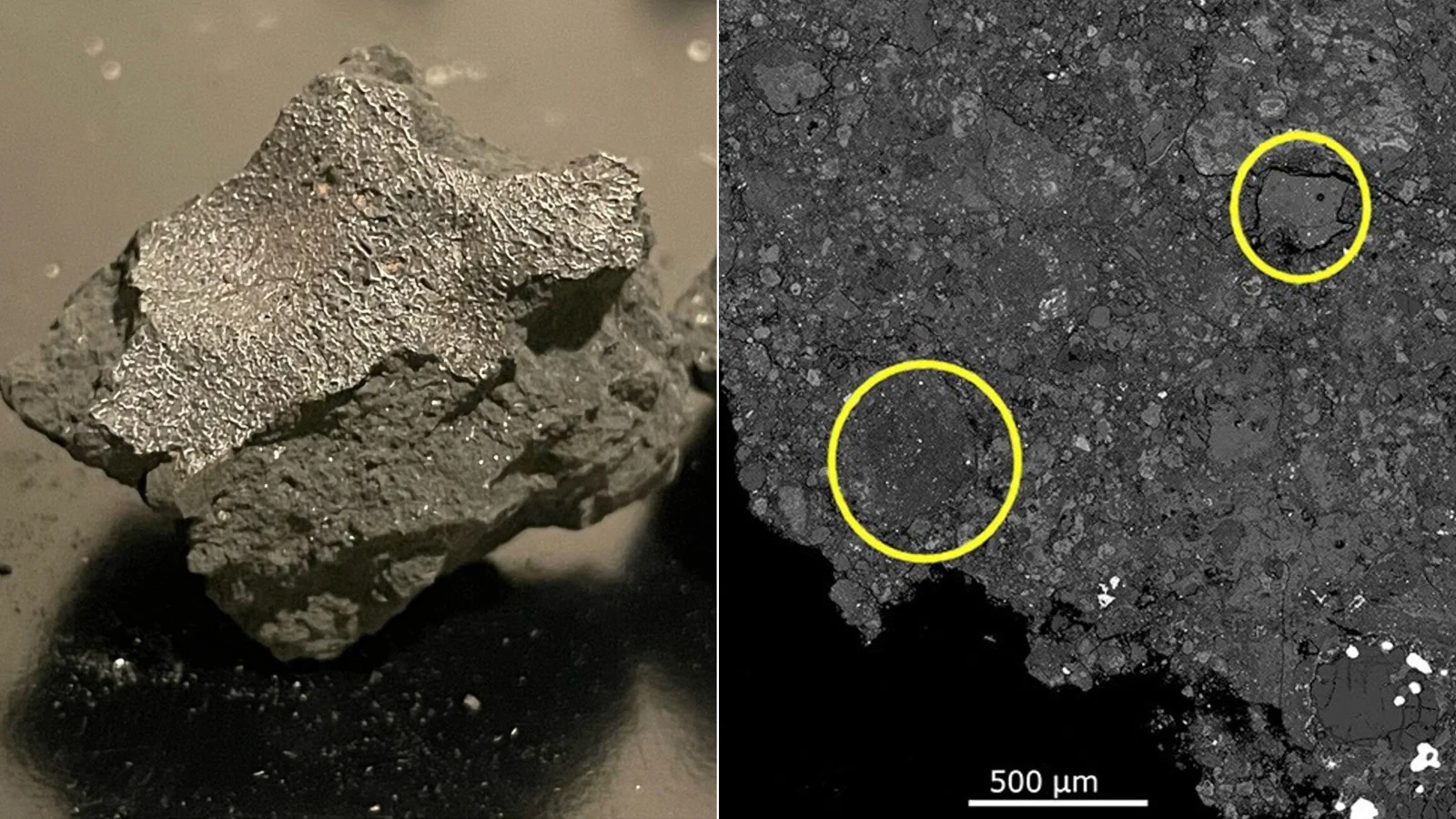
The Hillsborough meteorite (left), and a back-scattered electron image (right), with two C1 748 clasts circled, which point towards the meteorite's briny origin. (A. Gordon, NASA/SETI)
MORE FROM SPACE: Lucy's first closeup of asteroid Dinkinesh reveals it has a small moon!
One possibility, based on tracing back the meteoroid's trajectory through Earth's atmosphere, is that it could be from the Erigone asteroid family in the inner asteroid belt. Just last year, NASA's Lucy spacecraft flew past asteroid Donaldjohanson, which belongs to this same asteroid family.
"The chips of the most salt-rich bits of this meteorite are quite comparable to the samples returned by the Hayabusa2 and OSIRIS-REx missions," co-author Mike Zolensky, a meteoriticist at NASA's Johnson Space Center, said in a NASA press release. "They're not identical. They're different in some very interesting ways, but they've seen very similar processes."
"One of the big surprises for me when we analyzed a small chip of the Hillsborough meteorite was the complexity of amino acids and other organic compounds," Danny Glavin, another co-author of the study at the Astrobiology Analytical Laboratory at NASA's Goddard Space Flight Center, explained. "It's just more proof that the chemical building blocks of life could have been delivered — and are still being delivered — to Earth today by these carbonaceous asteroid fragments."
Thumbnail image combines a picture of the daytime meteor fireball from July 16, 2024, taken by Mark Kirschner, from Northford, Connecticut, with an image of one of the Hillsborough meteorite fragments collected after the fall, taken by A. Gordon.