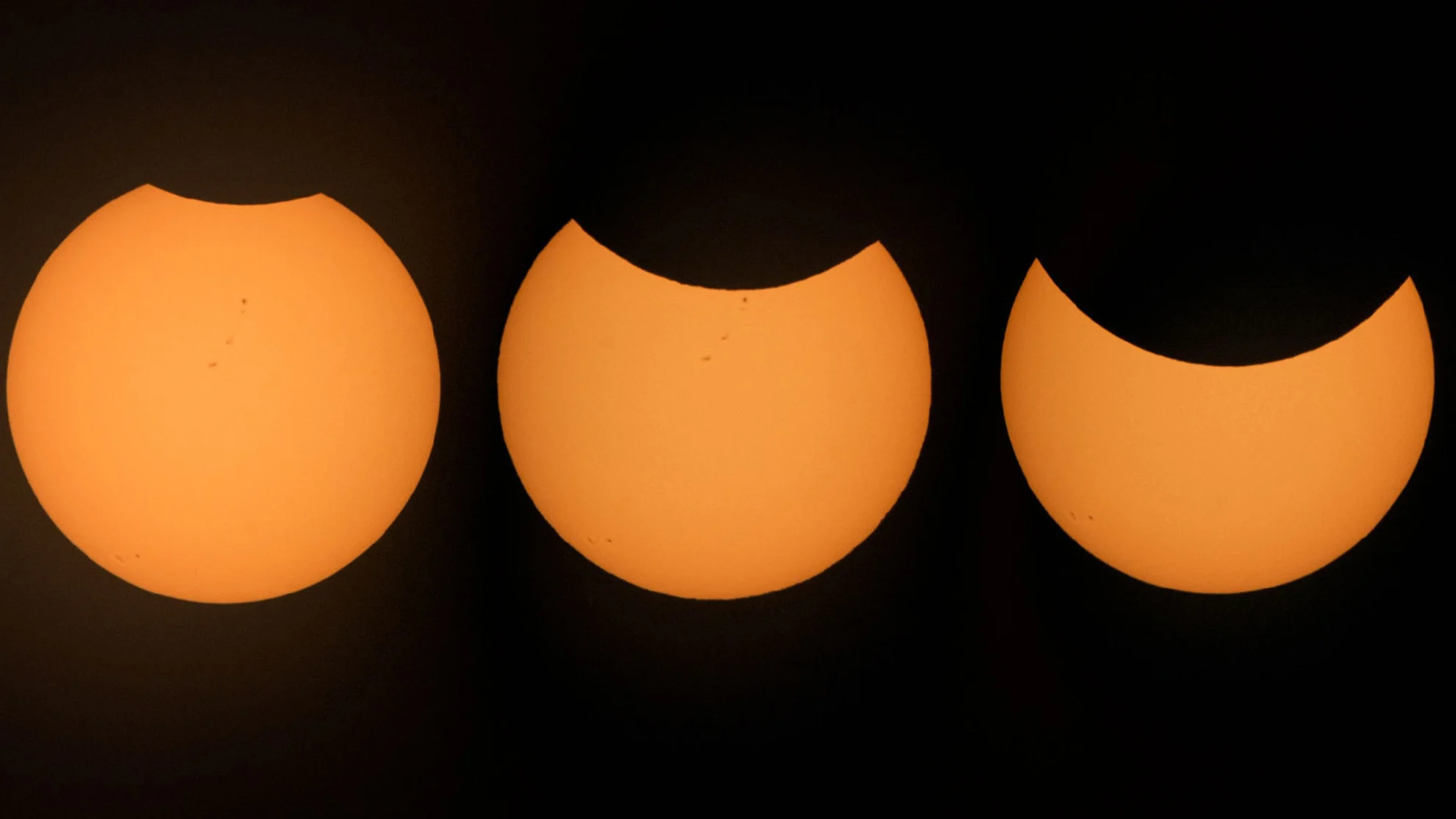
Mark your calendar: The Moon 'takes a bite' out of the Sun this summer

Unpack your eclipse glasses and cross your fingers for clear skies, so you don't miss this amazing celestial event!
This summer, an alignment of Earth, the Moon, and the Sun will produce a total solar eclipse along a line that stretches from the Arctic to southern Europe, and most Canadians have a chance to see a partial eclipse during the event.
After the stunning total solar eclipse on April 8, 2024, we have a long wait before the next one that passes over Canada — nearly 18 years, to be more precise, as the Moon's shadow will sweep over western Canada on August 22, 2044.
However, even this year, most of us have a chance to spot the Moon taking at least a tiny 'bite' out of the Sun.
On August 12, 2026, a total solar eclipse will begin in the Arctic, pass over eastern Greenland, the western tip of Iceland, the north Atlantic Ocean, and then through northern Portugal and Spain, before ending over the Mediterranean Sea.
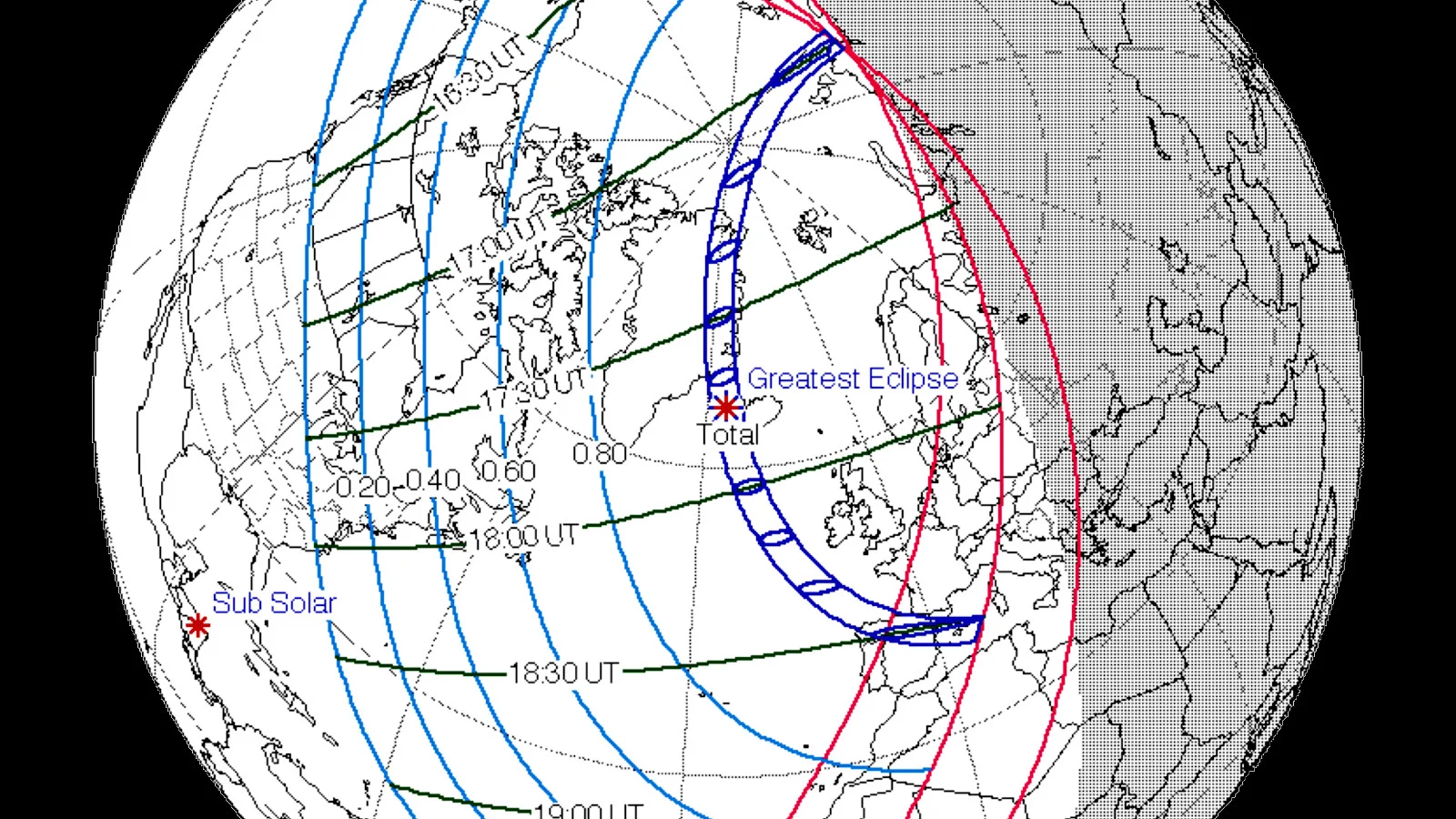
The path of totality of the August 12, 2026 solar eclipse is shown in this diagram, in dark blue. The lines extending away from the path denote where the partial solar eclipse will be visible. (NASA/Fred Espenak)
As is always the case with these events, a partial solar eclipse will be visible for hundreds of kilometres outside of the path of totality.
Almost all of Canada is within that range on August 12. Only southwestern British Columbia — specifically around Vancouver and the southern half of Vancouver Island — miss out.
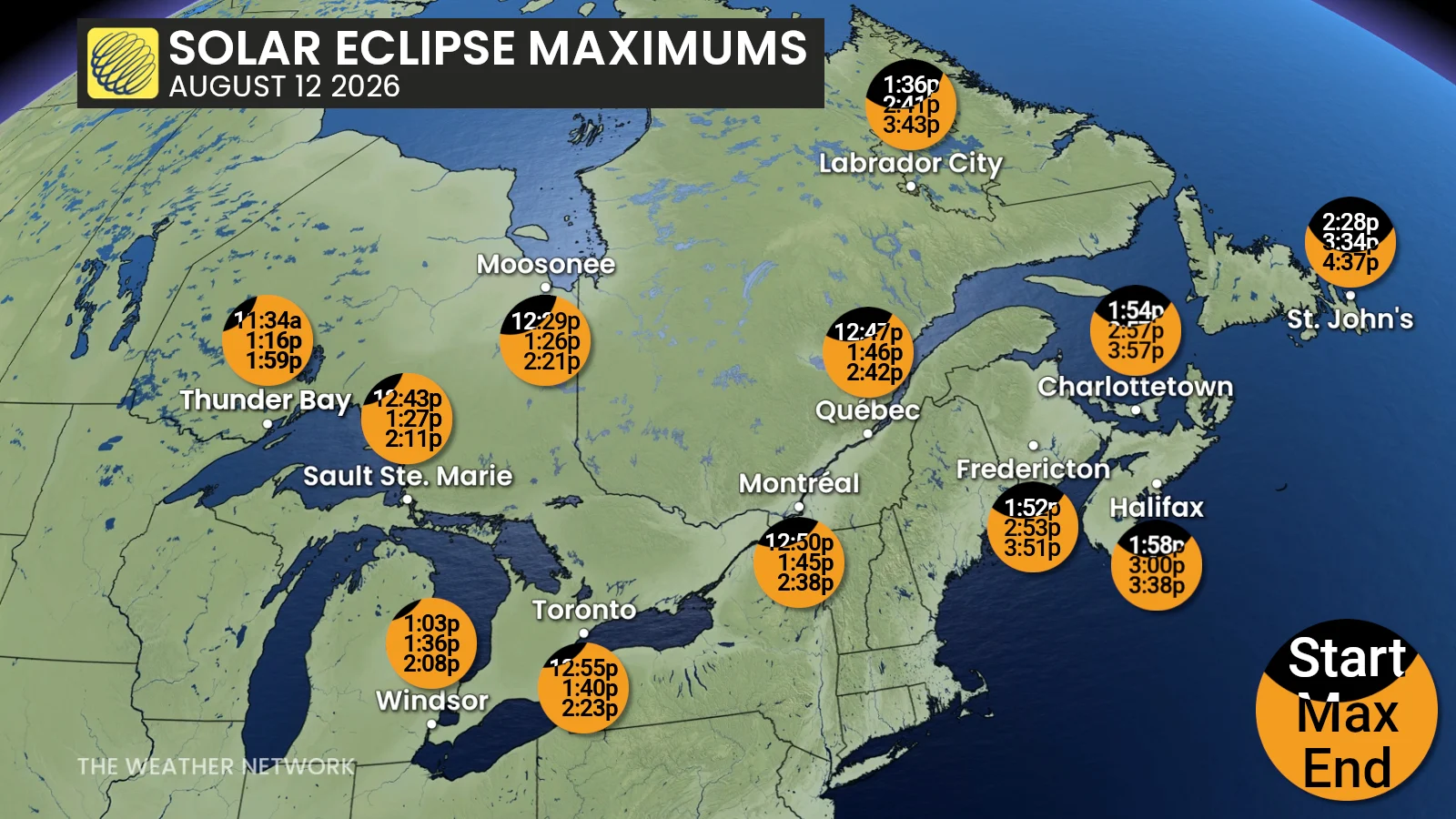
The timing and maximum partial eclipse for locations across eastern Canada.
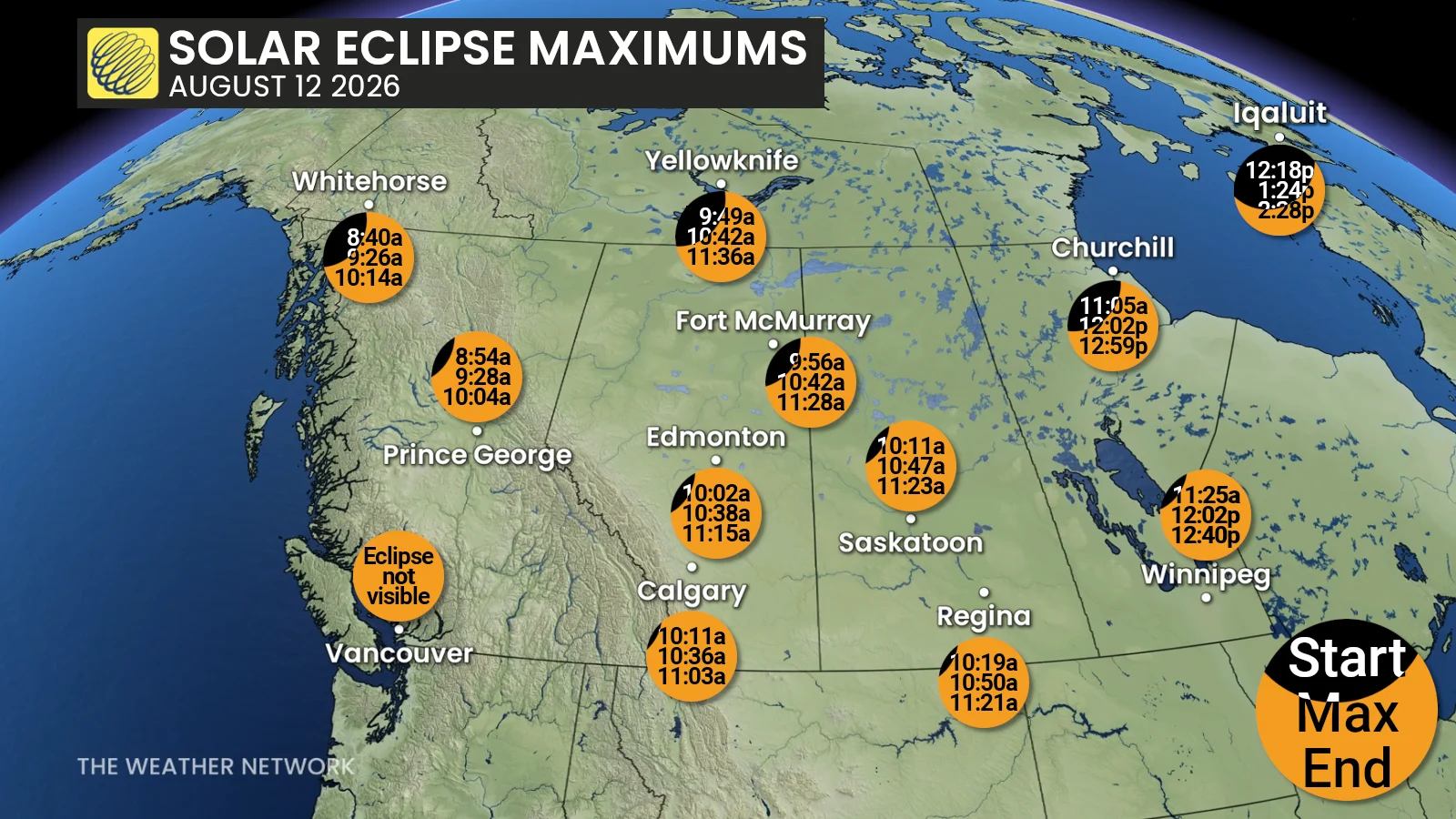
The timing and maximum partial eclipse for locations across western Canada.
The partial eclipse will be greatest in northeastern regions of the country, such as Nunavut, Labrador, and Newfoundland.
In general, the farther south and west the observer, the smaller the portion of the Sun that will be covered by the Moon.
Even in those areas that will only see a sliver of the Sun covered, the eclipse can still last for more than an hour, as the edge of the Moon slowly slides across the edge of the Sun.
Safety first!
During a total solar eclipse, there is only one safe time to look up at the alignment of the Sun and Moon without eye protection. That is during the brief moments when, for those stationed along the path of totality, the Moon is completely covers the Sun.
For the August 12 eclipse, there is no portion of the path of totality that crosses Canadian soil. Thus, for anyone watching this eclipse unfold in the skies above our vast country, eye protection should be worn at all times. Or, some kind of indirect method of observing the eclipse should be used.
At no time will it be safe to look directly at the Sun with the naked eye.
Eye protection, in this case, means a proper pair of mylar solar eclipse glasses.
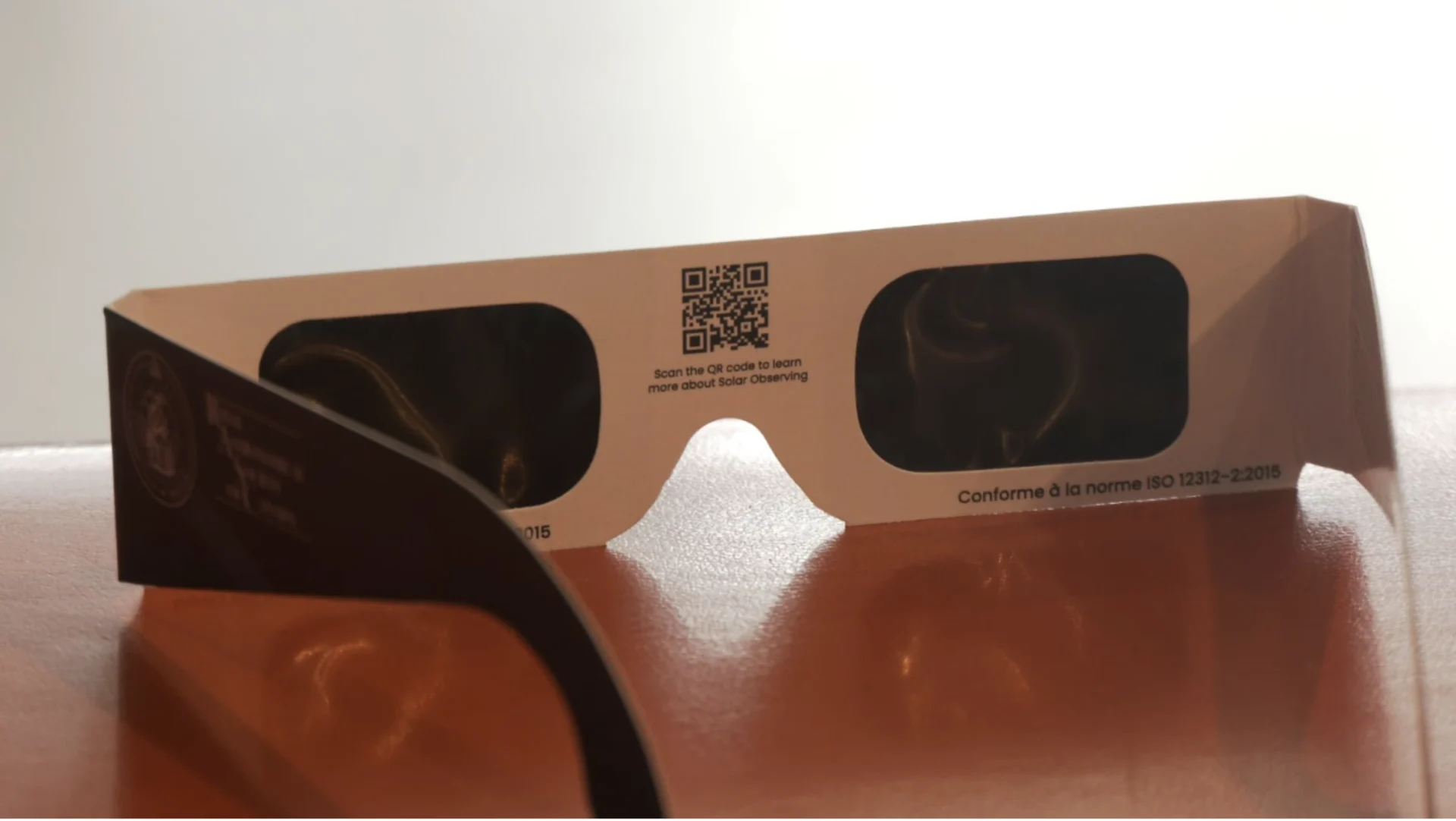
Solar eclipse glasses. (Connor O'Donovan)
DON'T MISS: Follow these tips to safely observe any solar eclipse
Alternatively, there will likely be livestreams of the event occurring on the internet.
Or, you can construct a simple pin-hole projector, as a way of observing the eclipse indirectly. Watch the video below for instructions on how to turn a cereal box into such a projector.
Now, will the weather cooperate on August 12, so that we can actually see this eclipse happen? More on that to come!