The Lyrid Meteor Shower peaks over Earth Day. Here's how to watch from anywhere

The 'meteor shower drought' is ending as the April Lyrids peak.
Eyes to the sky on Thursday and Friday nights! The first spring meteor shower is reaching its annual peak!
Every year, more than a dozen prominent meteor showers send streaks of light across our night skies. However, after the Quadrantids in early January, we go through what could be described as a meteor shower drought that lasts roughly three and a half months.
This week that drought ends, though. Earth is passing through the stream of dust, ice, and gravel left behind in space by a comet known as C/1861 G1 (Thatcher). As those bits of debris are swept up by Earth's atmosphere, they produce brief, sometimes exceptionally bright flashes of light.
This is the Lyrid meteor shower, and it reaches its peak over Earth Day, on the nights of April 21 and April 22.
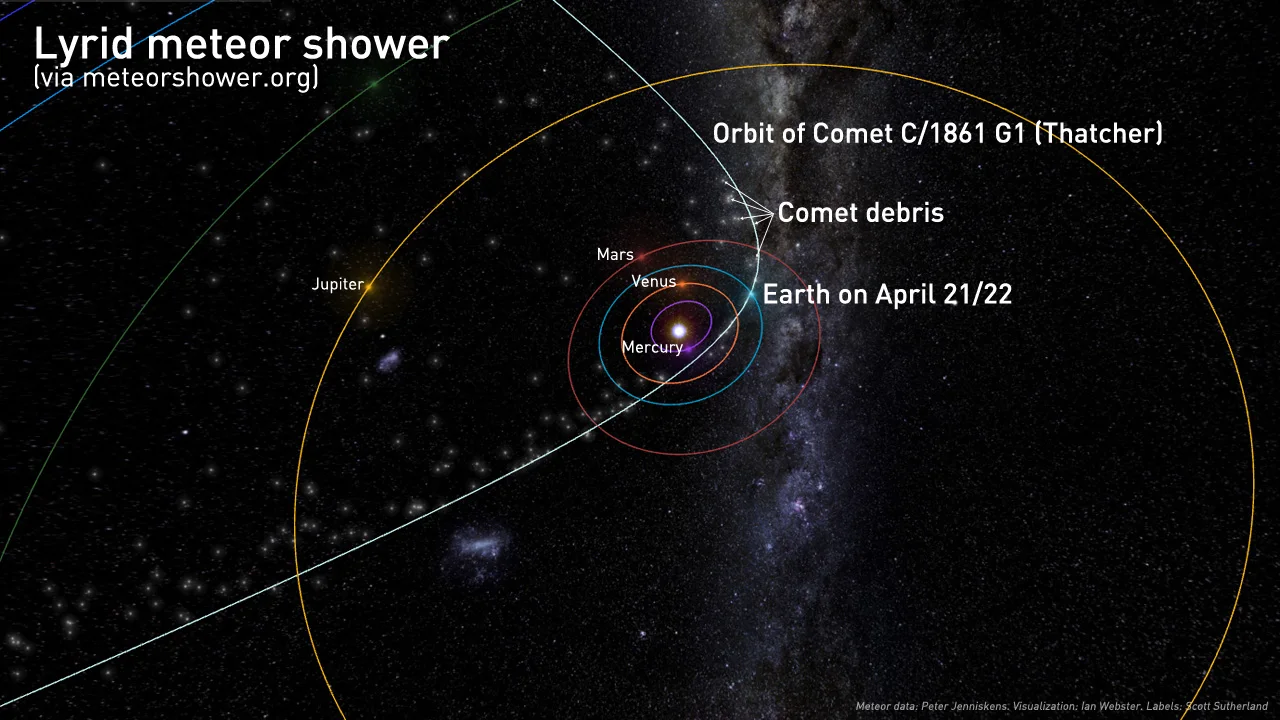
Nearly all meteor showers follow a similar pattern. First, they begin with a few meteors showing up, all originating from the same point in the night sky. Then, as Earth gets deeper into the debris stream, the number of meteors increases, night by night until it reaches a peak. After that, the numbers ramp down again until the planet exits the stream.
For the Lyrids, the meteor shower occurs every year from April 15-29, and it reaches its peak around April 21-22.
Comet Thatcher's debris stream tends to be sparse compared to some of the more active meteor showers. Even at their peak, the Lyrids typically deliver around 20 meteors per hour, with most viewers seeing about half that number.
That's one meteor every five minutes or so, which isn't too bad of a show, especially considering that the Lyrids are well-known for producing bright fireballs!
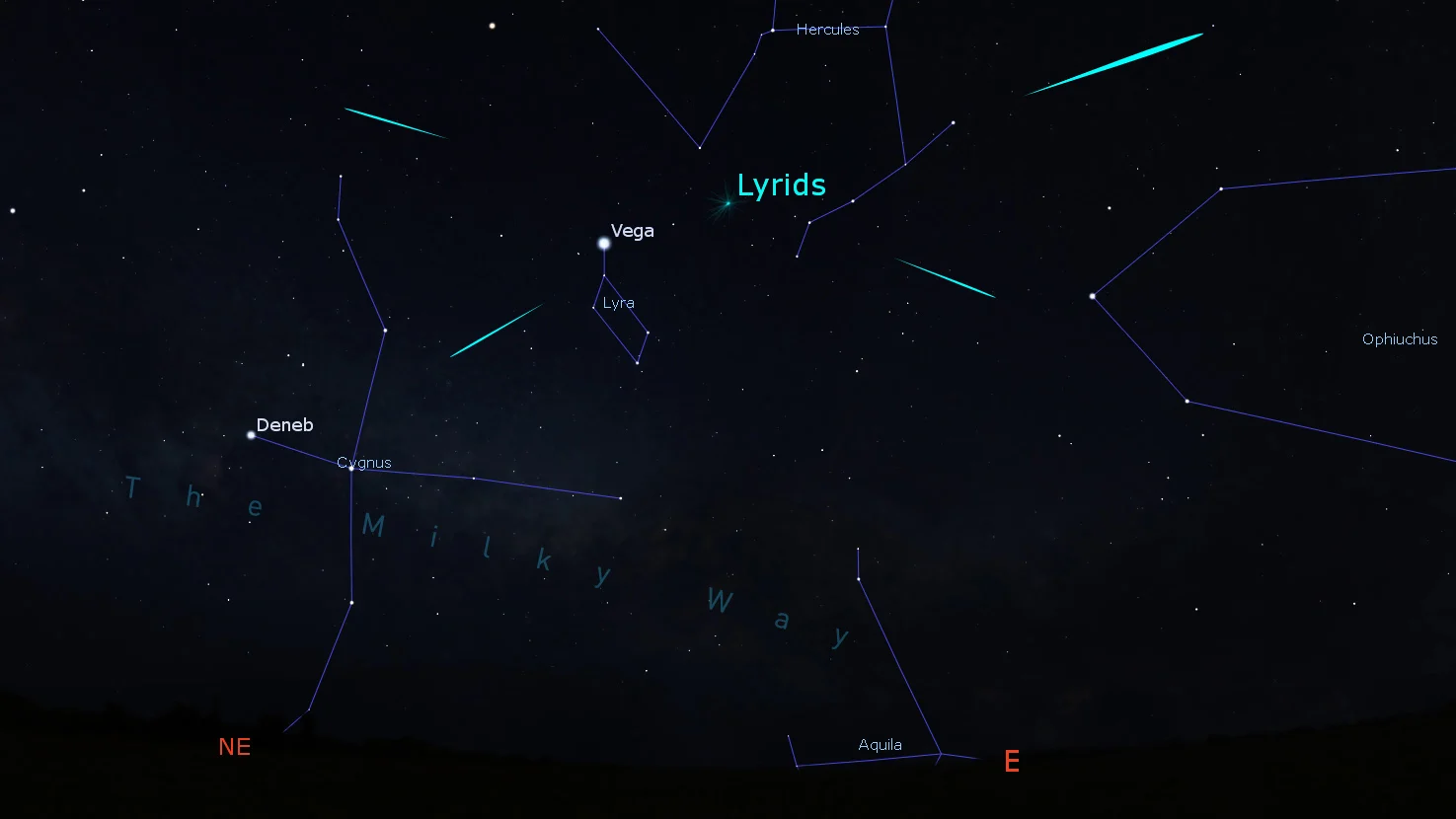
The apparent origin point of Lyrid meteors, known as the radiant, is shown here near the bright star, Vega, on the night of April 22. Credit: Stellarium/Scott Sutherland
The Lyrids are also remarkable in other ways. It is the oldest of all the meteor showers we see each year, having been observed now for over 2,700 years.
According to Sky and Telescope magazine, "Chinese court astronomers reported a Lyrid outburst on March 16, 687 BC when 'in the middle of the night, stars fell like rain.'
Also, while we only see 10-20 meteors per hour from the Lyrids, every 60 years, there's an 'outburst' of exceptional activity. In 1982, during the last outburst, the Lyrids rivalled the Perseids and Orionids, producing over 100 meteors per hour at its peak. We're not expecting the next outburst for another 20 years, though.
WILL WE SEE IT?
The 'radiant' of this meteor shower — where the meteors appear to originate — rises in the northeast after sunset. It then tracks across the night sky, reaching zenith (directly overhead) just before dawn.
The ideal time to watch is likely between 9 p.m. and 1 a.m., local time. That is when it will be dark enough to see meteors, but before the Moon rises and adds its light to the sky (which will wash out dimmer meteors). The pre-dawn hours are typically best for meteor showers, as that's when the radiant is usually highest in the sky. However, in this case, be sure to face away from the Moon to preserve your night vision, and check out the line-up of bright planets along the eastern horizon, too!
Unfortunately, based on the weather, this does not appear to be an ideal year for much of Canada to see the Lyrids.


On Thursday night, southwestern B.C. and southern Ontario have the best chance to see the meteor shower. Then, those clear patches shift over to south-central B.C. and southern Quebec on Friday night. Be sure to check your your local forecast, though, as even a few hours of reasonably clear skies will be enough to catch a glimpse of the meteor shower.
WATCH FROM ANYWHERE
If it is cloudy where you are, there are other ways to 'watch' the show.
You can see the signal meteoroids make when they hit the atmosphere via Meteor Radar or listen to them via the latest Meteor Echoes Livestream.
Additionally, the International Dark-Sky Association will present a live stream of the meteor shower from China. The stream begins at 8:30 a.m. EDT on Friday (8:30 p.m. Beijing time).
Also, the peak of the Lyrids tends to be wider than most meteor showers. So, feel free to go out on Wednesday night, before the official peak, and try over the weekend as well! Just be sure you have reasonably clear skies before heading outside to see the show.
Watch below: See the peak of the Lyrid meteor shower this week
METEOR? METEOROID? METEORITE?
There are a lot of similar-sounding words that get tossed around during events like these, and it's easy to get them mixed up. So here's a short guide to help.
The bright streaks we see during the Lyrids are known as meteors.
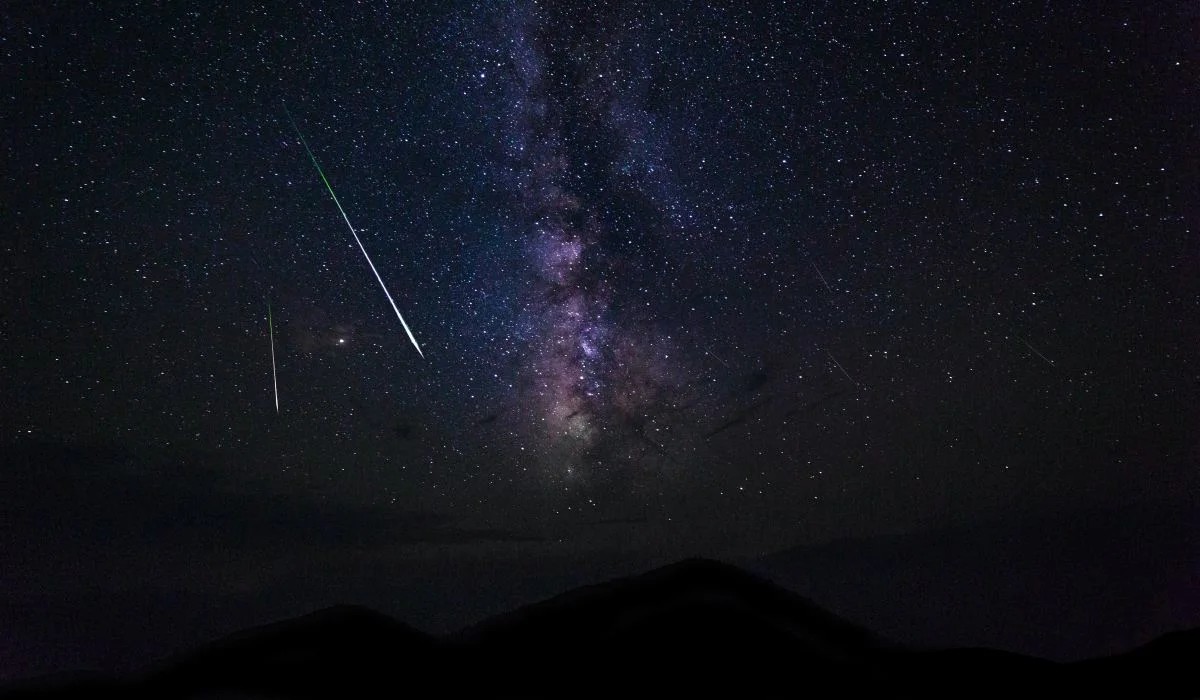
Image via Unsplash: Austin Human @xohumanox
Each meteor occurs due to a meteoroid — a piece of rock or ice the size of a speck of dust up to a grain of sand — plunging into Earth's upper atmosphere.
Meteoroids travel at incredible speeds, typically measured in kilometres per second! When they hit the atmosphere, they compress the air in their path, turning that air into a white-hot glowing plasma. Sometimes they will shine with other colours, usually based on the composition of the atmosphere they're flying through or specific minerals vapourizing off the meteoroid itself.
A typical meteor flash tends to last a second or less. Larger meteoroids, from a pebble to a boulder in size, produce much brighter and longer-lasting meteors, which we call fireballs. Some fireballs emit bright flashes along their path. This indicates that the meteoroid is exploding apart under the intense pressure. These are often referred to as a bolide.
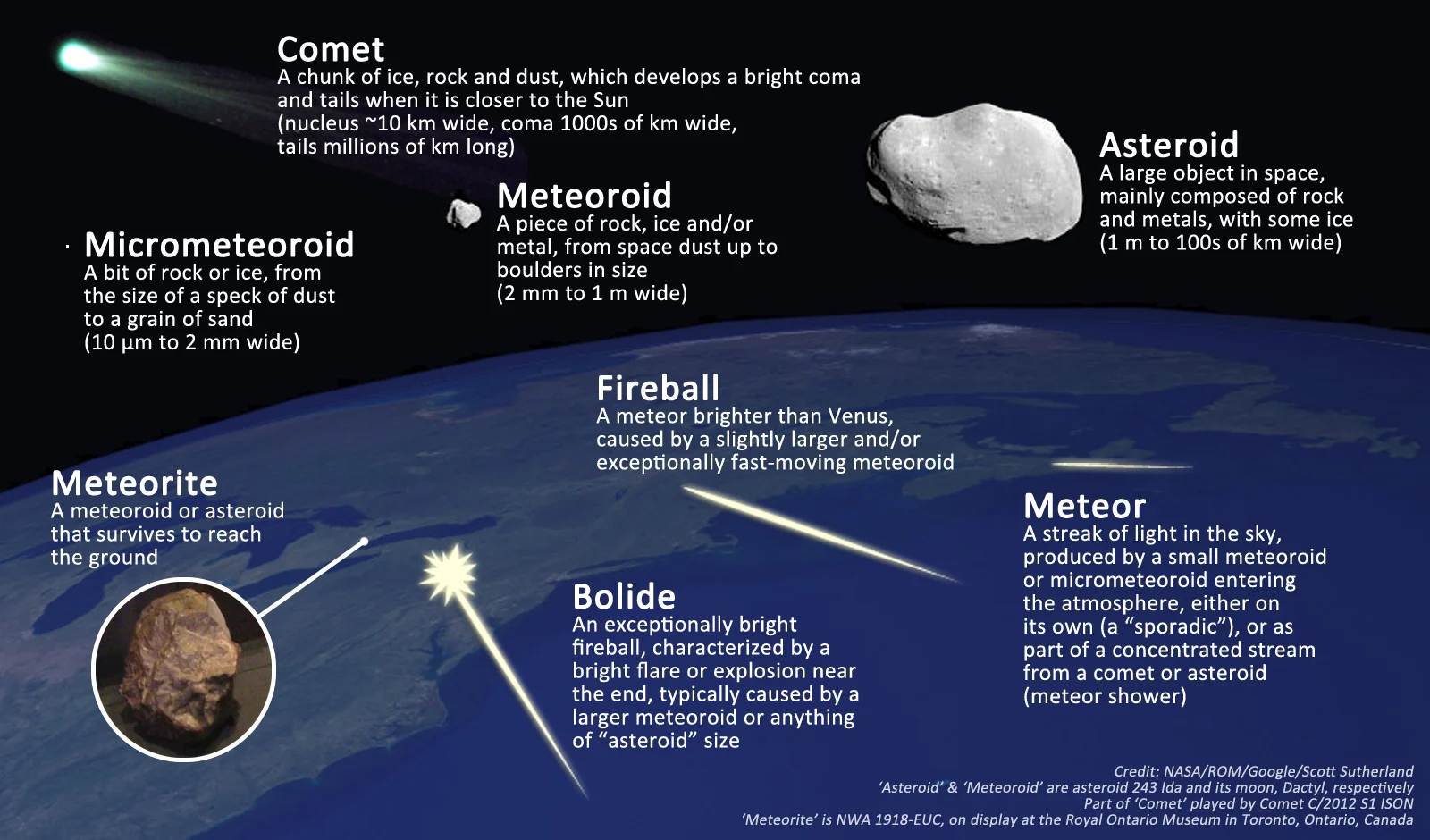
Regardless of how big and bright a meteor is, it 'winks out' when one of two things happens. Smaller meteoroids tend to be completely vapourized by the heat of the plasma around them. For larger ones, the 'pushback' from the air slows the meteoroid down enough that it can no longer compress the air into a plasma.
Any parts of the meteoroid that survive past this point enter what's known as dark flight. Basically, they become rocks falling under the force of gravity. If we find these rocks on the ground, we call them meteorites.
Related: Want to find a meteorite? Expert Geoff Notkin tells us how!
TIPS FOR METEOR WATCHING
Given how polluted our nights are with urban light, even if you have clear skies, it is no longer a simple matter to step outside and gaze up at the stars. It's even more difficult to watch an event like a meteor shower. Follow the tips below, though, and you'll be less likely to miss out.
There are three best practices for observing the night sky:
Check the weather,
Get away from light pollution, and
Be patient.
Clear skies are essential. Even a few hours of cloudy skies can ruin your chances of watching an event such as a meteor shower. So, be sure to check The Weather Network on TV, on our website, or from our app, and look for my articles on our Space News page, just to be sure that you have the most up-to-date sky forecast.
Next, you need to get away from city light pollution. Look up into the sky from home. What do you see? Some passing airliners? The Moon, a planet or two, perhaps a few bright stars such as Vega, Betelgeuse and Procyon? If so, the light pollution in your area may be too bright for watching a meteor shower.
Keeping streetlights and other light sources out of your direct line of sight will help. However, to get the most out of a meteor shower, it's best to watch from outside the city. The farther away you can get, the better.
For most regions of Canada, getting out from under light pollution is simply a matter of driving outside of your community until many stars are visible above your head.
In some areas, especially in southern Ontario and along the St. Lawrence River, the concentration of light pollution is too high. Getting far enough outside of one city to escape its light pollution tends to put you under the light pollution dome of the next city over. The best options for getting away from light depend on your location. In southwestern Ontario and the Niagara Peninsula, the shores of Lake Erie can offer some excellent views. In the GTA and farther east, drive north and seek out the various Ontario provincial parks or Quebec provincial parks. Even if you're confined to the parking lot after hours, these are usually excellent locations from which to watch (and you don't run the risk of trespassing on someone's property).
Watch: What light pollution is doing to city views of the Milky Way
If you can't get away, the suburbs can offer at least a slightly better view of the night sky. Here, the key is to limit the amount of direct light in your field of view. Dark backyards, sheltered from street lights by surrounding houses and trees, are your best haven. The video above provides an excellent example of viewing based on the concentration of light pollution in the sky. Also, check for dark sky preserves in your area.
When viewing a meteor shower, be mindful of the phase of the Moon. Meteor showers are typically at their best when viewed during the New Moon or Crescent Moon. However, a Gibbous or Full Moon can be bright enough to wash out all but the brightest meteors. Since we can't get away from the Moon, the best option is to time your outing right, so the Moon has already set or is low in the sky. Also, you can angle your field of view to keep the Moon out of your direct line of sight. This will reduce its impact on your night vision and allow you to spot more meteors.
Once you've verified you have clear skies, and you've limited your exposure to light pollution, this is where being patient comes in.
For best viewing, your eyes need some time to adapt to the dark. Give yourself at least 20 minutes, but 30-45 minutes is best for your eyes to adjust from being exposed to bright light.
Warning: This is possibly the one thing that causes the most disappointment when watching a meteor shower. Stepping out into your backyard from a brightly lit home and looking up for five minutes, you might be lucky enough to catch one of the brighter meteors. It's far more likely, though, that you won't see anything. However, waiting for at least twenty minutes and avoiding light sources during that time — streetlights, car headlights and interior lights, and smartphone and tablet screens — dramatically improves your chances of avoiding disappointment.
Sometimes, avoiding your smartphone isn't an option. In that case, set the display to reduce the amount of blue light it gives off and reduce the screen's brightness. That way, it will have less impact on your night vision.
You can certainly gaze into the starry sky while letting your eyes adjust. You may even see a few of the brighter meteors as your eyes become accustomed to the dark.
Once you're all set, just look straight up and enjoy the view!
Thumbnail photo credit: Getty Images/Allexxandar. Creative#: 826077456