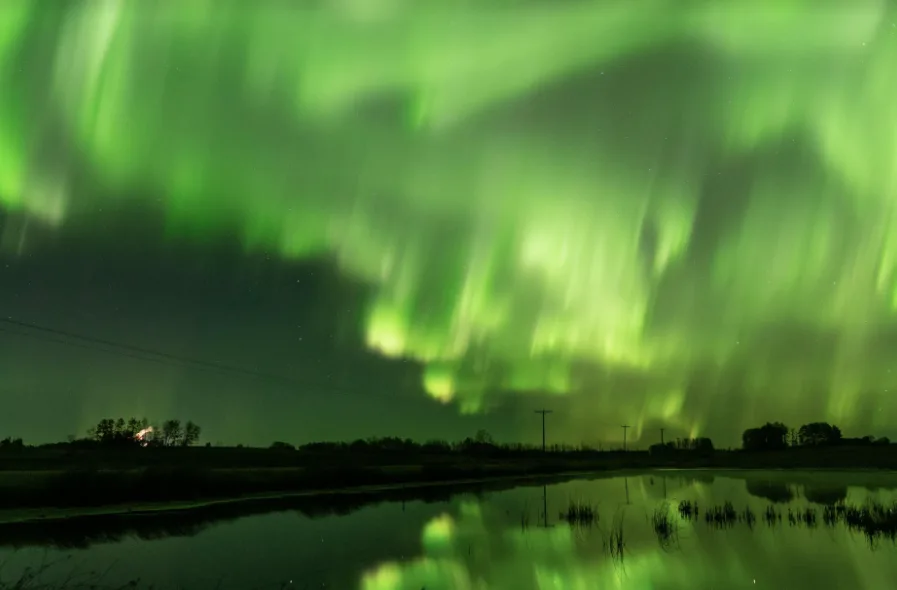
Look up! The Northern Lights may shine across Canada this weekend

An eruption from the Sun is set to spark auroras across Canada.
Eyes to the sky this weekend for a chance to see the Northern Lights shining bright.
In the early hours of July 21, a solar flare blasted out from an active sunspot on the surface of the Sun. The flare was relatively weak, it set off a 'solar tsunami' that spread out away from the sunspot.
At the same time, it also caused a 'coronal mass ejection' to erupt into space. This cloud of charged solar particles, sometimes called a 'solar storm', was more or less aimed directly at Earth.
The CME is expected to sweep by us late on Friday night. When it does, it may spark a geomagnetic storm around the planet. That means we could see auroras.
How bright the auroras are, and how far south they are visible, will depend on how strong that geomagnetic storm is.
Although the solar flare was weak and the coronal mass ejection fairly diffuse, according to NOAA's Space Weather Prediction Center, when the CME's impacts are combined with effects of the solar wind, it could produce G1 (minor), or possibly even G2 (moderate), storm conditions overnight from Friday to Saturday.
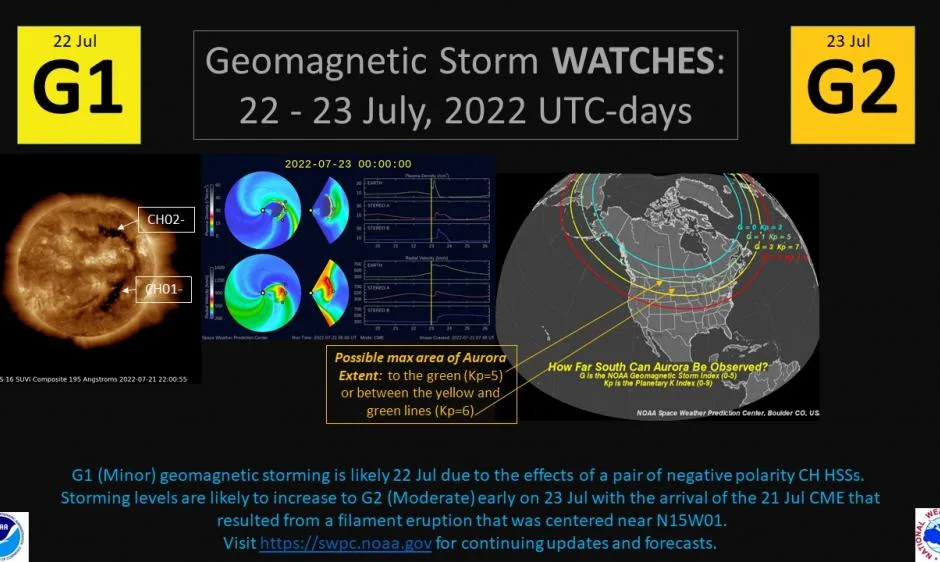
The geomagnetic storm watch combines the effects of two coronal holes with the incoming CME, to advise of potential space weather impacts overnight on Friday. Credit: NOAA SWPC
NOAA SWPC ranks geomagnetic storms as one of five classes: G1 (minor), G2 (moderate), G3 (strong), G4 (severe), and G5 (extreme). The severity is based on the predicted density, energy, and speed of the CME. The potential impacts, for auroras and for effects on our technology and power grids, ramp up with each successive rank.
If a minor geomagnetic storm does result from this encounter, auroras will likely be visible for northern regions of eastern Canada and across the prairie provinces.
On the map below, a G1 (minor) storm tends to have auroras extending as far south as the green line.
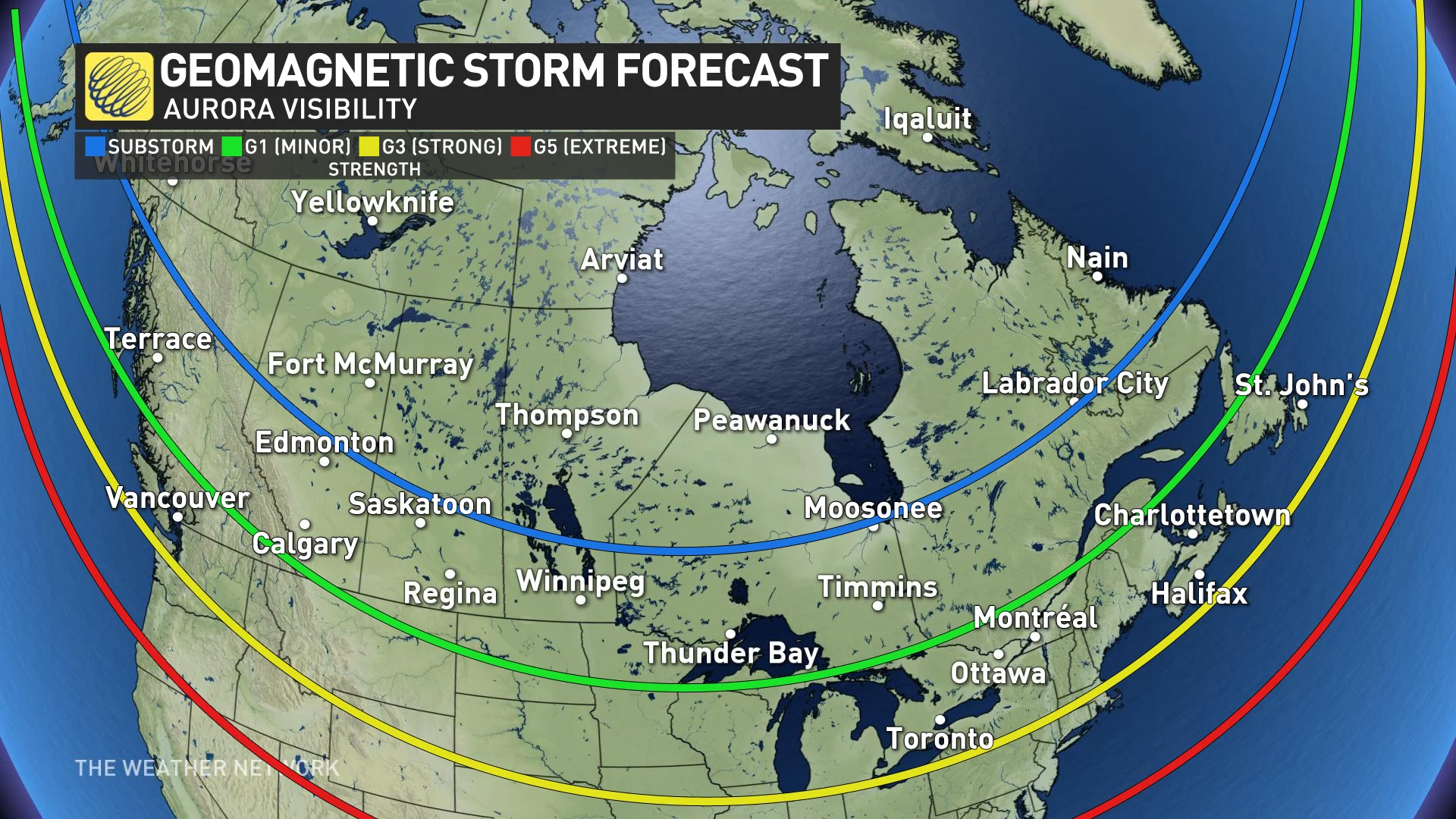
On this map, the coloured arcs indicate how far south the Northern Lights can typically be seen, based on the geomagnetic conditions around Earth.
During a G2 (moderate) geomagnetic storm, auroras can be seen as far south as between the yellow and green lines. Thus, it may be possible for skywatchers in southern Ontario to spot them, although they are typically not bright enough to be seen through city light pollution.
Depending on what happens, there may even be some residual effects on Saturday night, which could produce a second night of auroras.
Thumbnail image provided by Alberta aurora chasers Tree and Dar Tanner.