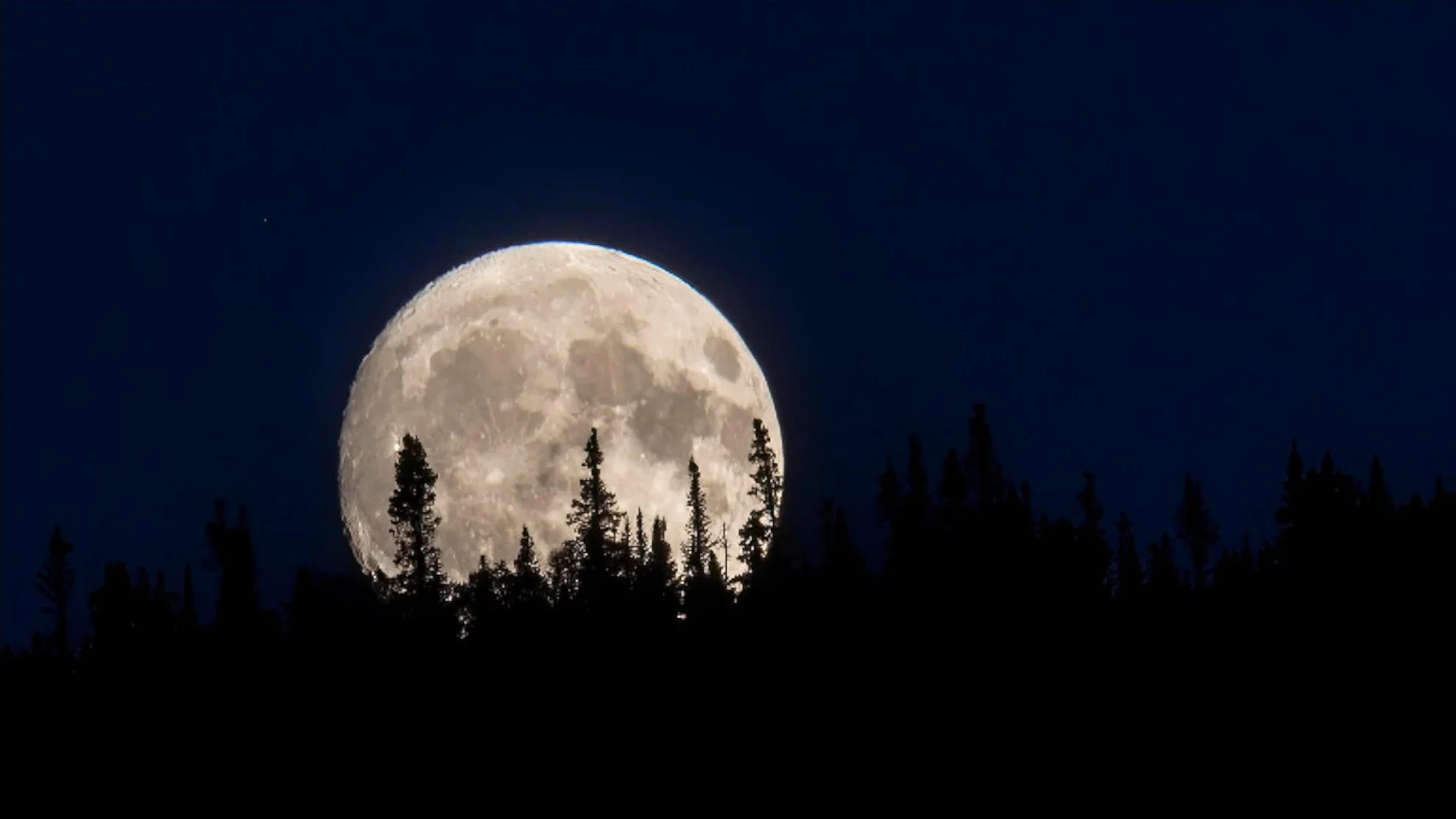
Look up! July's Full Buck Moon shines along with a trio of meteor showers

This week, the Moon will appear Full from Tuesday evening through Thursday morning.
If you have clear skies over the next few nights, take some time to pause and gaze up at the Full Buck Moon. You might just spy a fireball or two flashing across the sky, as well!
At 10:36 a.m. EDT on Wednesday, July 29, 2026, the Moon will line up on the exact opposite side of Earth from the Sun, producing this month's Full Moon.
Canada will miss the exact moment, as the Moon will be on roughly the opposite side of the planet from us at that time.
However, the Moon will appear full for a day or so, both before and after the morning of the 29th. Its Earth-facing side will be over 98 per cent illuminated starting just before moonset Tuesday morning, then over 99 per cent full all Tuesday night and Wednesday night. Plus, even when it rises again, Thursday evening, it will still be around 98 per cent illuminated.
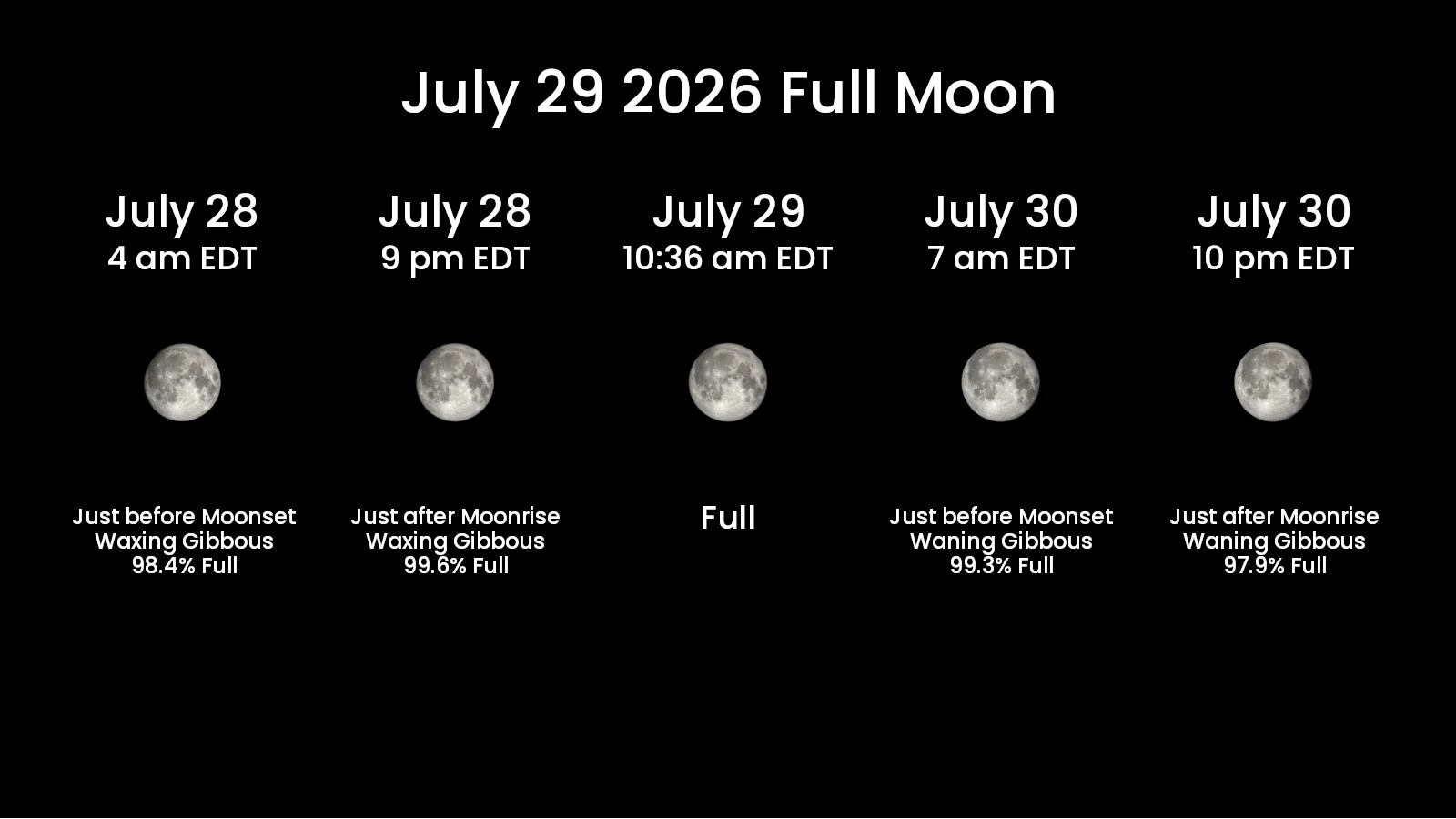
The Moon from moonset on the morning of July 28 through moonrise on the night of July 30, scaled to approximate their appearance in the sky. (NASA's Scientific Visualization Studio/Scott Sutherland)
RELATED: Planets shine and three meteor showers crisscross the night sky in July 2026
This happens because, from our vantage point here on Earth, with the Moon around 400,000 km away, it's challenging to notice the thin sliver of shadow along the Moon's edge on the days before and after the Full Moon. Thus, at a glance, the Moon will appear Full for all of that time.
Now, taking a few moments to focus on the Moon may reveal that one side doesn't look as distinct as the other; the left side during Waxing Gibbous phase and the right side for a Waning Gibbous. That's the effect of the shadow.
Also, a closer look, such as through a telescope or binoculars, or by zooming in with a camera, can make those shadows much more obvious.
What is a Buck Moon?
Western culture most commonly calls the July Full Moon the Buck Moon.
It was apparently the Maine Farmer's Almanac that first published a list of Full Moon names, back in the 1930s. Most were borrowed and simplified from the lunisolar calendars used by Indigenous peoples of what is now the northeastern United States. The other almanacs picked up this practice over the years, but these names didn't become popular until much more recently.
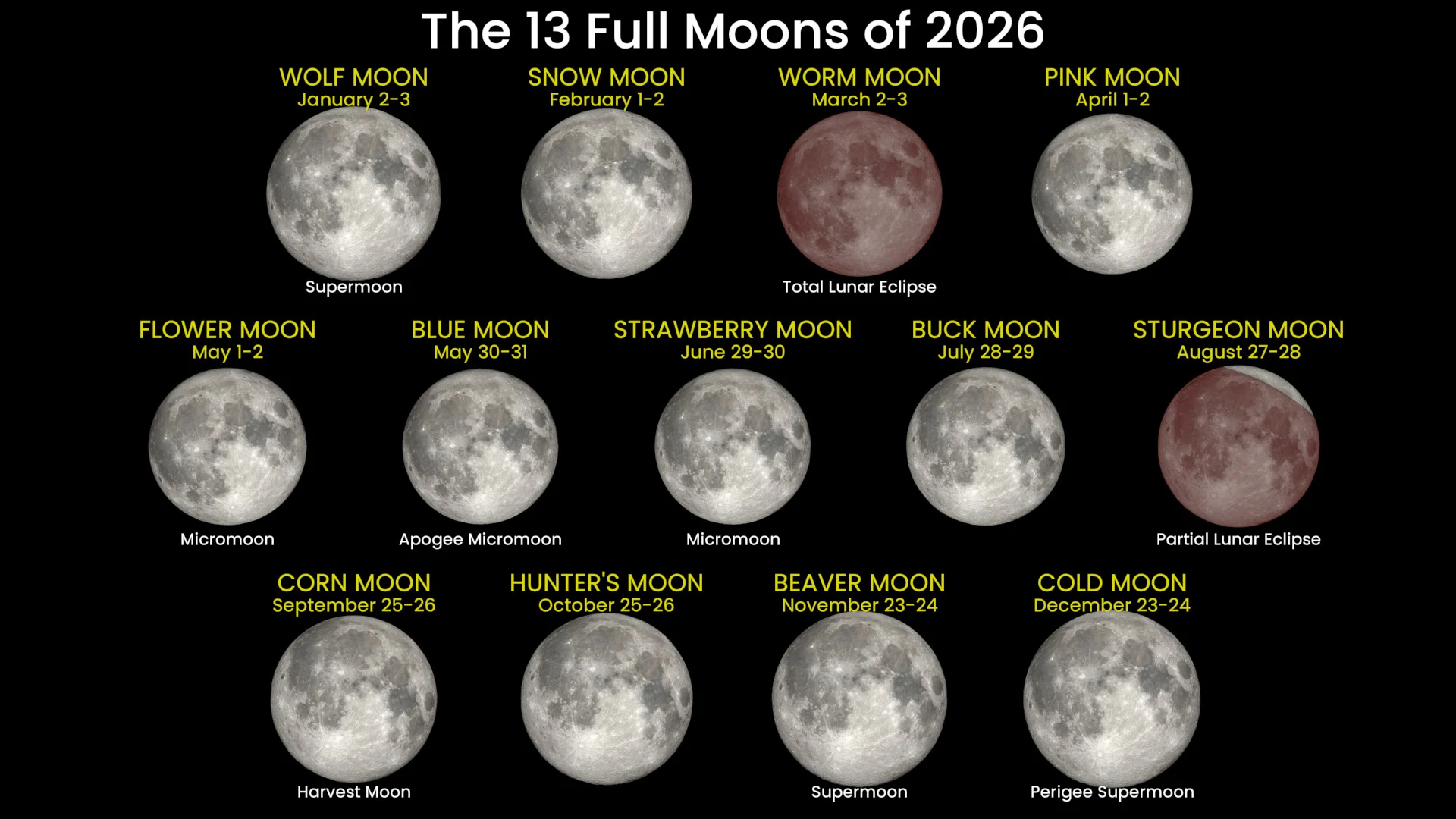
The 13 Full Moons of 2026, which include the typical 12, plus the 'extra' Blue Moon in May. (NASA's Scientific Visualization Studio/Scott Sutherland)
RELATED: Why does the Moon look so big? What is the mysterious Moon Illusion?
This particular Moon was named the Buck Moon due to early summer being the time of year when male deer begin to develop new antlers.
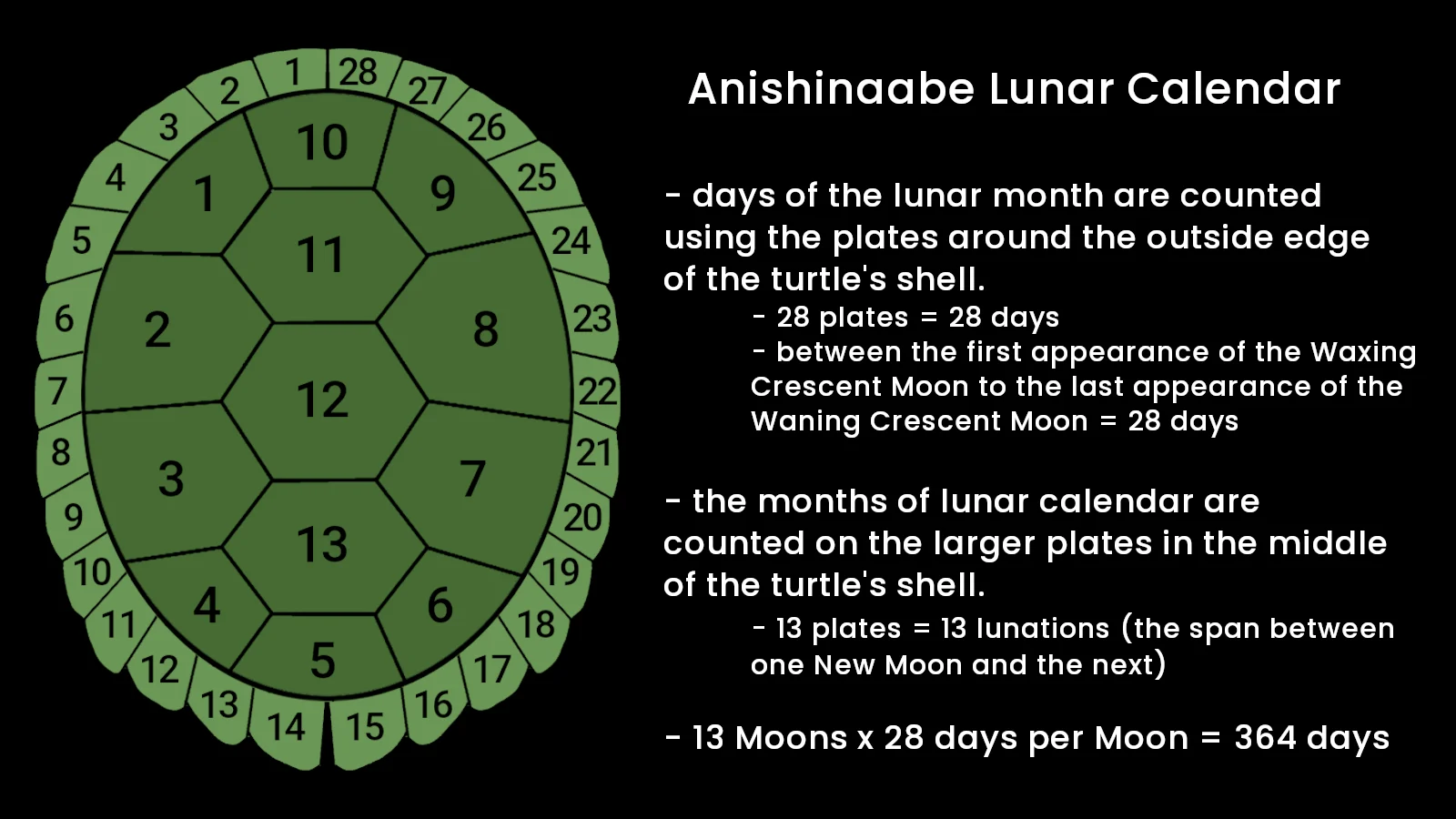
These names aren't only used for the Full Moon, though. They refer to the full 28-29 day 'lunation', counting either between one Full Moon and the next, or one New Moon and the next, depending on the culture.
For example, the calendar used by the Anishinaabe people is based on the pattern of plates on the shell of a turtle. The 28 small plates around the shell's edge corresponded to the 28 days of each Moon, and the 13 large plates on the turtle's back represent the 13 Moons of the year.
READ MORE: Indigenous constellations - part-science, part-art, all-important
Each Moon was given a name, similar to the months of the Roman or Gregorian calendar. However, whereas month names came from gods, festivals, rulers, and their original numerical order in the calendar, Moon names were taken from the aspect of nature that had the greatest influence on the peoples' lives at that time of year.
Meteor showers
This week, two annual meteor showers are reaching their peaks — the Southern delta Aquariids and the alpha Capricornids.
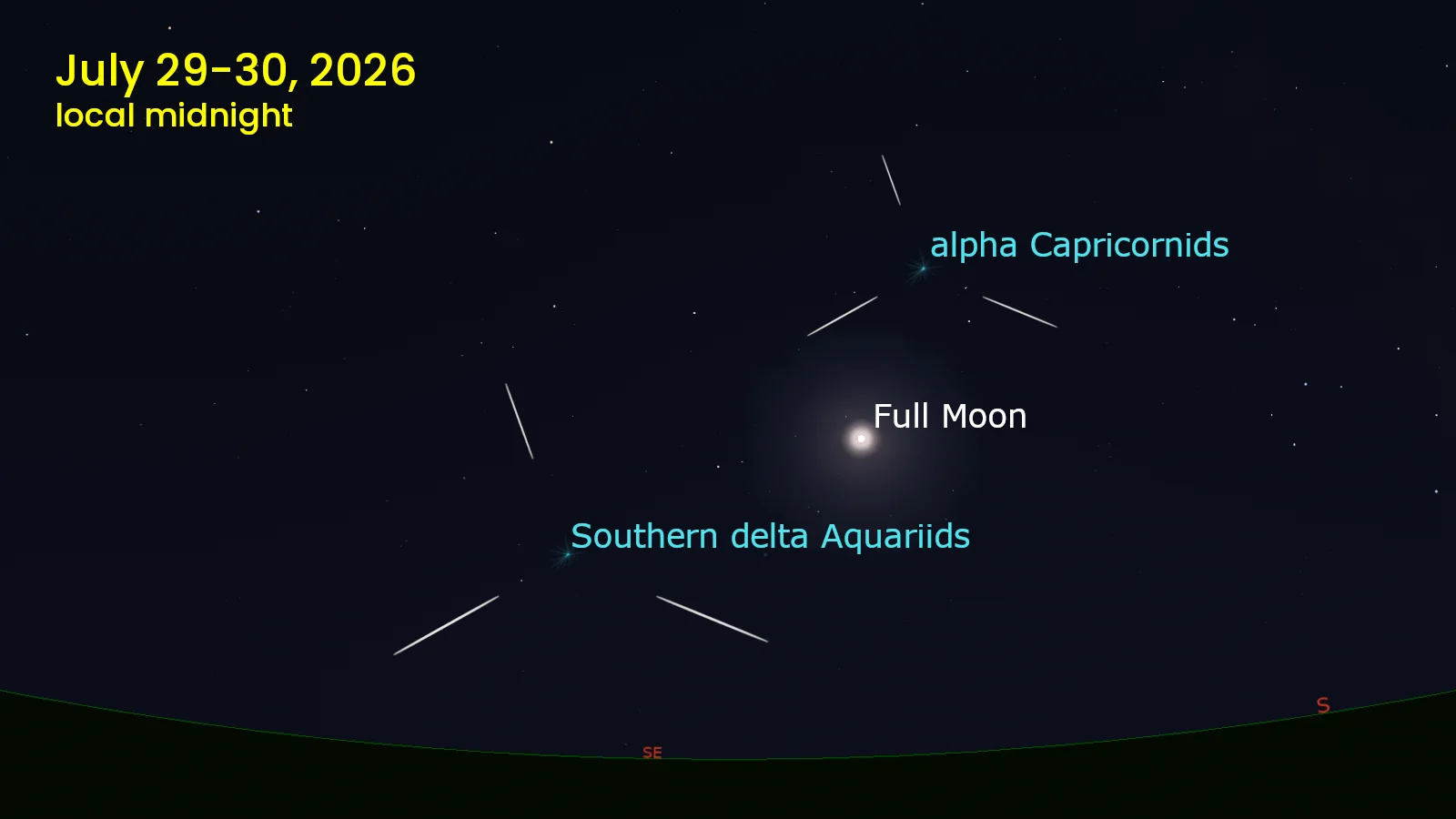
The radiants of the Southern delta Aquariids and alpha Capricornids in the night sky on July 29-30, 2026. (Stellarium/Scott Sutherland)
DON'T MISS OUT: How to get the most out of meteor showers and other night sky events
Neither are particularly strong meteor showers. However, along with these two, the Perseid meteor shower is also gaining strength as we approach its August 12 peak. Thus, the sparse meteors from the Southern delta Aquariids and alpha Capricornids will likely be joined by perhaps a dozen or so every hour out of the northeast sky, thanks to the Perseids.
Spotting meteors flash by overhead on any night requires at least partially clear skies, and a certain amount of luck. The sky also needs to be sufficiently dark, to allow our eyes to properly adjust, so that we can pick out the brief streaks of light.
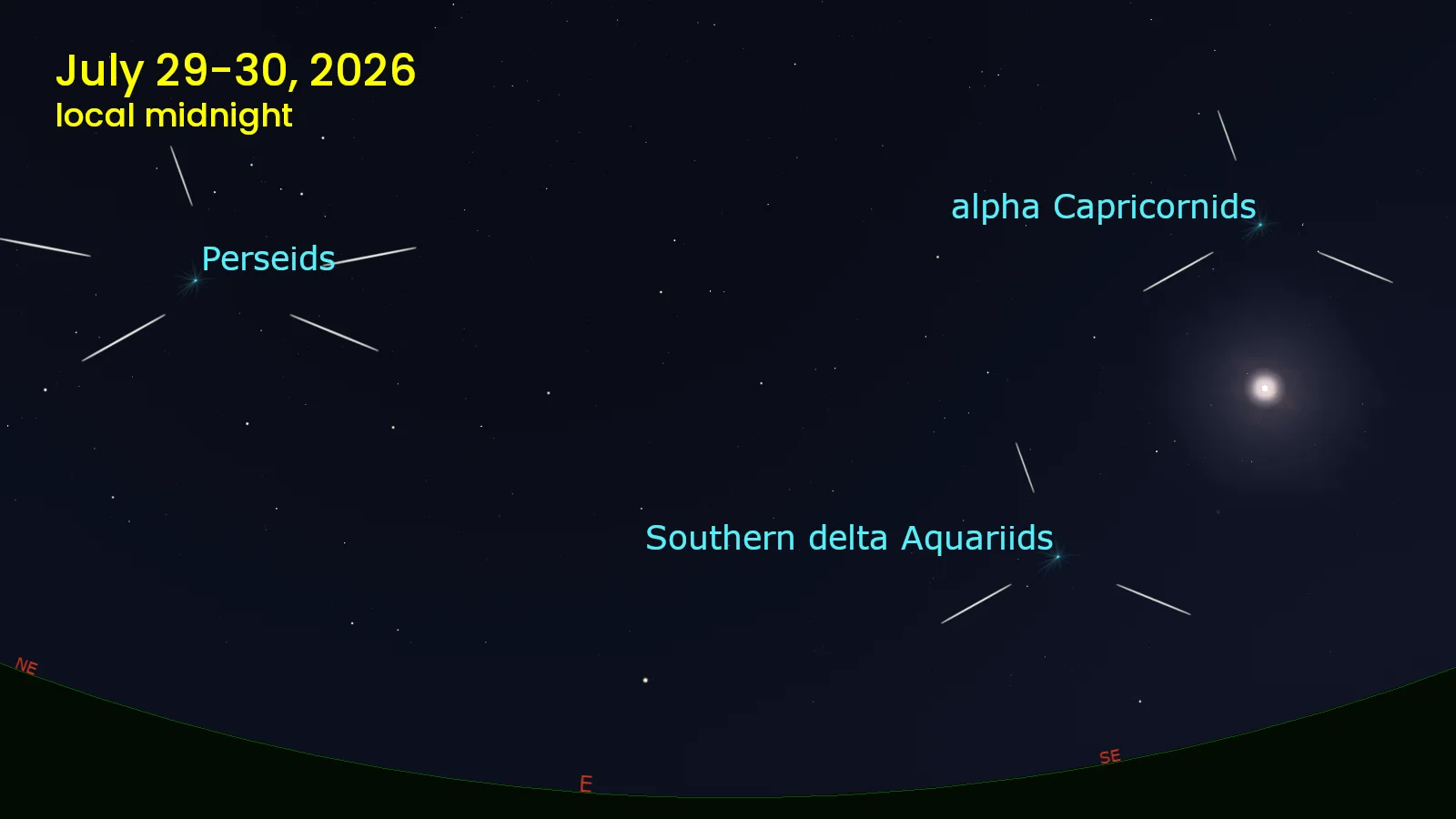
The radiants of the Perseids, Southern delta Aquariids, and alpha Capricornids in the night sky, on July 29-30, 2026. (Stellarium/Scott Sutherland)
MORE FROM SPACE: The Perseid meteor shower has begun. It could be the best we've seen in years!
Having a Full Moon in the sky makes this far more of a challenge, as the Moon's light is typically enough to prevent our eyes from fully adjusting to the darkness. Thus, only the brightest meteors are easily seen, with brief flickers on the edge of our perception leaving us wondering what we're missing up in the sky.
Still, with the Perseids ramping up, and the abundant fireballs the meteor shower tends to produce, we could still see something even with the bright Full Moon shining above. So, keep your eyes to the sky!