
Eyes to the sky! The Full Wolf Moon shines tonight

If you have clear skies tonight, look up to see the Wolf Moon, the first Full Moon of 2024.
Whatever you may be up to on the night of January 25th, if you have reasonably clear skies and a few moments to spare, stop and take in the splendour of the Full Moon.
Rising just before sunset, the Full Wolf Moon will be up all night long and will slip below the western horizon only after the Sun rises. So, there is plenty of time to check it out.
Why is this Full Moon the "Wolf Moon"?
Roughly a century ago, the Maine Farmer's Almanac began printing a list of names for the 12 Full Moons of the year. These were taken from various sources, such as Indigenous lunar calendars, the Anglo-Saxon lunar calendar, and Colonial and European folklore. Since then, other almanacs have picked up the practice, and these names have become part of the public lexicon.
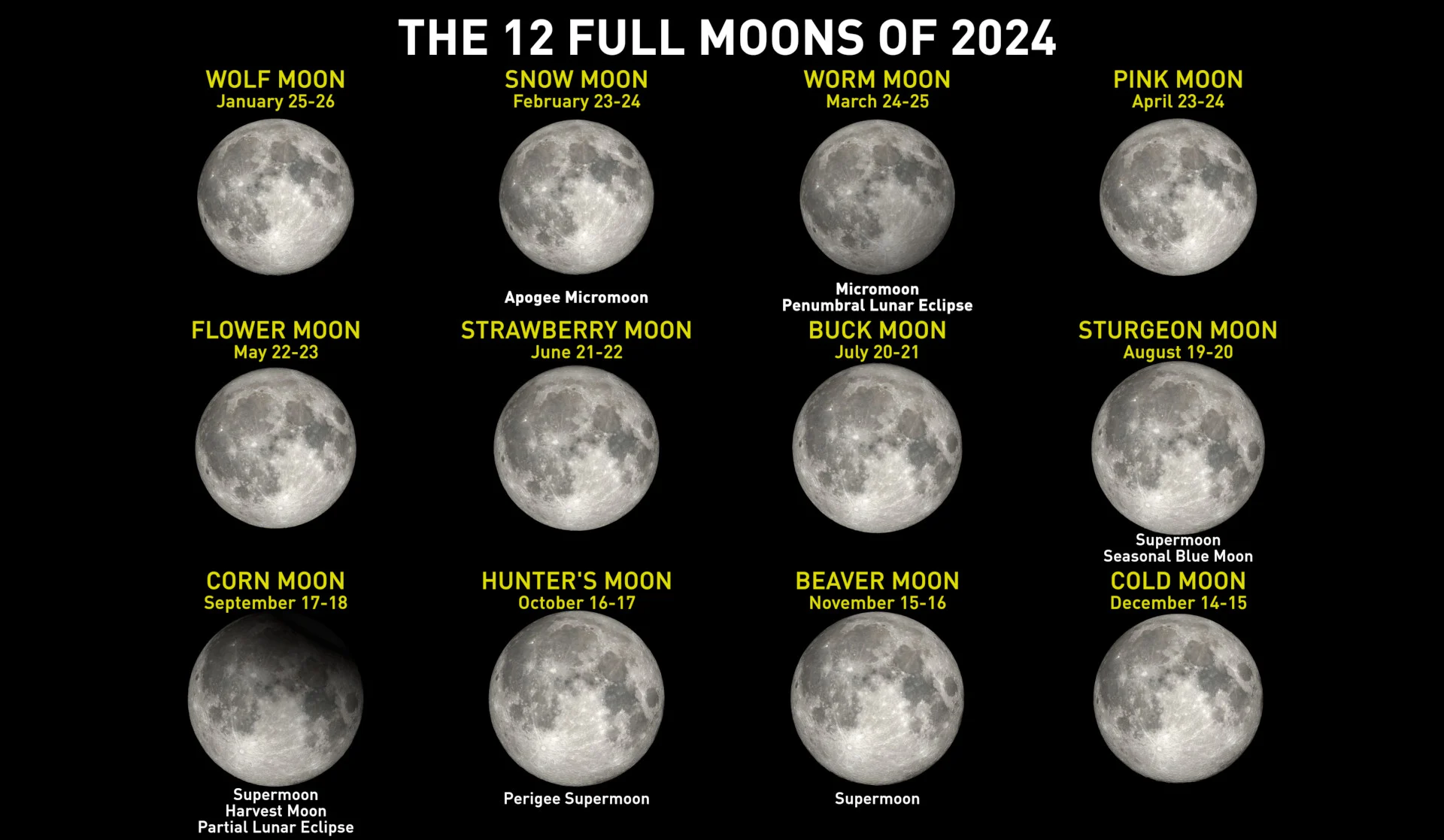
The 12 Full Moons of 2024 are presented here, along with their popular names and any notable characteristics, such as lunar eclipses, micromoons or supermoons, and blue moons. Credit: Scott Sutherland/NASA's Scientific Visualization Studio
The January Full Moon is known as the Wolf Moon, as this time of year typically marks when wolves become more active, and their howls are most often heard throughout the night.
DON'T MISS: Are you ready for the April 8th Total Solar Eclipse? Here's how to prepare
It's not alone!
The Full Moon isn't the only thing we can see in the night sky right now.
As the Moon tracks across the sky, it will be located near the star Asellus Borealis, in the heart of the constellation Cancer. Preceding it throughout the night will be a few other recognizable constellations.
Look for Gemini, the Twins, which can be located using the bright star, Pollux. Canis Minor and Canis Major will be hanging out closer to the horizon, identifiable by the stars Procyon and Sirius, respectively. However, perhaps the most prominent will be Orion, the Hunter — one of the most popular northern constellations and 'home' to both Betelgeuse and Rigel, two of the brightest stars in the night sky.
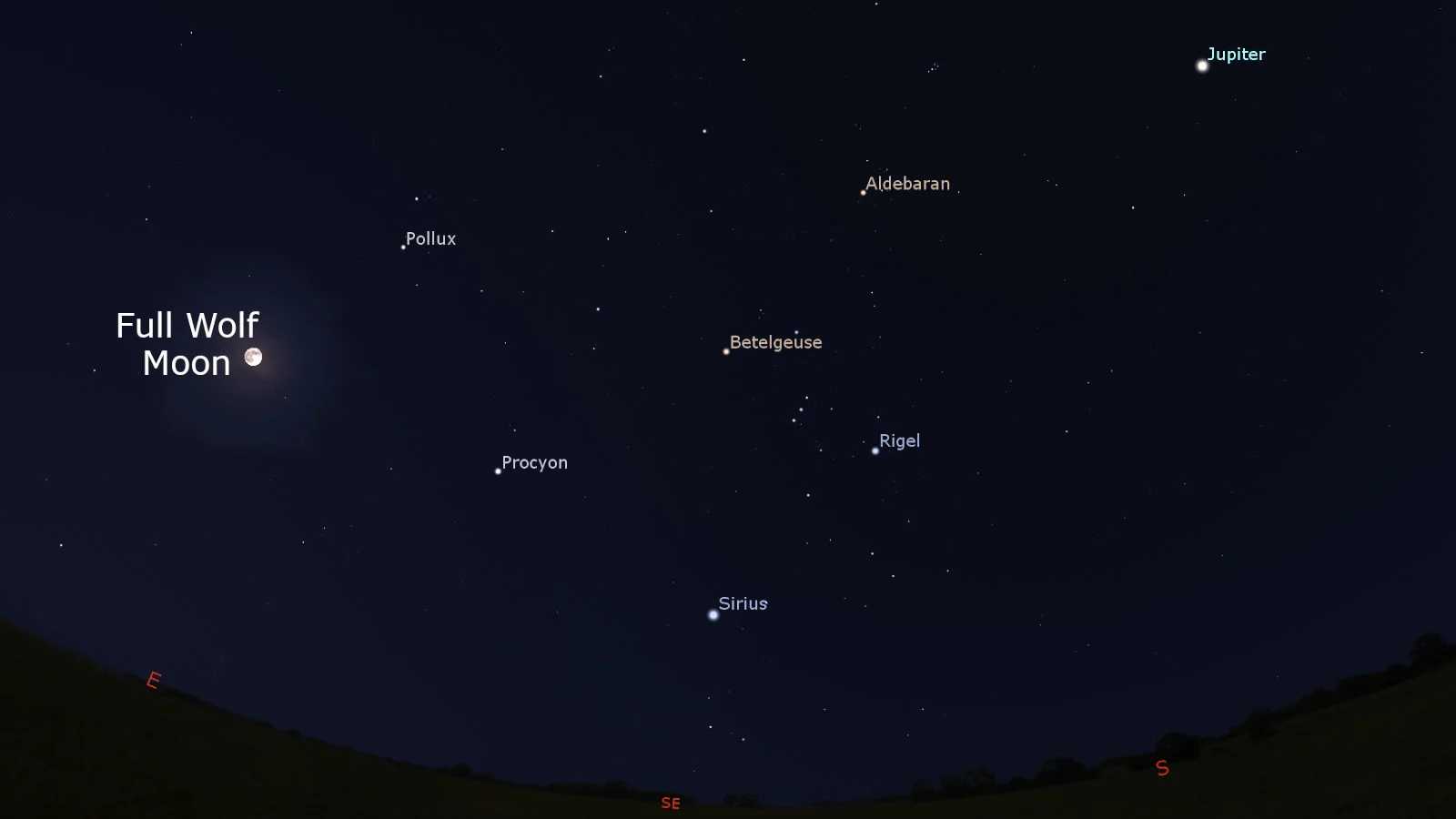
This simulated view of the night sky shows the positions of the stars, the Moon and the planets on January 25, 2024, at 8 p.m. local time. Credit: Stellarium/Scott Sutherland
Turn your gaze farther to the west, and you can also find Jupiter, the largest planet in our solar system, shining brightly.
When viewing Jupiter through a pair of binoculars or a small backyard telescope, it's possible to see some or all of the giant planet's four largest Moons — Io, Europa, Ganymede and Callisto.
Read more: Why does the rising Moon look so big?! What is the mysterious Moon Illusion?