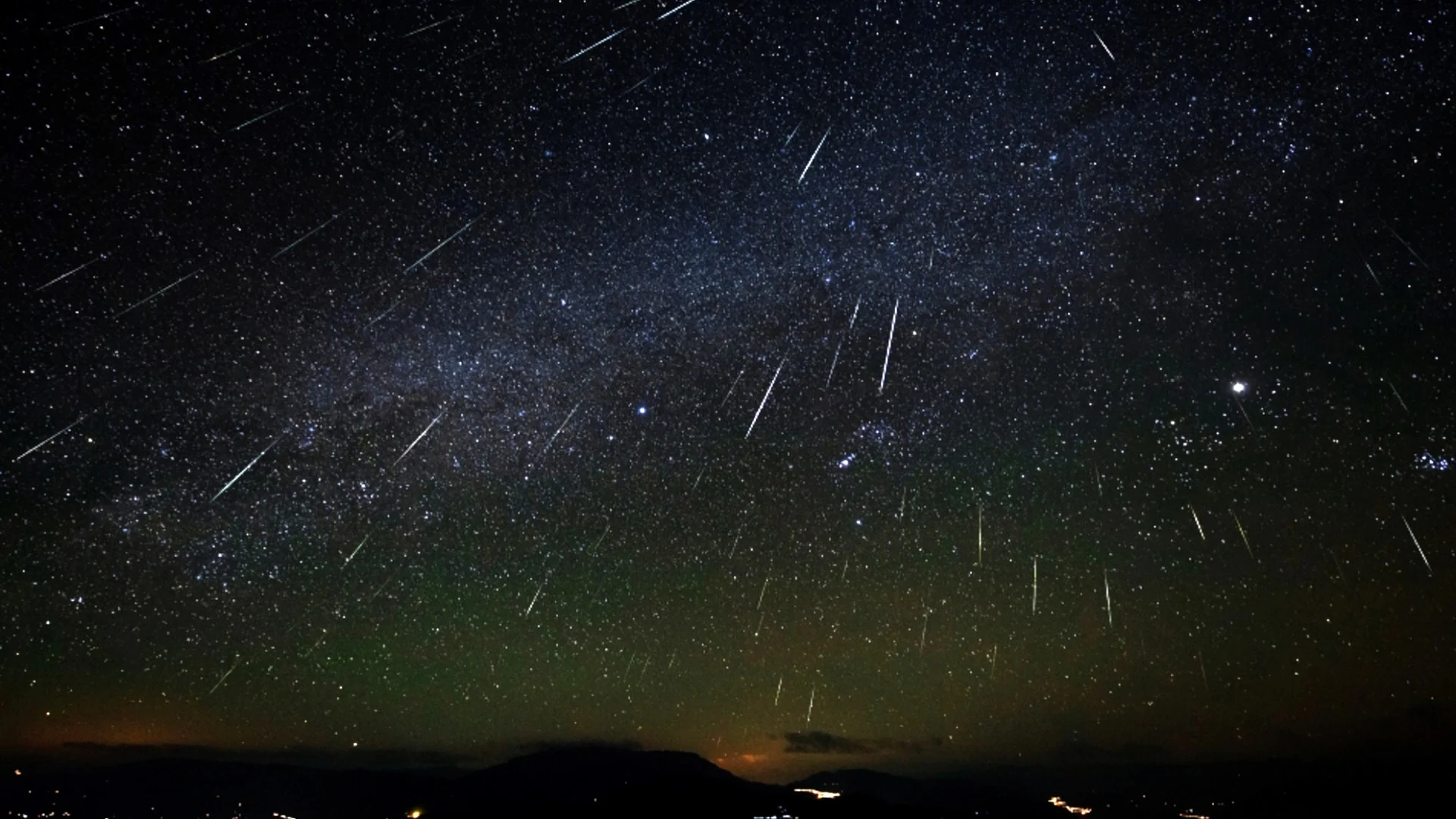
The Geminids, last of the best meteor showers of the year, peak Monday night

Look up after dark Monday to catch this consistently great meteor shower!
Hope for clear skies. The best of the fall meteor showers and the last of the best meteor showers for the entire year — the Geminids — peaks on Monday night.
While you are out looking for Comet Leonard this weekend, glance around to take in the entire sky. You may spot several meteors flash by overhead, as part of the Geminid Meteor Shower.
This meteor shower began on November 19, as Earth slipped into a broad stream of meteoroids (pebbles and dust) left behind by an 'extinct comet' named 3200 Phaethon.
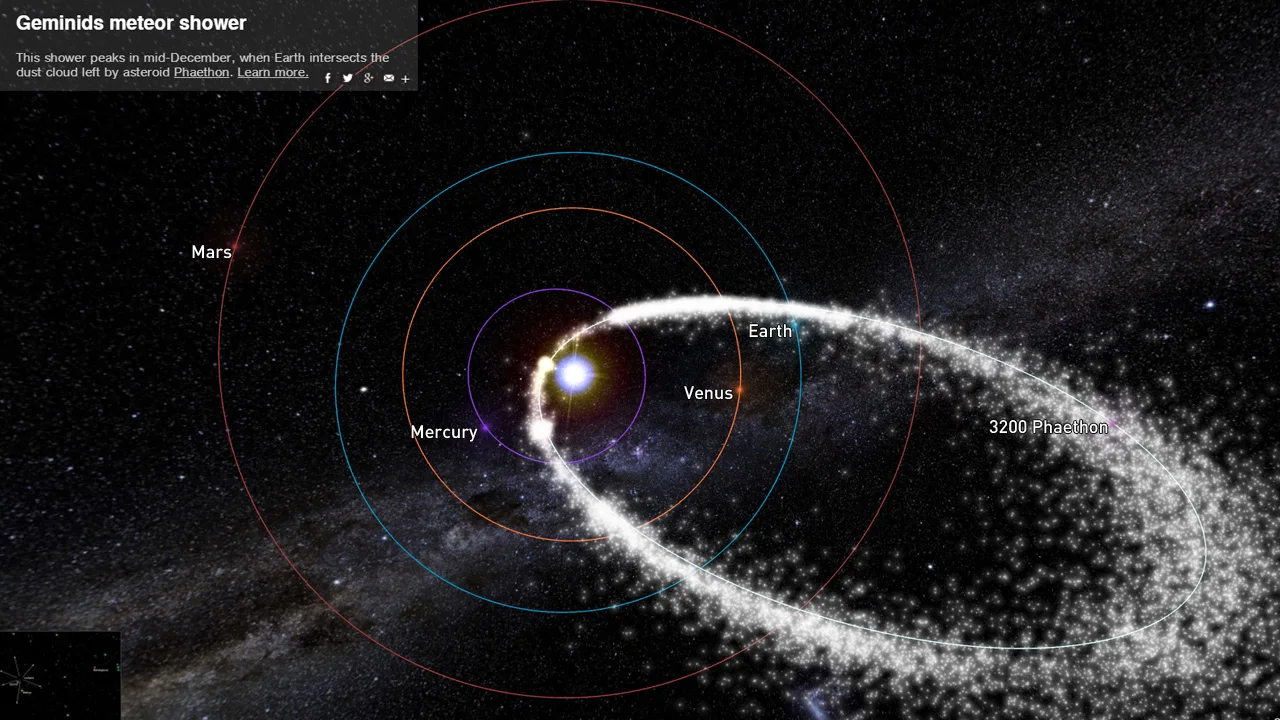
The orbit of 3200 Phaethon is littered with gravel and dust that it leaves behind as it travels around the Sun. Once thought to be an asteroid, 3200 Phaethon is now considered to be the rocky remnant of an ancient comet that lost all its ice after repeated trips around the Sun. This simulation exaggerates the size of the debris in the stream to make it easier for us to see. Credit: Meteorshowers.org/Scott Sutherland
As Earth sweeps up the meteoroids directly in its path, these bits of rock and dust plunge into the upper atmosphere at high speed. This results in bright streaks of light we call meteors. Due to the rocky nature of the debris in the stream, some of these meteors show up multi-coloured!
For the first few weeks of the shower, the Geminids typically deliver a handful of meteors every hour, which appear to streak out of the constellation Gemini. Starting about a week and a half into December, though, these numbers climb as we begin passing through the densest part of the meteoroid stream. This is the peak of the Geminid meteor shower, which occurs on the night of December 13-14, this year.
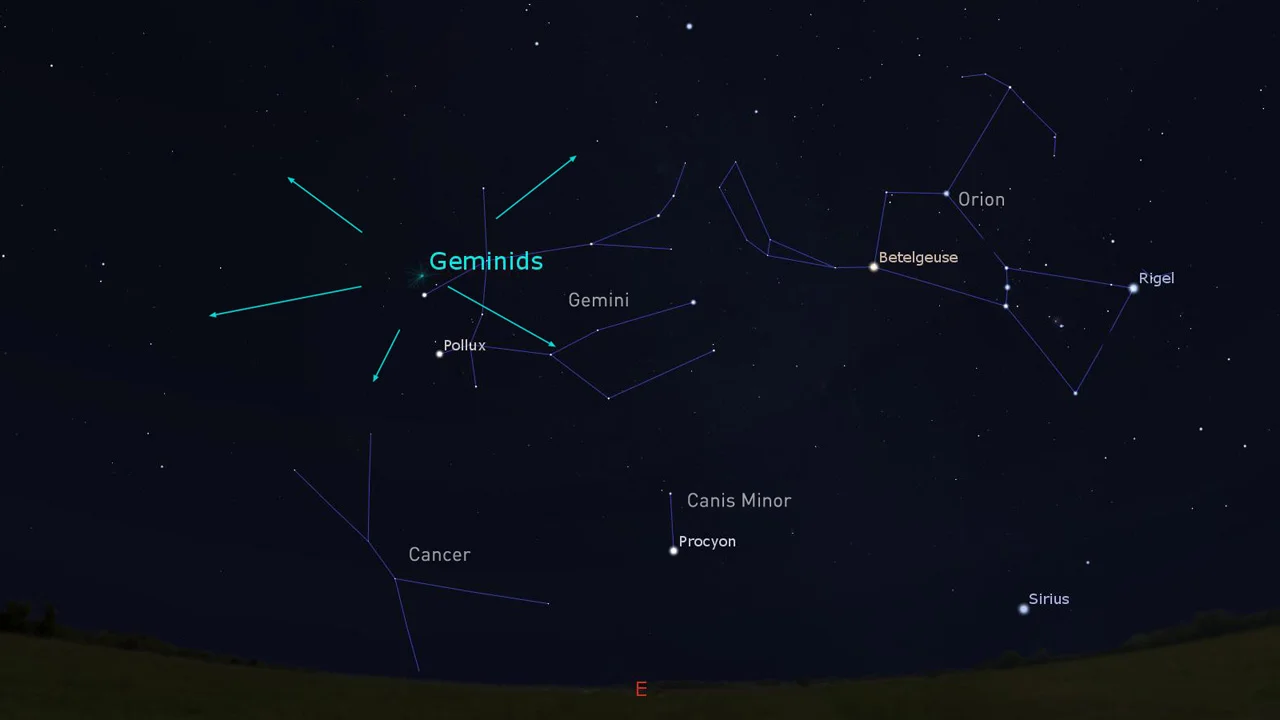
The Geminids radiant — the point in the sky the meteors seem to originate from — rises in the northeast after sunset on the night of December 13, and tracks across the sky. Credit: Stellarium
Beginning on the night of December 11, viewers could spot around a dozen meteors per hour flashing overhead. The following night, on December 12, this may double to two dozen meteors every hour (or maybe even more!). Then, from Monday night through Tuesday morning, the rate will peak at around 50 per hour, or one seen every minute or so.
Author's Note: The numbers presented above are what a typical observer will probably see during the meteor shower when viewing with clear skies and from somewhere away from city lights. Cloudy sky conditions and light pollution will reduce these numbers (read on, below). The actual number of Geminid meteors recorded by astronomers, the so-called Zenith Hourly Rate or ZHR, is typically double these rates. However, only those with access to the clearest, darkest skies tend to see anything approaching the true ZHR.
While the meteor shower is happening all night long, the absolute best time to watch the peak of the Geminids is in the hours after midnight, on the morning of December 14. That is when the radiant is highest in the night sky, and we are essentially looking straight into the oncoming debris stream of 3200 Phaethon.
Clear skies are essential for the best view of the meteor shower. However, partly cloudy skies (or even mainly cloudy, depending on the circumstances) can still provide a decent view of the night sky for the event. Also, for best results, be sure to watch from someplace far from urban light pollution. Read on for more details.
There's one extra challenge to watching this year's Geminids, though. Even if we can get away from city lights, a Waxing Gibbous Moon will be in the sky that night.
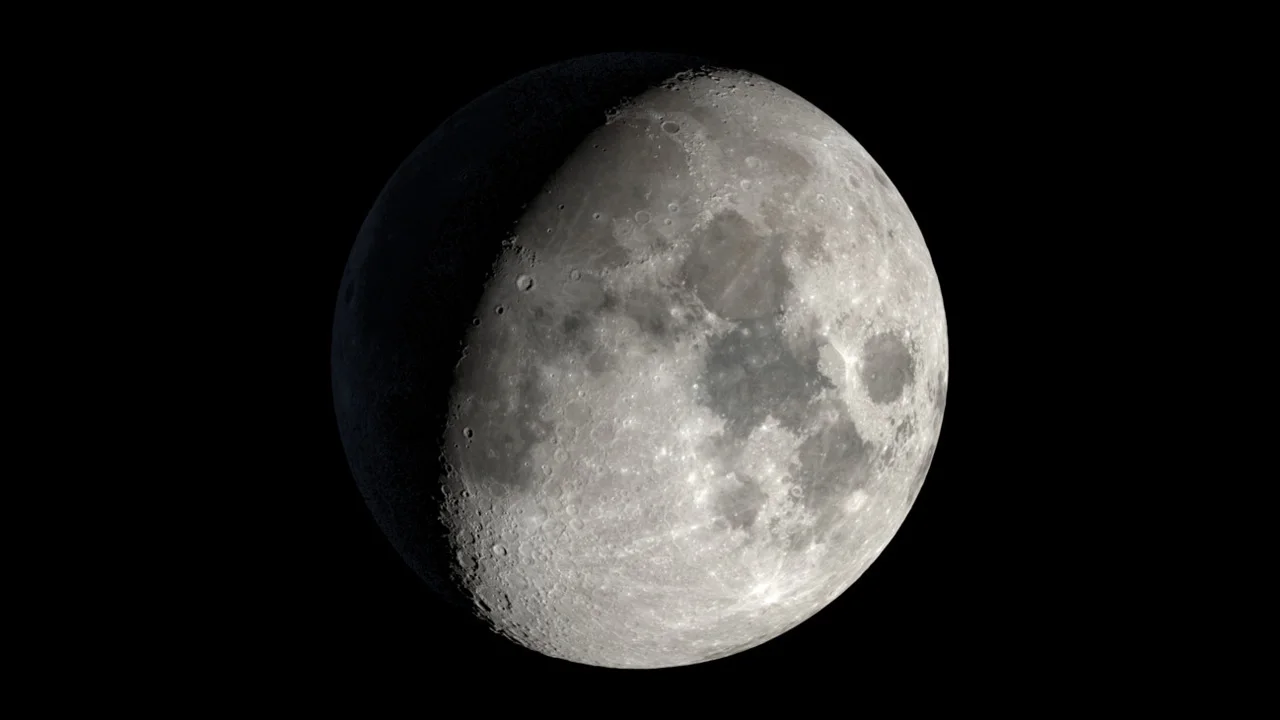
The Moon will be over 77 per cent illuminated on the night of December 13-14. Credit: NASA's Scientific Visualization Studio
While the Moon is up, the light it casts will spoil our night vision a bit. This will make it more difficult to spot the dimmer meteors and thus reduce how many we see overall. However, if you can stay up extra late on Monday night or get up extra early on Tuesday morning, the Moon is scheduled to set a little after 3 a.m. local time. Once it slips below the horizon, that will leave the rest of the night with a darker sky to spot Geminid meteors.
TIPS FOR WATCHING A METEOR SHOWER
Given how polluted our night skies are with urban light, it is no longer a simple matter to step outside and gaze up at the stars. It's even more difficult to watch an event such as a meteor shower. Follow the tips below, though, and you won't miss out on these amazing events.
There are three 'best practices' for observing the night sky:
Check the weather,
Get away from light pollution, and
Be patient.
Clear skies are very important. Even a few hours of cloudy skies can ruin your chances of watching an event such as a meteor shower. So, be sure to check The Weather Network on TV, on our website, or from our app, and look for my articles on our Space News page, just to be sure that you have the most up-to-date sky forecast.
Next, you need to get away from city light pollution. If you look up into the sky from home, what do you see? The Moon, a planet or two, perhaps a few bright stars such as Vega, Betelgeuse and Procyon, as well as some passing airliners? If so, light pollution in your area is too strong for you to get the most out of something like a meteor shower. You might catch a particularly bright fireball if one happens to fly past overhead, but that's likely all you'll see. So, to get the most out of your stargazing and meteor watching, get out of the city. The farther away you can get, the better.
For most regions of Canada, getting out from under light pollution is simply a matter of driving outside of your city, town or village until a multitude of stars is visible above your head.
In some areas, especially in southern Ontario and along the St. Lawrence River, the concentration of light pollution is too high. Getting far enough outside of one city to escape its light pollution tends to put you under the light pollution dome of the next city over. The best options for getting away from light depend on your location. In southwestern Ontario and the Niagara Peninsula, the shores of Lake Erie can offer some excellent views. In the GTA and farther east, drive north and seeking out the various Ontario provincial parks or Quebec provincial parks. Even if you're confined to the parking lot after hours, these are usually excellent locations from which to watch (and you don't run the risk of trespassing on someone's property).
If you can't get away, the suburbs can offer at least a slightly better view of the night sky. Here, the key is to limit the amount of direct light in your field of view. Dark backyards, sheltered from street lights by surrounding houses and trees, are your best haven. The video below provides a good example of what viewing is like based on the concentration of light pollution in the sky. Also, check for dark sky preserves in your area.
When viewing a meteor shower, be mindful of the phase of the Moon. Meteor showers are typically at their best when viewed during the New Moon or when there is a Crescent Moon in the sky. However, the light from a Gibbous or Full Moon can be bright enough to wash out all but the brightest meteors. Since we can't get away from the Moon, the best option is just to time your outing right so the Moon has already set or is low in the sky. Also, you can angle your field of view to keep the Moon out of your direct line of sight. This will reduce its impact on your nightvision and allow you to spot more meteors.
Once you've verified you have clear skies, and you've limited your exposure to light pollution, this is where being patient comes in.
For best viewing, your eyes need some time to adapt to the dark. Give yourself at least 20 minutes, but 30-45 minutes is best, for your eyes to adjust from being exposed to bright light.
Warning: This is possibly the one thing that causes the most disappointment when it comes to watching a meteor shower. Stepping out into the backyard from a brightly lit home and looking up for five minutes, you might be lucky enough to catch a rare bright fireball meteor. However, it's far more likely that you won't see anything at all. However, waiting for at least twenty minutes and avoiding sources of light during that time — streetlights, car headlights and interior lights, and smartphone and tablet screens — greatly improves your chances of avoiding disappointment.
Sometimes, avoiding your smartphone or tablet isn't an option. In this case, set the display to reduce the amount of blue light it gives off, and reduce the screen's brightness. That way it will have less of an impact on your night vision.
You can certainly gaze into the starry sky while you are letting your eyes adjust. You may even see a few of the brighter meteors as your eyes become accustomed to the dark.
Once you're all set, just look straight up and enjoy the view!