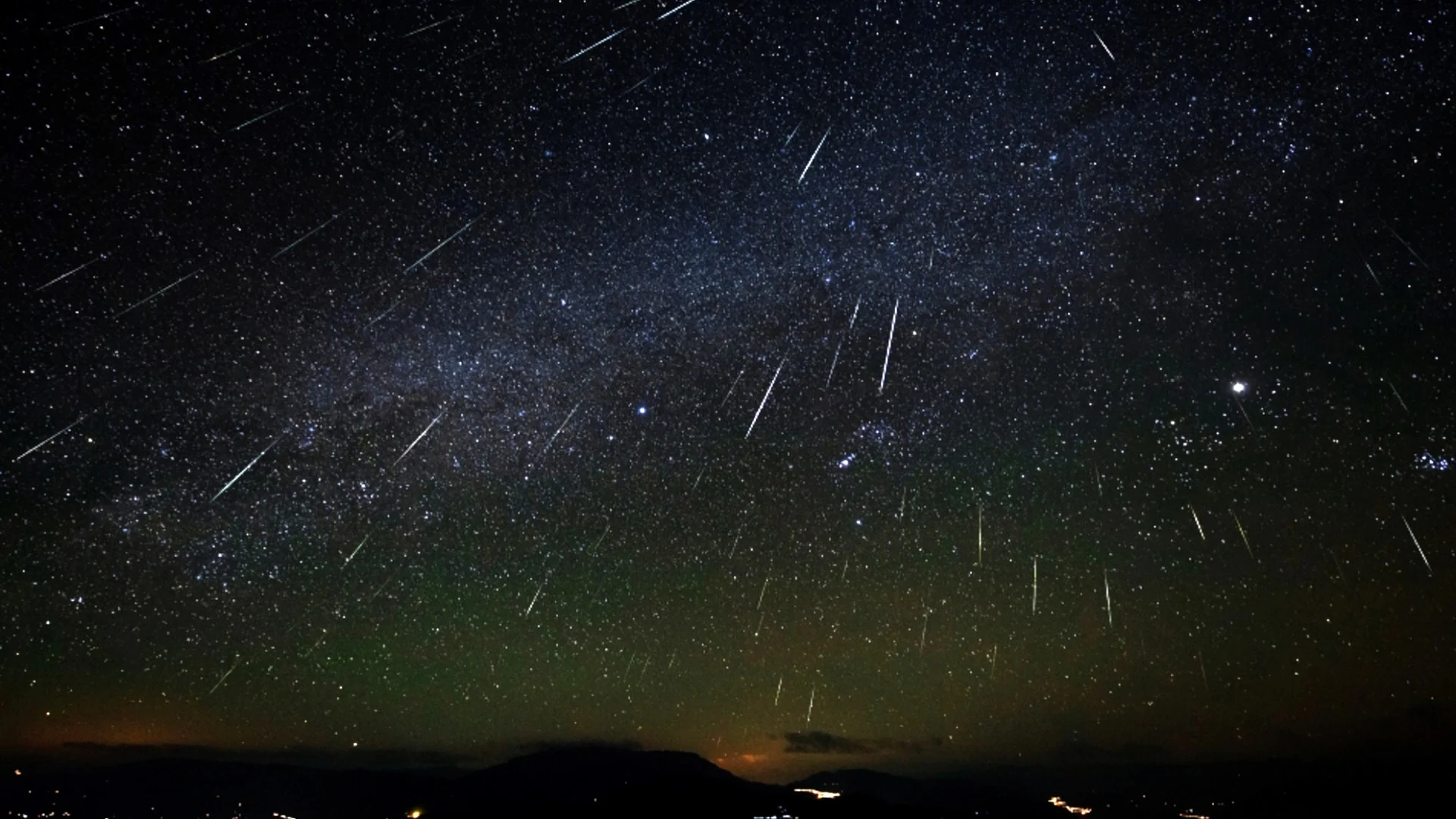
Look up! The fabulous Geminid meteor shower peaks this week

If you have any clear night skies this week, bundle up and get outside to see the best meteor shower of the year!
On any night this week, when a fair number of stars are visible in the sky above, pause for at least a few moments to watch for meteors flashing by overhead.
However, it's this weekend, especially on Friday and Saturday nights, that the universe is expected to deliver an amazing show, in the form of the annual Geminid meteor shower.
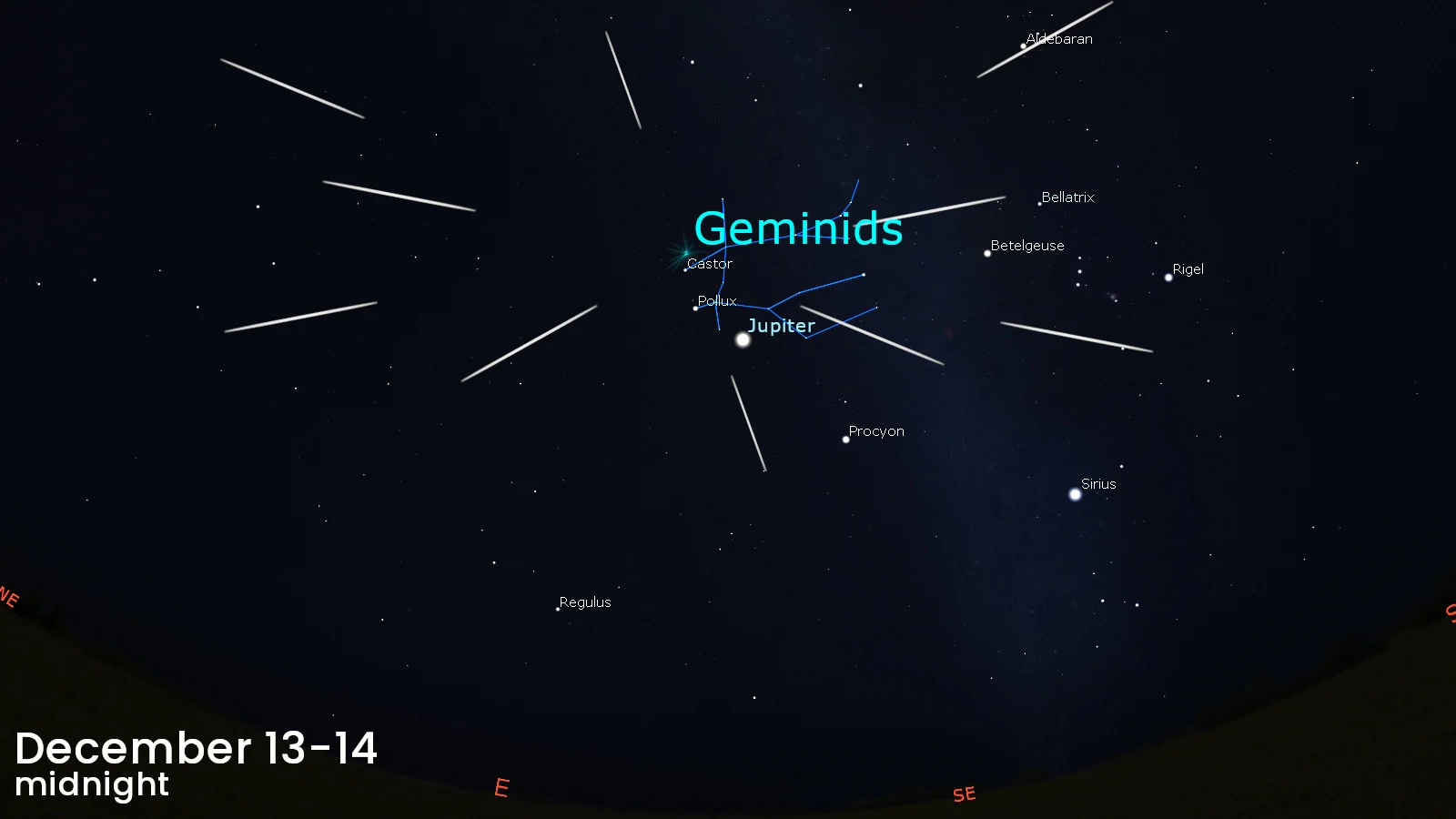
The radiant of the Geminid meteor shower, in the southeastern sky, on the night of December 13-14, 2025. (Stellarium/Scott Sutherland)
DON'T MISS: Look up! What's going on in the December night sky?
Although the Perseids receive a lot of attention in the summer, the Geminids are, quite possibly, the best meteor shower of the entire year.
Not only is it consistently the strongest of the annual meteor showers, delivering up to 150 meteors per hour on the night of December 13-14, but the meteors are also a bit more 'leisurely' as they cross the sky, which makes them easier to spot. Additionally, the Geminids occasionally produce bright fireballs, and typically appear in hues of yellow and green.
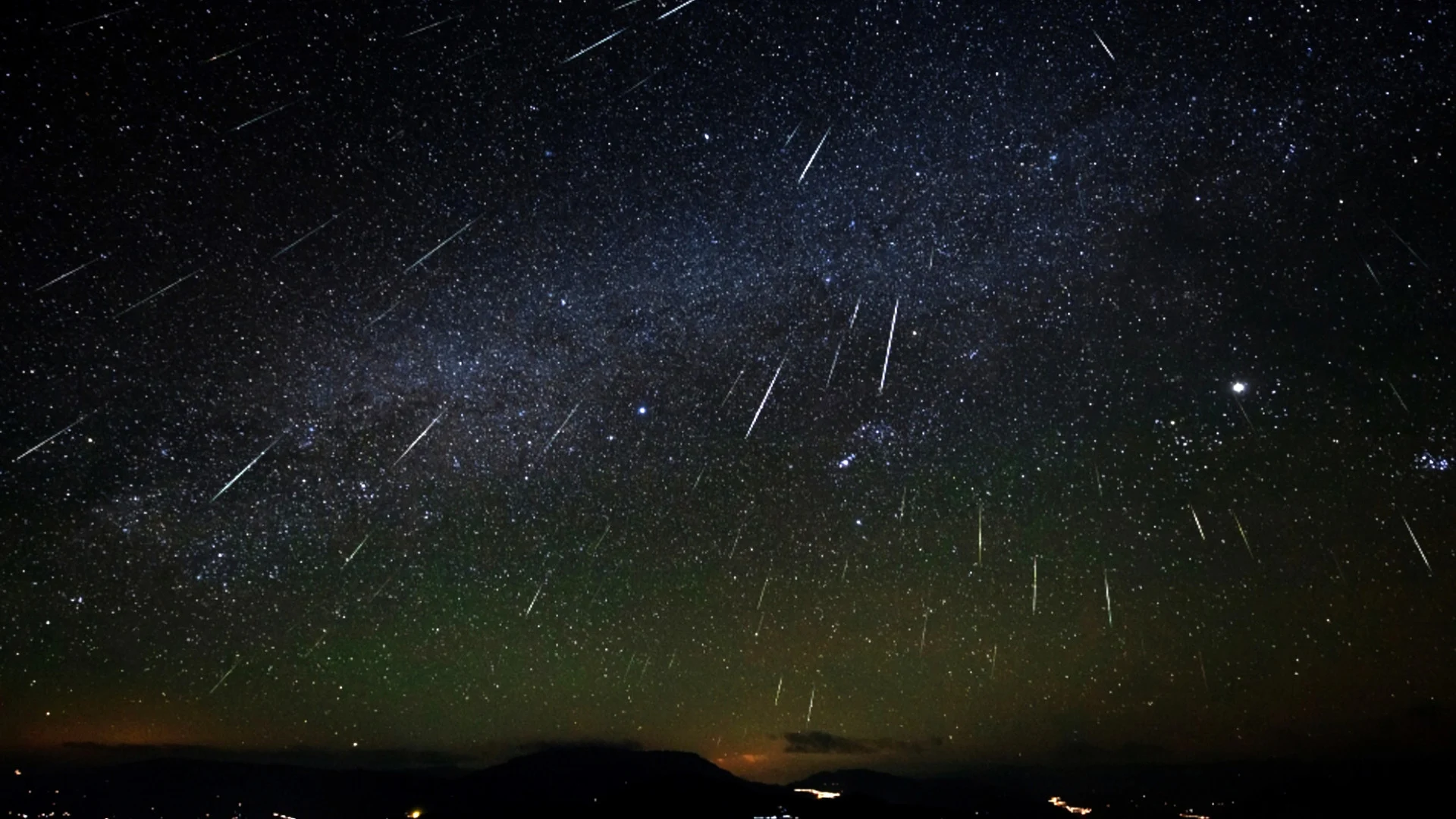
This composite image shows several Geminid meteors captured throughout the night during the peak of the shower in December 2012. (Jeff Dai/NASA)
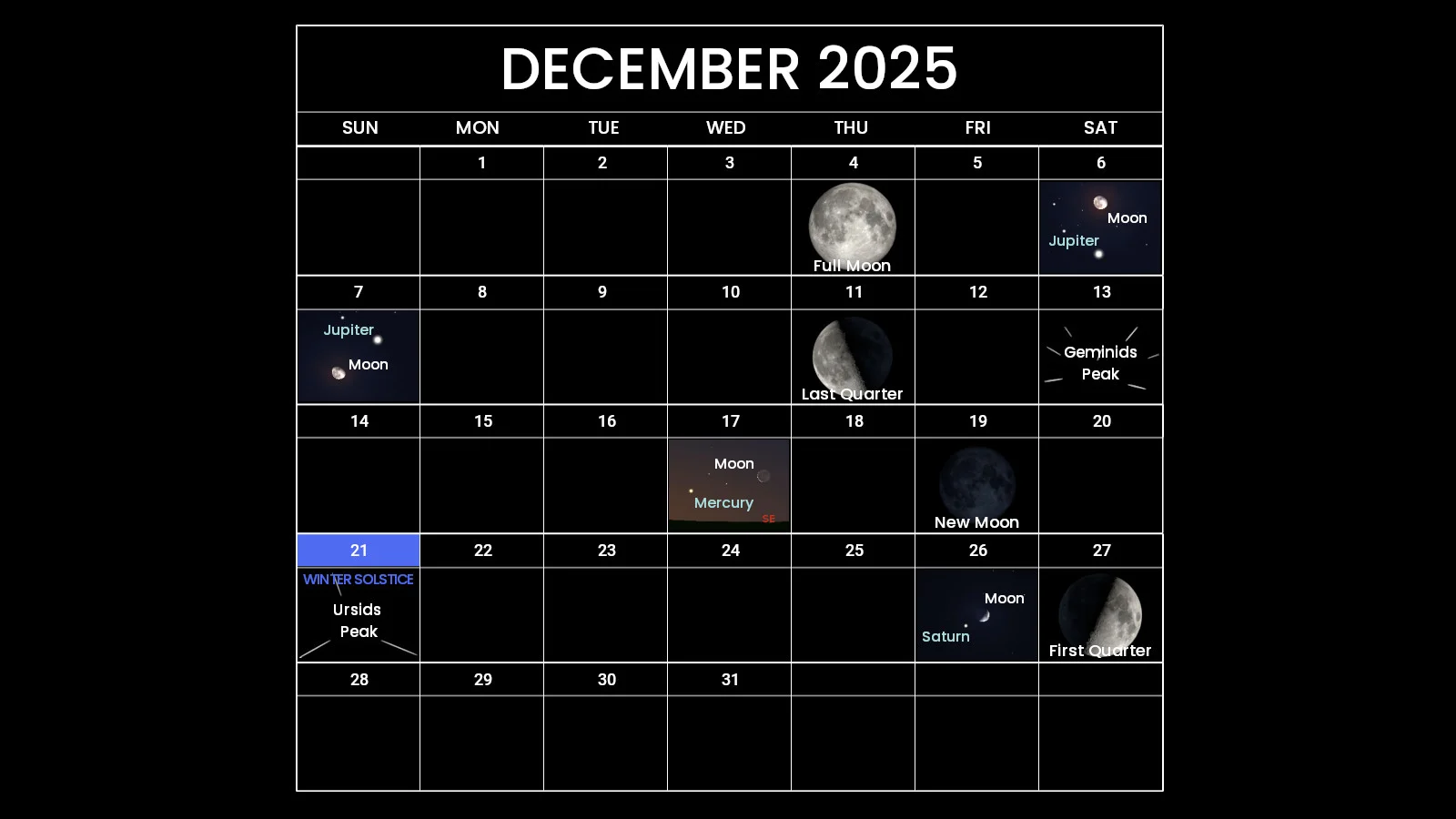
Last year, in 2024, a bright Waxing Gibbous Moon shone in the sky on the 13th, making it more difficult to spot dimmer Geminid meteors.
However, this year, there is only a Waning Crescent Moon, which won't even appear in the sky until around 1:30 in the morning. Thus, we'll have the entire evening up until then with a completely moonless sky, and even after it rises it won't offer much in the way of light pollution to spoil the show.
Even so, to get the most out of the event, it's best to watch the Geminids from under clear, dark skies, as far away from city light pollution as possible. From a dark sky site, with perfectly clear conditions and a view of the entire sky above, keen-eyed observers may spot from 75-100 meteors (or maybe more) every hour during the peak.
For those who can't get outside the city, a backyard sheltered from surrounding sources of light can still offer a reasonably good view. The key is to keep any bright light sources out of direct line of sight, including street lamps, vehicle headlights, and even cellphone screens, to allow your eyes to adjust to the dark as much as possible. In that case, one might spot between 50-80 meteors per hour, depending on how much of the sky you can see at any one time.
READ MORE: How to get the most out of auroras, meteor showers, and other night sky events
Will there be clear skies?
The weather is extremely important when it comes to how much enjoyment we get out of a meteor shower. Overcast skies can completely cancel the show, as the meteors flash by tens of kilometres above the cloud tops, hidden from view for those of us on the ground.
Even with only partly clear skies, it is still worth making an attempt during a meteor shower like the Geminids, though. Depending on how long it lasts, any clear break amid the clouds can offer a chance to spy dozens of meteors.
As of Tuesday's forecast, the skies across Canada on the night of the Geminids peak do not look promising for most of the country.
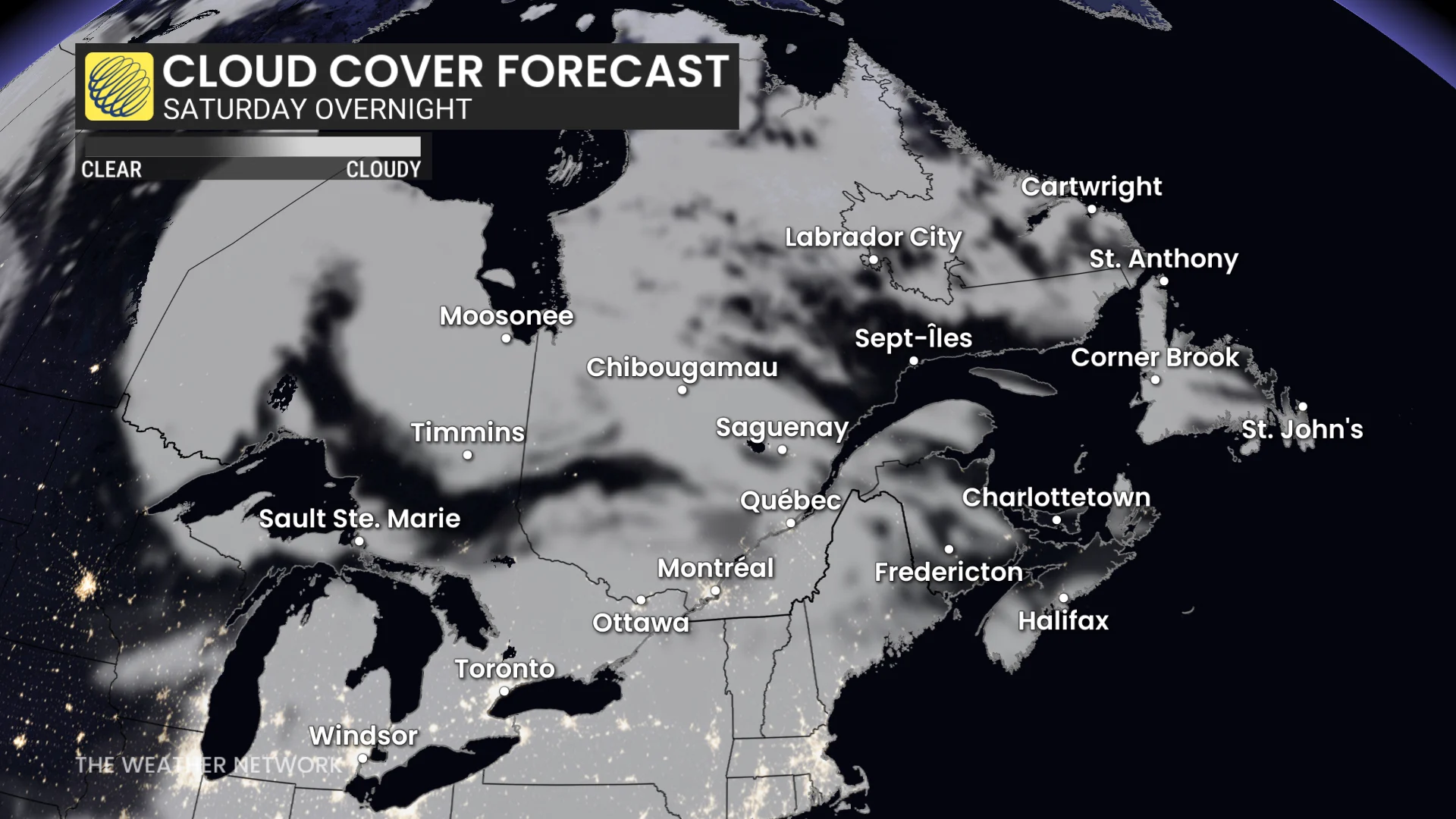
Through the eastern half of the country, the clearest conditions appear to be over eastern Newfoundland, parts of Nova Scotia, New Brunswick, P.E.I., and northern Ontario. South-central Quebec may also see some breaks in the cloud.
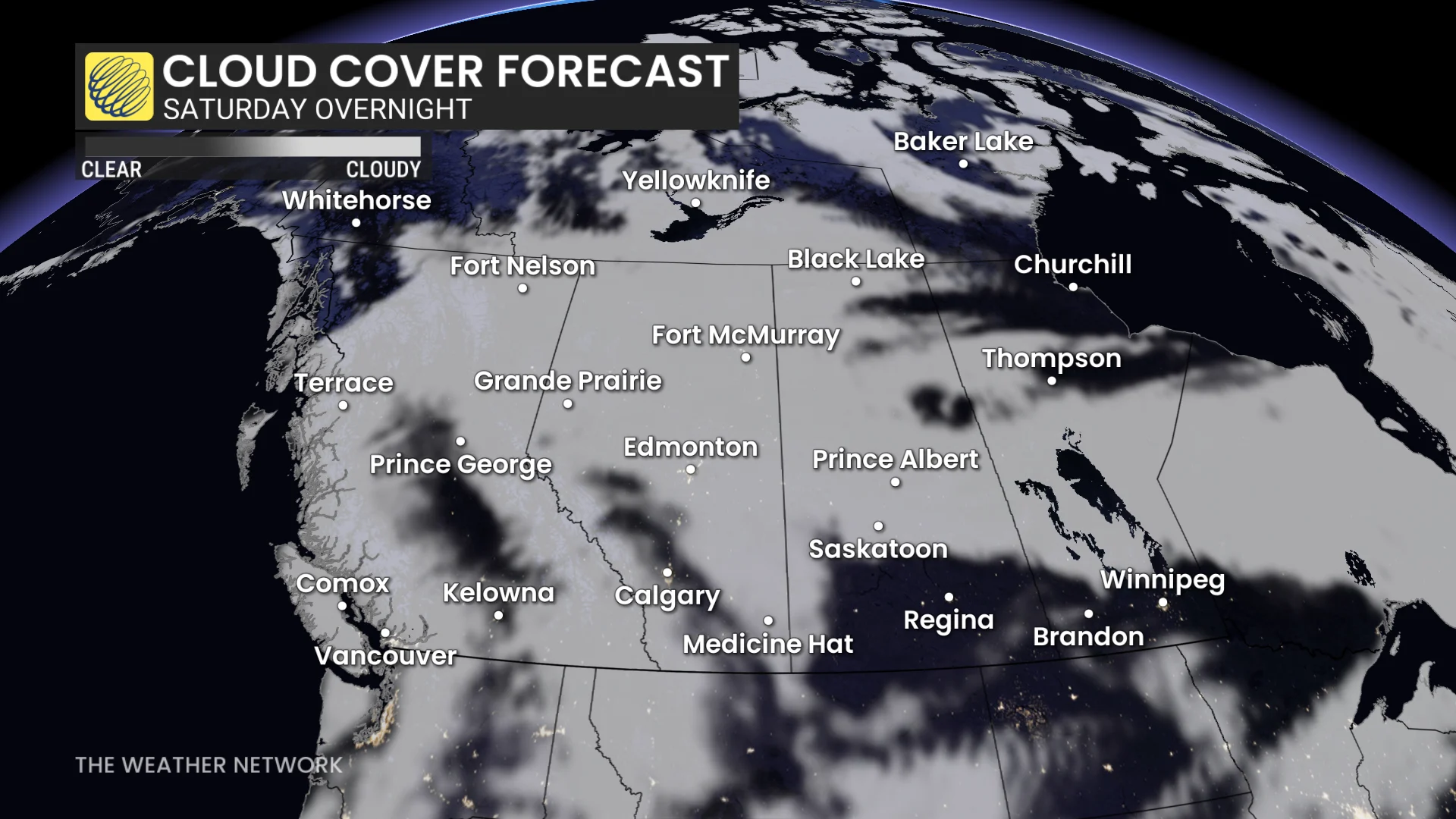
In the west, Thunder Bay through southern Manitoba and southern Saskatchewan appears to have clear skies, along with the leeside of the mountains in Alberta and interior British Columbia.
Even though the night of the 13th to 14th is definitely when the Geminids will be at their strongest, it's possible to see a decent number of meteors from this shower the two nights before the peak. Thus, check your forecast for Thursday and Friday nights for clear skies, and keep an eye on Saturday night's forecast, to see if conditions improve.
SPACE WEATHER: Geomagnetic storms: When should we look up and when should we worry?
What's going on here?
Space is often thought of as being empty. However, there's enough cosmic dust and meteoroids in the inner solar system that Earth sweeps up nearly 5,000 metric tonnes of it every year as we travel around the Sun.
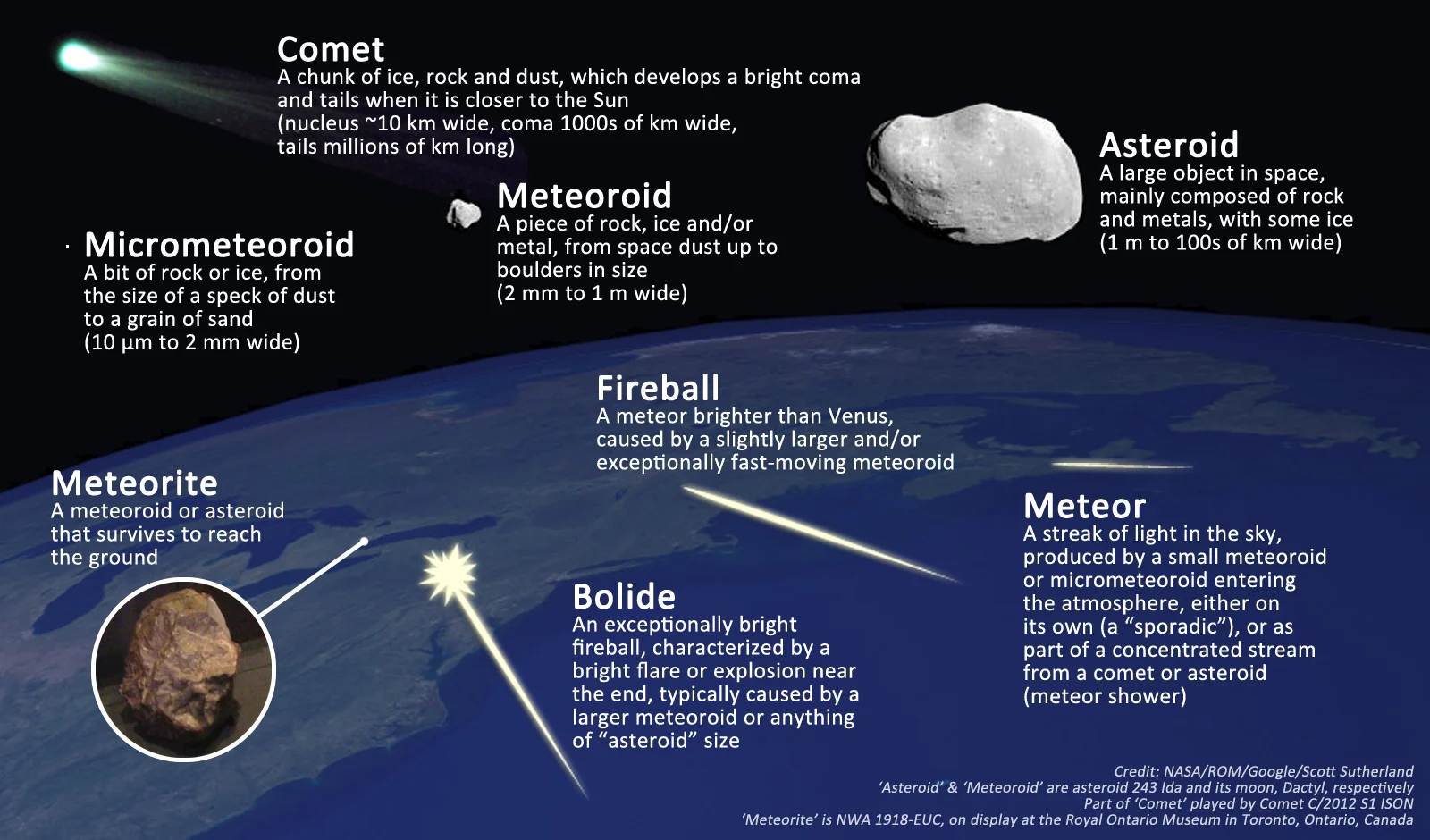
As each speck of dust or tiny bit of rock or ice plunges into the atmosphere, they streak through the air at speeds of tens to hundreds of thousands of kilometres per hour. In the process, they compress the air in their path, turning that air into a white-hot plasma, resulting in a flash of light across the sky that we call a meteor.
On any clear, dark night, it's possible to look up and spot a random meteor streak by overhead. There are specific times of the year, though, when there are dozens, or even hundreds of meteors flashing through the sky on the same night. These are known as meteor showers.
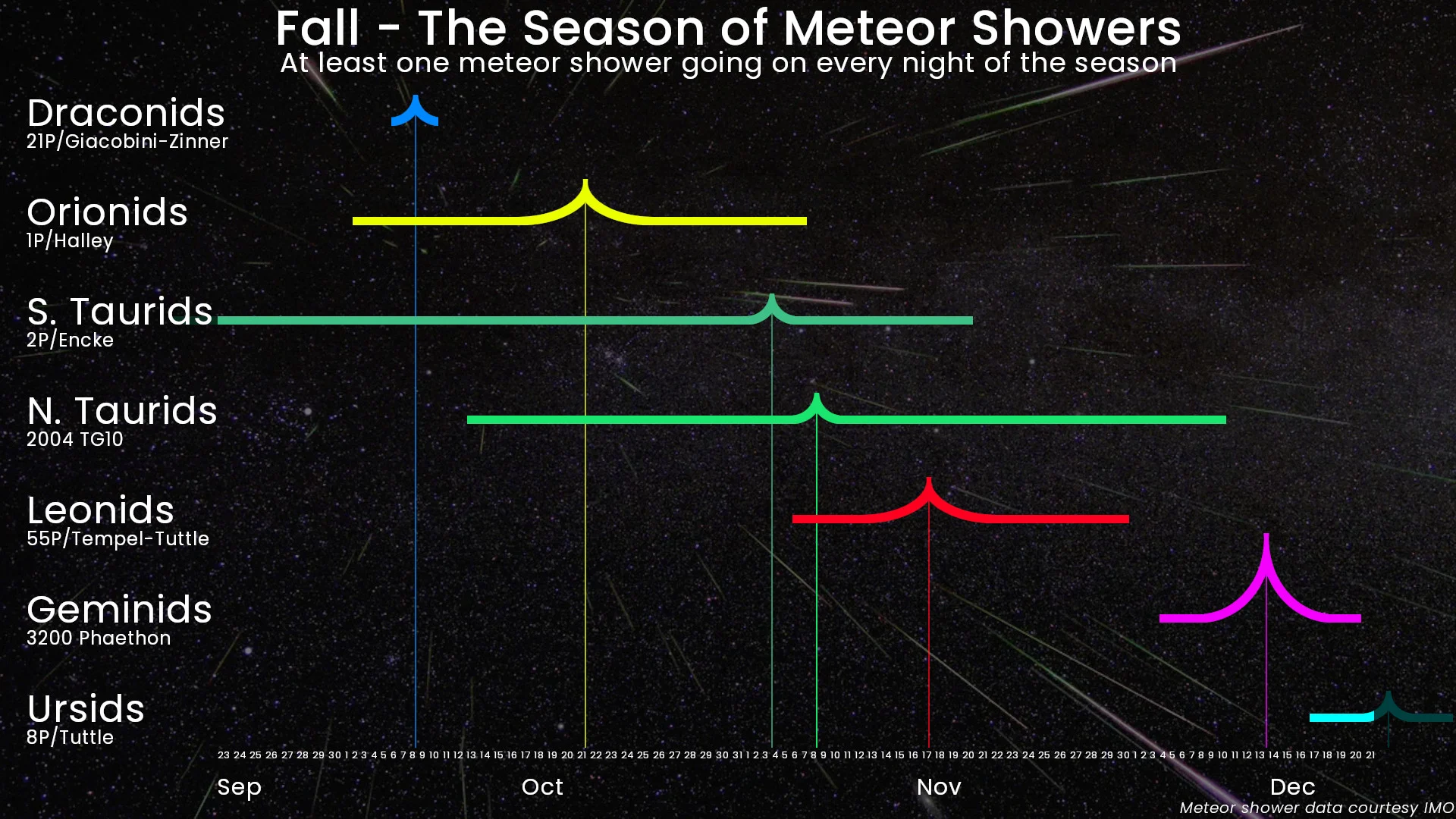
The seven Fall meteor showers (more than half of the dozen showers we see each year) are plotted here, showing their total duration and when each peaks. (Scott Sutherland, data from IMO)
In contrast to random 'sporadic' meteors, a meteor shower occurs when Earth passes through a concentrated stream of debris left behind in space by a comet or asteroid that periodically crosses Earth's orbit as it travels around the Sun. As shown in the diagram above, although meteor showers vary in length and strength, each follows roughly the same pattern — starting off slow, then ramping up to a peak, and then diminishing until the shower ends. This represents Earth slipping into the debris stream from that shower's parent body, reaching the densest part of the stream, and then eventually exiting the stream until we encounter it again next year.
Comet Halley provides an excellent example of all this. The comet was last seen near Earth in February of 1986, and it won't be back until July of 2061. However, every year, Earth passes through the comet's stream of debris, not just once, but twice!
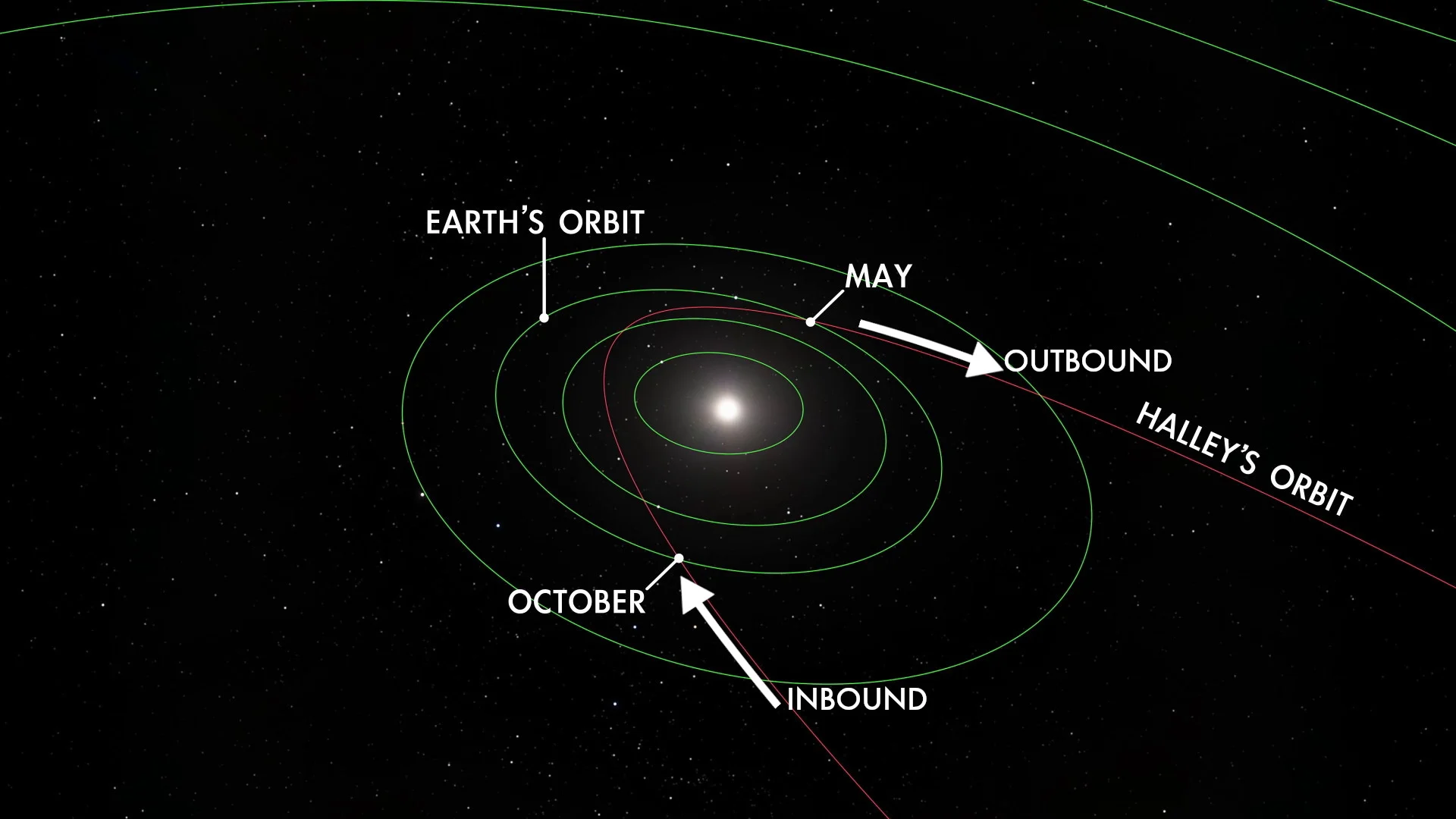
As shown in this diagram, the orbit of Comet Halley through the inner solar system crosses Earth's orbit twice, in April and May, and again in October. (NASA/JPL-Caltech/Scott Sutherland)
The first time is from mid-April through late May, when we cross the portion of the stream that is following the comet's path as it was headed outwards from the Sun. Thus, when the meteoroids hit the atmosphere, they produce meteors streaking from east to west across the predawn sky, originating from a point near the constellation Aquarius. This is the eta Aquariid meteor shower.
The second time we cross the stream is from early October through early November, when the particles are falling in towards the Sun. In this case, the resulting meteors appear to originate from the constellation Orion, which rises around 11 p.m. at that time of year. The resulting meteor shower is named the Orionids.
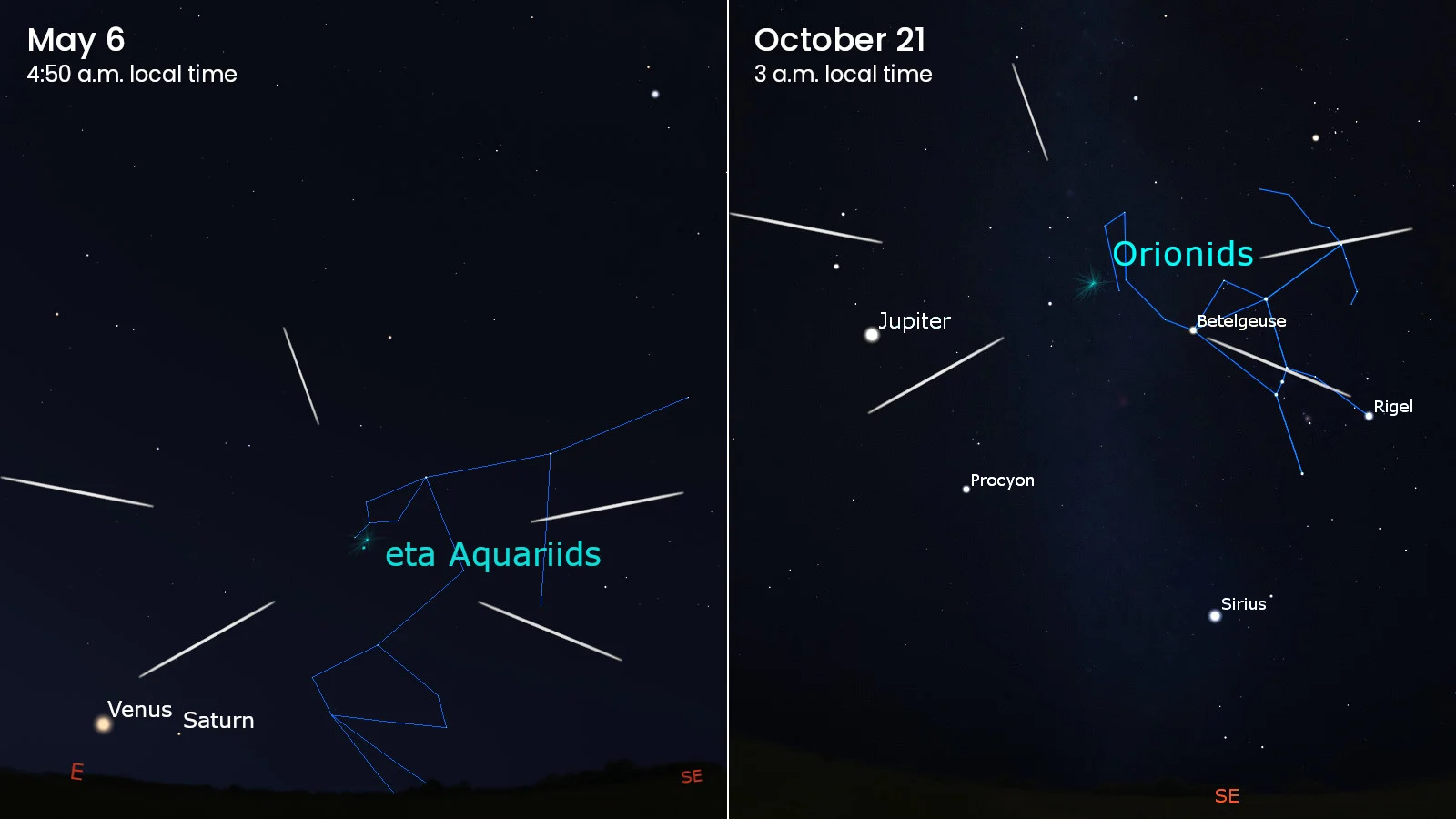
The eta Aquariid and Orionid meteor shower radiants are shown in these sky simulations from May 6 and October 21, 2025, when those two meteor showers peak, respectively. (Stellarium/Scott Sutherland)
At this time of year, in early December, Earth is passing through the debris stream that produces the Geminid meteor shower. However, this stream originates from an unusual object known as 3200 Phaethon.
Most meteor shower debris streams come from comets, due to the abundant ice, rock, and dust those objects expel every time they are heated by the Sun. 3200 Phaethon, on the other hand, is different. Although it's comet-sized (at roughly 6 kilometres wide), and follows a comet-like orbit that takes it well within the orbit of Mercury, it is actually a rocky asteroid. Some scientists actually refer to it as a 'rock comet'.
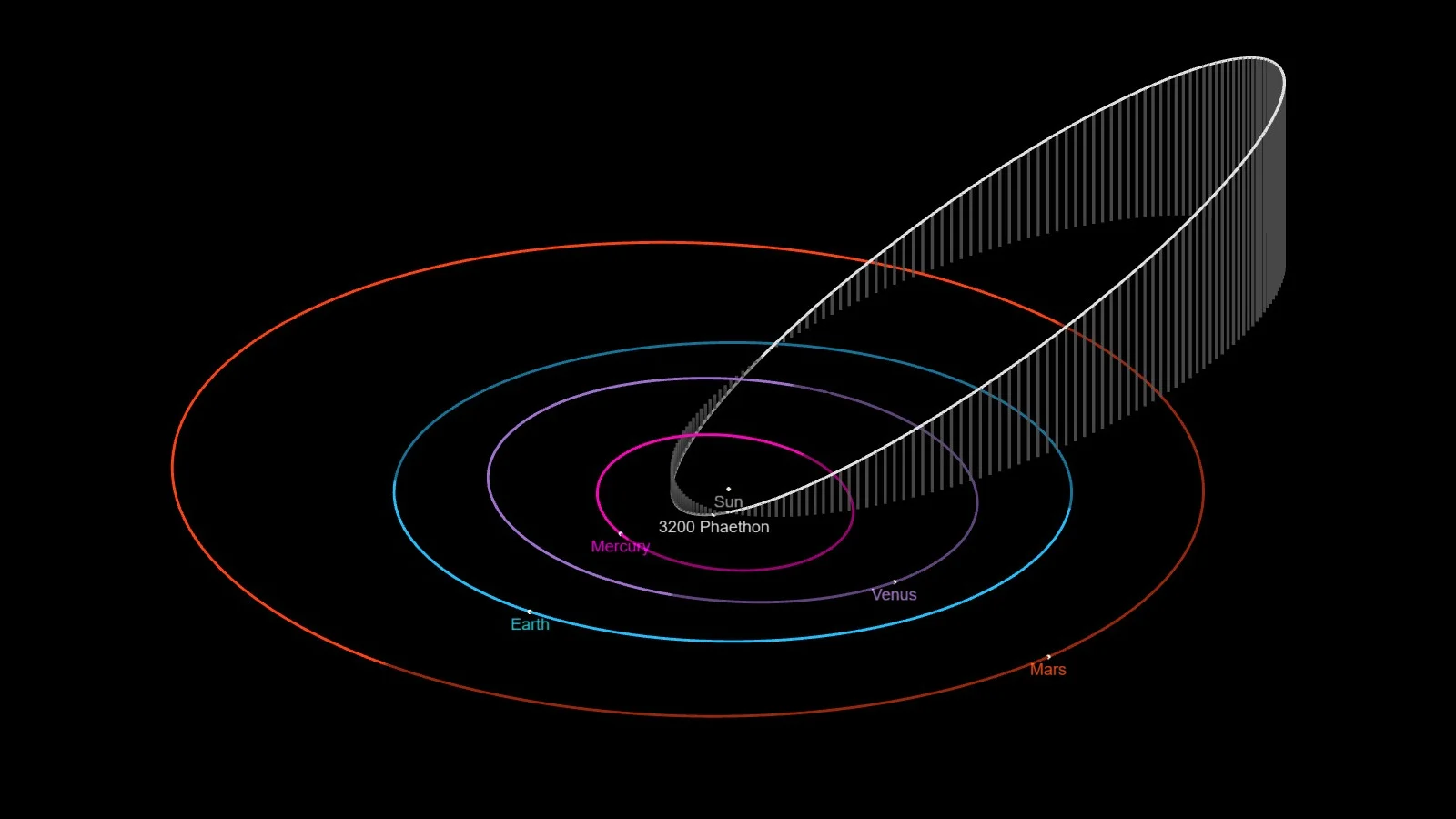
The orbit of 'rock comet' 3200 Phaethon as it travels around the Sun. The stream of debris that produces the Geminid meteor shower follows this same path. (NASA/JPL-Caltech)
Studies of this odd object have shown that each time it makes a close pass around the Sun, the extreme heat cracks open Phaethon's surface, causing it to eject dust and gravel into space.
As a result, 3200 Phaethon's debris stream is composed almost entirely of rock dust and pebbles, which tends to produce bright, sometimes multi-coloured meteors as they flash across our night sky.