
Look up! The Hunter's Moon lights up our night skies this weekend

Eyes to the sky this weekend to see the Full Hunter's Moon
The biggest and brightest normal Full Moon of 2026 will shine in the night sky this weekend, so be sure to look up!
Just after midnight, eastern daylight time, on the night of October 25-26, the Moon will be on the exact opposite side of Earth from the Sun, with its Earth-facing side fully illuminated.
This will be the Hunter's Moon, the 11th of 13 Full Moons for this calendar year, and the largest and brightest Full Moon we've seen since January's Full Wolf Supermoon.
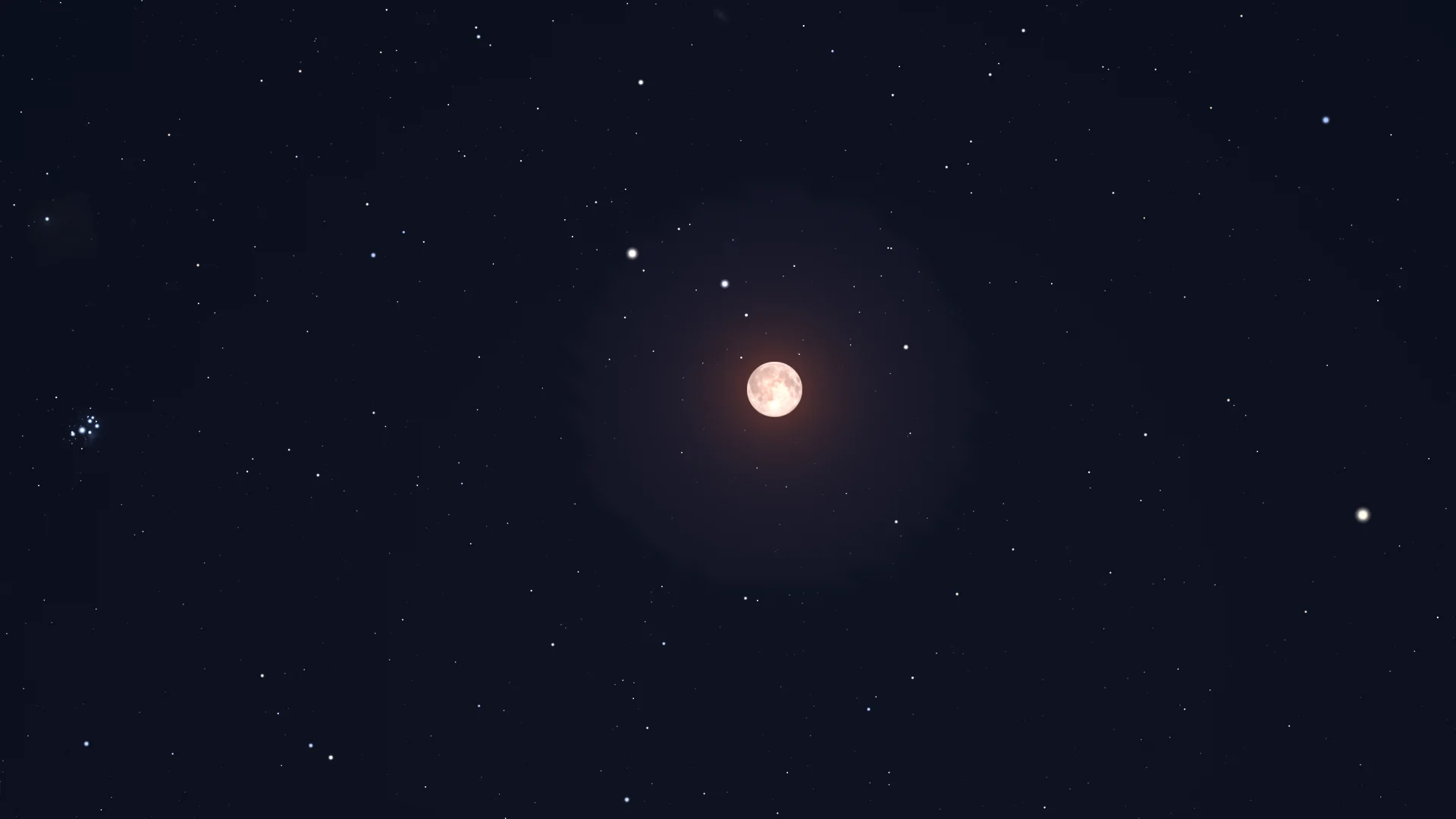
The Hunter's Moon shines amid the stars of the constellations Aries and Pisces, with the Pleiades star cluster off to the left, and the planet Saturn off to the right. (Stellarium)
This Full Moon reaches its fullest at 12:12 a.m. EDT Monday morning.
However, the Moon will appear full (around 98 per cent illuminated or more) for much longer — from late Saturday night until Sunday morning, then all night Sunday to Monday, and again all night Monday to Tuesday.
The reason for this is simply due to the Moon's brightness and relative size in the sky. On Saturday night to Sunday morning the Moon will still be in its Waxing Gibbous phase, and it will have transitioned to Waning Gibbous on Monday night. Given how bright the lit portion of the Moon is, though, and with it only being about 31-32 arcminutes across (about half the width of a thumb held out at arm's length), at a casual glance, it can still appear full for all three nights.
Upon closer examination, observers may note a difference in how 'crisp' the edges of the Moon look on the nights before and after the Full Moon. The night before, the right side will be crisp while the left side will be more fuzzy, with this reversed (left side crisp and right side fuzzy) on the night after. Using a telescope or pair of binoculars will make it much easier to see the thin sliver of shadow along the Moon's edge on those nights.
What is a Hunter's Moon?
While most popular Full Moon names originate from the lunar calendars used by the Indigenous peoples of North America, the name Hunter's Moon has its roots in European folklore.
It is traditionally the Full Moon that occurs right after the Harvest Moon. It marks the time of the year when the harvest is complete, and the community switches to hunting as it prepares for the coming winter.
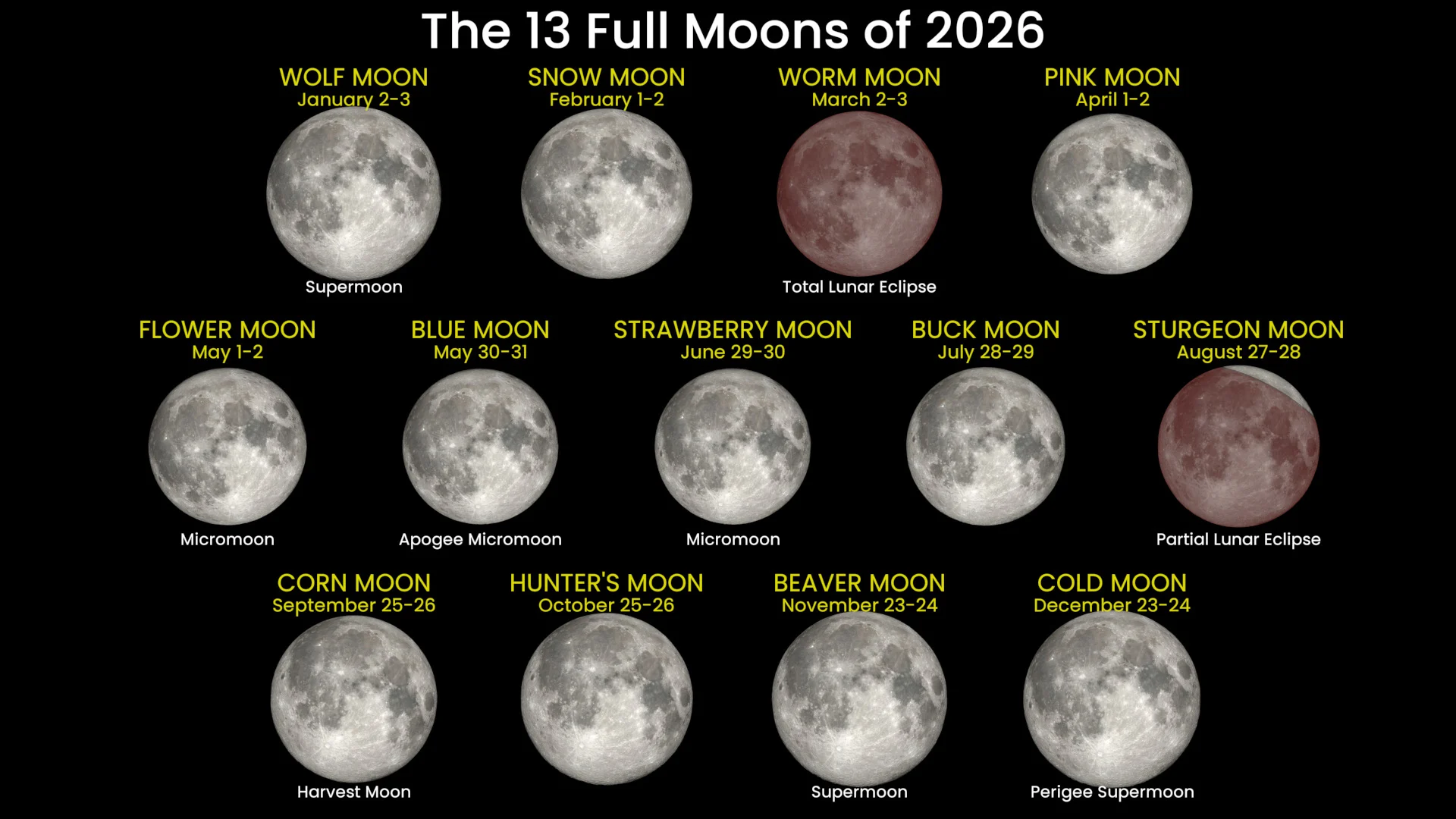
The 13 Full Moons of 2026, including their popular names, dates, and remarkable aspects (micromoon, supermoon, harvest moon, eclipses, etc). (NASA SVS/Fred Espenak/Scott Sutherland)
The Indigenous peoples of the Great Lakes region, and what is now the northeastern United States and eastern Canada, most often referred to the October Full Moon as the Leaves-Falling Moon, or sometimes the Leaves-Turning-Colour Moon.
A shifting name
Since the Harvest Moon is the Full Moon closest to the fall equinox, it usually occurs in September. Afterward, we have the Hunter's Moon in October, and then the Beaver Moon in November.
Due to the timing of the lunar cycle, though, every few years, the Harvest Moon title goes to a Full Moon in the first week of October. In that case, September has the Corn Moon, and the Hunter's Moon in November. We saw this last in 2025, and the next time will be in 2028. After that, we'll have to wait until 2036 for the next occurrence.
Six years ago, we even had a special treat! A rare Halloween Blue Moon gave us both a Harvest Moon and a Hunter's Moon in the very same month!

Halloween Blue Moons are rare events, only seen decades apart! (Scott Sutherland/NASA's Scientific Visualization Studio)
On October 1, 2020, we had a Full Moon — the Harvest Moon, just nine days after the fall equinox. Then, on October 31, there was a second Full Moon for the month — the Halloween Blue Moon. With that timing, from September through November, we had the Corn Moon, Harvest Moon, Hunter's Moon, and Beaver Moon, all in a row!
The last time that occurred was back in 1944, with the next time expected in 2039!
Biggest, brightest Full Moon in months!
We haven't had a supermoon in the sky since the beginning of January, and we'll have to wait another month, until near the end of November, before we see the next one. That will begin a string of four supermoons, which will end after February 2027.
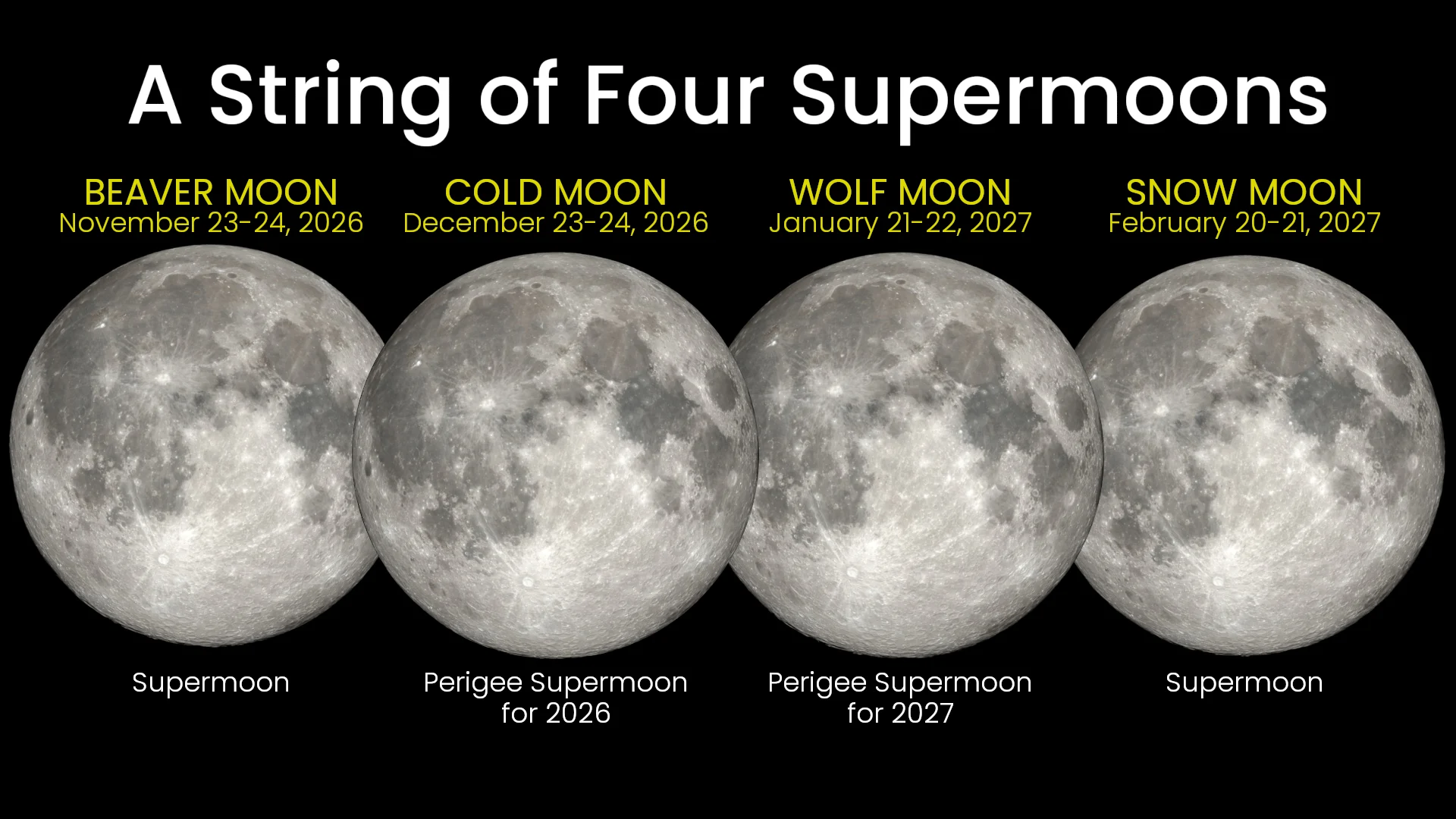
We'll see four supermoons in the coming months! (NASA's Scientific Visualization Studio/Scott Sutherland)
However, the October 25-26 Hunter's Moon is the closest, largest, and brightest 'normal' Full Moon that we've seen so far this year!
Why is this the case? In addition to its monthly cycle of phases, there is also a roughly 13-month cycle where the Full Moons draw closer to Earth and then move farther away. The closer the Full Moon is, the bigger and brighter it will appear in the sky, and when it reaches close enough (within 90 per cent of its closest approach for a particular orbit), we call it a supermoon. The last cycle began in November 2025, we reached the middle at the end of May, with the Blue Apogee Micromoon (the farthest Full Moon of the cycle), and the cycle ends with the next supermoon in November and perigee supermoon in December.
Now, just ahead of the next supermoon, we're seeing the closest, largest, and brightest Full Moon that is just outside that "90 per cent" threshold.
Without some kind of direct reference to what the previous Full Moons of the year looked like, it will be difficult to notice an actual size difference with this one. However, it will certainly look brighter.
It's not alone!
Over the next few nights, if you take a few moments to look up at the Moon, you can spot a few other remarkable things in the sky, as well.
The most obvious, for anyone not stuck under the worst urban light pollution, will be the bright 'star' just off to the right of the Moon. That will be the planet Saturn.
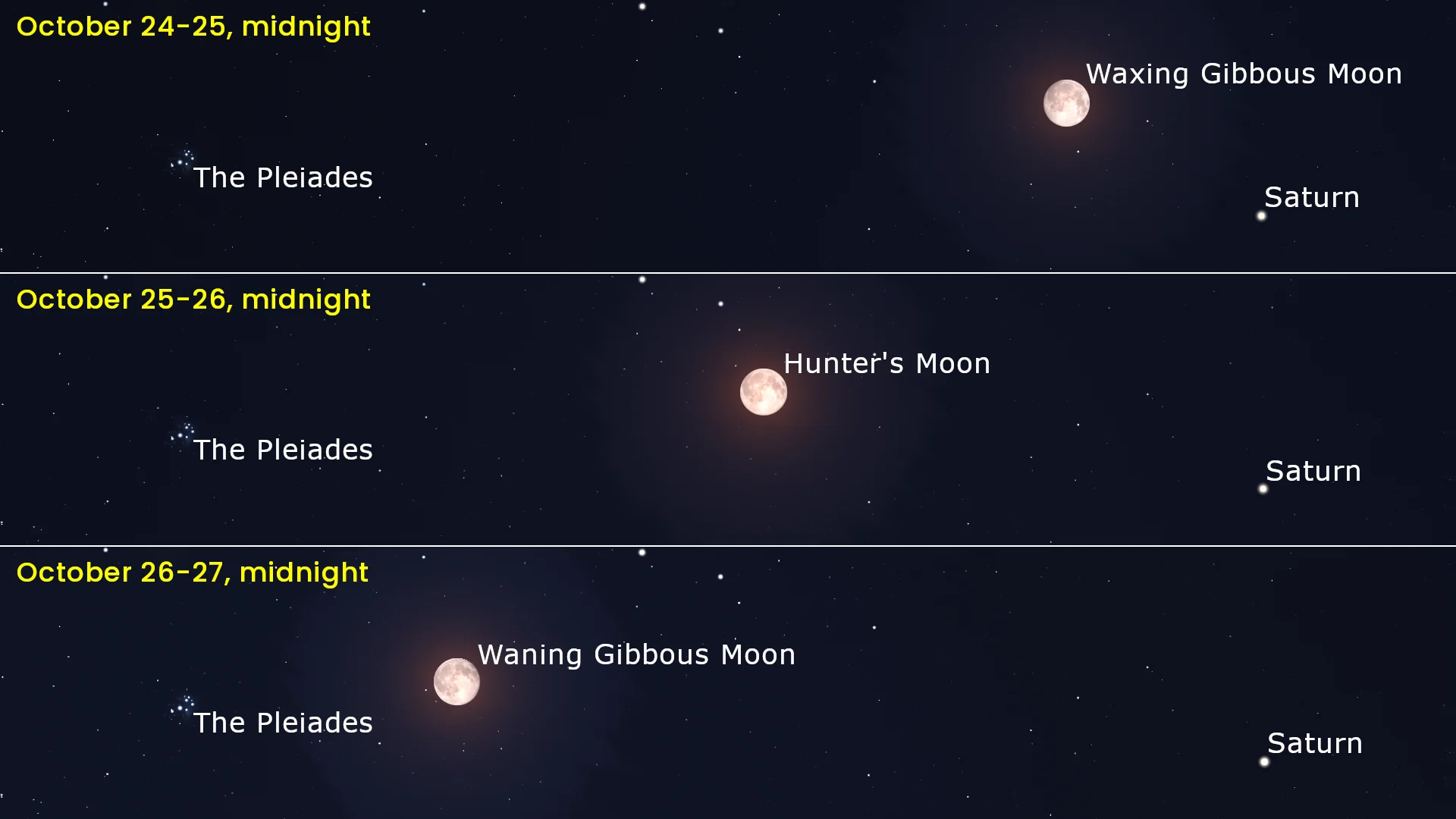
The positions of Saturn, the Moon, and the Pleiades star cluster in the night sky from October 24 through 27, 2026. (Stellarium/Scott Sutherland)
Take a look through a telescope, or a pair of binoculars with high magnification, and you should be able to see the planet's brilliant rings!
Off to the left of the Moon will be another bright 'object' — a cluster of stars known as the Pleiades, or the Seven Sisters.
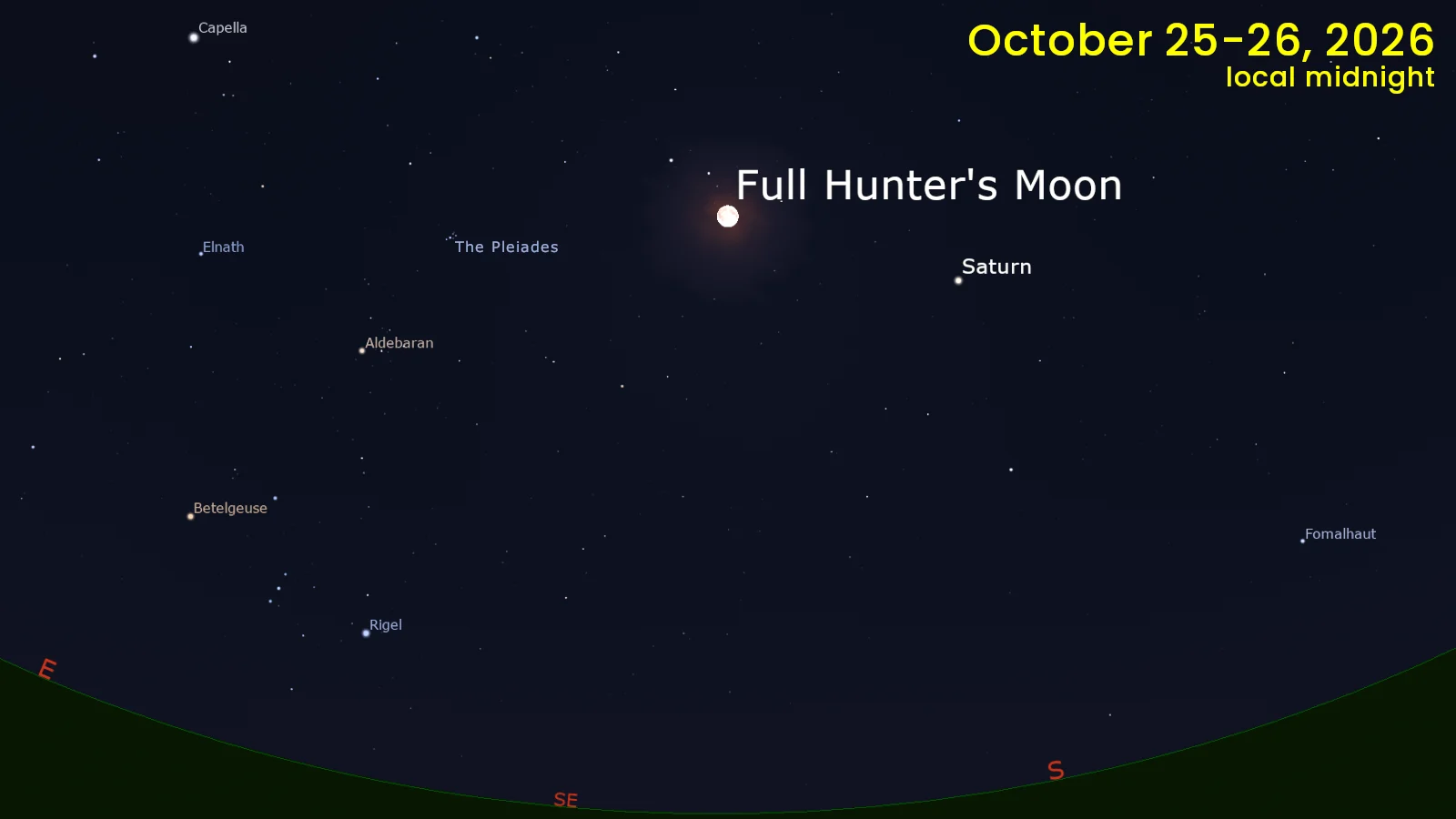
A wider view of the southern and eastern night sky on October 25-26, 2026. (Stellarium/Scott Sutherland)
The Pleiades are best seen from darker skies, and may appear as a small hazy smudge that only resolves into separate stars when viewed with binoculars or a telescope.