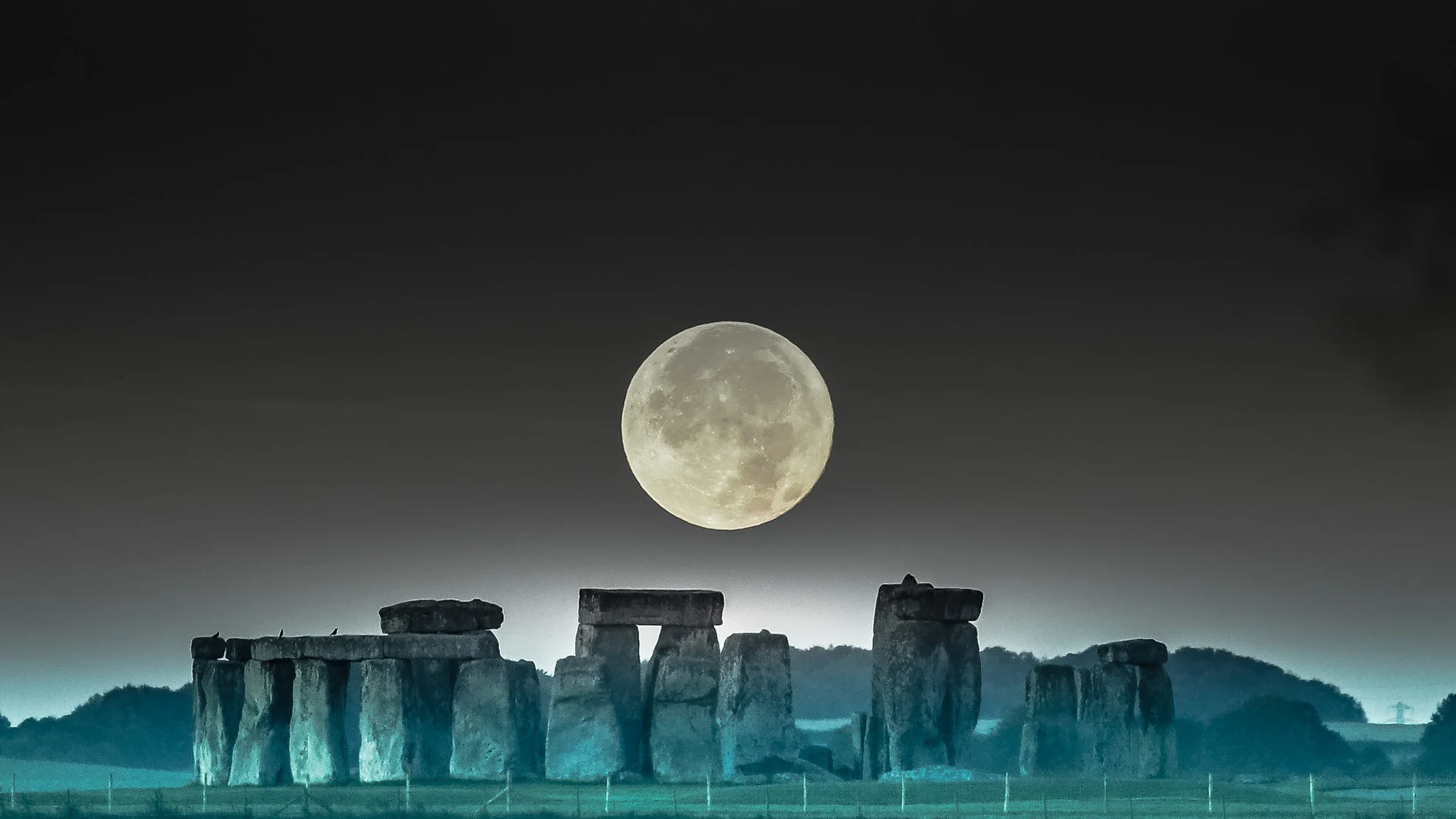
The Harvest Moon lights up our night sky this weekend

Take a few moments to look up at the Moon this weekend, and you may spot the ringed planet, Saturn, nearby!
Eyes to the sky this weekend to see the Full Corn Harvest Moon shining in Canadian skies.
On Saturday, September 26, the Moon will line up on the opposite side of Earth from the Sun, presenting its fully illuminated face to us.
This Full Moon's exact timing is at 12:49 p.m. EDT on the 26th. As such, it will be on the other side of Earth from Canada at that time.
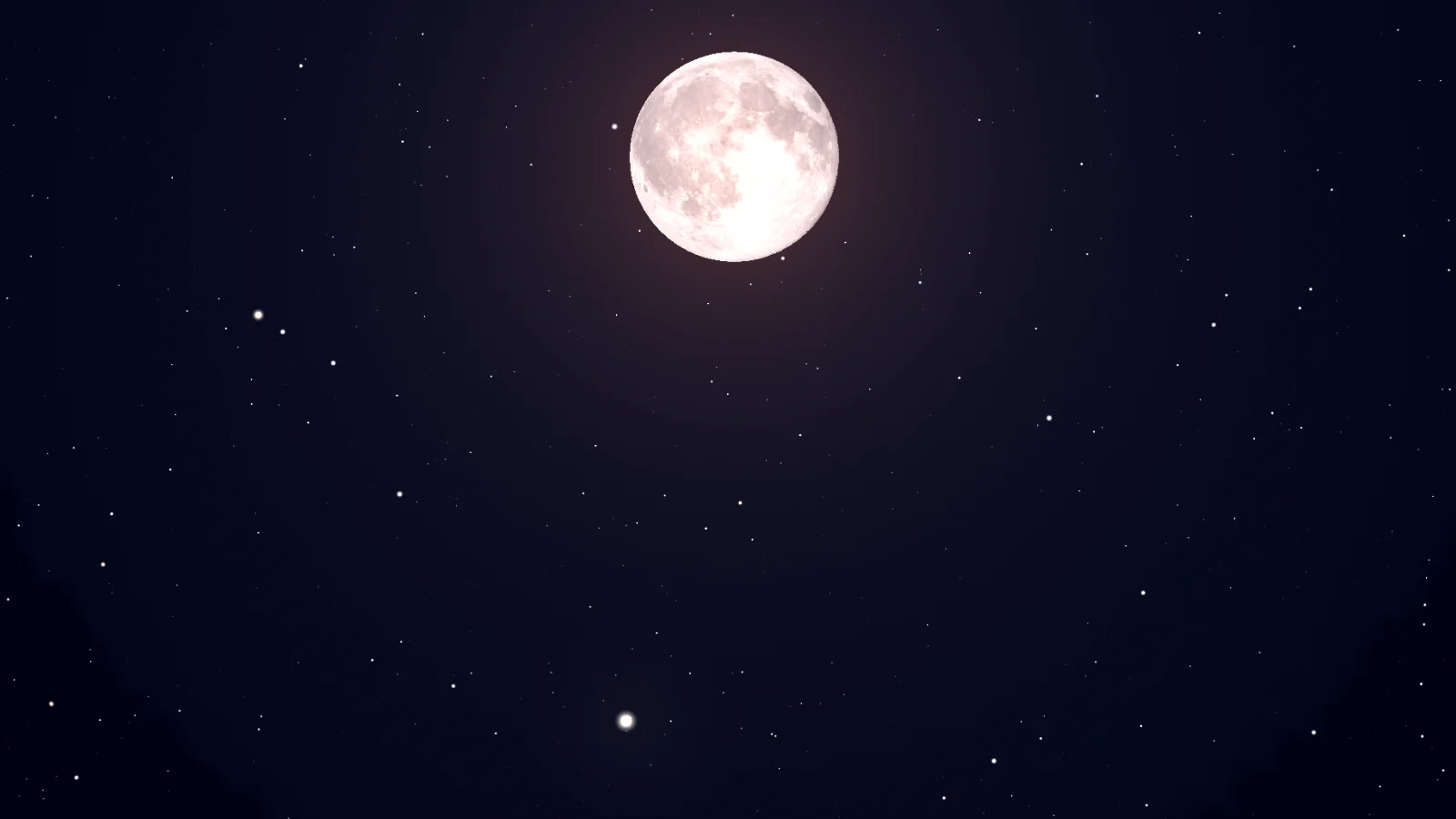
A simulated view of the Full Moon on Sep 26, 2026, shows the planet Saturn nearby (the bright 'star', near the bottom of the field of view, just left of centre). (Stellarium)
However, that same timing means that the Moon will appear full — over 99 per cent illuminated — starting Friday night, from just after moonrise until moonset the next morning, as well as from moonrise to moonset Saturday night.
What is a Corn Moon?
Back in the 1930s, the Maine Farmer's Almanac printed a list of names for each of the 12 typical Full Moons we see during the course of a year. Some of these names were from traditional Colonial and European folklore. However, most were inspired by the lunar calendars of the Indigenous peoples living around the Great Lakes and what is now the U.S. Northeast.
According to that list, the September Full Moon is named the Corn Moon.
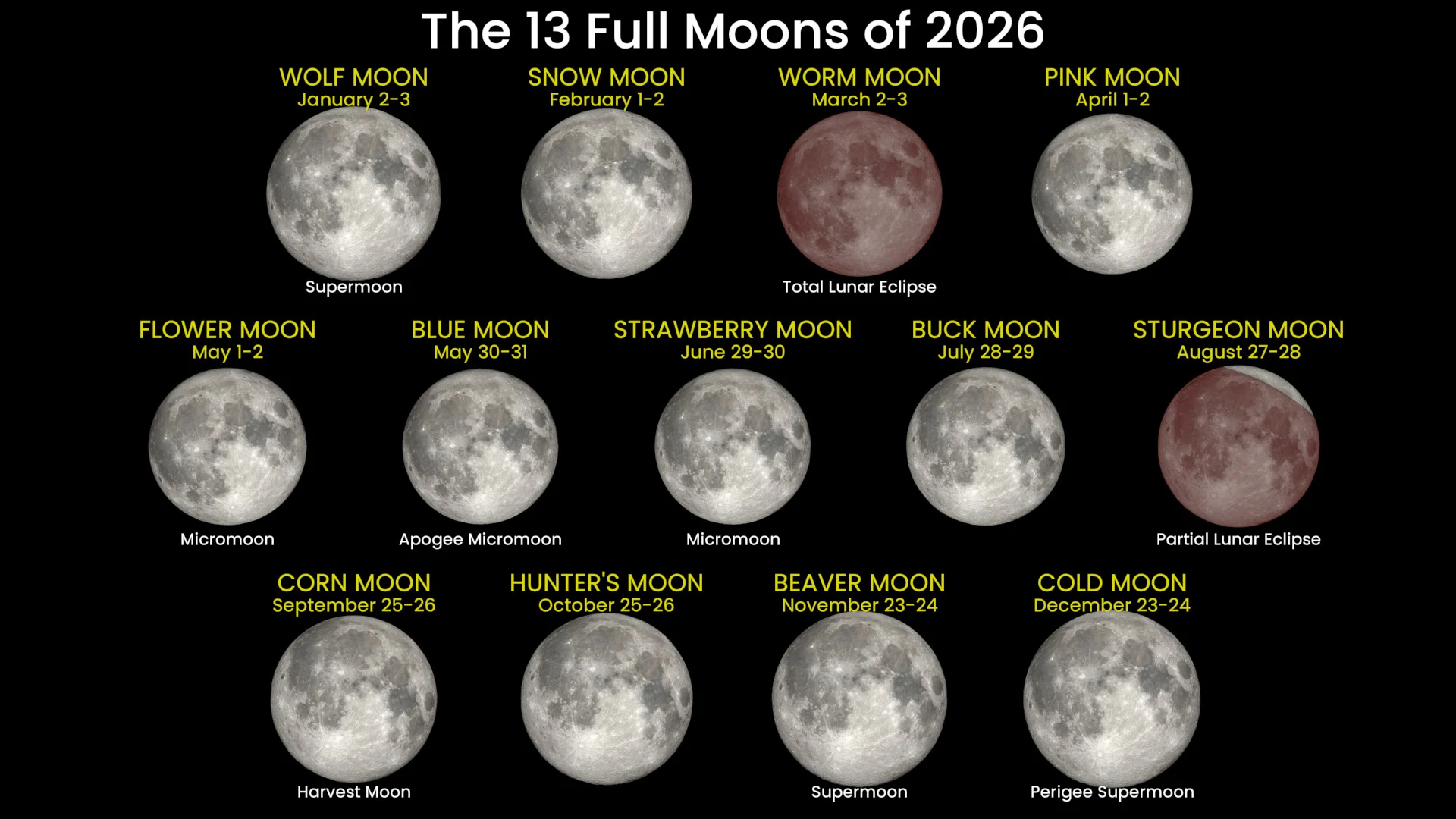
The 13 Full Moons of 2026, including their popular names, dates, and remarkable aspects (micromoon, supermoon, harvest moon, eclipses, etc). (NASA SVS/Fred Espenak/Scott Sutherland)
The Old Farmer's Almanac says: "This time of year — late summer into early fall — corresponds with the time of harvesting corn in much of the northern United States. For this reason, a number of Native American peoples traditionally used some variation of the name 'Corn Moon' to refer to the Moon of either August or September."
Fall 2026: Meteor shower season is about to begin!
What is the Harvest Moon?
The Harvest Moon is the Full Moon that occurs closest to — either before or after — the Fall Equinox.
It gets this name because with the Moon rising so close to sunset for roughly a week's time, farmers take advantage of its bright light to continue their work bringing in the harvest.
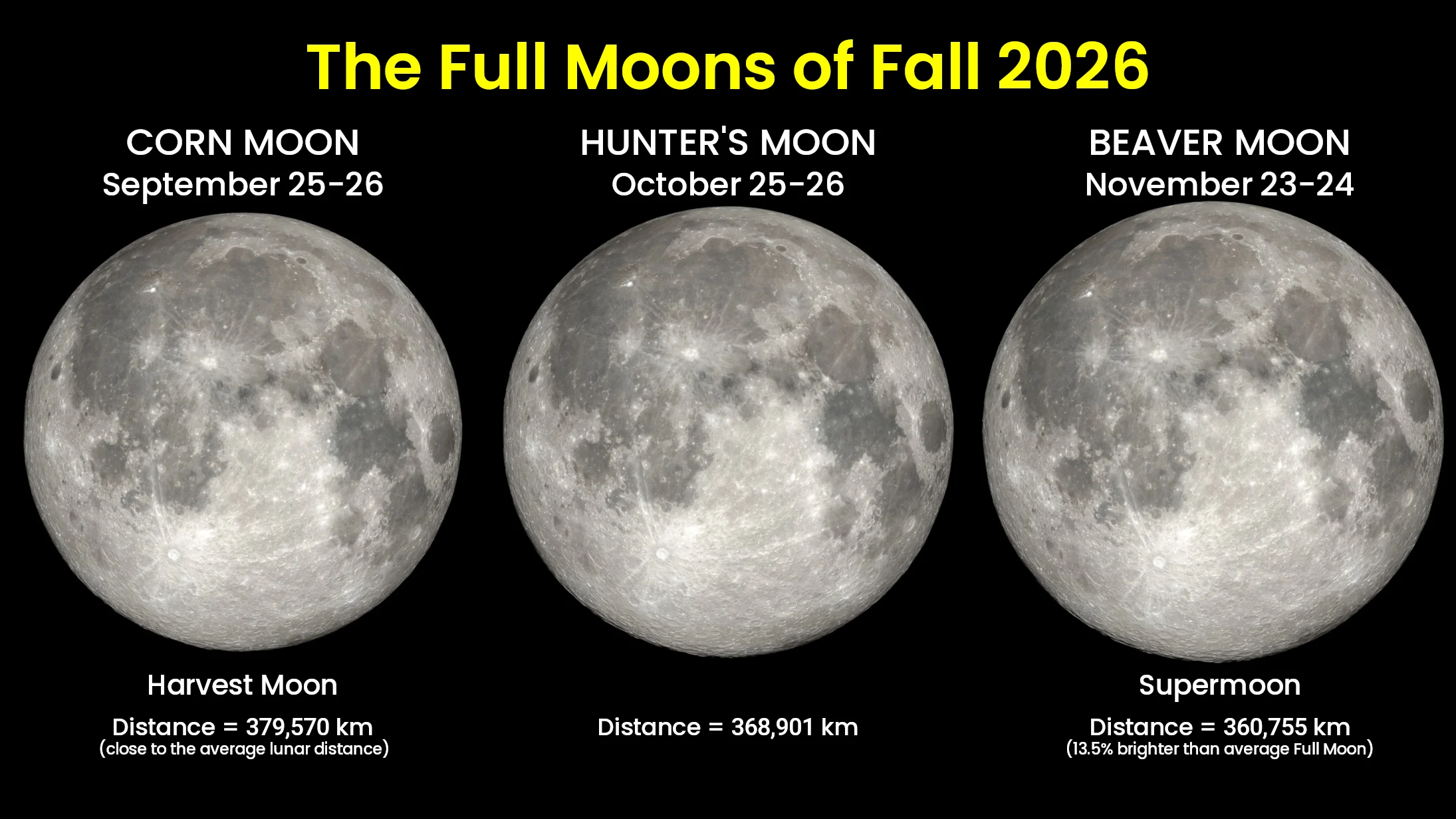
The three Full Moons of Fall 2026, with the Harvest Moon coinciding with this year's September Corn Moon. (NASA SVS/Scott Sutherland)
Due to the timing of the Harvest Moon, most often it coincides with September's Corn Moon.
However, every three to five years, the October Hunter's Moon falls within the first week of October. In that case, the Hunter's Moon is also that year's Harvest Moon.
READ MORE: Our Sun is capable of producing devastating superflares; should we worry?
NASA Moons
The September Full Moon has also been given two special names by NASA scientists.
Informally, they call it both the GRAIL Moon and the LADEE Moon, after two lunar satellite missions that launched during the month of September.
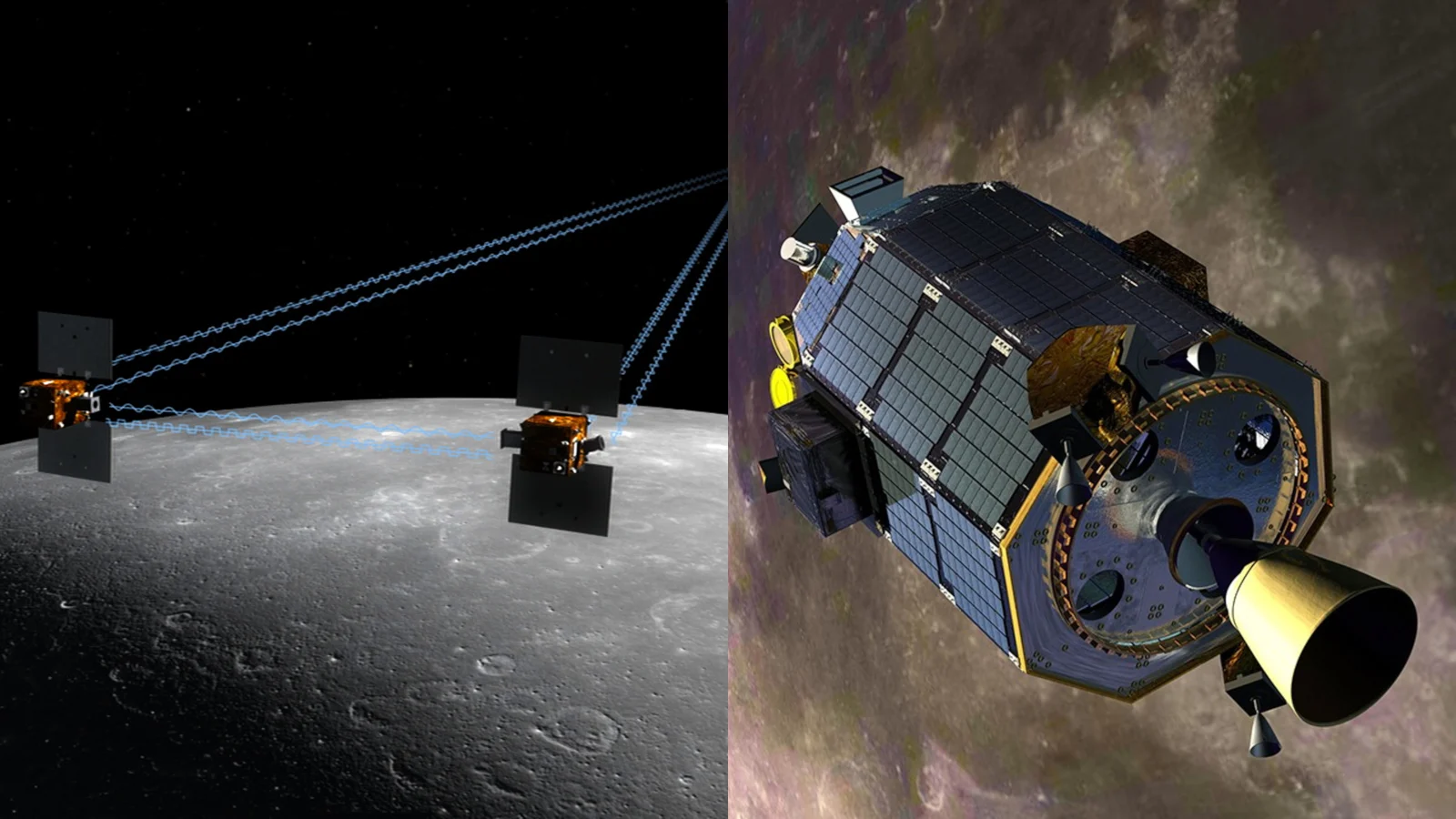
On the left, the twin GRAIL satellites communicate with each other as they orbit the Moon, while transmitting data back to Earth. On the right, the LADEE spacecraft orbits the Moon, gathering information on its thin atmosphere. (NASA)
GRAIL was the Gravity Recovery and Interior Laboratory mission. It began on September 10, 2011, when a pair of twin satellites — Ebb and Flow — were launched into orbit around the Moon.
As they circled around their orbit, they kept precise data on the exact distance between the two of them. This allowed researchers back on Earth to map out the tiny changes in their altitude, caused by differences in the Moon's gravitational field, as the satellites passed over regions of the Moon that had more or less mass. Mission data ultimately provided scientists with clues to the Moon's internal structure.
LADEE was the Lunar Atmosphere and Dust Environment Explorer, which lifted off on September 6, 2013. It's mission was to study the space directly surrounding the Moon. Of particular interest was measuring the Moon's tenuous xenon atmosphere, as well as collecting data about how much lunar dust is lofted up into space, due to factors such as meteorite impacts and static charging of dust from solar radiation.
Look for Saturn nearby!
If you pause for a few moments to look up at the Moon this weekend, also glance around it in the sky. You might just spot one of the amazing planets of our solar system.
On Friday night, the Moon will rise in the east at around 6:30 p.m. local time, when the Sun is still above the western horizon. Shortly after sunset, the planet Saturn will appear, following the Moon across the sky for the rest of the night. It may be difficult to spot in the twilit sky, but after around 8 p.m., it should be plainly visible, down and to the left of the Moon.
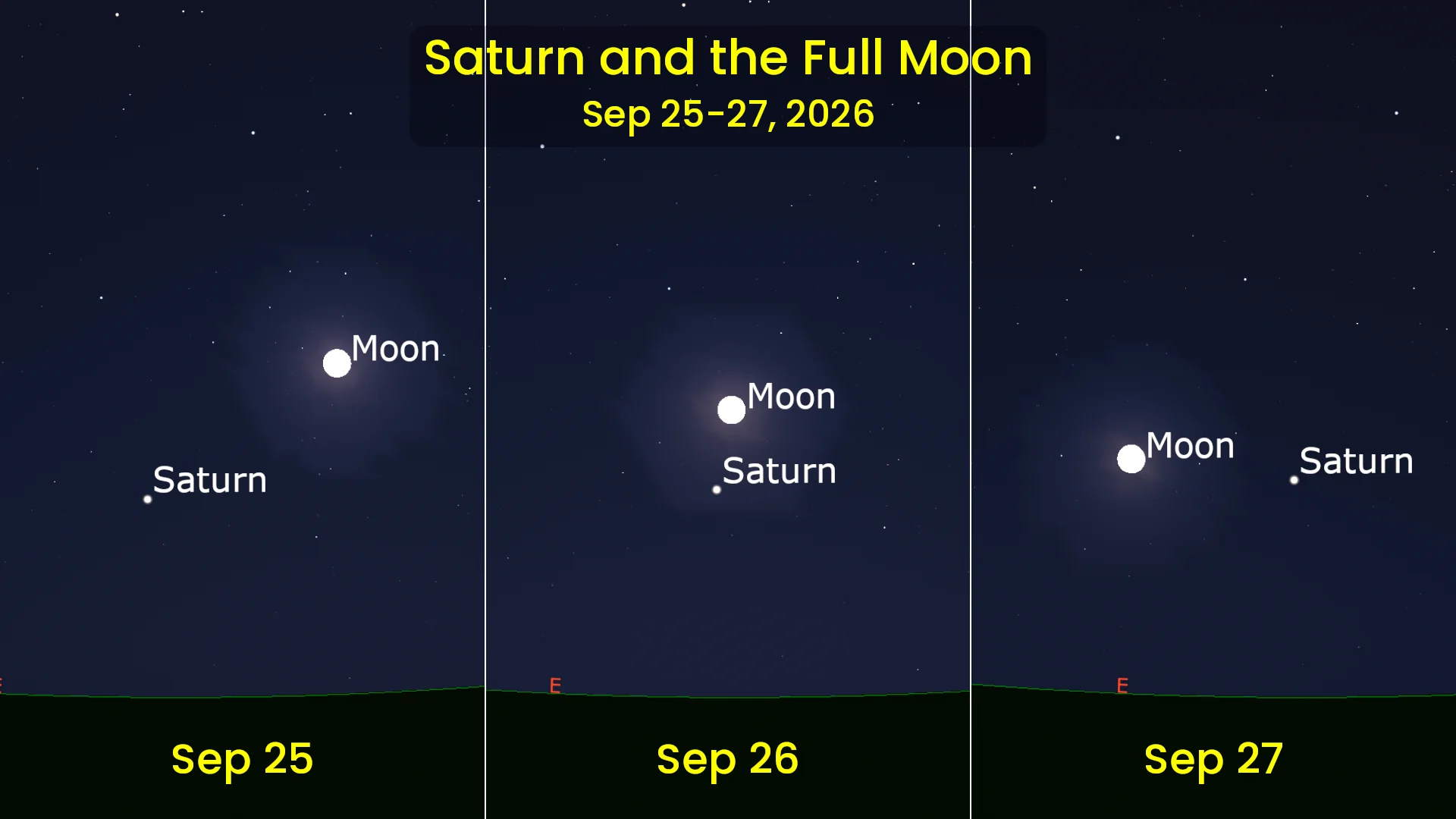
The Moon and Saturn on the nights of Sept. 25-27. (Stellarium/Scott Sutherland)
On Saturday — literally 'Saturn's day' — the pair will be even closer together. The Moon will rise just before 7 p.m., with Saturn following around 30-40 minutes later. The ringed planet will remain almost directly beneath the Moon for the entire night.
Plus, even on Sunday, we can still see them paired up, but this time with them both rising at the same time, and Saturn appearing to lead the way across the sky until dawn.