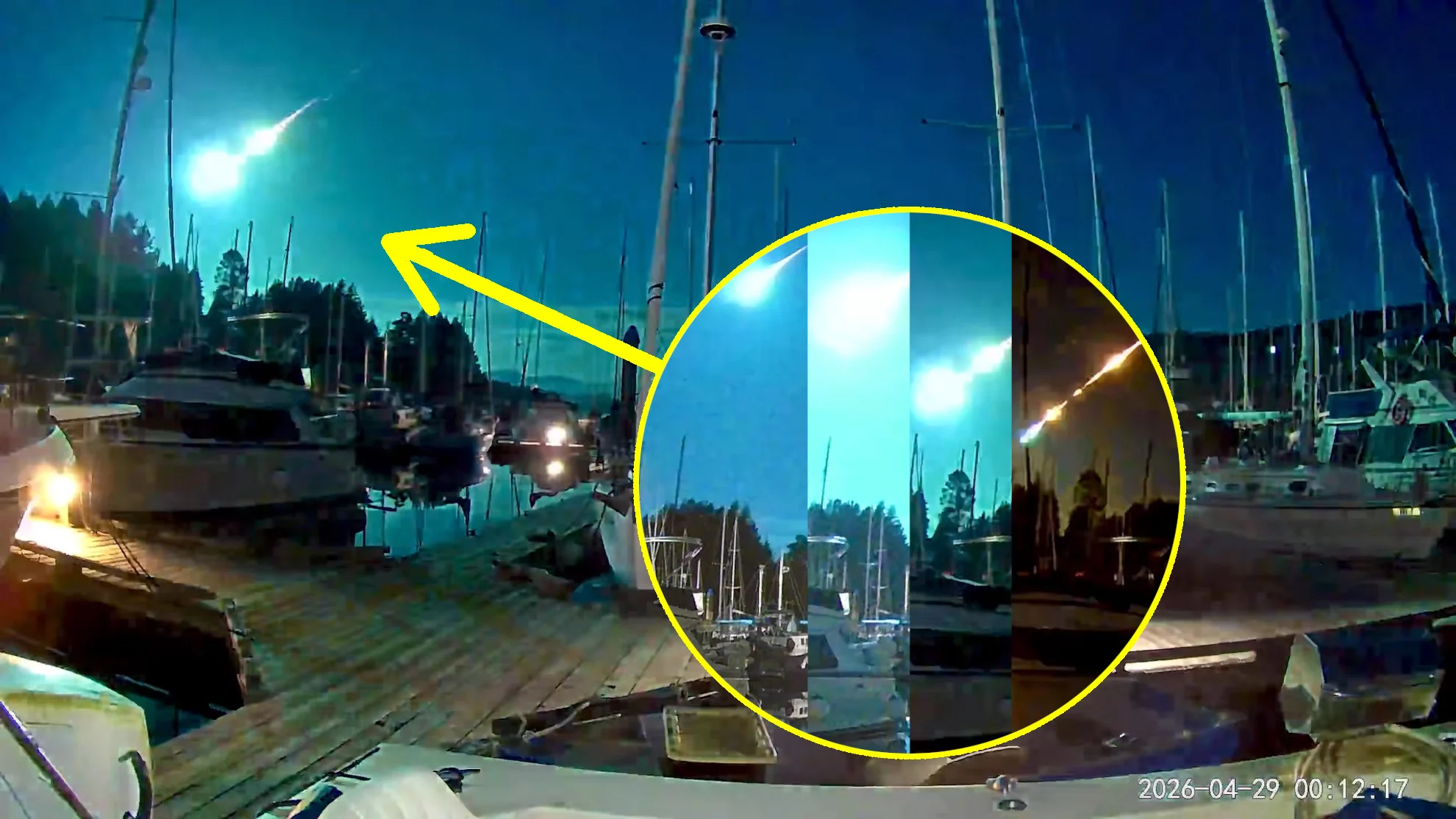
Bright fireball meteor lights up the night sky over Vancouver Island

Did you spot this meteoroid flash across the sky?
A bright fireball meteor flashed across southern British Columbia on Tuesday night, lighting up the sky as if it was day for a brief moment.
According to video timestamps and eyewitness reports, the fireball occurred shortly after midnight, Pacific Time, and lasted for five to six seconds as it flashed through the sky, exploding and fragmenting multiple times along its path.

Six frames from a video of the fireball are combined here to show the explosions and fragmenting as it passed through the sky. (Tony Hagen, courtesy AMS)
DON'T MISS: Amazing fireballs captured during the Lyrids, the oldest meteor shower on record
As of Thursday morning, the American Meteor Society website has recorded nearly 150 reports of the event.
The majority of these reports came in from witnesses in Victoria and Vancouver, communities along the east and south coasts of Vancouver Island, and from around Seattle, WA.
Also, due to the mainly clear skies over the area at the time, it was spotted by witnesses that, in some cases, were more than 600 kilometres away — as far north as Prince George, from the Okanagan Valley and Spokane, WA, to the east, and as far south as central Oregon.
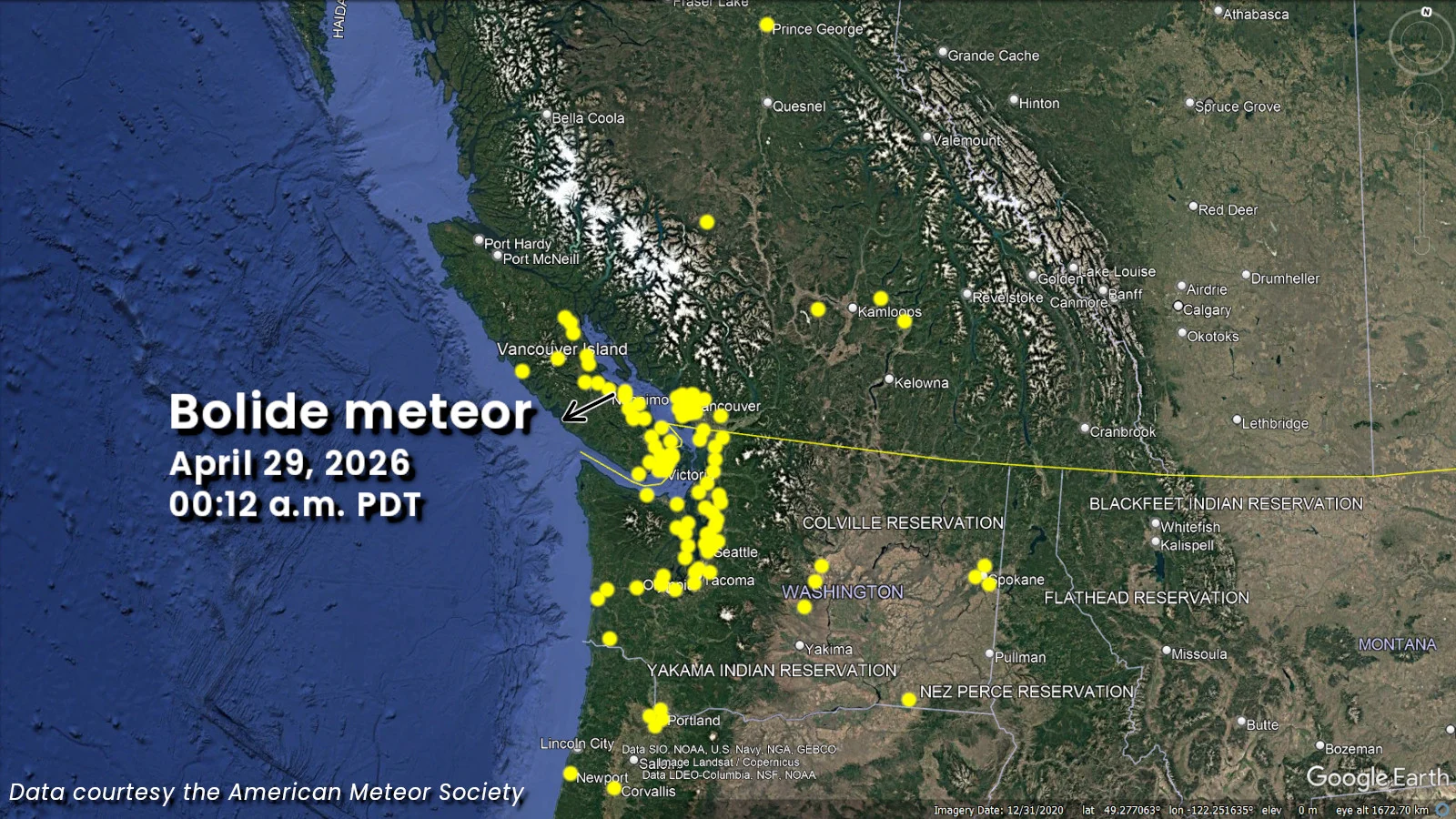
The map plots the location and path of the meteor, as compiled from reports to the AMS, as well as the locations of reports made by witnesses of the event. (Scott Sutherland, data courtesy AMS)
READ MORE: With so many bright fireball meteors lately, what's going on?
Fireballs like this occur when small meteoroids plunge into our atmosphere from space. As they are travelling at tens of thousands to hundreds of thousands of kilometres an hour during this plunge, they compress the air in their path to the point where it becomes a superheated plasma that envelopes the meteoroid.
The effect is very similar to what happened when the Artemis 2 Orion spacecraft returned to Earth on Friday, April 10.
READ MORE: Artemis 2 Splashdown - Orion's fiery plunge was the riskiest stage of its flight
In most cases, meteors only last a fraction of a second, as the extreme heat of the plasma vapourizes the tiny speck of dust at their core. Larger or exceptionally fast meteoroids will produce bright fireballs, which last a second or two before they wink out.
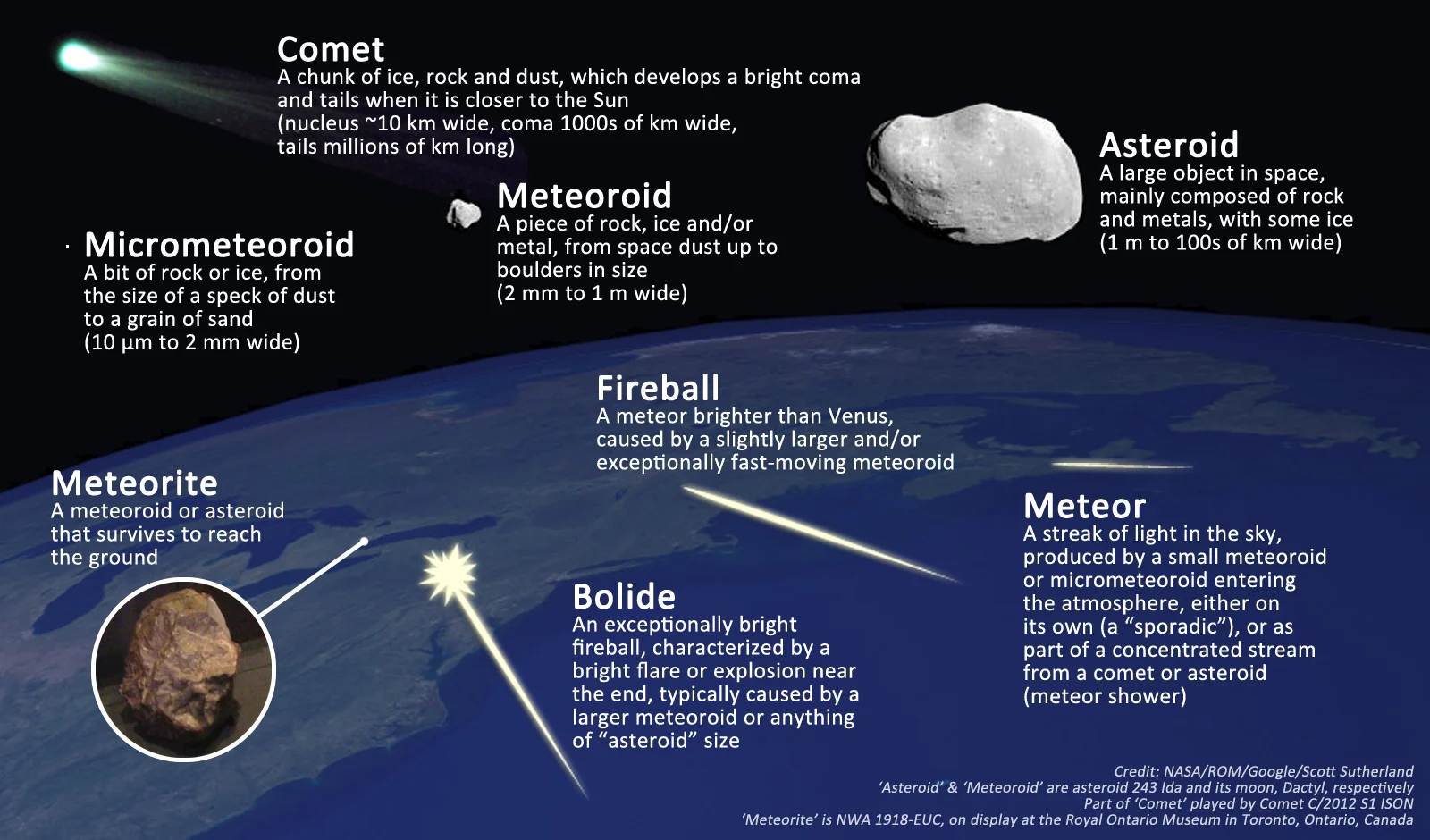
This infographic provides examples of the various types of meteors, as well as their sources. (NASA/Royal Ontario Museum/Google Earth/Scott Sutherland)
RELATED: Look up! The first of TWO May Full Moons will rise Friday night
Meanwhile even larger space rocks will produce bright flares along their path, as they explode under the intense pressure the air exerts on them during their flight.
Some of these flares can even light up the night sky as if it was day, for a brief moment of time. These are called bolides.
Although bigger and brighter fireballs can sometimes drop meteoroids along their path, this often depends on the speed of the object. The faster the meteoroid is travelling, the more likely it is to completely burn up, leaving nothing behind but a trail of vapour and space dust, high in the atmosphere.