
A very strong solar storm just hit Earth! Expect bright auroras tonight!

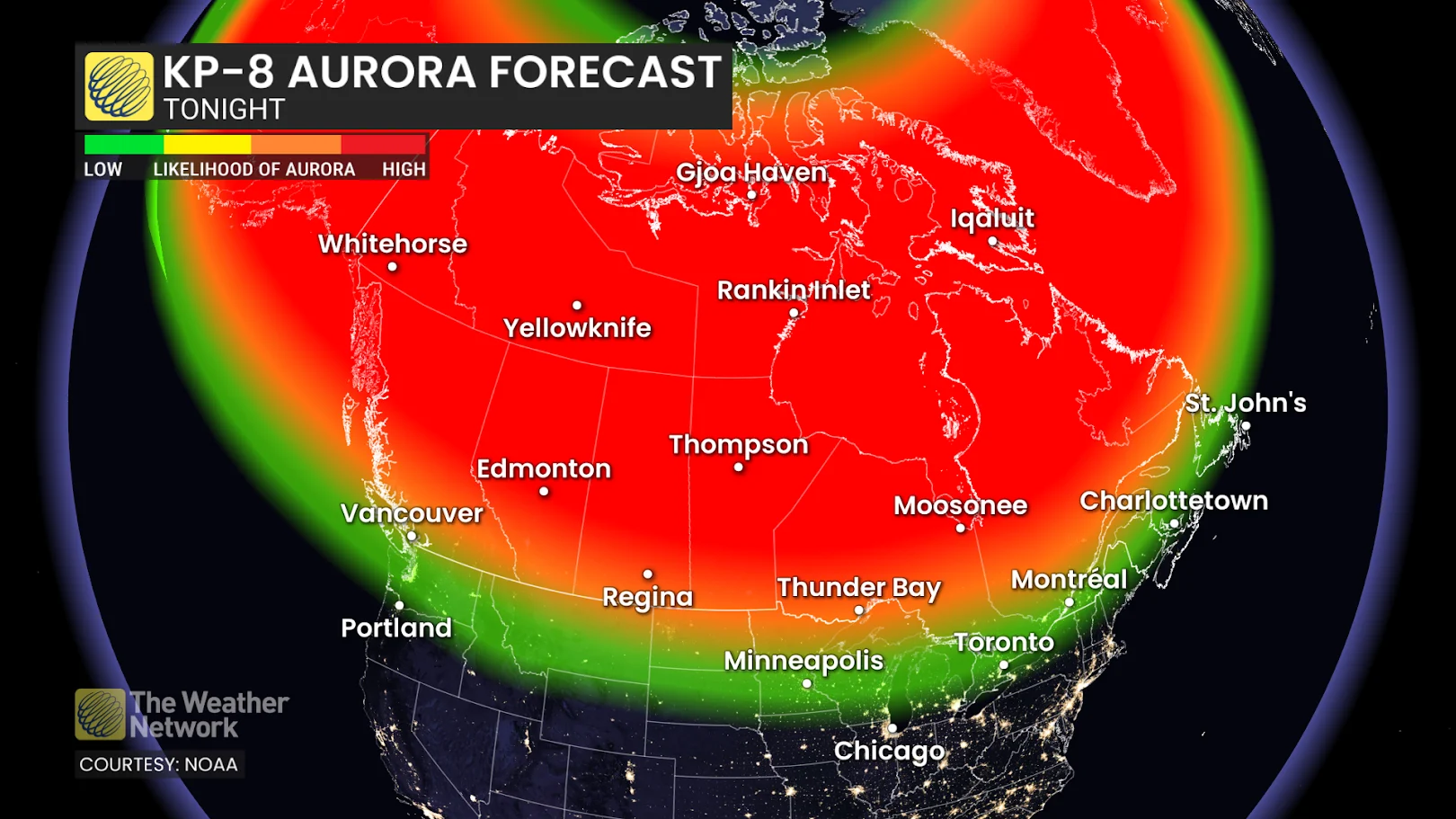
Sparked by a fast-moving solar storm, the Northern Lights may stretch far to the south tonight, and might even be visible from the southern United States.
Eyes to the sky tonight, for a chance to spot another amazing display of the Northern Lights! It all comes down to the exact timing of when a speedy solar storm sweeps past us as it blasts away from the Sun.
Around midday Sunday, a large sunspot known as AR 4341, which has been crackling with activity since it first appeared last week, exploded in an intense X1.9-class solar flare. From the initial spike of energy to when it finally tapered off, this long-duration flare lasted for roughly 7 hours.
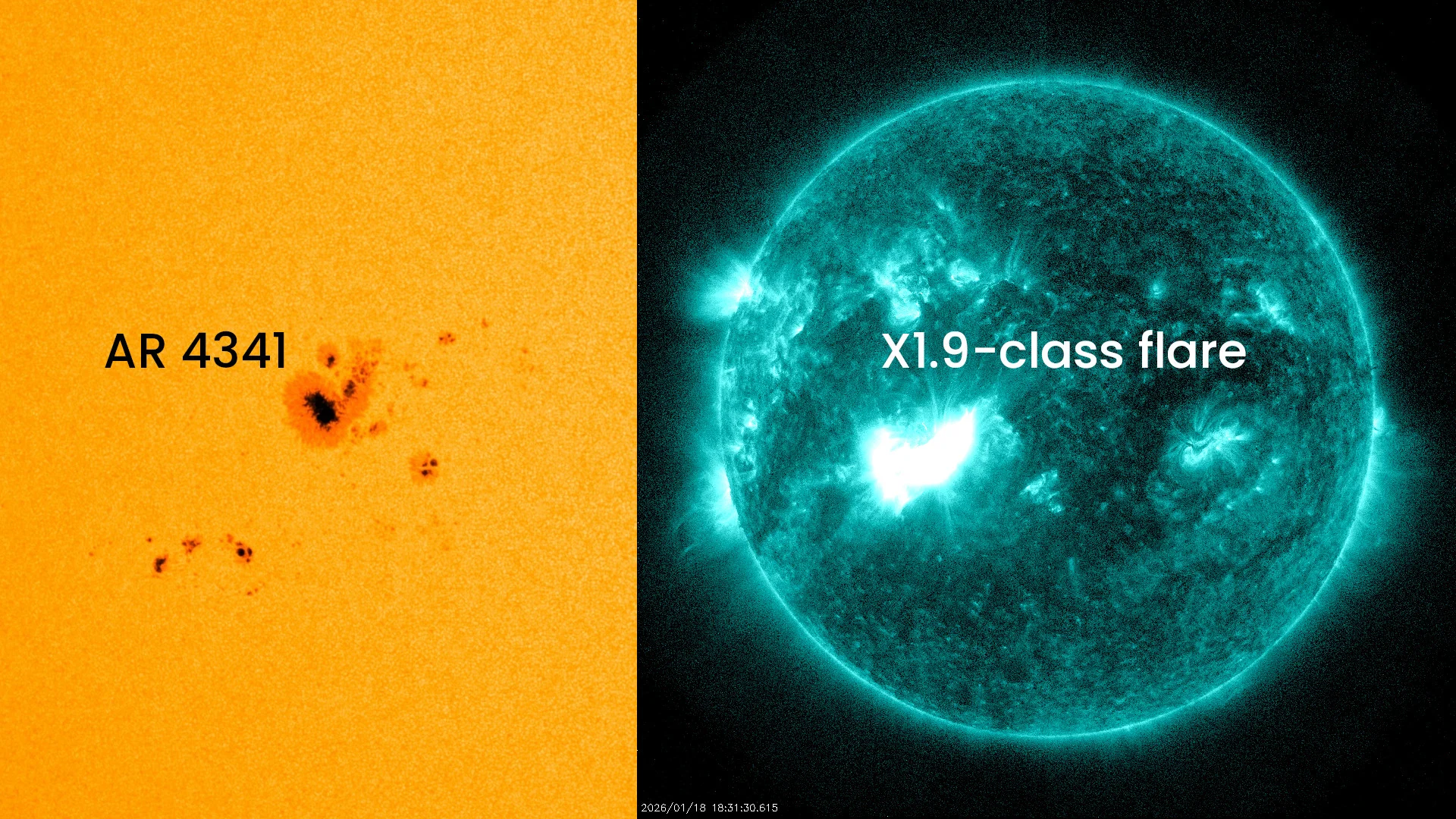
Active Region 4341 (left), with the X1.9-class solar flare captured by satellite imagery on Sunday, January 18, at 18:31 UTC. (NASA SDO)
The powerful shock from this flare, along with the energy and x-rays it poured into space, touched off two follow-up impacts.
The first was a solar radiation storm, as the flare energized solar protons, causing them to rocket away from the Sun at very high speeds. According to NOAA, as of Monday afternoon (EST), this radiation storm reached a peak at S4 (severe) levels. This could expose astronauts on orbiting spacecraft, as well as crew and passengers on aircraft flying over the Arctic, to radiation risks.
The second impact was a massive cloud of solar matter, known as a coronal mass ejection or solar storm, which erupted into space. This CME absorbed the brunt of the energy from the flare, resulting in a very fast-moving cloud of charged solar particles, which was first expected to reach Earth in just 30 hours. Typical CMEs take anywhere from three to four days to reach us after they erupt.
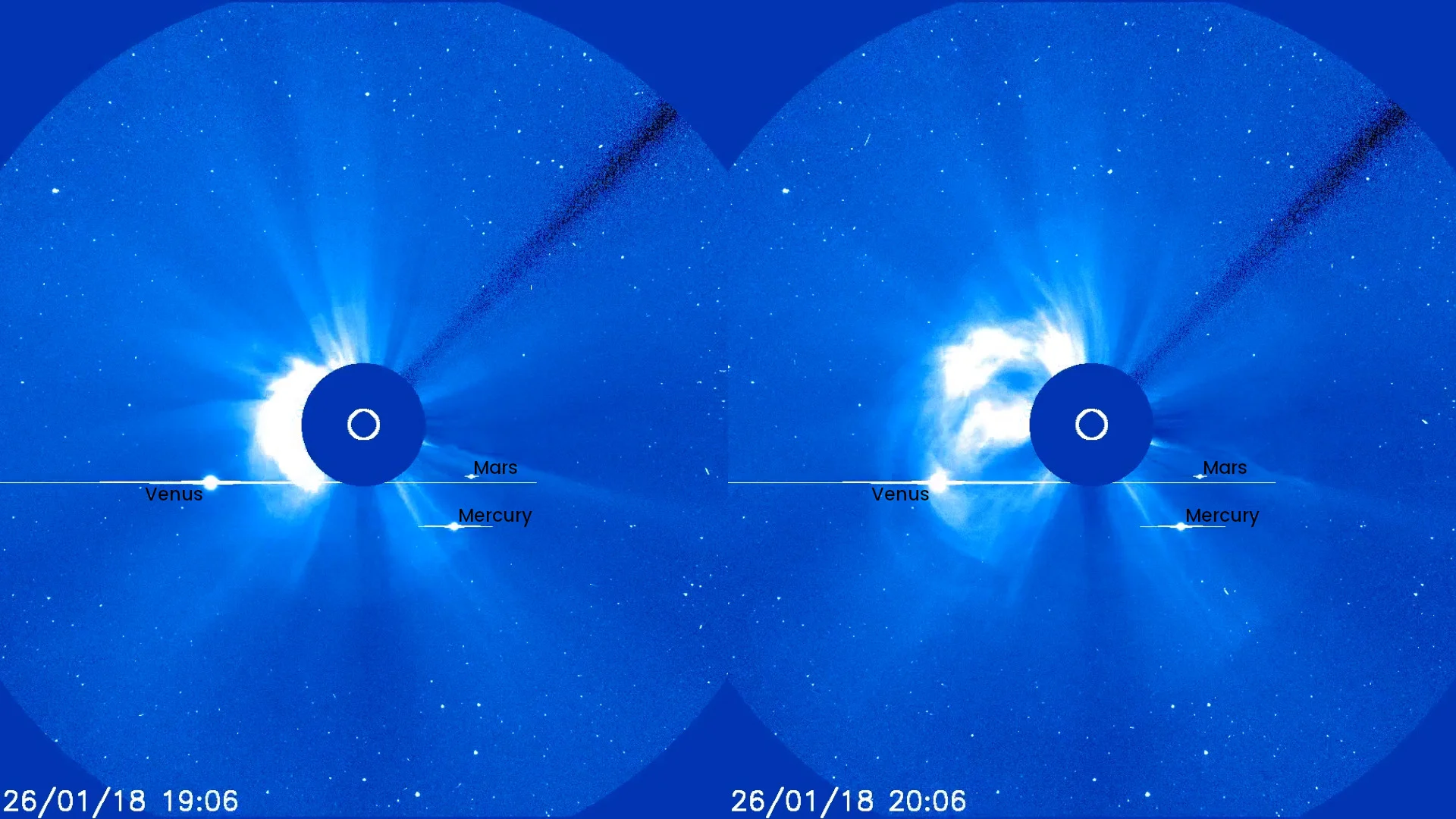
Two coronagraphs of the January 18 2026 CME, taken one hour apart, show the erupting CME expanding mainly towards the left. A fainter 'halo' can also be seen, indicating that a portion of the cloud is headed towards Earth. The planets Venus, Mars, and Mercury are labelled. (Scott Sutherland/NASA ESA SOHO)
Coronagraph imagery taken after the eruption, as shown above, reveals that the bulk of the CME was directed towards the space 'behind' Earth in its orbit. Thus, the densest portion of the cloud will likely miss us. However, the imagery also shows that this was a 'halo' CME, meaning that some portion of the cloud is headed directly for us.
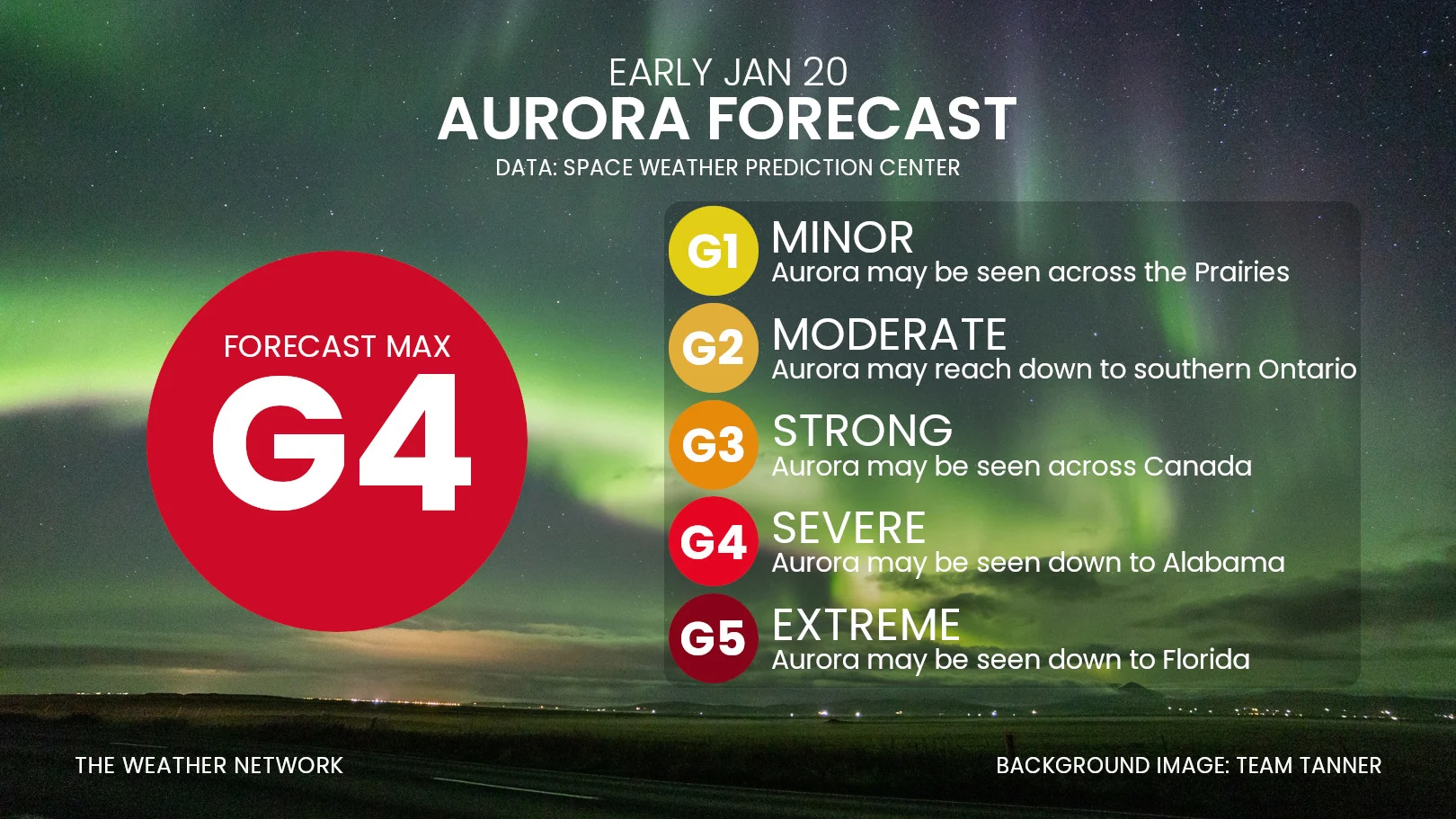
Based on computer modelling of the solar storm, NOAA's Space Weather Prediction Center originally expected the CME to sweep past Earth early Monday evening. As a result, they issued a G4 (Severe) geomagnetic storm watch for overnight on January 19 through the morning of January 20.
READ MORE: Why are the Northern Lights so supercharged lately and how long will this last?
The geomagnetic storm was originally anticipated to begin gradually, with G1 (minor) levels Monday evening, and ramping up to G4 levels overnight. However, the CME appears to have arrived much earlier, after only 25 hours since it erupted, and with a much stronger initial impact, than expected.
Satellite data indicates that the cloud of solar particles reached us just after 2 p.m. EST, causing geomagnetic activity to immediately spike up to G3 (strong) levels, and then G4 (severe) shortly after.
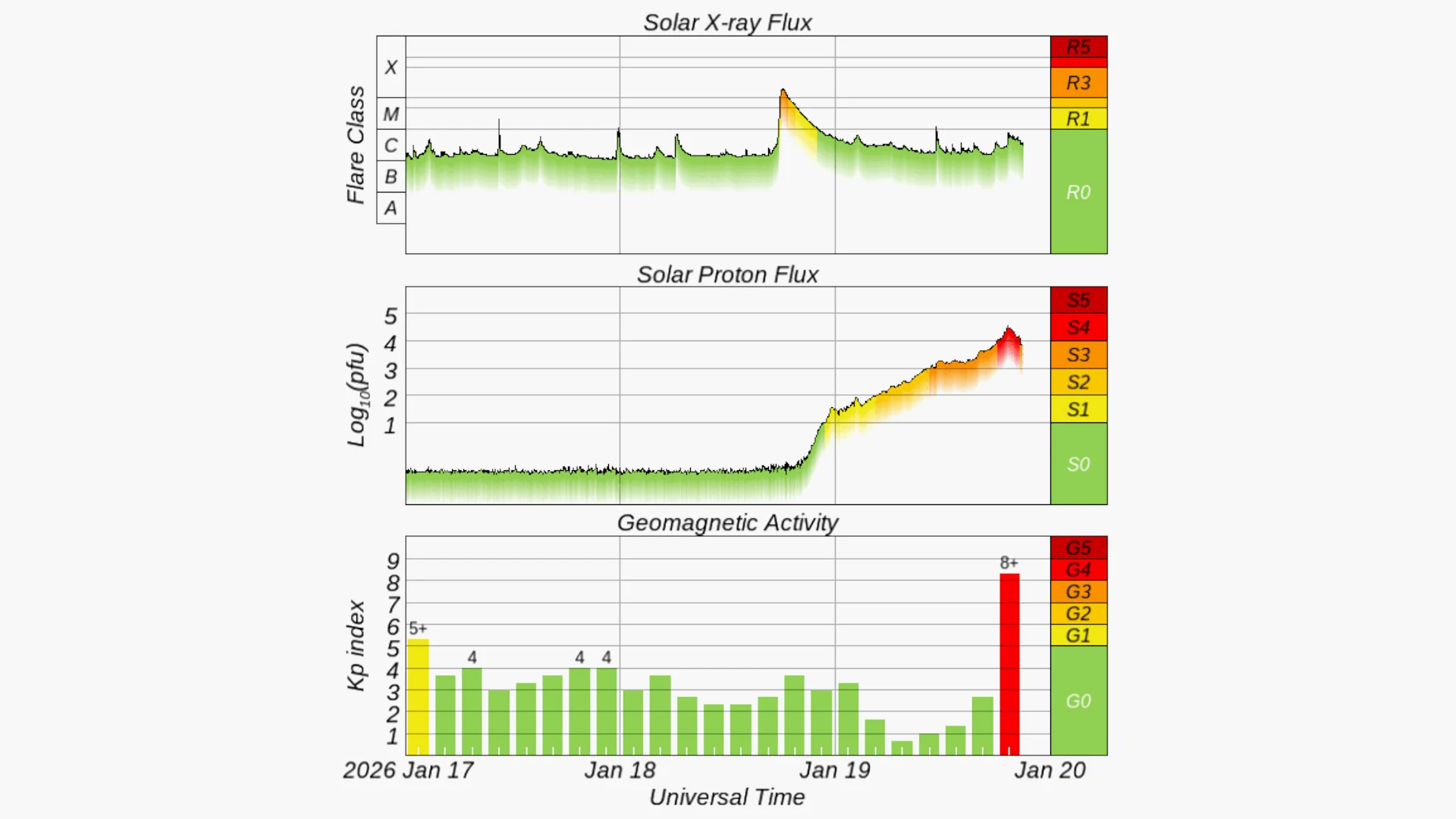
Space weather conditions, plotting solar flares (Solar X-ray Flux, top), solar radiation storms (Solar Proton Flux, middle), and geomagnetic activity (bottom), show the progression of this event, with the solar flare peaking midday Sunday, the solar radiation storm building afterward, and the CME arriving, causing geomagnetic activity to spike up to G4 Monday afternoon. (NOAA SWPC)
DON'T MISS: Geomagnetic storms - When should we look up and when should we worry?
Based on all of this, we may not need to wait until overnight for the brightest auroras to show up.
It's possible we could see the Northern Lights in the skies above Canada and the northern United States right after sunset, as soon as it becomes dark enough to see stars in the sky.
MORE AURORAS: Northern Lights put on a show across Canada, U.S., and parts of Europe in mid-November
However, they may also be spotted along the northern horizon for regions as far south as California, Arizona, New Mexico, Northern Texas, Oklahoma, Mississippi, Alabama, Georgia, and South Carolina.
WATCH: Severe solar storm brings blackout risks and aurora alerts
Despite the potential extent of the Northern Lights, tonight, the weather is going to dictate exactly who gets to witness the event.
As of the latest forecast, cloud conditions are mixed across the country.
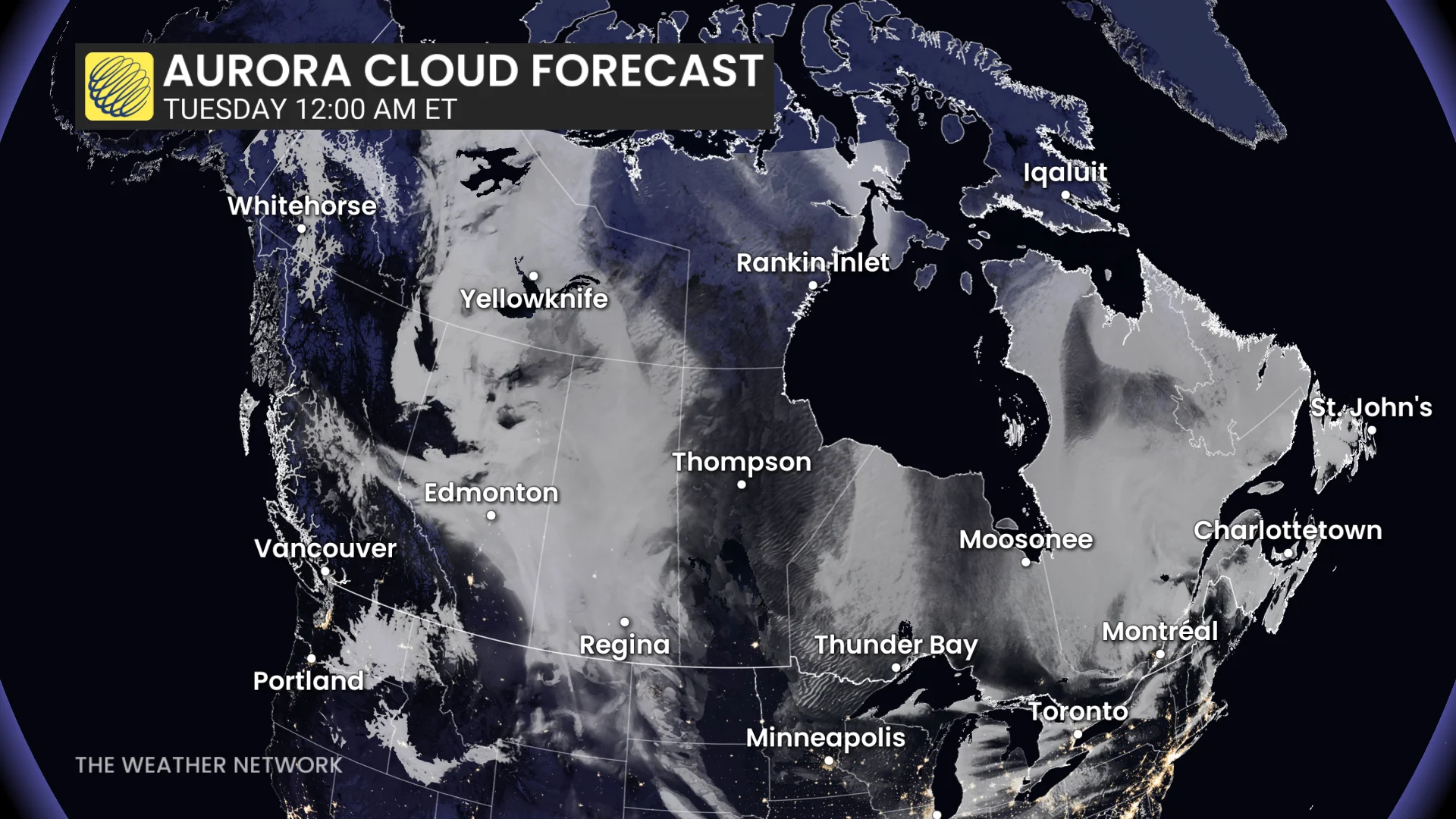
Atlantic Canada looks to have mainly cloudy skies, although St. John's and the Avalon Peninsula could have clear breaks. Much of Quebec appears under cloudy skies, as well, except Montreal and parts of the Eastern Townships. Eastern Ontario has mainly clear skies, with mixed chances for central and southwestern Ontario, due to bands of cloud and snow off of Lake Huron and Georgian Bay. The northern shores of Lake Huron and Lake Superior appear mainly clear, although lake effect off Superior could bring cloudy skies to the Sault Ste Marie area.
In western Canada, Manitoba is mainly clear, but a wide swath of cloud covers much of Saskatchewan and northern Alberta throughout the night. Central and southern Alberta and nearly all of British Columbia should have clear skies overnight.
(Editor's note: this story has been updated based upon developing conditions with this solar storm. More updates could be on the way.)
(Thumbnail image shows a bright arc of coloured auroras from one end of the sky to the other in this image captured by Matt Melnyk, north of Calgary, Alberta, on October 6, 2024)