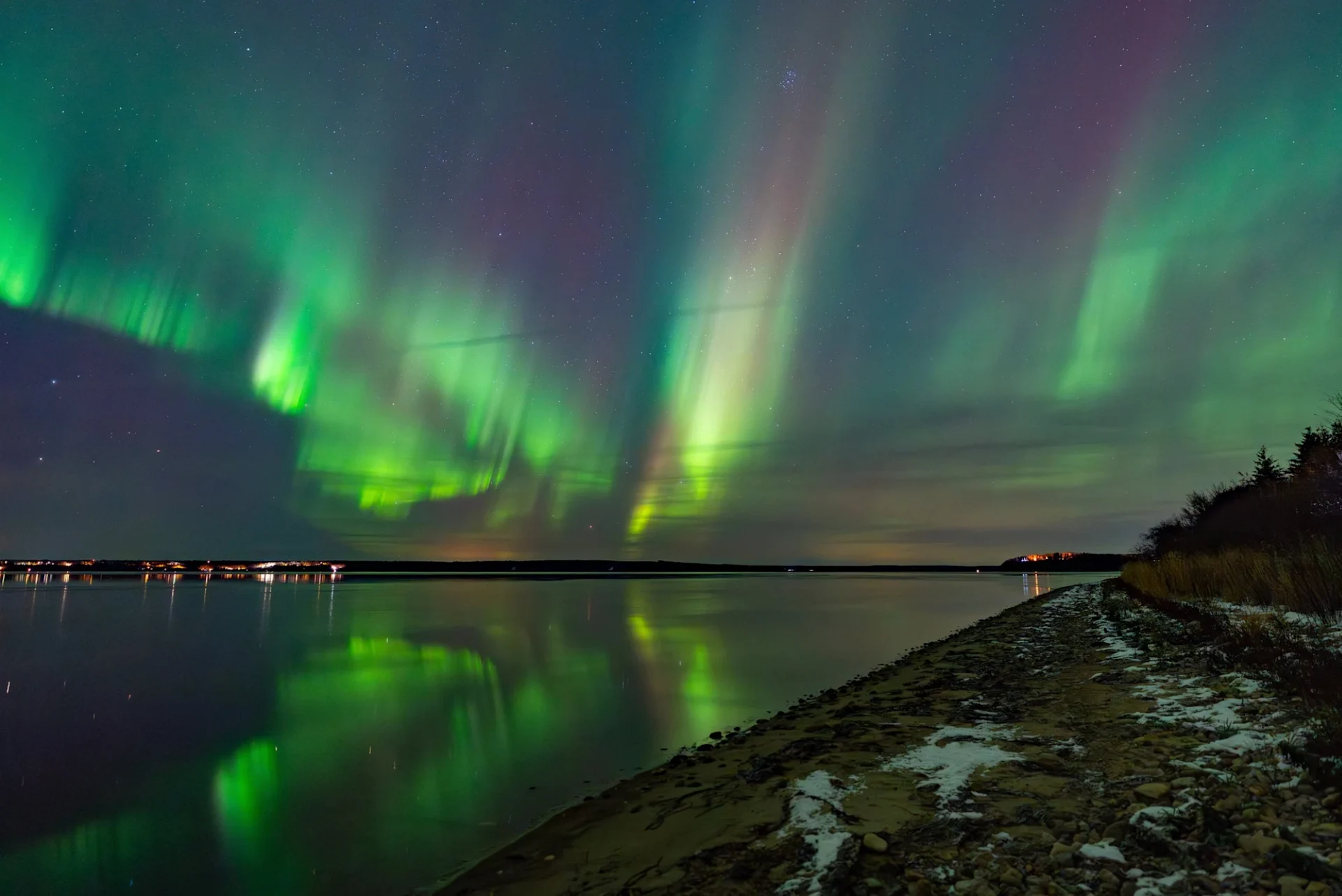
The Northern Lights may shine over parts of Canada tonight. Will you see them?

Who has the best chances across Canada of seeing the Aurora Borealis light up the sky tonight? Read on!
Check your weather forecast for clear skies tonight! A blustery solar wind could cause a burst of the Northern Lights to spring into our skies Tuesday night into Wednesday morning.
As seen through the high-energy filtered view from NASA's Solar Dynamics Observatory as it orbits around our planet, there is an immense hole in the Sun's atmosphere, aimed almost directly at Earth.
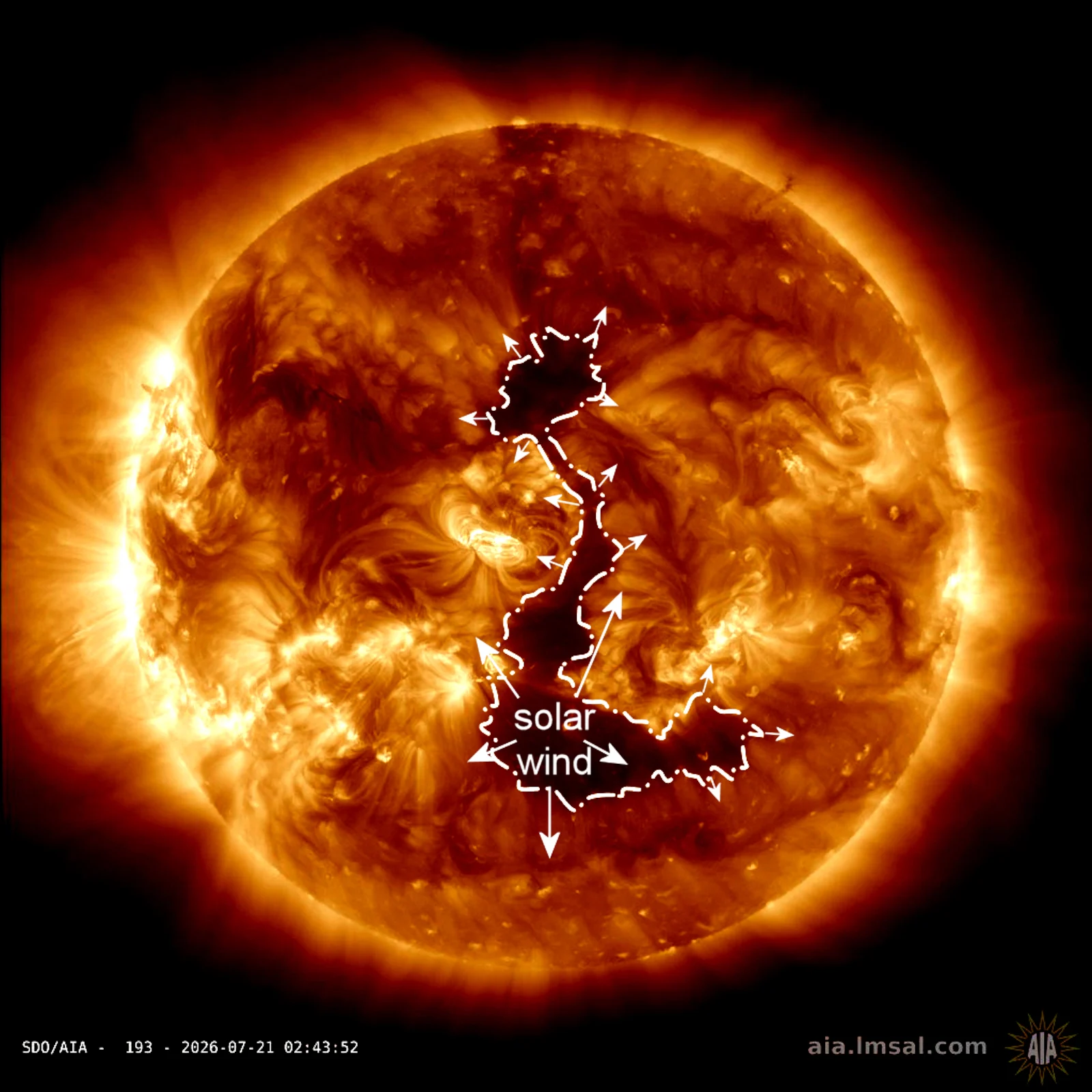
A large canyon-like coronal hole - a literal magnetic hole in the Sun's super-hot atmosphere - is pointed towards the camera of the Solar Dynamics Observatory, and thus at Earth. White lines border the coronal hole, for emphasis, and arrows represent the fast stream of the solar wind emanating from it into space. (NASA SDO/AIA)
Emanating from this gap in the Sun's local magnetic field is a fast, energetic stream of the solar wind.
This 'coronal hole high speed stream' (CH HSS) is flowing out into the solar system, trailing along behind the coronal hole, and is set to sweep past Earth over the next few days, starting on Wednesday. However, before that happens, a relatively dense region of high-energy particles known as a 'co-rotating interaction region' (CIR) is expected to pass by.
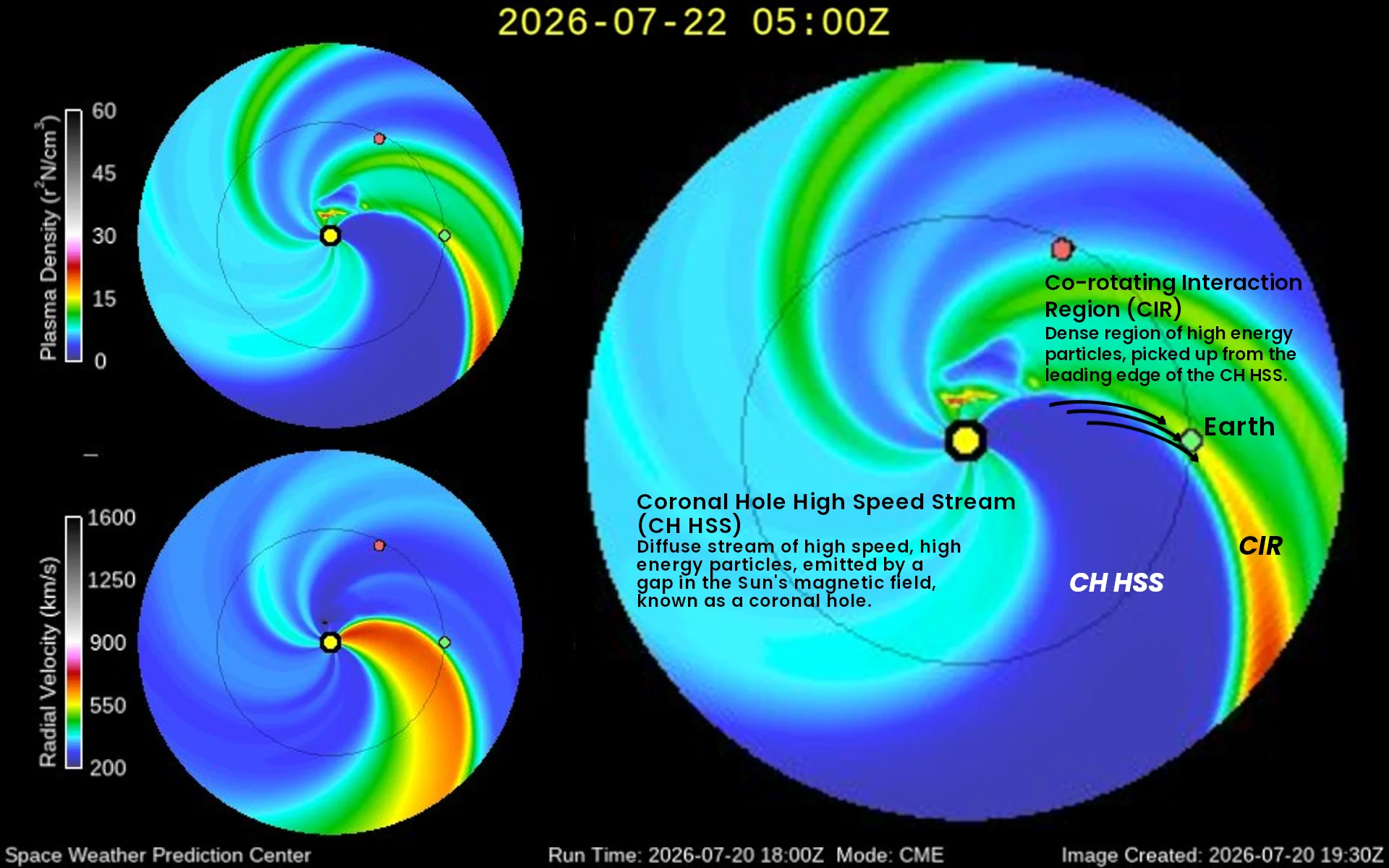
Computer model plots show the density (top left, centre right) and speed (bottom left) of the solar wind around the Sun, and its relation to the position of Earth (green dot) and the STEREO spacecraft (red dot), for July 22, 2026. The CH HSS and CIR are labelled on the right-hand plot. (ENLIL computer plots by NOAA SWPC, labels added by Scott Sutherland)
Click here for a zoomable version of the above graphic.
The CIR results from high energy particles flowing along the leading edge of the coronal hole stream becoming trapped at the trailing edge of the slower solar wind.
The impact of a co-rotating interaction region is typically not as strong as we'd see from the passage of a solar storm (aka coronal mass ejection or CME). Still, as a CIR sweeps past, its effects can produce a geomagnetic storm, as well as aurora displays in our night sky.
Geomagnetic storm
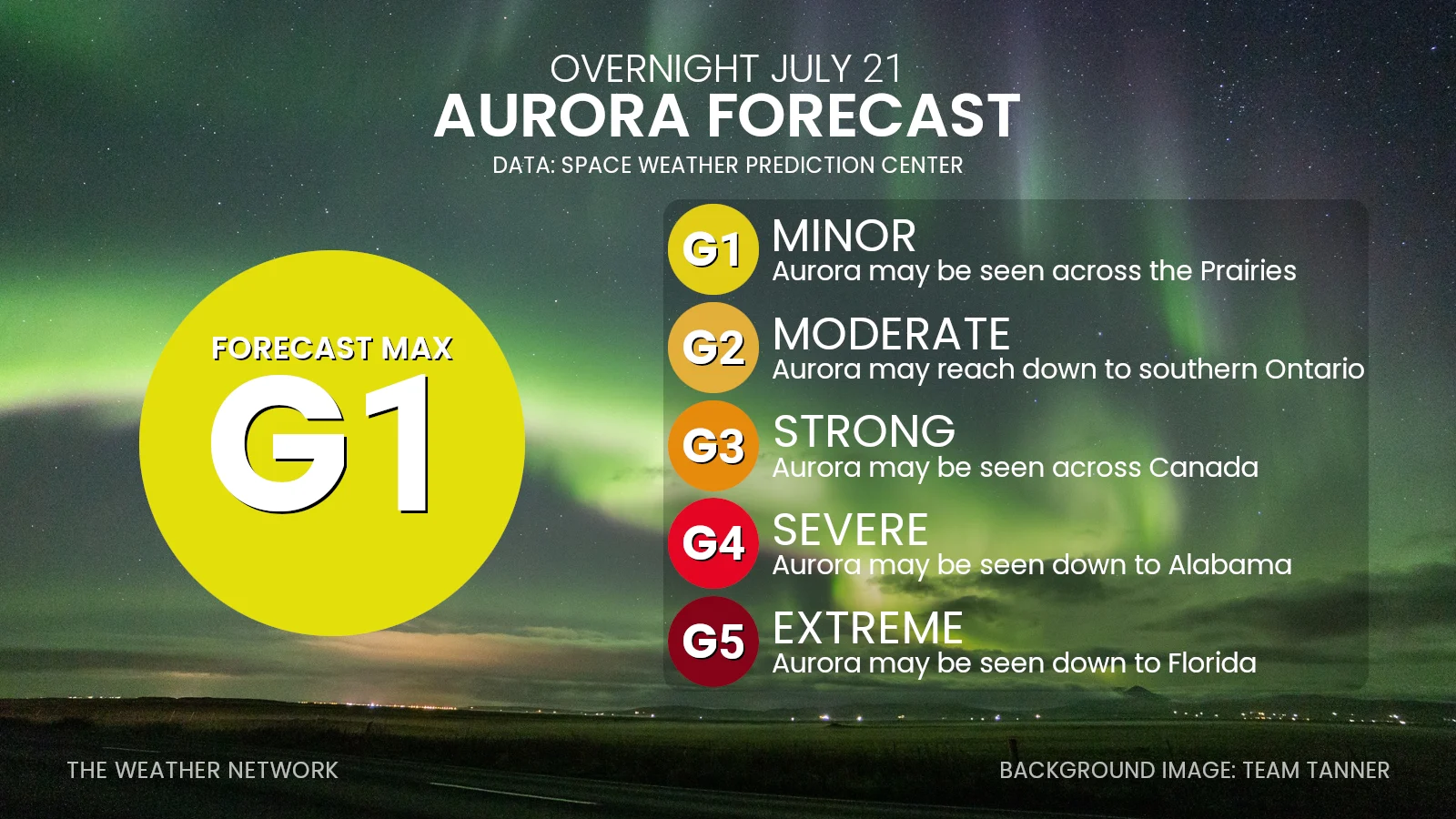
In response to this CIR passing by tonight, NOAA's Space Weather Prediction Center is expecting a potential G1 (minor) geomagnetic storm.
DON'T MISS: Two eclipses and a meteor shower are the 'don't miss' sky events for Summer 2026
The timing of the storm, based on their forecast, is 11 p.m. Tuesday through 5 a.m. Wednesday, EDT (9 pm Tuesday through 3 a.m. Wednesday, MDT).
As shown below, auroras from a G1 geomagnetic storm typically favour western regions of the country, due to the higher latitude. For the eastern half of the country, the 'aurora oval' tends to remain too far north for auroras to be visible in the most populated areas (the Windsor-Montreal corridor, and along the St Lawrence River).
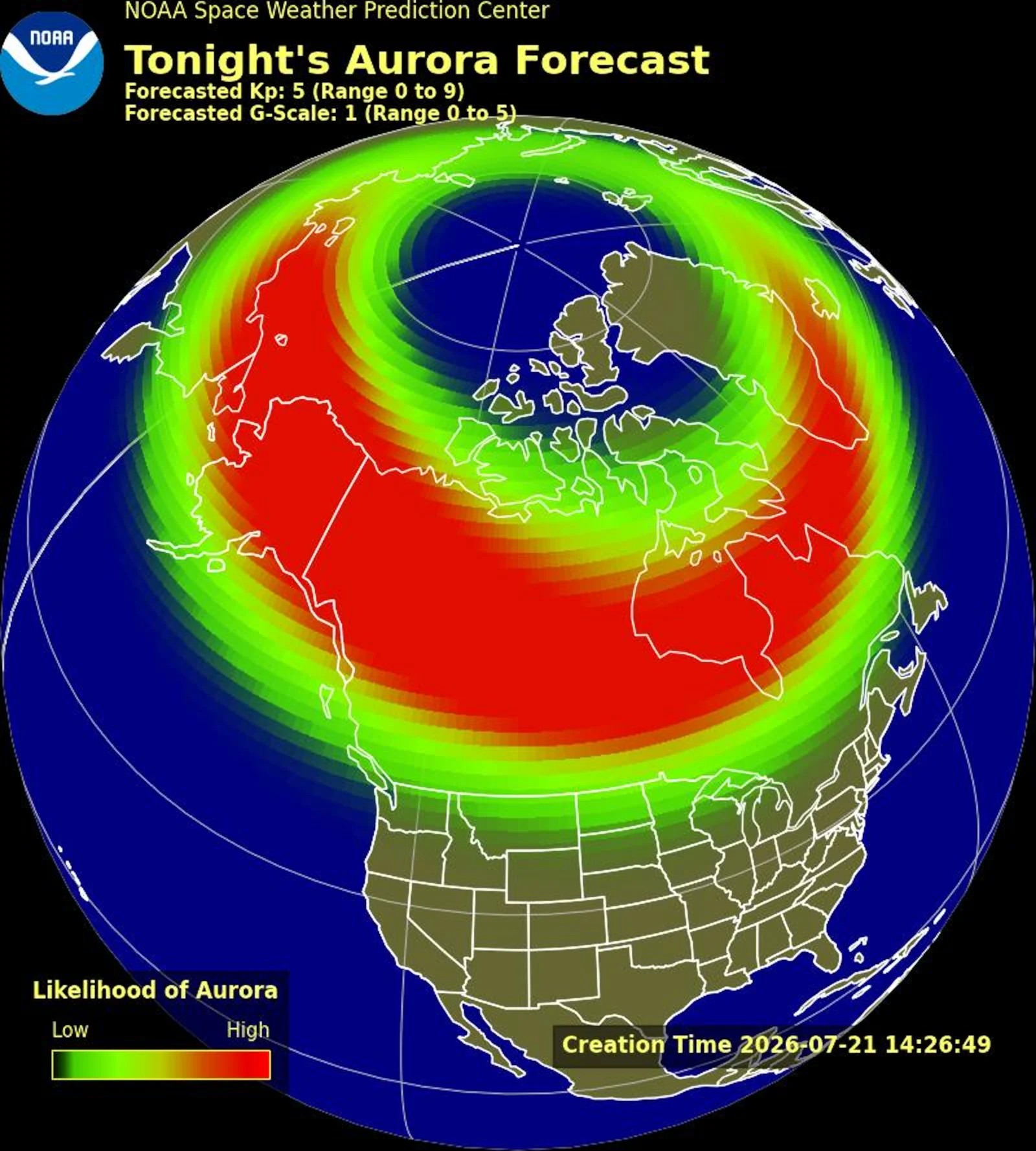
Aurora viewing potential for July 21-22, 2026, with the aurora oval (green through red) indicating the chances of seeing the auroras overhead. The viewline (thin white line) represents the potential southern extent where auroras might be spotted along the northern horizon. (NOAA SWPC)
MORE FROM SPACE: New CRASH Clock, measuring chance of satellite collisions, is ticking down fast
However, with any geomagnetic storm, there also comes the potential for substorm activity.
Substorms?
Geomagnetic storm levels represent the average activity measured over a three hour period of time.
A substorm is any pulse or burst of stronger and brighter auroras that occurs over a shorter period. Some only show up for a minute or so. Others can persist for significantly longer.

Auroras captured from Leamington, on September 14, 2025, change in brightness throughout the night. (Michael Vincent Ledesma/UGC)
READ MORE: How to get the most out of auroras, meteor showers, and other night sky events
Along with the increase in brightness from a substorm also comes the chance that the auroras will spread farther to the south.
So, regardless of your location across the country, check for clear skies tonight, and look to the north for a chance to spot the Northern Lights.
(Thumbnail image is courtesy Jason Caine, who captured this amazing view of the Northern Lights from Lac La Biche, AB, on November 12-13, 2025, and uploaded the image to The Weather Network's user-generated content gallery)