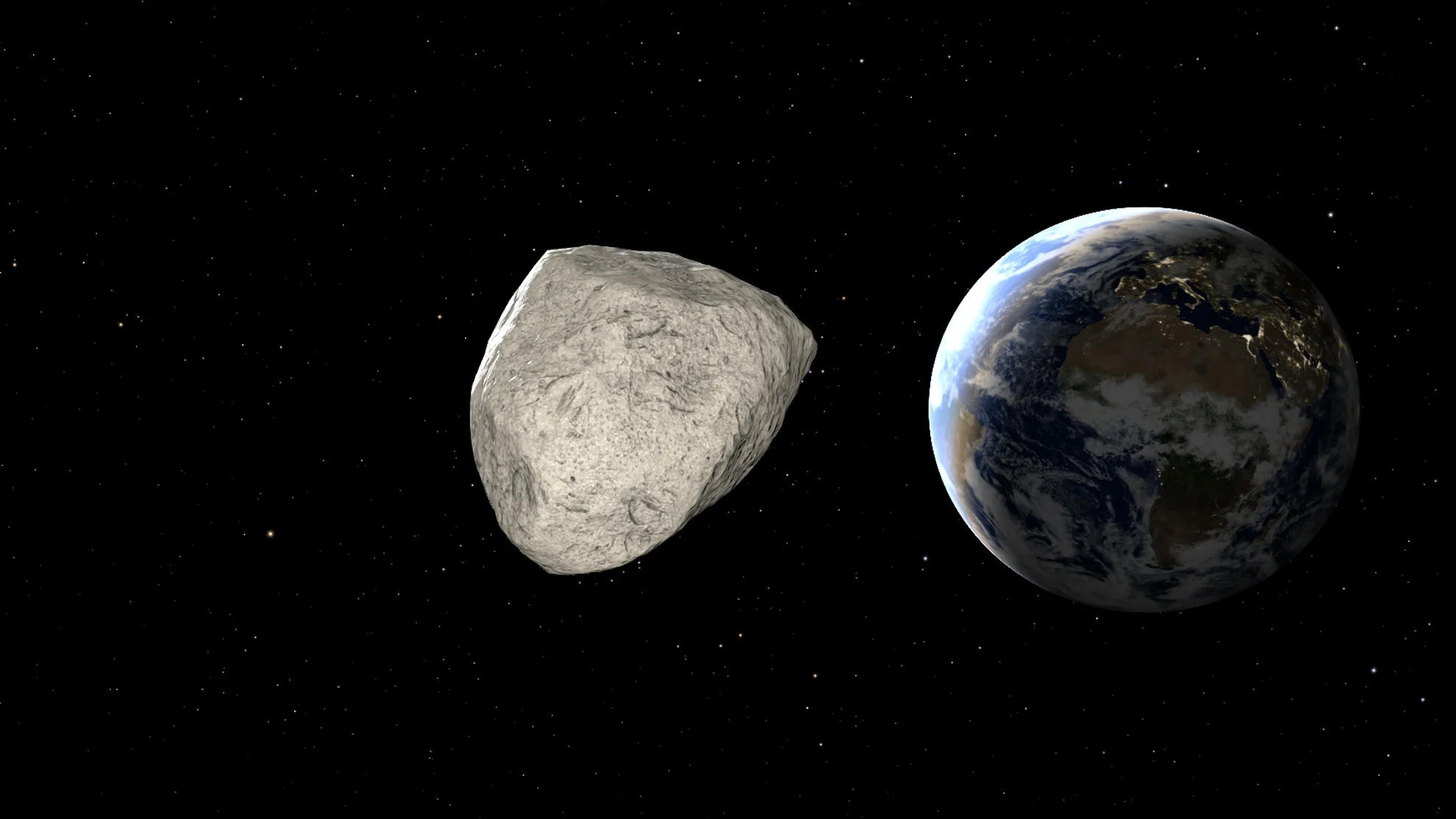
Asteroid Apophis' 2029 flyby of Earth will be visible to billions of people

During this completely safe pass, asteroid Apophis will appear to the naked eye as a small white dot, slowly crossing the night sky.
In a little less than three years, a massive asteroid will make a record-setting flyby of Earth and, as it does, skywatchers with clear skies can watch it happen with their own eyes.
On Friday, April 13, 2029, a roughly 333-metre–wide asteroid named Apophis will pass near Earth. Based on observations of this space rock over the years, and detailed computations of its path through the solar system, at its closest distance, Apophis will come to within 32,000 km of Earth's surface.
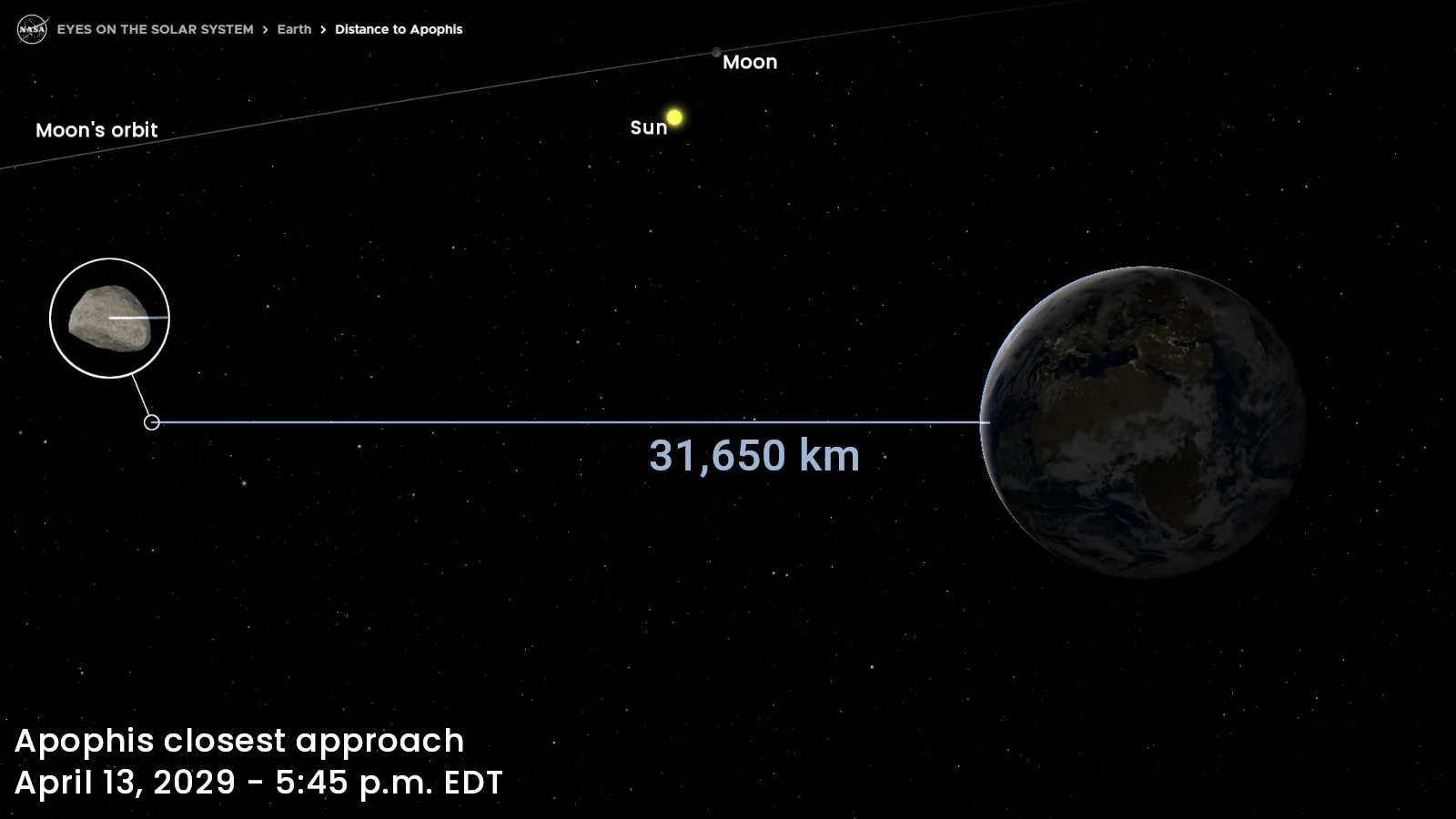
NASA's Eyes on the Solar System provides a look at Apophis' closest distance to Earth during the April 13, 2029 flyby. (NASA/Scott Sutherland)
For context, that's less than 10 per cent of the distance between the Earth and the Moon. It is also closer to Earth than the ring of geostationary weather and communications satellites, which sits at around 36,000 km out.
In the decades since we began observing and tracking asteroids, and quite possibly in all of human history, no object as large as Apophis has ever come that close to Earth.
Watch below: Asteroid Apophis flies above Earth and the geostationary satellite ring, on April 13, 2029
At one time, Apophis was considered to be the most dangerous asteroid threat known to Earth.
While we have known for some time that there was no chance of impact during this 2029 pass, it was still of some concern to scientists. The problem was, during the flyby, Apophis was coming so close to Earth that the planet's gravity was going to shift the asteroid's orbit around the Sun.
This little 'nudge' would not cause any immediate danger. However, based on the uncertainties in its orbital path, as we knew it at the time, there was a small chance Apophis would pass through a specific 'gravitational keyhole' in space, where the effect would have been significant enough to cause it to swing around and impact with Earth in 2036.
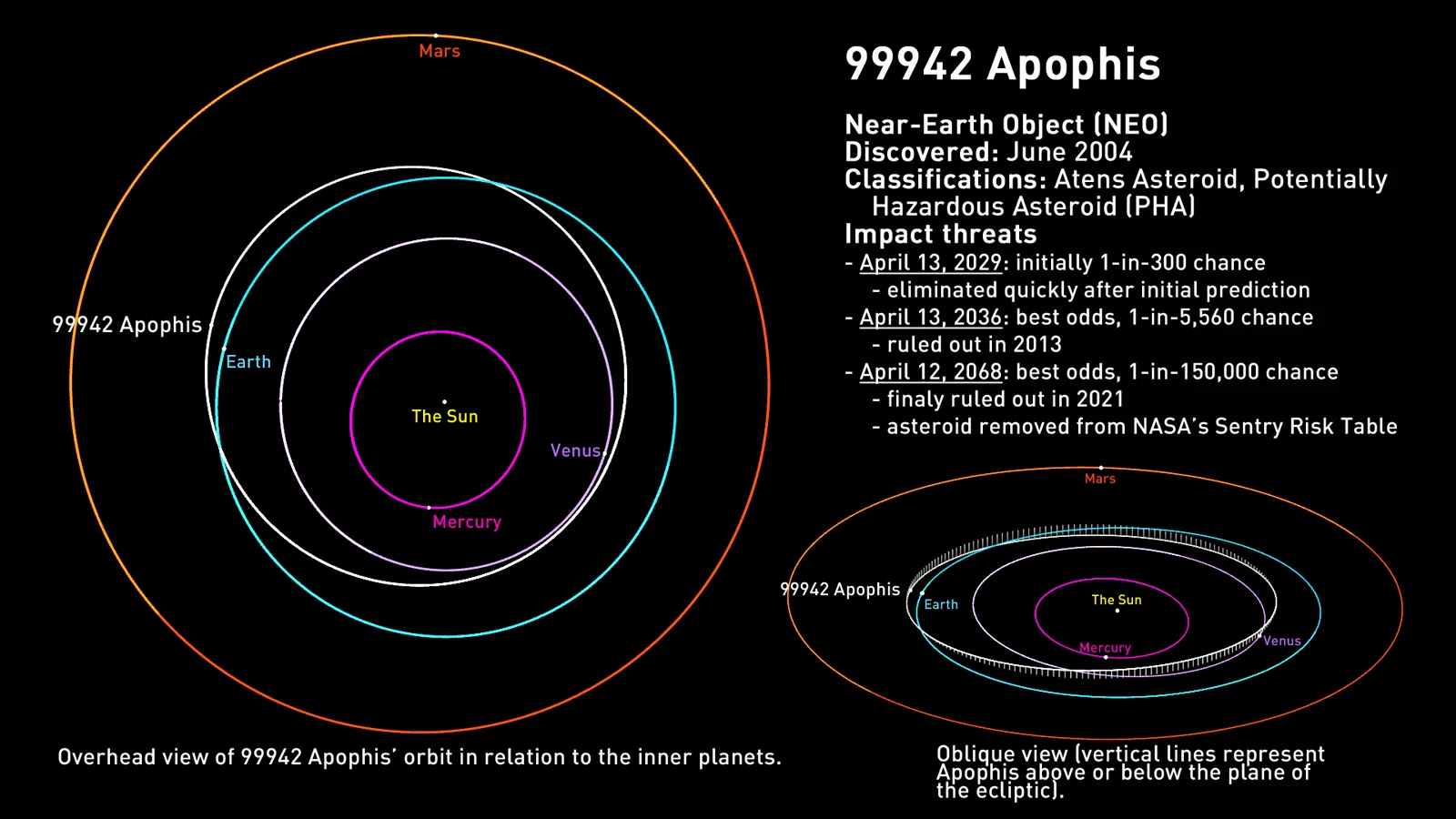
Fortunately, through further observations and computations, scientists completely ruled out that possibility. As of now, we know exactly how far away Apophis will be during its 2029 flyby, with a margin of error of just four metres on either side.
Thus, even though Earth's gravity will still deviate its orbit, we know that Apophis will miss that particular 'keyhole', and remain safe in the future. In fact, based on NASA's calculations, the 2029 close pass is the only one that Apophis will ever make. Afterwards, the asteroid stays at least 2.5 million km away from us for the foreseeable future! That's over six times farther away than the Moon!
READ MORE: Could a collision in space cause asteroid Apophis to hit Earth? New study says no
See it for ourselves!
With the threat from Apophis eliminated, the asteroid has simply become a scientific curiosity.
When the time comes for this close pass, telescopes will observe it, using the light it reflects and heat it emits to refine its composition. Radio telescopes will bounce radar waves off of it to better characterize its size and surface features. The renamed OSIRIS-APEX probe, which returned samples from asteroid Bennu in 2018, will catch up with Apophis during the flyby, to follow the asteroid, study it, and its new path around the Sun, in greater detail.
And, on April 13, 2029, billions of people here on Earth have a chance to watch Apophis as it zips past us.
The asteroid makes its closest pass at 21:45 UTC, or 5:45 p.m. EDT, on the 13th. A little over an hour before that, though, it will reach peak brightness, as seen from Earth.
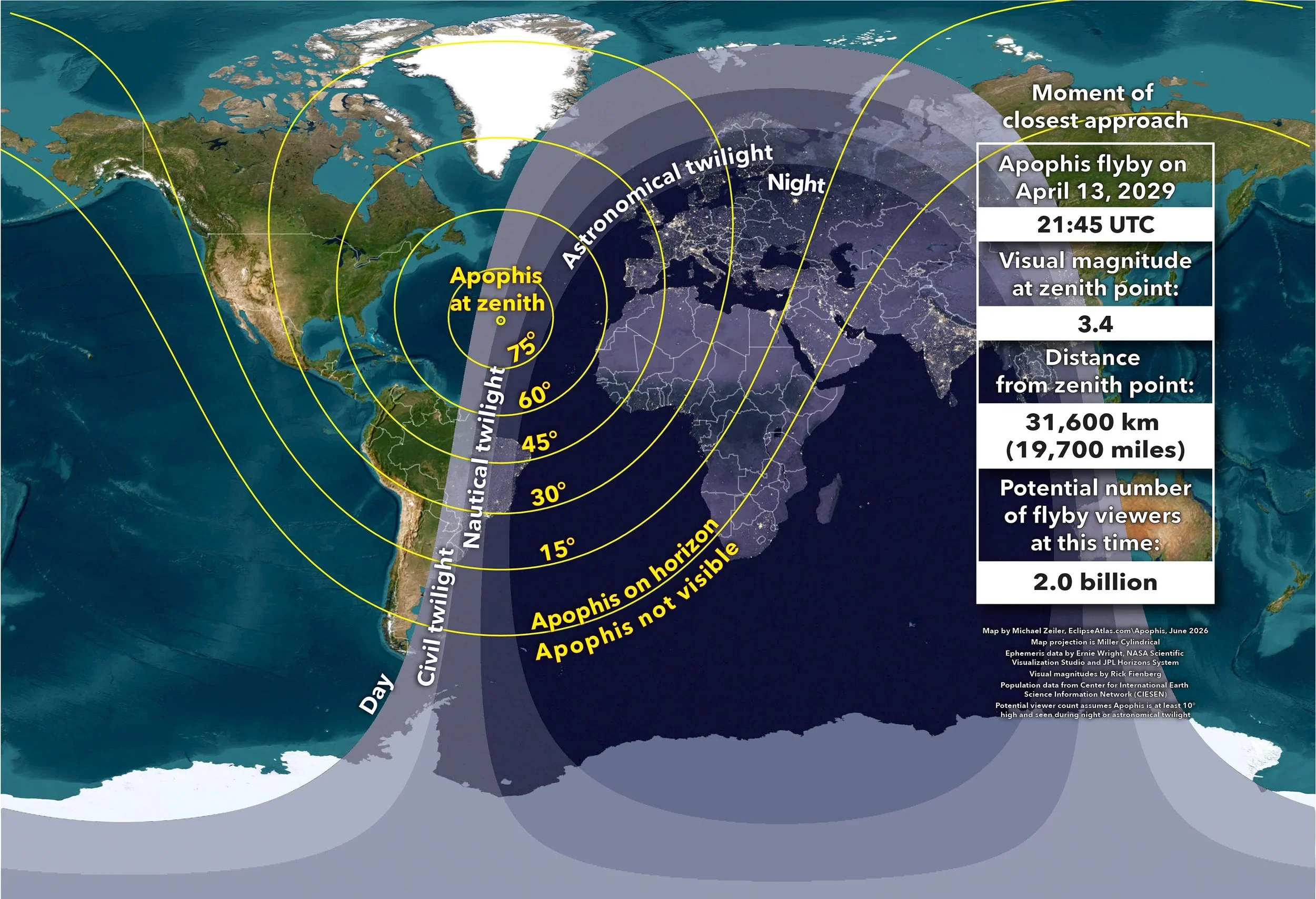
A map of the regions of the world experiencing night, twilight, and day, at the time of Apophis' closest approach, at 21:45 UTC. (Michael Zeiler/EclipseAtlas.com)
As the asteroid crosses the Earth-Moon system, its brightness will depend on two factors. The first is its distance from us. The closer it gets, the brighter it will appear. The second is how much of its sunlit side is facing towards us.
Basically, as Apophis passes by, it will go through phases, just like the Moon. It will first appear in a 'waning gibbous' phase, with most of the side facing towards us lit by the Sun. Then, as it draws closer, the Earth-facing side will eventually be half sunlit and half in darkness, and then transition into being mostly dark.
There will be a point where the combination of distance and phase cause it to reach a maximum brightness. This will be at 20:35 UTC, or 4:35 p.m. EDT.
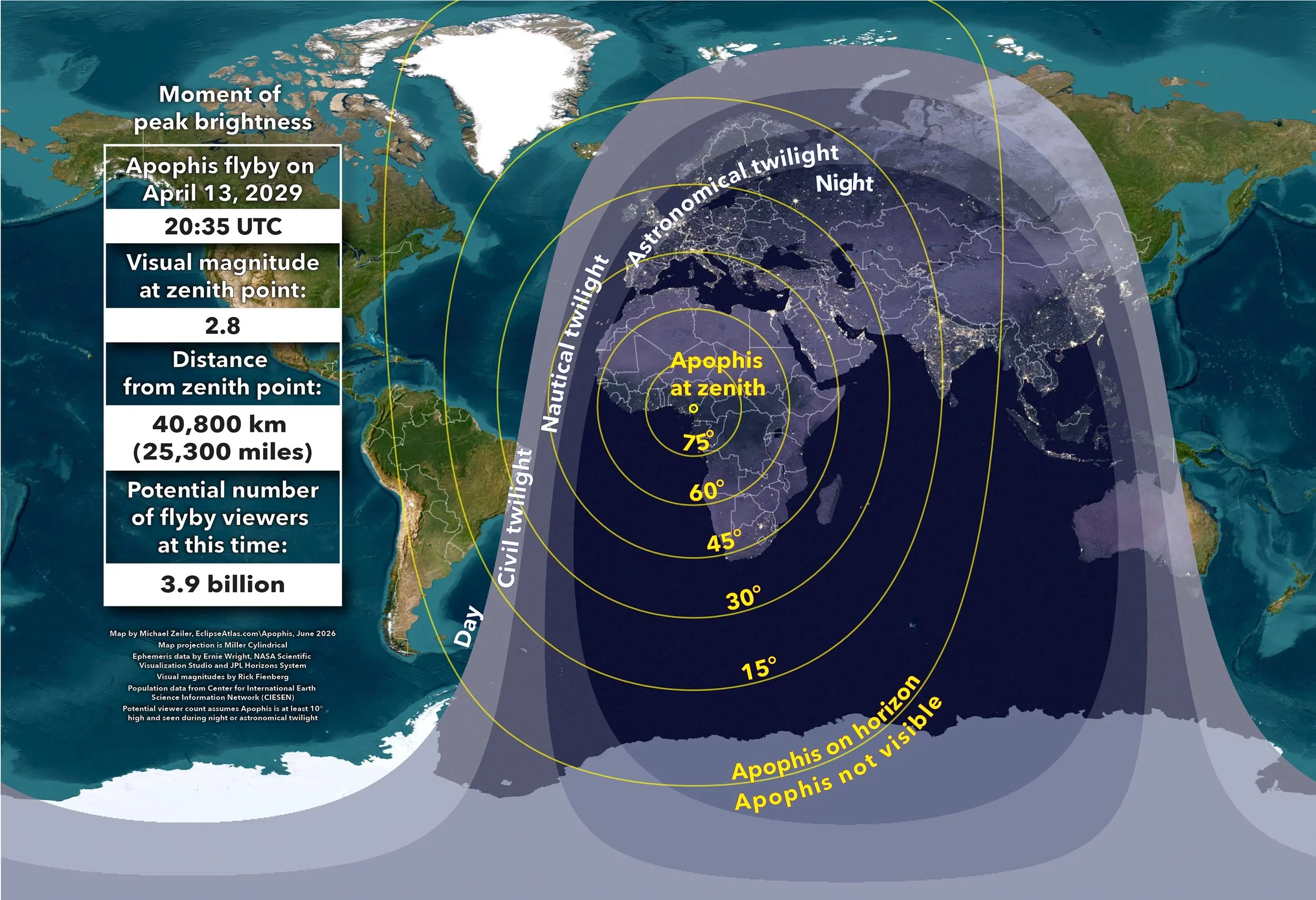
A map of the regions of the world experiencing night, twilight, and day, at the time Apophis reaches its brightest, as seen from Earth, at 20:35 UTC. (Michael Zeiler/EclipseAtlas.com)
Due to the timing of its flyby, Apophis will not be visible from Canada — neither at maximum brightness nor at closest approach.
There will be a brief period in the hour or two just before sunrise on April 13, when it might be visible above the southwestern horizon. However, as it will be farther away, and thus quite dim at that time, any observers will require binoculars or a telescope to see it.
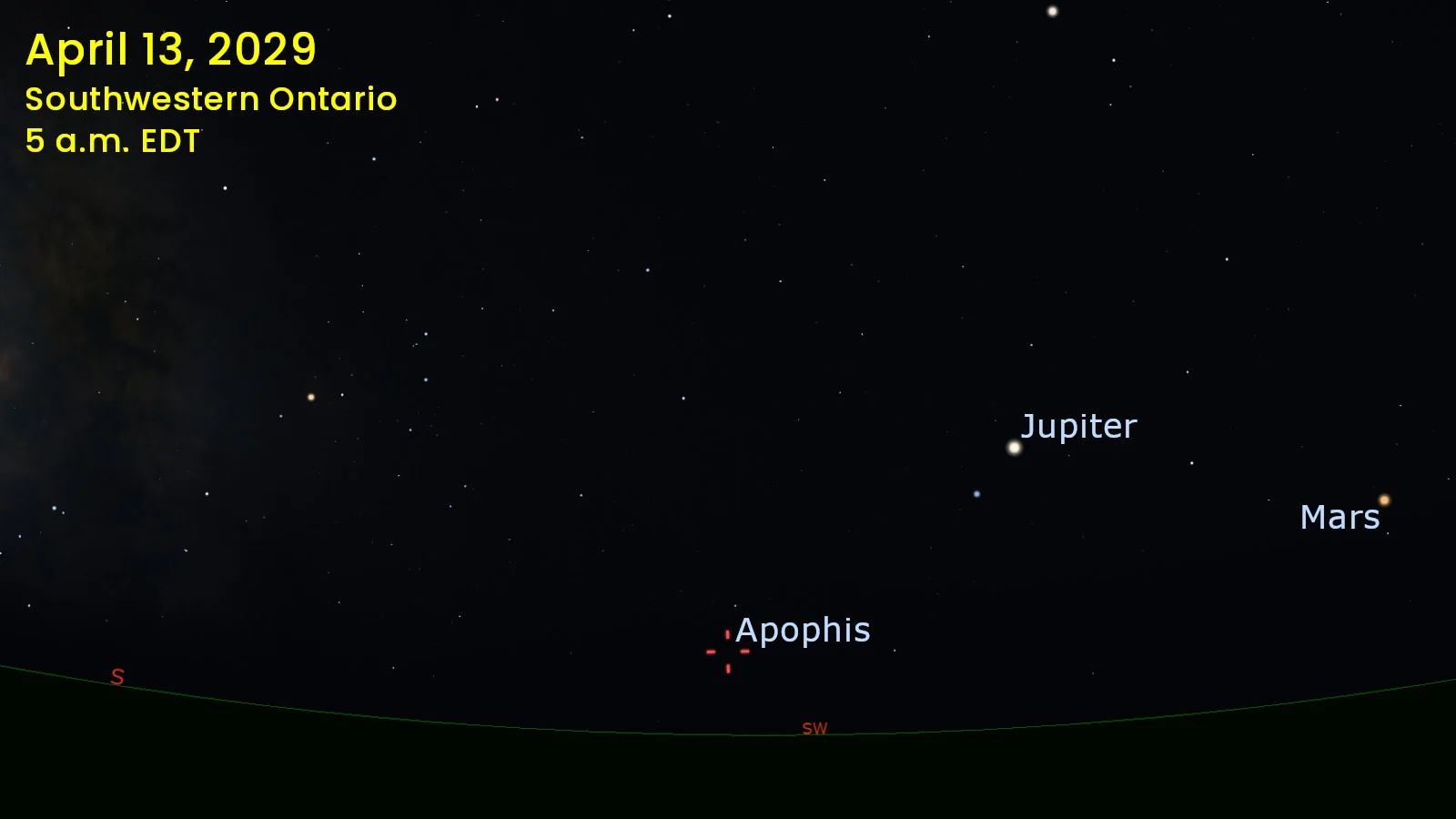
Apophis' location in the predawn sky, as seen from southwestern Ontario, when its visual magnitude will be around 7, making it too dim to see with the unaided eye. (Stellarium)
Since it will be quite close to Earth (compared to other observable objects in the night sky), it's exact location in the sky at any time will depend greatly on where the observer is.
The above sky simulation shows where it should be at 5 a.m. EDT, as seen from southwestern Ontario. However, a similar observer farther east, in Montreal for example, would see it at roughly the same position 40 minutes earlier, at 4:20 a.m. EDT. Even farther east, say in Halifax, an observer would find it there at around 4:40 a.m. ADT.
Although Canada will miss the asteroid at its brightest and closest, there will no doubt be astronomers and even space agencies that will live stream the event from the other side of the planet.
Additionally, we should also get various telescopic and radar views of Apophis, and possibly pictures taken by geostationary satellites, or perhaps even by astronauts on the International Space Station or other orbiting spacecraft.
After this encounter, Apophis will likely be one of the best studied and observed asteroids in our solar system!