
Eyes to the sky tonight, on April 1, to spot the Full Pink Moon rising

Check your weather forecast for clear skies Wednesday night, for a chance to see the next Full Moon.
Look up, Wednesday night, to see the Full Pink Moon rise!
On April 1, 2026, the fourth Full Moon of the year will cross the night sky, rising as the Sun sets and setting as the Sun rises on Thursday.
If everything works out as planned, we can also see this Full Moon rise while watching four astronauts blast off on the Artemis 2 mission, which will send them on a 10-day trip around the Moon and back.
DON'T MISS: Will fair weather hold for Wednesday's historic Artemis 2 Moon launch?
What is a Pink Moon?
Nearly every Full Moon has its own unique popular name. These were first gathered together in the early 20th century by the Farmer's Almanac. Most originate from the indigenous peoples of what is now the US Northeast, the Great Lakes region, and eastern Canada.
The most common name for the April Full Moon in the western world is the 'Pink Moon'.
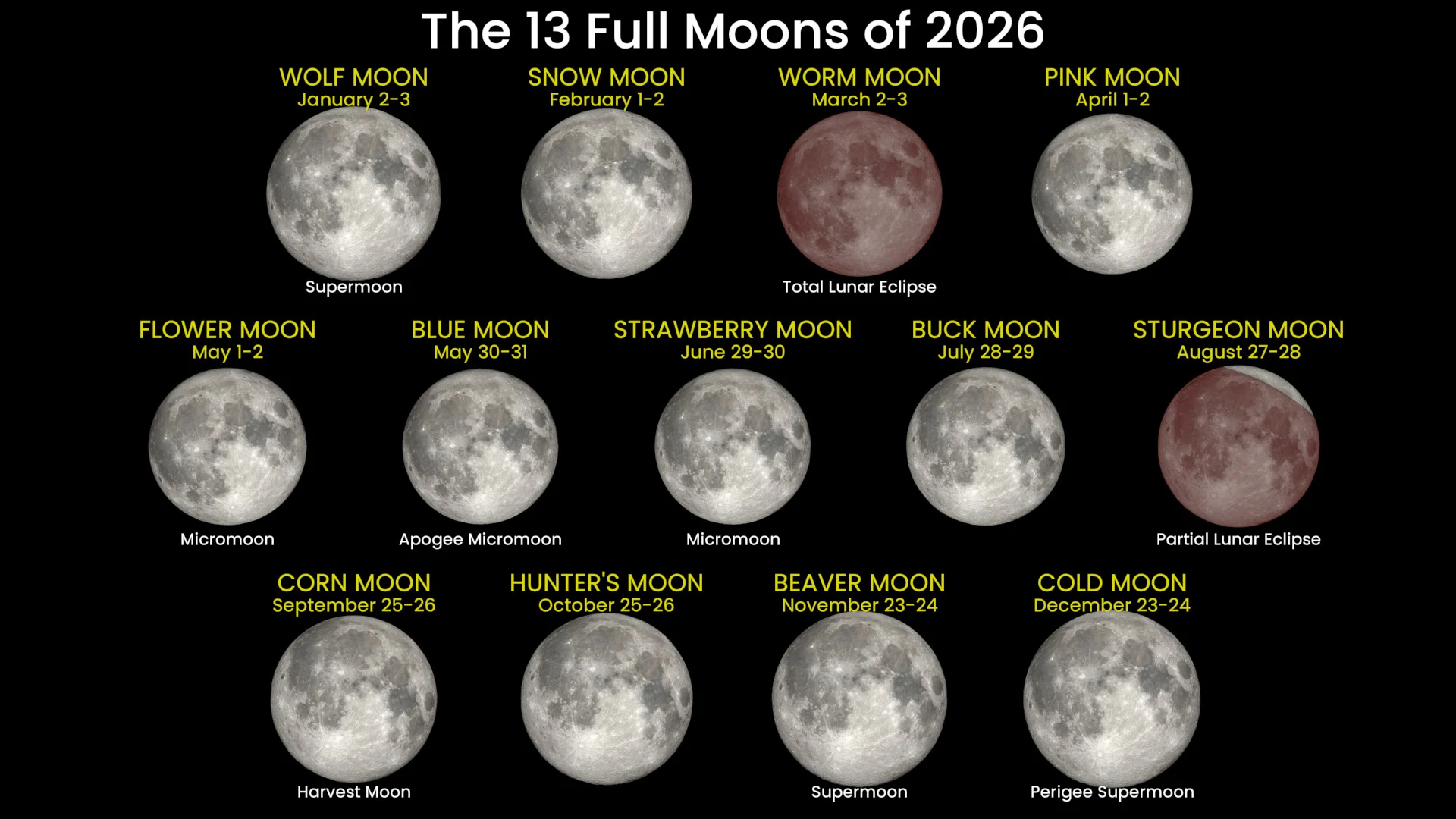
Each Full Moon of 2026 is shown in this infographic, along with their popular names, whether they are a micromoon or supermoon, a perigee or apogee Full Moon, and whether they are remarkable in some other way, such as the Blue Moon, Harvest Moon, or if there is a lunar eclipse. (NASA's Scientific Visualization Studio/Fred Espenak/Scott Sutherland)
This name isn't a reference to the Moon's colour, though.
According to The Old Farmer's Almanac, the name comes from a flowering plant called wild ground phlox, or pink moss, which is one of the first wildflowers that blooms in the US Northeast during the spring.
Other names used by indigenous people for the April Full Moon are the Breaking Ice Moon (Algonquin), Broken Snowshoe Moon (Anishinaabe), Budding Moon of Plants and Shrubs (Tlingit), Frog Moon (Cree), Moon of the Red Grass Appearing (Oglala), Moon When the Ducks Come Back (Lakota), Moon When the Geese Lay Eggs (Dakota), Moon When the Streams are Again Navigable (Dakota), Sucker Moon (Anishinaabe), and Sugar Maker Moon (Western Abenaki).
It's also important to note that these names do not specifically refer to the Full Moon, alone.
Like other advanced cultures around the world, the indigenous peoples of North America tracked their year using a lunar calendar. Thus, the name used for each moon actually refers to the 'lunation' — the roughly 28-day period between when the first Waxing Crescent Moon appears in the sky after the New Moon, and when the last Waning Crescent Moon is seen, just before the next New Moon.
READ MORE: Why does the Moon looks huge? What is the mysterious Moon Illusion?
Setting up a Blue Moon
The occurrence of this Full Pink Moon sets up some interesting timing for the Full Moons ahead.
With it happening right on April 1, the next Full Moon after — May's Full Flower Moon — will also rise on the first night of the month.
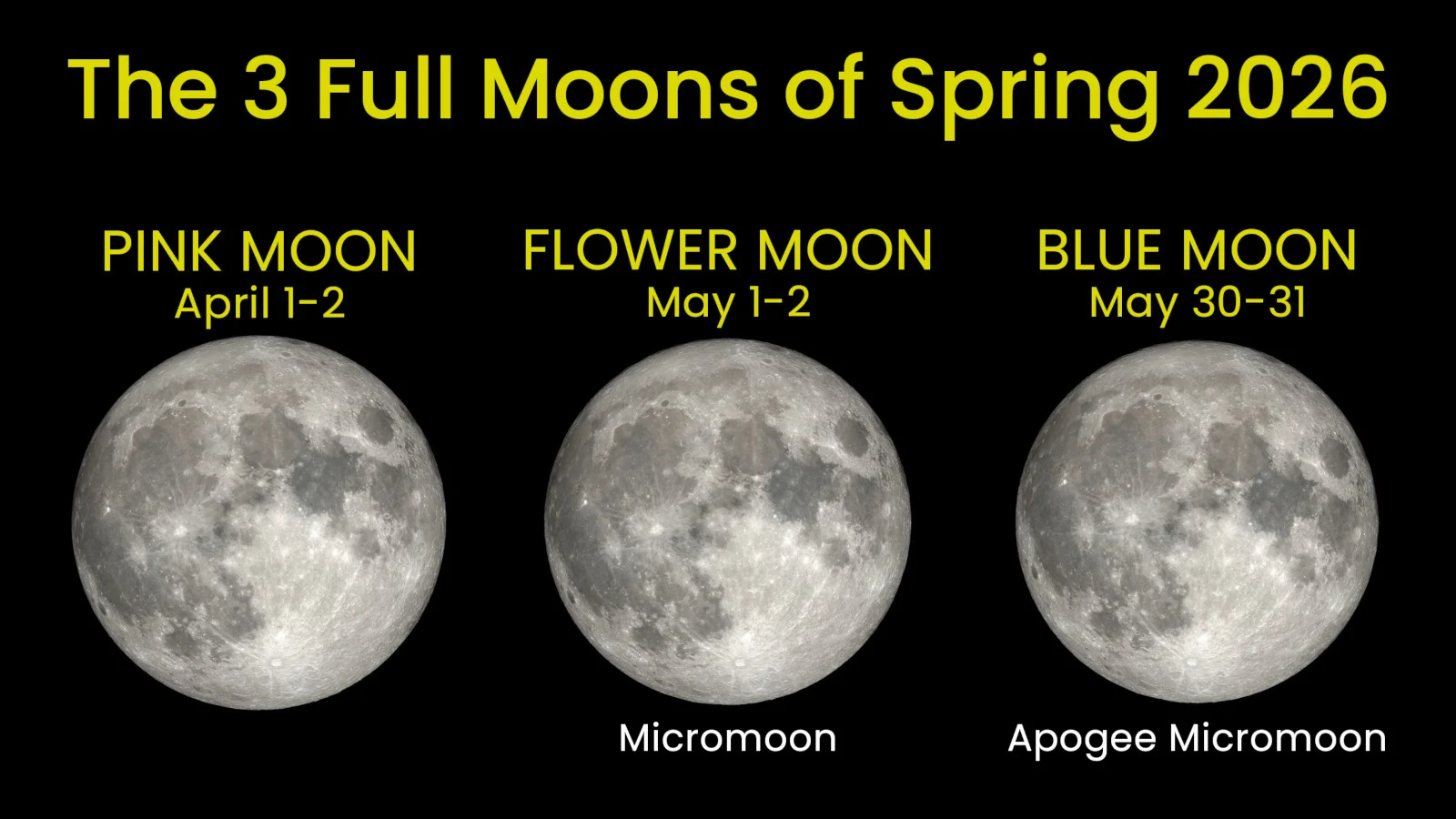
The three Full Moons of Spring 2026, with two of them occurring within the month of May. (Scott Sutherland/NASA's Scientific Visualization Studio/Fred Espenak)
After that, with May being 31 days long, and there being only 29.5 days between Full Moons, the next Full Moon will rise on the night of the 30th, producing a 'calendar' Blue Moon.
This is in contrast to the 'seasonal' Blue Moon, which is when we see four Full Moons in a single season, with the third of those considered the Blue Moon.
Although both types of Blue Moons occur with roughly the same frequency, at once every two to three years, they are often off-set from each other.
Thus, the last calendar Blue Moon was in August of 2023 — a rare Super Blue Moon that we won't see again for several decades — and after the one on May 30 of this year, the next one will be on December 31, 2028. Meanwhile, the last seasonal Blue Moon occurred in August of 2024, with the next one rising in May of 2027.
(Thumbnail image of the April 2023 Pink Moon courtesy viewer submission from Grand Fork, British Columbia)