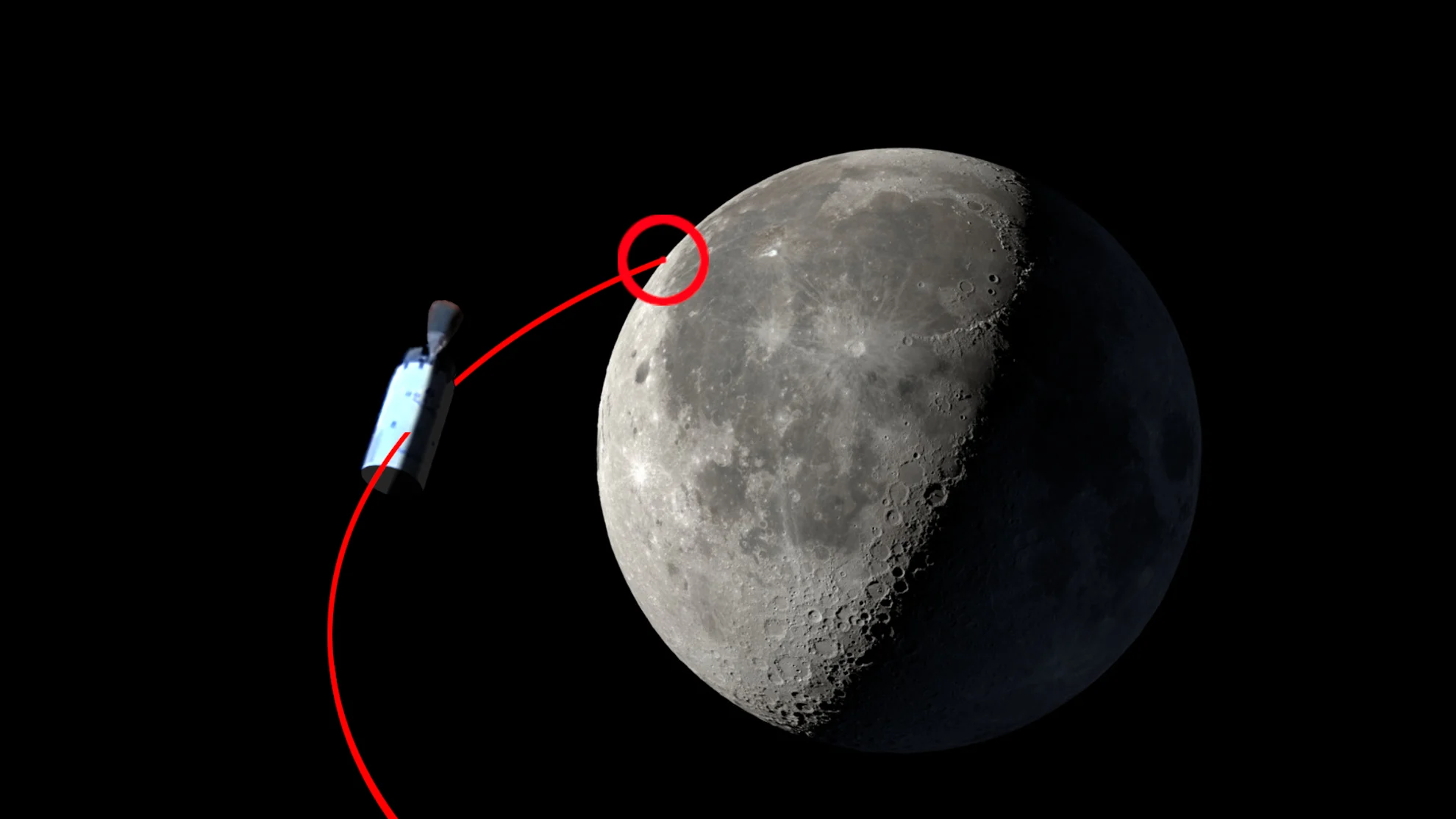
A SpaceX booster is about to slam into the Moon. There's a chance we may see it

Unlike the previous rocket booster impact on the Moon, from 2022, this time there's a chance we might actually see something from here on Earth.
In less than a week, an out-of-control rocket booster will slam into the Moon, producing a new crater, and possibly an impact plume that might be seen from Earth.
On January 15, 2025, a SpaceX Falcon 9 rocket blasted off from Launch Complex 39A at NASA’s Kennedy Space Center in Florida. Perched atop the rocket were two new robotic landers bound for the Moon — Firefly Aerospace's Blue Ghost Mission 1 and ispace Inc's Hakuto-R mission 2.
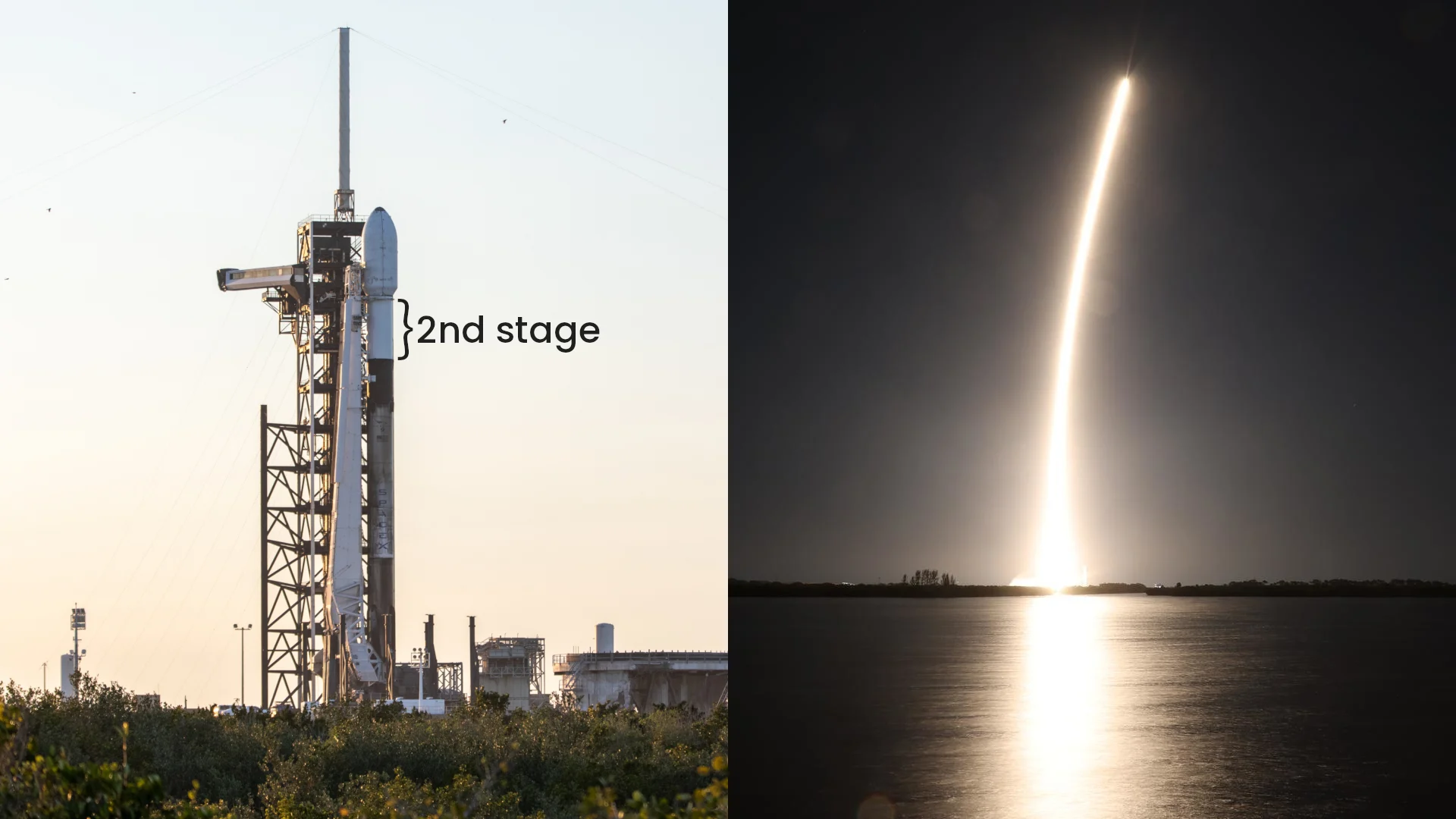
*The Falcon 9 rocket carrying the Blue Ghost and Hakuto-R missions sits on the launch pad on Tuesday, January 14, 2025 (left). The second stage of the rocket is highlighted. The bright exhaust plume shines as an arc up into the dark sky in a long-exposure image of the launch, which took place very early in the morning on January 15, 2025 (right). (NASA/Kim Shiflett (left), NASA/Frank Michaux (right)(
READ MORE: Two private landers touched down on the Moon this week. One didn't survive
Both landers were propelled out of low-Earth orbit by the same rocket upper stage. After that booster completed its job, it released the pair and then drifted off into space.
Blue Ghost Mission 1, nicknamed Ghost Riders in the Sky, went on to be a success, touching down on the lunar surface on March 2, 2025, and remaining active until March 16, when it ran out of power. Hakuto-R, unfortunately, wasn't so lucky. It crashed during its landing attempt on June 5, 2025.
As astronomer Bill Gray notes on his Project Pluto site, once the Falcon 9 2nd stage booster had released its payload, it was labelled as '2025-10D' in the database of space junk. Along with the tens of thousands of other large objects in that database, astronomers continued to keep tabs on it, logging its wide lopsided orbit around the Earth.
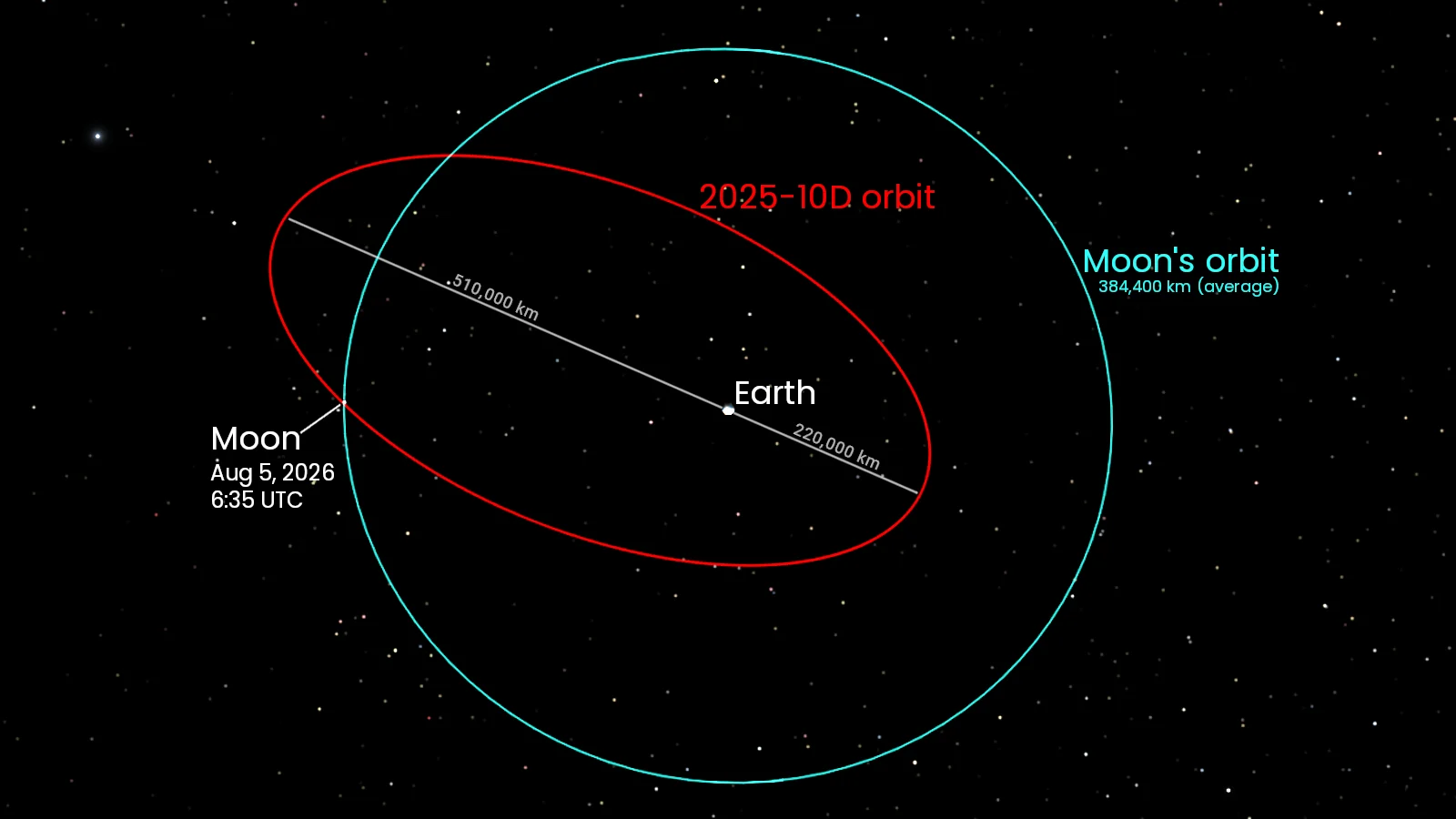
The above graphic depicts an approximation of 2025-10D's orbit around Earth, during its encounter with the Moon on August 5, 2026. (Celestia/Scott Sutherland)
Once every 26 days, 2025-10D would trace an elliptical path through the Earth-Moon system, with its closest distance to Earth at around 220,000 kilometres, and its farthest at roughly 510,000 kilometres, or about 100,000 km beyond the Moon's farthest apogee distance.
"The orbit of the Moon and of this object, roughly speaking, intersect," Gray wrote on his site. "Usually, one goes through the intersection point while the other is someplace else. But on August 5, they'll reach that point at the same time."
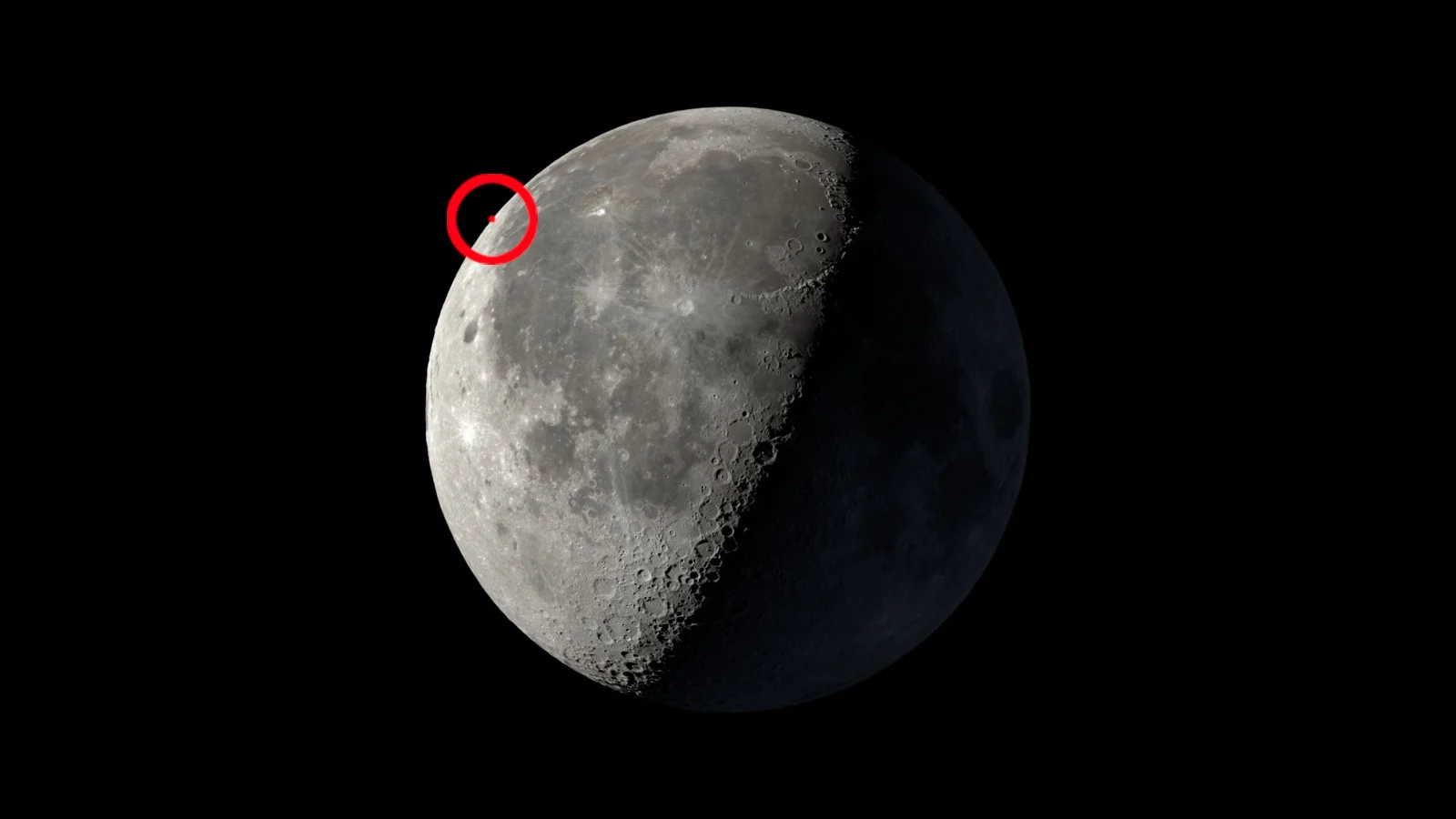
The projected impact zone of the SpaceX booster on August 5, 2026, as seen from Earth. (NASA Scientific Visualization Studio/Scott Sutherland/Adapted from Bill Gray/Project Pluto)
Gray narrowed this rendezvous down to within a few minutes of 6:35 UTC on the 5th, or around 2:35 a.m. EDT on Wednesday. At that time, this massive piece of space junk will slam into the lunar surface travelling at 2.43 kilometres per second, or over 8,700 kilometres per hour.
"The impact will be close to the crater Einstein, in a heavily cratered part of the lunar surface," Gray wrote.
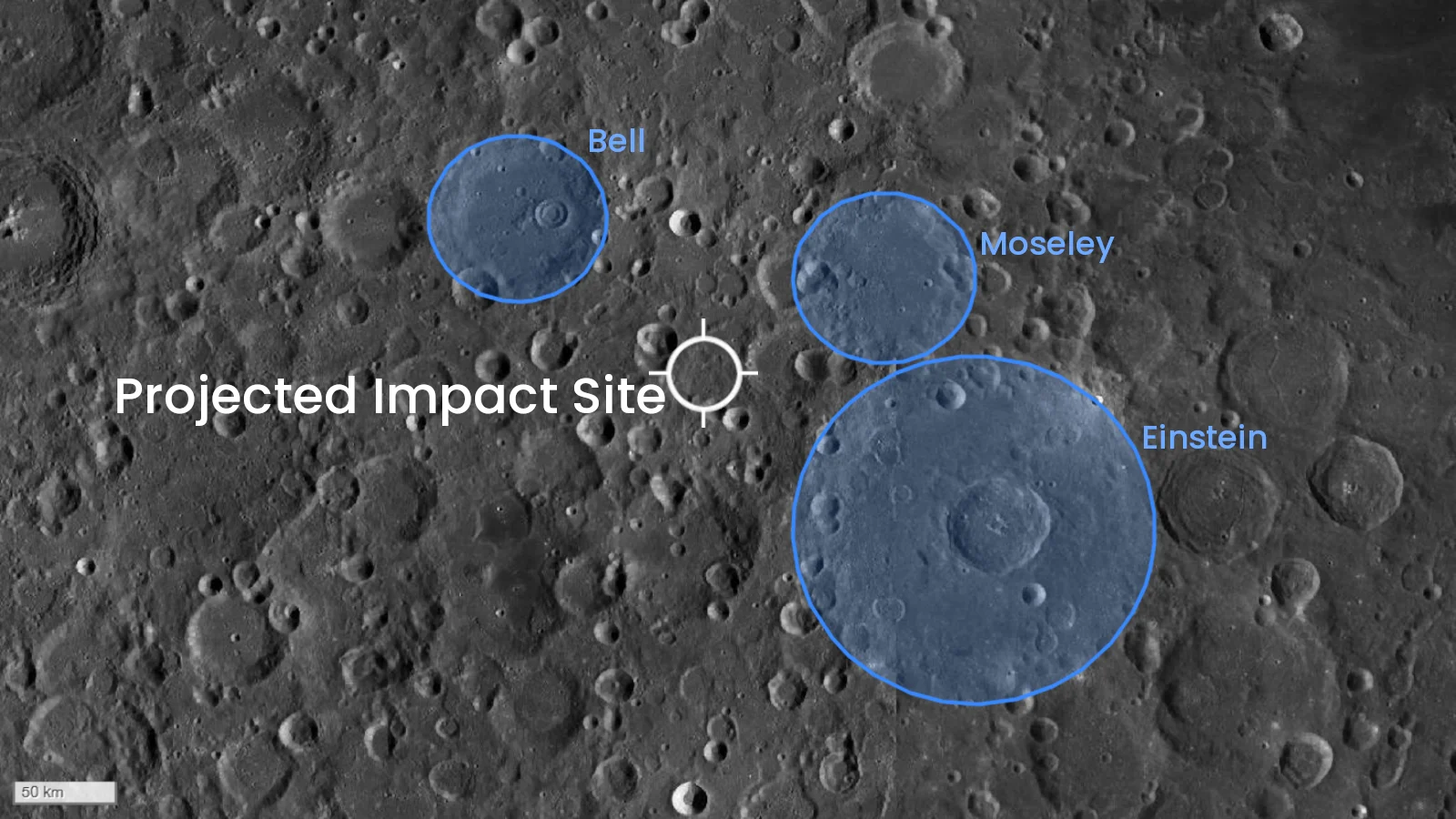
The projected impact site of the booster is shown here in this map from the USGS, adapted from a map made by Bill Gray of ProjectPluto.com (USGS/Bill Gray/Project Pluto/Scott Sutherland)
This is the second time in recent years that Gray has predicted a rocket booster impact with the Moon.
The first was a Chinese Long March 3C booster, which had launched in October 2014, and crashed into the lunar far side on March 4, 2022.
According to Gray, just like that last impact, it is very unlikely that we'll see any flash of light from this one, but for a different reason. The 2022 impact happened around the other side of the Moon, completely out of sight from Earth.
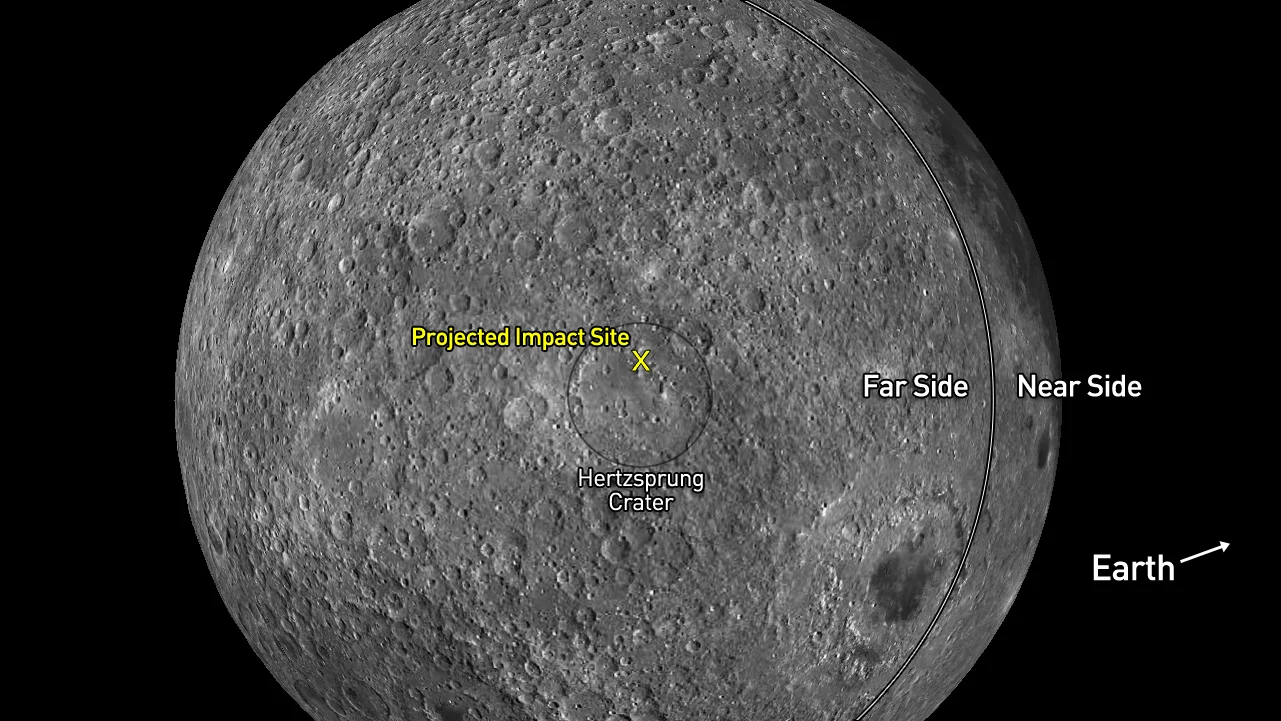
The Long March 3C booster's projected crash site on March 4, 2022, in the northern end of Hertzsprung crater, a large impact crater on the far side of the Moon. (NASA/LROC/ASU/Scott Sutherland)
In this case, the rocket booster isn't very large, and it isn't travelling very fast, relatively speaking.
We have seen lunar impact flashes from meteoroids. However, those space rocks typically crash into the shadowed part of the Earth-facing side of the Moon, which makes their flash easier to see. More importantly, they are also travelling at speeds of between 11-72 kilometres per second, which means that their impacts occur at much higher energies.
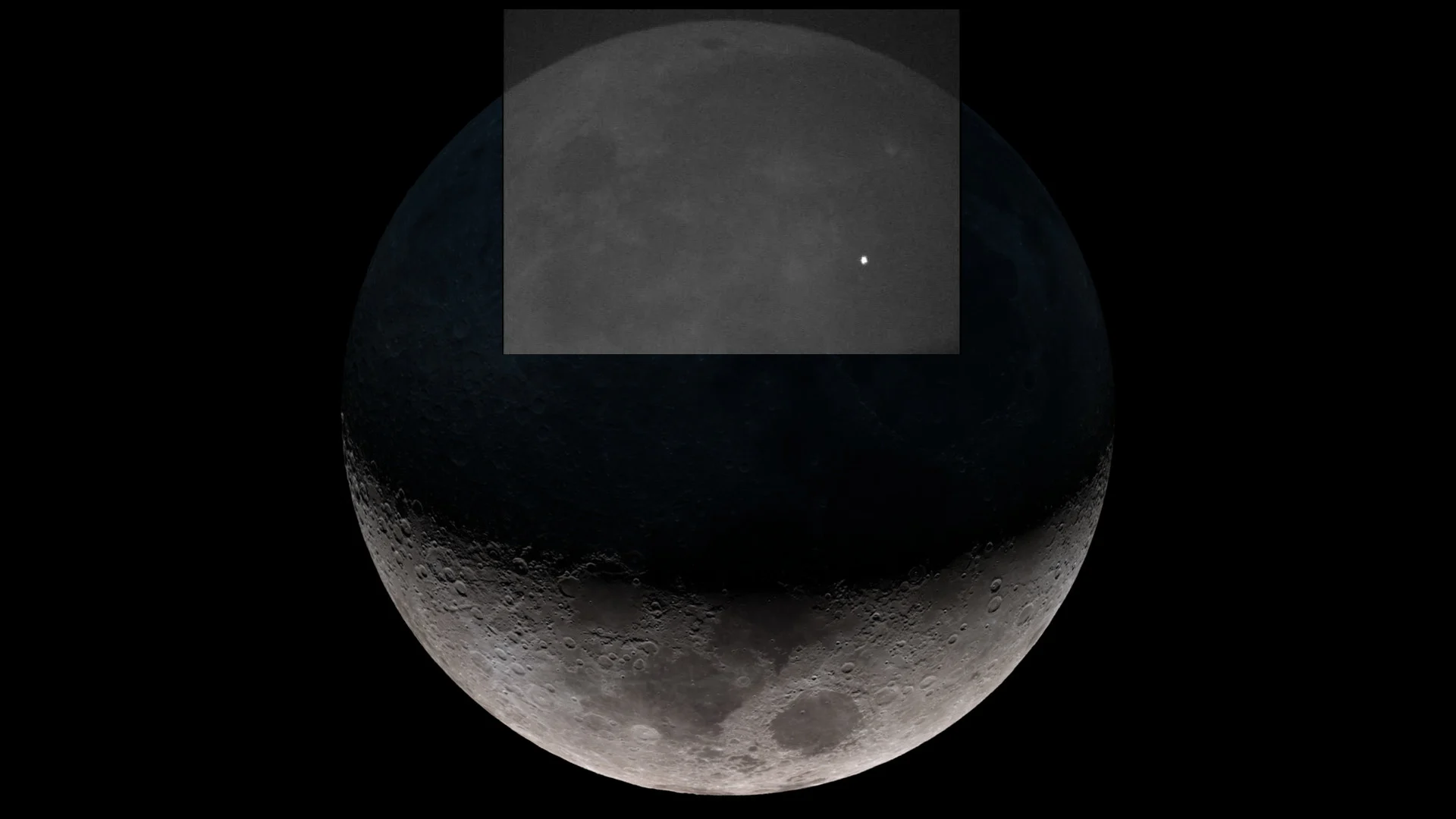
The lunar impact monitoring program at NASA's Marshall Space Flight Center captured this lunar impact flash on March 17, 2013. The meteoroid was estimated at 30 to 40 cm wide, with a mass of 40 kg, and hit the Moon at around 25 km/s (90,000 km/h).(NASA's Scientific Visualization Studio)
With this rocket booster crash occurring at only 2.43 km/s, chances are very low that it will produce a visible flash that we can see from here on Earth.
What might be visible, Gray says, is the plume of dust and rock that explodes out of the newly-formed crater that 2025-10D will carve into the Moon's surface.
Computing an impact energy of 14.5 billion joules, or the equivalent of about three tons of TNT, Gray estimates that lunar material blasted out of the roughly 17-metre-wide crater from 2025-10D crashing into the surface might reach high enough to be spotted.
"This close to the lunar limb, ejecta at an altitude of three kilometers would be visible, just barely, away from the lunar limb," Gray says. His estimate (or 'guesstimate') puts ejecta travelling at about 100 metres per second, for around 1 minute, to reach a height of about 3 km above the lunar surface.
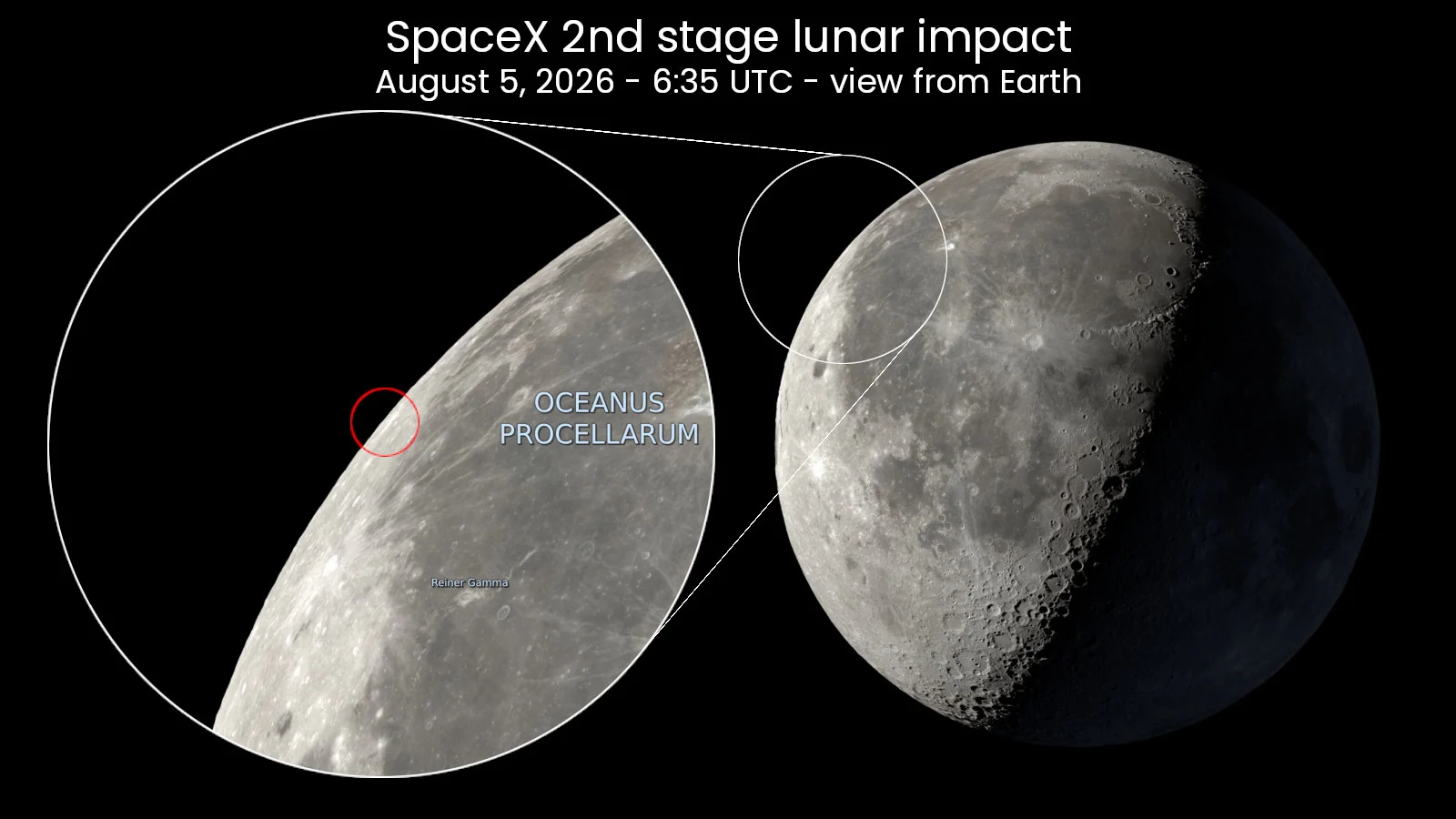
The approximate location of the rocket booster impact, plotted on a closeup view of the August 5 Waning Gibbous Moon. (NASA's Scientific Visualization Studio/Scott Sutherland, courtesy Bill Gray, Project Pluto)
Observers will need a reasonably good telescope, with high magnification, for a chance at spotting anything (perhaps a 150-200 mm aperture, with 150x-250x magnification). Although Gray isn't very optimistic about the chances of anyone spotting something, he notes it still might be worth trying.
"If you do imaging for ejecta, I'd recommend looking before impact and for at least a few minutes afterward," Gray said. "Your best hope is that some bits are ejected at, say, 300 m/s, and therefore rise for three minutes instead of one, and reach a height nine times greater than the above guesstimate."
Due to hard-to-predict factors, such as how much of an effect solar radiation pressure may have had on the rocket booster's trajectory since the last observations, the exact timing and position of the impact may change slightly. Gray says they will probably know more in the day or so just before the impact.
Check back for any updates in the days ahead.
Thumbnail image combines a view of the Waning Gibbous Moon, from NASA's Scientific Visualization Studio, and a Falcon 9 second stage taken from a SpaceX launch animation, with details added using the free, open-source GNU Image Manipulation Program.