Circle the date! Today is Pi Day for 2026!

This day only comes 'round' once every year!
Today is Pi Day for 2026, the universal celebration of an amazing, mysterious, and irrational mathematical constant.
What's that, you say? Why do we celebrate something that shows up in some of the most complex and complicated geometry and trigonometry equations that mathematicians and scientists can devise?
Well, for one, it's just for a bit of whimsy. Math and science are often thought of and portrayed as being 100 per cent serious, at all times. However, those that practice these disciplines have a sense of humour, like anyone. It doesn't hurt that the constant also shares its name with a very tasty treat.
Additionally, though, this particular mathematical constant deserves some recognition. After all, it might unravel some of the deepest mysteries of the universe.
What is pi, really?
Pi (usually written with the greek symbol π) is a mathematical constant — a 'stand in' used in mathematical equations, representing one specific value that never changes.
That value, specifically, is equal to the ratio of a circle's circumference to its diameter.
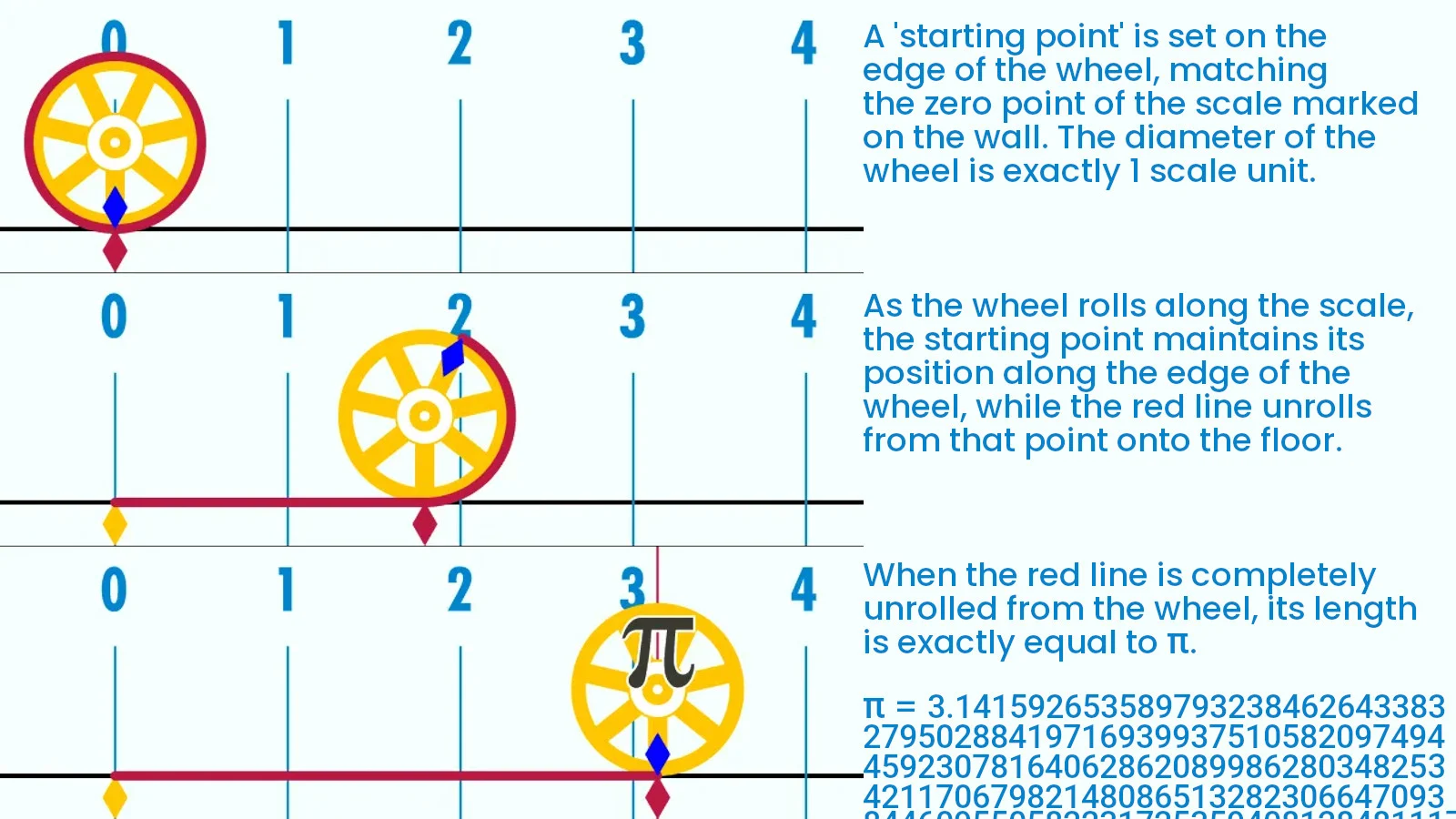
The circumference of a circle rolled out flat plots the value of pi. Credit: Wikimedia Commons
So, if you draw a circle that's 1 metre across, its circumference will be pi metres. A circle 1 centimetre across will be pi centimetres around.
The simplest value used for pi is 3.14. Pressing the π button on a calculator will return a value of 3.1415926 or 3.1415926535897932384626433832795, depending on what kind of calculator you use.
However, the decimal places of this constant go on for much, much longer.
Ok, but how much longer?
There's a really odd feature of pi.
When you have the circumference of the circle all unrolled onto the scale, and zoom in on the end of the line, no matter how closely you look and how fine the scale you're using, the end never, ever falls exactly onto one of the lines of that scale.
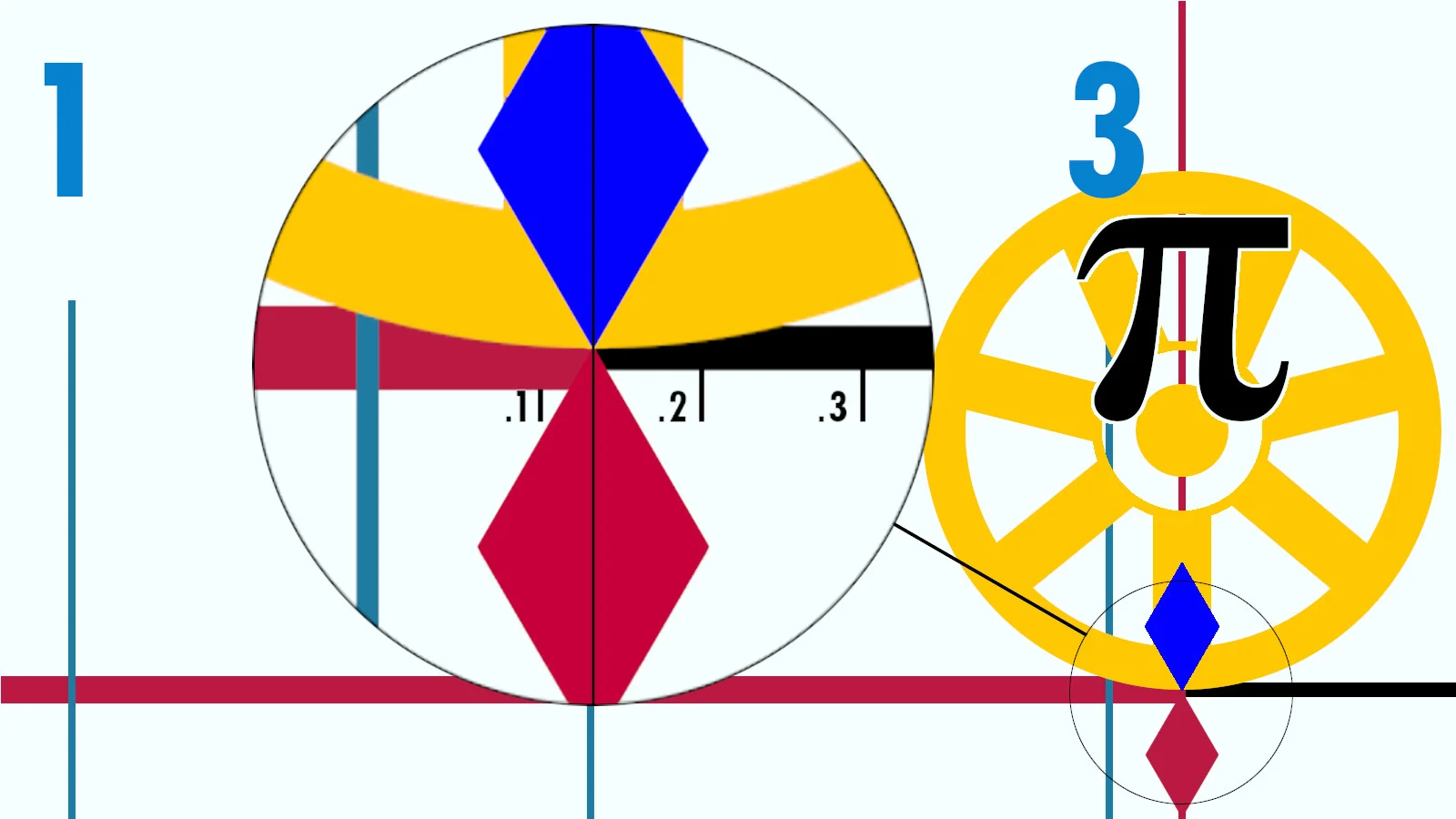
(Wikimedia Commons/Scott Sutherland)
For this reason, pi is known as an irrational number.
What that means is, as far as we can tell, given our current level of technology and knowledge of the universe, the decimal places of pi apparently go on forever, and produce absolutely no recognizable pattern of any kind!
Up until the 1400s, the greatest number of digits known for pi was 6 or 7, as computed by Chinese astronomers. Afterwards, approximations and calculation methods became better, and by 1949 we knew of over 1,000 digits.
From there, it has all come down to computing power. By 1973, they had cracked the first 1 million digits. In 1981 they reached 2 million digits, followed by 200 million digits by 1988, and over 1 billion digits just one year later.
As supercomputers became faster and faster, they topped 1.2 trillion digits in 2002, 10 trillion digits by 2011, and Google took that up to 100 trillion in 2022, after 158 days of calculations! That number was matched in 2023, but in just 59 days, a little over one-third of the previous time. Then, in 2024, the number of digits reached 202 trillion, and this was increased to 300 trillion in April of 2025.
As of the most recent attempt, in November 2025, pi has been calculated to 314 trillion decimal places.
Even with these incredible computational feats, we still haven't found the end of pi. That's why asking a computer or robot to compute the last digit of pi was such a good trick to use in science fiction stories. If the computer or robot didn't overload in the process, it at least bought the heroes some time to escape.
Perhaps if we were able to look at our universe from the outside, we'd be able to see pi resolve down to a simple, rational number. However, from our vantage point inside the universe, this mathematical constant still holds as an enigma of the cosmos.
Fortunately, the cosmos is forgiving enough that we don't need to know pi to the last digit to produce practical results.
For example, according to NASA, they only need pi to 15 decimal places (3.141592653589793) to make their highest accuracy calculations for spacecraft navigating our solar system.
Watch below: The fine people at YouTube's Numberphile channel show how to calculate pi using pies.
RELATED: Our world looks gorgeous from space
Pi in weather?
How often do we see pi show up in meteorology? More often than you might think!
While there aren't too many exact circles in weather, whenever you have rotation — convection, turbulence, storms, supercells and tornadoes, extra-tropical cyclones, tropical storms, and hurricanes — pi plays a vital role in that motion!
Check out how closely the 'Fibonacci Spiral' matches the clouds of Hurricane Lester, back on September 1, 2016, as the storm approached the islands of Hawaii.
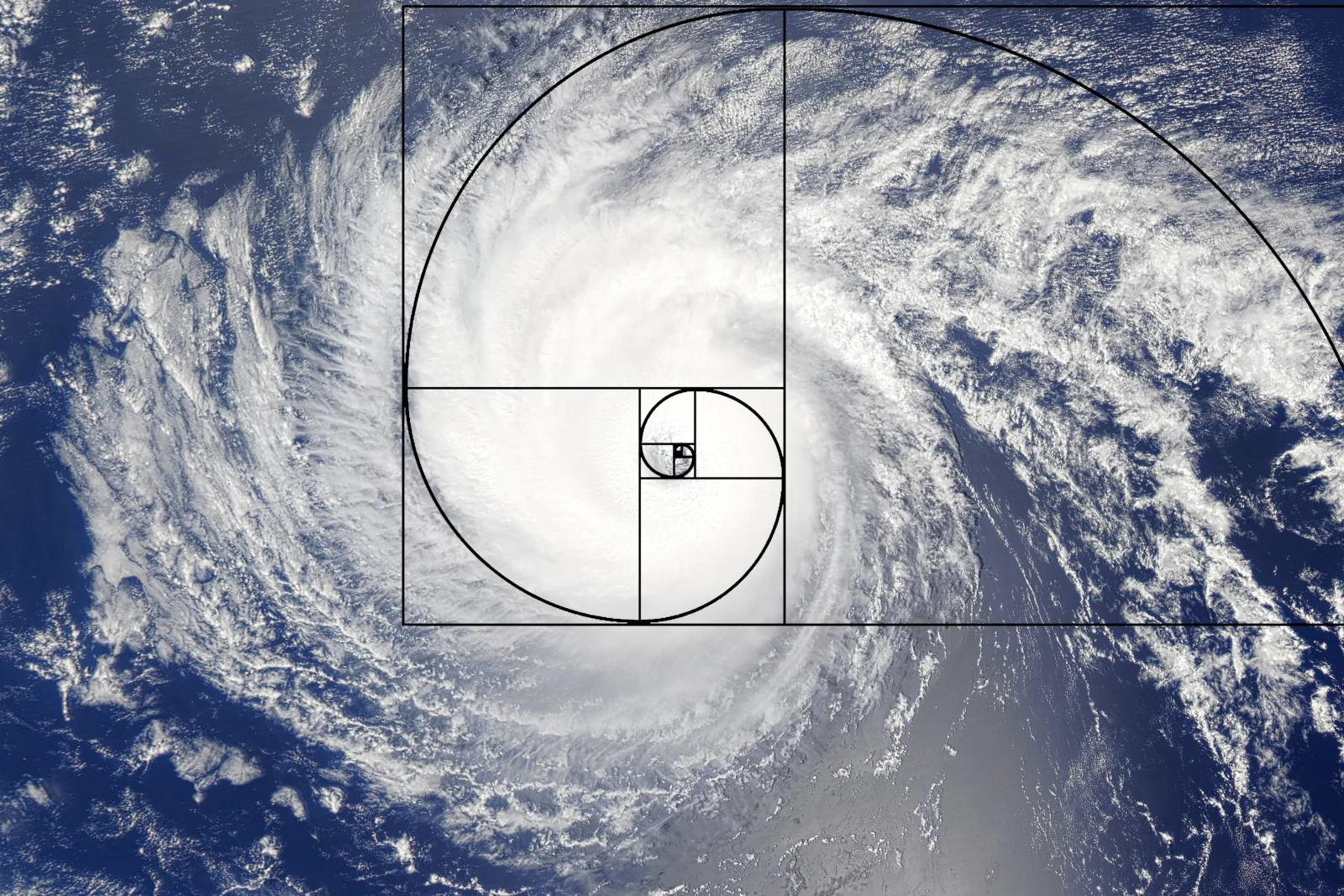
(NASA/Jeff Schmaltz, LANCE/EOSDIS Rapid Response)
The "Golden Spiral" overlaid onto the storm pattern is one where the radius of the spiral increases so that it matches a Fibonacci number sequence. The sizes of the boxes that the spiral curves through are 1x1, 1x1, 2x2, 3x3, 5x5, 8x8, 13x13 and 21x21, and it would continue with 34x34, 55x55, 89x89, 144x144, etc.
The radius at any point along the curve, though, can be found with the equation below,

where phi (φ) is the 'golden ratio' (itself an irrational number equal to 1.6180339887...), theta (θ) is the angle from the origin (in radians), and we can see pi figuring prominently in the exponent of the equation.
Frankly, we just can't get away from pi in weather!
DON'T MISS: The science behind the infamous nor'easter
Celebrating a mathematical constant?
So, how does one celebrate a mathematical constant? As mentioned above, the name of this one is a homonym for a delicious treat — pie!
Apple pie, cherry pie, blueberry pie, strawberry-rhubarb pie, and even pizza pie.
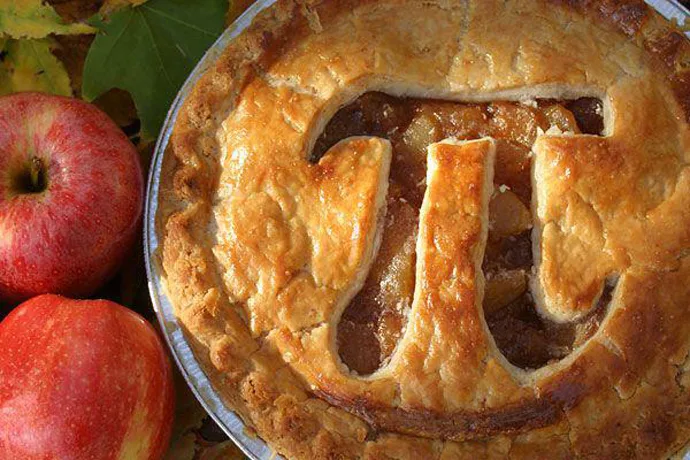
Pi pie, courtesy koka_sexton/Flickr
As long as it's round, it will do just fine!
READ MORE: An ice storm is on the way. Here's how to prepare
Other special constant days
Pi isn't the only scientific or mathematical constant we celebrate!
Pi Approximation Day is on July 22, since 22/7 is a fraction used to approximate pi (it comes out as exactly 3.14285714286).
Depending on whether you write your dates day first or month first, e-Day is either on January 27 or February 7. It recognizes Euler's Constant, e, which is approximately 2.71, but also goes on forever, just like pi. It shows up, mostly, when calculating compound interest, computing exponential growth or decay, or when using the 'normal distribution', aka, the 'bell curve'.
For the chemists, there's Mole Day. A "mole" is a standard measurement of any substance in chemistry, equal to 6.02 x 10²³ atoms or molecules of that substance. When you look at an element on the Periodic Table, the mass of one mole of that element is its atomic mass in grams. For example, Helium's atomic mass is 4.002602, so one mole of Helium is 4.002602 grams. Mole Day is observed on October 23 (10/23), specifically between 6:02 a.m. and 6:02 p.m.
There's also Tau Day, on June 28, which celebrates the mathematical and scientific constant tau (τ), which is equal to 2 times pi (2π = 6.28571428571...). Or, pi is equal to one half of tau, depending on which side of the rivalry you're on... and yes, there is a rivalry!
Why? Because a circle is defined as the set of all points in a plane that are at a given distance from the centre point. In other words, a circle is defined by its radius, not its diameter. Therefore, technically, the circumference of a circle is found by measuring from the centre to the edge, and then multiplying that number by 2π, or τ. So, the argument is that tau is technically a better mathematical constant than pi.
Unfortunately, while tau may be better mathematically, it does not have a tasty food associated with it.
For more on pi and try out some cool uses of it, check out NASA's Pi in the Sky Challenge!
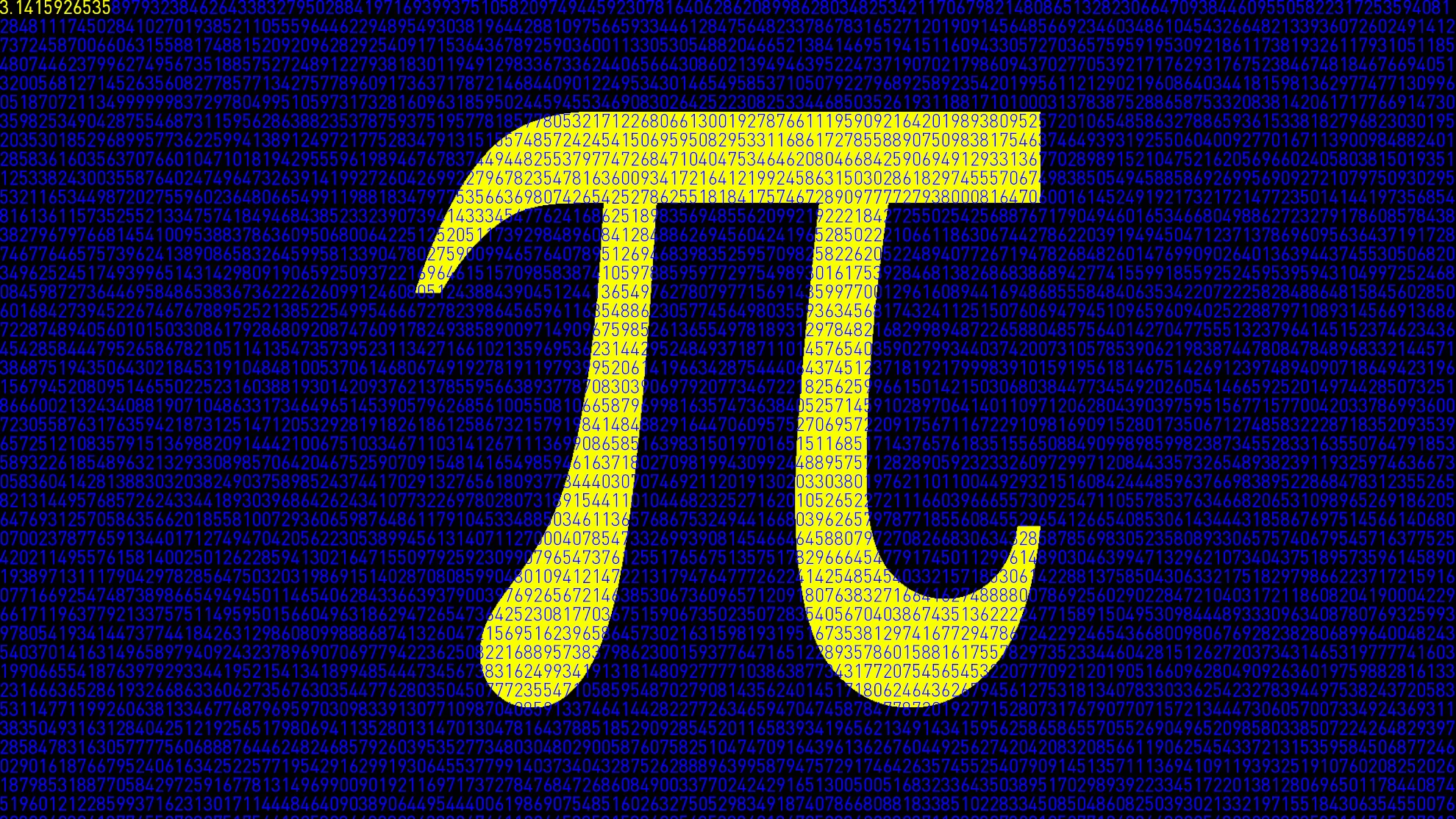
Thumbnail image shows the Greek symbol for Pi superimposed upon 6600 digits of the mathematical constant