
Can you forecast a home run? Here’s what to look for this baseball season

Are you ready to see your favourite baseball team hit some home runs? Then pay attention to the forecast, because the weather conditions outside could determine whether or not you’ll be cheering or jeering.
You’re standing at bat, staring down the opposing team’s pitcher and a wide-open field beyond them. Fans roar their cheers from the stands, but the only roaring you hear is the blood pounding in your ears as the pitcher winds up to throw. You swing the bat at just the right moment, slicing it through the air like a knife, and hear a loud CRACK as the baseball makes contact. But a gust of wind comes from the darkening clouds creeping in with an approaching cold front, and the ball doesn’t go as far as you thought it would. In fact, the ball goes straight into the glove of the left outfielder, as if the glove were a homing device the ball had locked onto. You’re out.
Baseball is a classic American outdoor sport, but the historic 2025 season had Canadians across the country temporarily casting aside their hockey jerseys, choosing instead to don their baseball jerseys and caps as the Toronto Blue Jays made it to the World Series in October. Now, as this next season continues, we’re all watching with anticipation for a repeat of 2025's run (with a better end result, hopefully).
SEE ALSO: From Home Runs to High Flyers: 5 backyard birds to spot in Canada
It’s no secret that hard work and skill are the basis of how well a baseball game goes, but did you know there are other, meteorological factors out of the players’ control that can make or break the game?
Wind
First off is the biggest and most obvious factor: wind. Winds can easily push or carry a ball flying through the air in different directions. According to a study conducted by baseball physicist Dr. Alan Nathan, a tailwind of just 8 km/h can carry a baseball an extra 5.7 metres.
But wouldn’t the stands act as a barrier against the wind? The answer is a bit complicated.
Major League Baseball (MLB) data scientist Clay Nunnally outlines in the MLB Technology Blog how the stands around a baseball field create a barrier effect and subsequent wind shadow. Essentially, some of the air flowing over the stadium may be redirected at field level. How impactful this effect is largely depends on the size and shape of the stadium, as well as the prevailing wind’s direction.
DON'T MISS: Game day temps: Quirky weather stats to watch as the Blue Jays take the field
Air density
Perhaps even more impactful in baseball than wind is air density. A baseball will have a harder time flying through denser air because the tight-knit air molecules will create more friction to slow the ball.
So, what determines the air density? Three things:
Air pressure
Temperature
Humidity
Air will be denser under high pressure and cooler temperatures due to the molecules being condensed, slow-moving, and unable to move freely. It’s also important to note that stadiums at higher elevations will naturally have higher air pressure. According to The Weather Network meteorologist Tyler Hamilton, it’s about a 1.8-metre increase in distance travelled by a baseball per 300 metres of gained elevation.
So that just leaves humidity. It may surprise you to know that the air is actually denser in dry conditions than in humid ones. It seems counterintuitive—the air feels heavier when it’s muggy out, after all. But the mass of water vapour is actually lighter than those of the oxygen and nitrogen in the atmosphere! So when there’s more water vapour in the atmosphere, we actually see the air become less dense. However, this is a fairly minor effect.
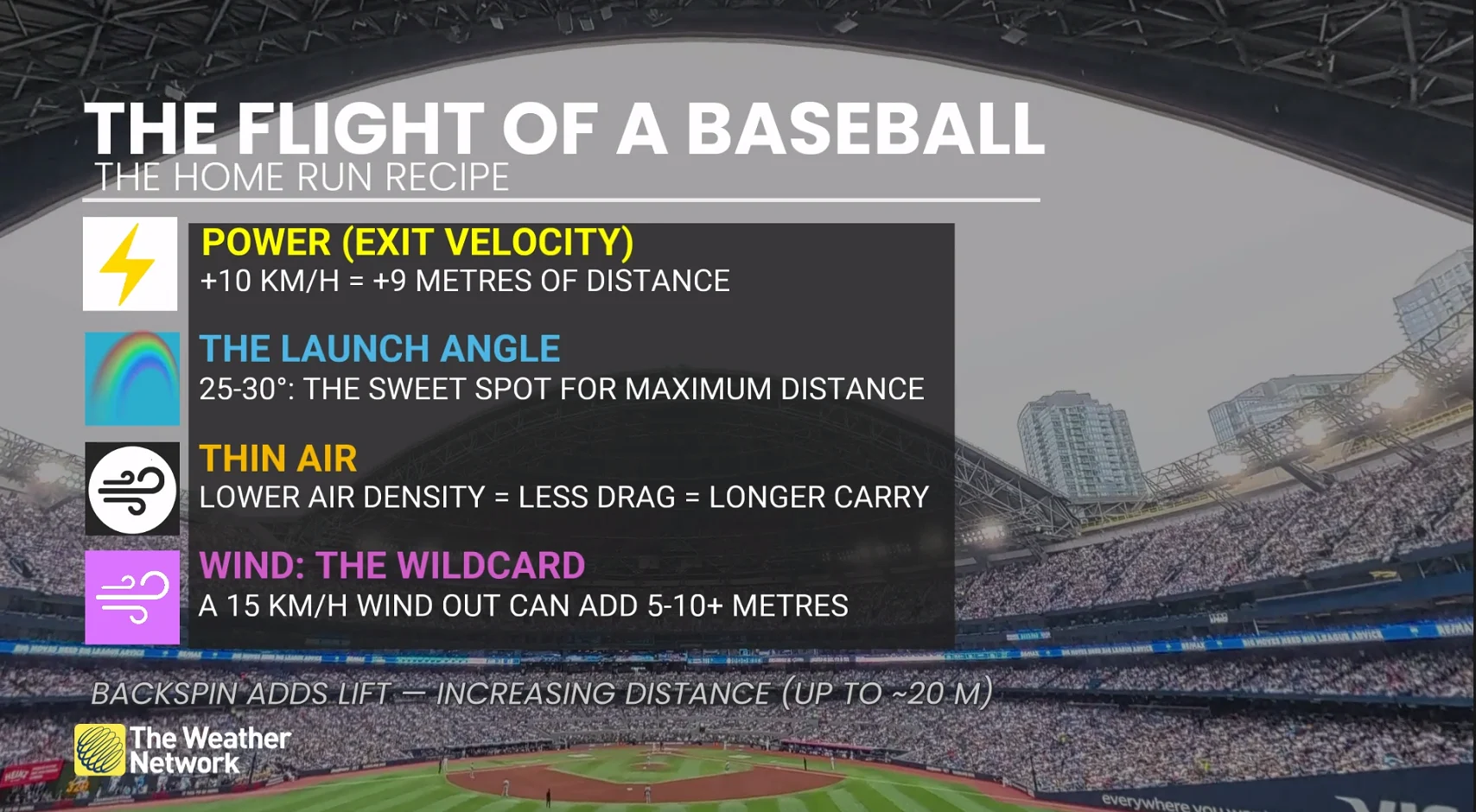
The best forecast for a home run
With baseball season underway, here’s what you should look for in the forecast if you want to see the Toronto Blue Jays hit some home runs.
First off, we’ll want to see warm temperatures. That way, the air molecules will be energized and less densely packed together.
“For every 10°C increase in temperature, you can expect the ball to fly an additional metre further,” Hamilton notes.
RELATED: MLB home run counts are rising – and global warming is playing a role
Second, we want to see some low pressure and high humidity. Low pressure is commonly associated with rain and storms, though, since the air is able to freely rise and fall in the atmosphere. So we’ll want to look for either a few hours before or after a round of rainy weather.
Last is the wind. While this is less of a factor somewhere like the Rogers Centre, where the roof can be closed during bad weather, most other fields are fully exposed to the elements. In away-game instances, a good wind coming from behind home plate will help to carry the baseball further through the air.
Putting it all together, Toronto baseball fans will want to look out for a hot summer day with high humidity and an incoming or outgoing low-pressure system. Ideally, the roof would be closed, which would eliminate the wind factor, as well as trap additional heat and humidity.
It’s important to remember, though, that the weather doesn’t choose sides—if conditions are favourable for one team, they’re also favourable for the other.